Around 5 million households in England and Wales live in leasehold flats, yet a significant proportion of buyers commission no survey at all, or choose a level of inspection that leaves the biggest risks completely unexamined. Choosing the best property survey for a flat purchase in the UK means understanding not just what a surveyor physically inspects, but where the survey stops and where leasehold, block finances and common-parts risks begin.
This article sets out the survey options available, explains what each level covers and misses in a flat context, and identifies the separate legal and financial checks that no physical inspection can replace.
Key Takeaways
- RICS Home Survey Level 2 is the standard choice for most conventional leasehold flats, but it cannot inspect roofs, high elevations, plant rooms or basements directly.
- Level 3 (Building Survey) is worth considering for older conversions, non-standard construction or blocks with known defects.
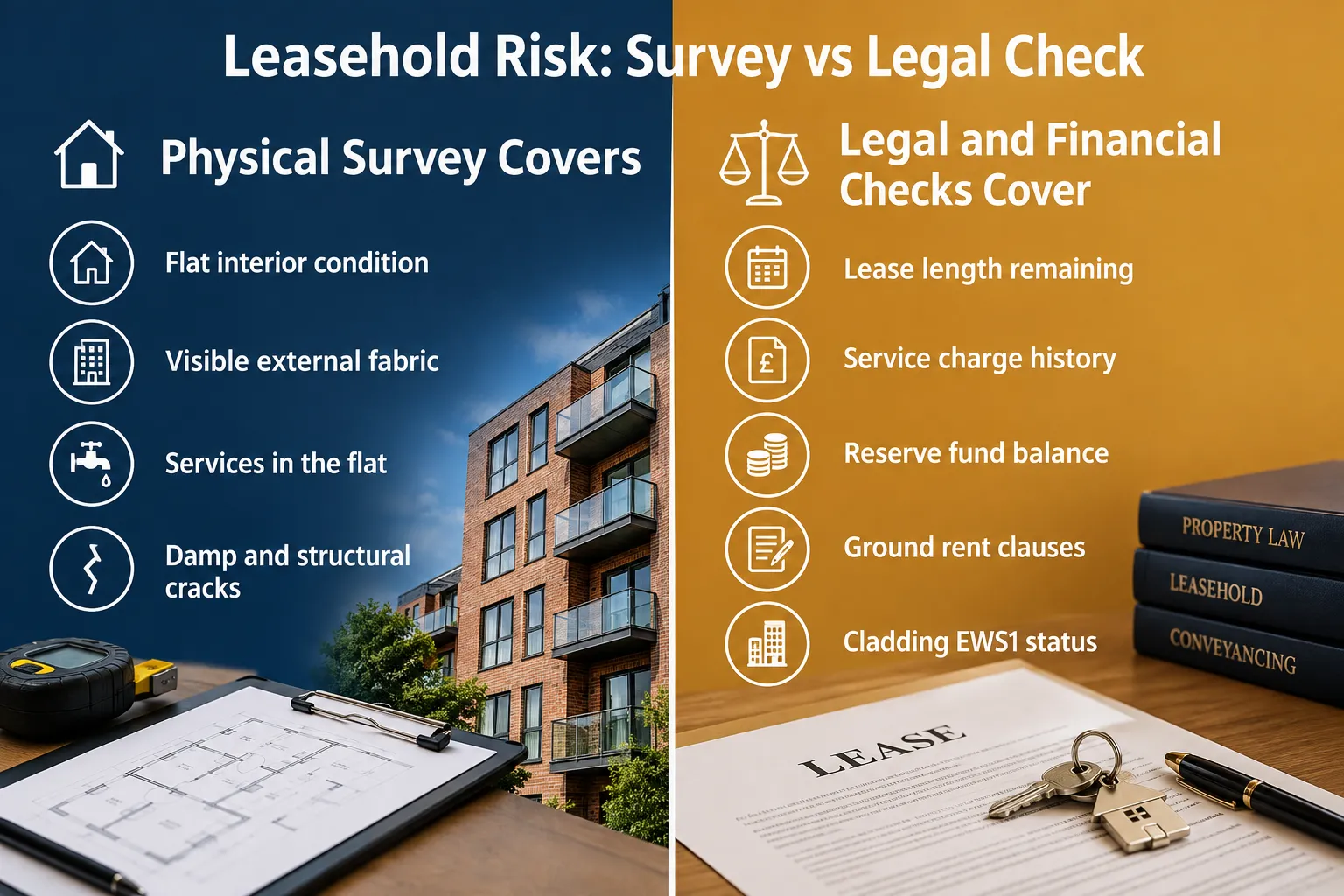
- Service charges, reserve funds, lease length and ground rent clauses sit outside any physical survey and must be checked through conveyancing.
- Common parts, staircases, roofs, lifts, communal plant, are the freeholder's responsibility but the leaseholder's financial risk.
- The RICS Home Survey Standard 1st edition remains in force in 2026 while the 2nd edition is being finalised.
Why Flat Surveys Differ From House Surveys
A flat buyer does not own the building. They own a long leasehold interest in part of it, with rights to use shared areas and obligations to contribute to the block's upkeep through service charges. That legal structure changes the surveying task considerably.
When a RICS surveyor inspects a house, they can walk around the full perimeter, enter the loft, check the roof from close range and assess drainage. With a flat, the surveyor's physical access is limited to the demised premises, the flat itself, plus whatever can be observed of the building and common parts from accessible positions. Roofs, roof terraces belonging to other flats, plant rooms, basement car parks and high external elevations may be visible only from ground level or not at all.
RICS confirms that "home" includes flats, studios, duplexes and maisonettes, and recommends an RICS Home Survey before purchasing any such property, even though surveys are not legally mandatory in England and Wales [3]. The professional benchmark for all RICS Home Surveys is the Home Survey Standard, currently in its 1st edition, with a 2nd edition under active consultation and review in 2026 [1][6].
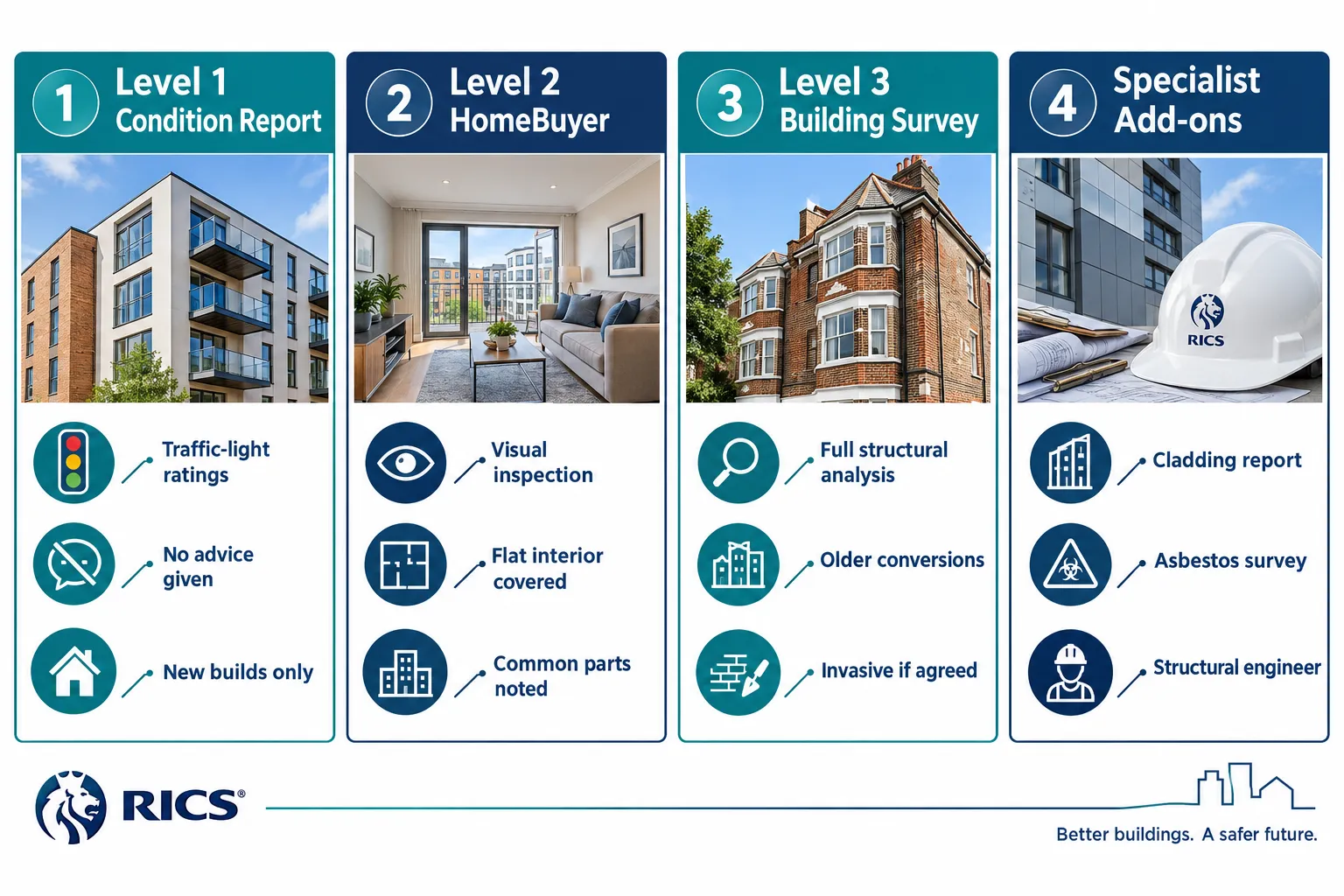
RICS Survey Levels Explained for Flat Buyers
The three RICS Home Survey levels each carry a different scope. Understanding them is the first step to choosing the best property survey for a flat purchase in the UK.
Level 1, Condition Report
The Condition Report uses a traffic-light rating system to flag visible defects. It provides no advice on repairs and no market valuation. RICS positions it as appropriate for new-build or near-new properties in good condition [3]. For most leasehold flat purchases, it provides too little information to be useful.
Level 2, HomeBuyer Report
The Level 2 survey is the standard choice for conventional leasehold flats in reasonable condition. It includes a more extensive visual inspection of the flat, its services and the parts of the building and grounds that are accessible and visible [2][3]. The surveyor will note the condition of the roof covering if visible from ground level, comment on the external fabric of the block, flag any visible damp, cracking or structural movement, and assess the condition of services within the flat.
A Level 2 survey can also include a market valuation if instructed, which is useful when the purchase price needs an independent check. See our guidance on how to challenge a building survey valuation in the UK if the surveyor's figure differs materially from the agreed price.
Limitations specific to flats:
- The surveyor cannot open up floors, ceilings or wall finishes without the buyer's written agreement.
- Roofs of multi-storey blocks are rarely accessible.
- Plant rooms, communal boiler rooms and basement areas may be locked.
- High external elevations are assessed from ground level only.
- The survey covers the flat and what can be seen of the block, it does not audit the block's finances, the lease terms or the freeholder's maintenance record.
Level 3, Building Survey
The Level 3 Building Survey provides the most thorough physical inspection available under the RICS Home Survey Standard [1][4]. The surveyor describes the construction, identifies defects in greater detail, advises on repair options and, where agreed, may carry out limited opening up.
Level 3 is worth instructing for:
- Pre-1920 conversions, particularly those converted from large Victorian or Edwardian houses.
- Blocks with non-standard construction, concrete-frame, large-panel system, or timber-frame.
- Properties where a Level 2 report has already flagged significant concerns.
- High-value purchases where the cost of a more thorough report is proportionate.
- Blocks with known cladding, fire safety or structural issues.
For guidance on what a surveyor physically checks inside a flat and throughout a building, the room-by-room UK building surveyor inspection guide sets out the process in plain terms.
Common-Parts Risks: What the Survey Can and Cannot See
The communal areas of a block, entrance lobbies, staircases, corridors, lifts, roof, external walls, communal plant, are the freeholder's or management company's responsibility to maintain. But every leaseholder pays for that maintenance through service charges. A defect in the roof affects every flat owner's wallet, even if it is nowhere near their flat.
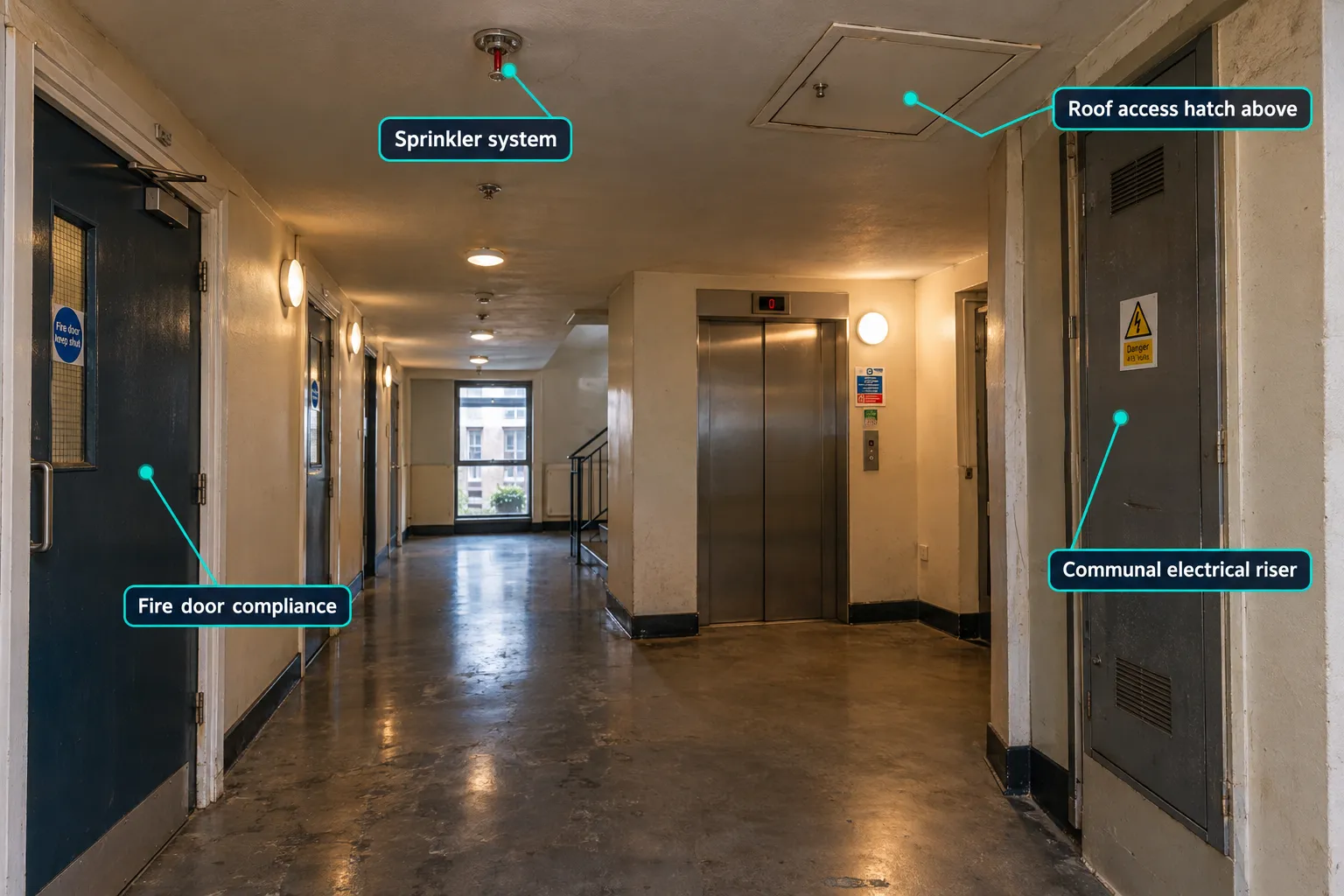
A RICS surveyor will note visible defects in common parts during a Level 2 or Level 3 inspection, but access is often restricted. The key risks that a physical survey may not fully capture include:
| Common-Parts Risk | Can Survey Detect? | How to Check |
|---|---|---|
| Roof condition (multi-storey block) | Partially, ground-level view only | Specialist roofing inspection or drone survey |
| Cladding and external wall systems | Visible elevation only | EWS1 form; specialist fire engineer |
| Communal heating / plant room | Only if accessible | Service charge accounts; engineer's report |
| Lift condition | Visual only | Lift maintenance records |
| Fire doors and compartmentation | Accessible doors only | Fire risk assessment (FRA) |
| Basement / underground car park | Only if accessible | Management company records |
| Structural frame (concrete or steel) | Surface cracking noted | Structural engineer's report |
Where a block has had recent fire safety concerns, particularly post-Grenfell cladding remediation, buyers should request the EWS1 (External Wall System) form and any fire risk assessment before exchange. These are not produced by the surveyor but by specialist fire engineers, and they sit entirely outside the physical survey.
For blocks where structural defects have been flagged, the article on structural defects found in building surveys and what to do next explains the options available to buyers.
Damp is a particular concern in ground-floor and basement flats, and in older blocks where communal drainage passes through the structure. A damp survey can be instructed separately if the Level 2 report flags moisture readings that warrant further investigation.
Leasehold and Financial Risks: Beyond the Physical Survey
This is where many flat buyers are caught out. The issues most likely to derail a flat purchase, or to create significant costs after completion, often sit entirely outside the physical survey and inside the conveyancing paperwork and public records [7].
Lease Length
A lease with fewer than 80 years remaining is expensive to extend and can make the property difficult to mortgage. Below 70 years, many high-street lenders will not lend at all. The surveyor will note the lease term in the report, but the legal and financial implications are a matter for the solicitor and, where needed, a specialist leasehold valuer.
Service Charges and Reserve Funds
Service charges fund day-to-day maintenance of the block. Reserve funds (sometimes called sinking funds) accumulate capital for major works, roof replacement, lift overhaul, external redecoration. A block with a depleted reserve fund may issue a large one-off demand, known as a major works notice, shortly after a buyer completes.
Buyers should ask the seller's solicitor to provide:
- Three years of service charge accounts.
- The current reserve fund balance.
- Any pending or anticipated major works.
- Minutes of recent residents' or management company meetings.
The government's leasehold guidance sets out the rights leaseholders have to inspect service charge accounts and request a summary of costs [5].
Ground Rent
Ground rent clauses that double periodically or are linked to the Retail Price Index can make a property unmortgageable. The Leasehold Reform (Ground Rent) Act 2022 restricts ground rents on new leases to a peppercorn, but older leases may still carry onerous terms. This is a legal check, not a surveying one.
Commonhold and Leasehold Reform
The Leasehold and Freehold Reform Act 2024 introduced changes to lease extension rights and service charge transparency. Buyers should confirm with their solicitor how the current legislation affects the specific property, particularly if the lease is short or the service charge history is unclear.
Specialist Reports to Consider Alongside the Main Survey
For many flat purchases, the RICS Level 2 survey is sufficient as the physical inspection. The table below summarises when additional specialist reports add genuine value.
| Specialist Report | When to Instruct |
|---|---|
| Structural engineer's report | Cracking, subsidence, non-standard frame, post-war concrete block |
| Asbestos survey | Pre-2000 blocks, especially during refurbishment or if works are planned |
| Damp and timber survey | Ground-floor flats, older conversions, or where Level 2 flags moisture |
| Fire engineer / EWS1 | Any block with ACM or HPL cladding, or where the lender requires it |
| Drone survey | High-rise blocks where the roof cannot be accessed on foot |
| Electrical installation condition report | Older blocks or where the surveyor notes concerns about wiring |
Asbestos is a particular concern in blocks built between 1945 and 2000. For properties in the North West, asbestos surveys can be arranged as a standalone instruction.
When reviewing any surveyor's proposal, check exactly what is and is not included in the scope. The guide to reading UK surveyor proposals and avoiding hidden extras explains the key clauses to examine before signing.
The RICS Home Survey Standard in 2026
The RICS Home Survey Standard 1st edition remains the professional benchmark for all RICS Home Surveys in 2026 [1][4]. RICS members must continue to work to this standard while the 2nd edition is being consulted on and finalised [6][10].
The 2nd edition, when it comes into force, is intended to strengthen best-practice requirements and public-interest protections in residential surveys [6]. Until that point, buyers commissioning a survey should confirm that the surveyor is an RICS member working to the current Home Survey Standard, and that the report will be produced in accordance with it [1][3].
For a broader view of what to look for when selecting a surveyor, the article on why to choose an RICS chartered building surveyor covers the qualifications and regulatory framework in plain terms.
Frequently Asked Questions
Do I need a survey on a leasehold flat?
A survey is not legally required in England and Wales, but RICS recommends one for any residential purchase, including leasehold flats [3]. Without a survey, defects in the flat or the block may only become apparent after completion, at which point the buyer bears the cost.
Is a Level 2 survey enough for a flat?
For a standard modern flat in reasonable condition, a Level 2 survey is generally appropriate. For older conversions, blocks with known defects, or properties where the physical condition is uncertain, a Level 3 Building Survey provides more detail [2][14].
Can the surveyor inspect the roof of my block?
In most multi-storey blocks, the surveyor will observe the roof from ground level. Direct access to the roof is rarely possible during a standard survey. If the roof condition is a specific concern, a specialist roofing inspection or drone survey can be arranged separately.
What is an EWS1 form and does my surveyor provide it?
An EWS1 (External Wall System) form is a fire safety assessment produced by a qualified fire engineer, not by a building surveyor. It is required by many mortgage lenders for blocks with certain types of cladding. The RICS surveyor may flag cladding concerns in their report and recommend that an EWS1 is obtained, but they do not produce the form themselves.
What should I check about service charges before buying?
Request three years of service charge accounts, the current reserve fund balance, any major works notices and recent management company meeting minutes. Your solicitor should obtain these through the conveyancing process. The government's leasehold guidance sets out your rights to this information [5].
Does the survey cover the lease terms?
No. The physical survey does not examine the lease. Lease length, ground rent clauses, service charge obligations and rights of way are legal matters for your solicitor. The surveyor may note the lease term as recorded, but legal advice on its implications is separate.
What if the surveyor finds structural defects?
Structural defects in a flat or block are serious and may affect the purchase price, mortgage offer or decision to proceed. The article on structural defects in UK building surveys, when to walk away versus renegotiate sets out the options clearly.
Conclusion
Choosing the best property survey for a flat purchase in the UK requires a clear-eyed view of what any physical inspection can and cannot cover. A RICS Level 2 survey is the right starting point for most conventional leasehold flats, giving a thorough visual assessment of the flat and what can be observed of the block. Level 3 is the appropriate choice where the building is older, structurally complex or already known to have defects.
The physical survey, however, is only part of the picture. Service charge history, reserve fund levels, lease length, ground rent terms and fire safety documentation all sit outside the surveyor's remit and must be addressed through conveyancing and specialist reports. Buyers who treat the survey as the only due diligence step risk missing the financial and legal risks that are, in many cases, the more consequential ones.
Practical next steps:
- Instruct an RICS-qualified surveyor working to the current Home Survey Standard before exchange of contracts.
- Choose Level 2 for standard modern flats; Level 3 for older conversions or blocks with known concerns.
- Ask your solicitor to obtain three years of service charge accounts, the reserve fund balance and any major works notices.
- Check the lease length and ground rent terms with your solicitor before proceeding.
- If the block has cladding, request the EWS1 form and confirm your lender's requirements before exchange.
- Commission specialist reports, damp, asbestos, structural or fire engineering, wherever the Level 2 report flags concerns.
References
[1] Home Survey Standards – rics.org
[2] Building Surveying Standards – aemdev.rics.org
[3] House Surveys UK: The Costs, Types and Benefits of an RICS Home Survey – rics.org
[4] Home Surveys – rics.org
[5] How to Lease – gov.uk
[6] Home Survey Standard 2nd Edition April 2026 Update – rics.org
[7] Do I Need a Survey on a Leasehold Flat – hoa.org.uk
[8] Common Parts – legislation.gov.uk
[10] Home Survey Standard 2nd Edition: A Progress Update – rics.org