Roughly one in five mortgage applications in the UK is affected by a down valuation, a figure that has remained stubbornly consistent through 2026 despite shifting market conditions. When a lender's surveyor values a property below the agreed purchase price, the gap does not simply disappear. It falls on the buyer, the seller, or both to resolve it. Knowing how to challenge a building survey valuation in the UK without jeopardising your mortgage offer is therefore one of the most commercially valuable skills a property buyer can develop.
This guide explains the formal dispute process, the evidence that actually moves lenders, the regulatory rights available to buyers, and the practical fallback strategies that protect a transaction when an appeal does not succeed.
Key Takeaways
- A down valuation does not end a purchase, but it must be challenged through a formal, lender-specific reconsideration process, not an informal complaint.
- Successful appeals depend almost entirely on recent completed comparable sales, not opinions, asking prices, or condition reports.
- Most lenders allow only one appeal per application, so the evidence package must be thorough before submission.
- Regulatory complaints about a lender's conduct fall under FCA dispute-resolution rules, while complaints about a surveyor's professional standards go to RICS, these are separate channels [10].
- If the appeal fails, renegotiating the price, increasing the deposit, or switching lender are the most reliable alternatives.
What a Down Valuation Actually Means for Your Mortgage
A mortgage valuation is not a full structural survey. It is a short, lender-focused assessment designed to confirm that the property provides adequate security for the loan. Lenders base the mortgage offer on the surveyor's figure, not the price agreed between buyer and seller. If those two numbers diverge, the lender will only advance funds against the lower valuation, leaving a shortfall that must be covered elsewhere.
This distinction matters when planning a challenge. Because the valuation is a lender's risk tool rather than a market appraisal, the surveyor is not trying to establish what the property is "worth" to the buyer, they are establishing the price at which the property could be reliably sold in the open market. RICS-linked commentary describes "down valuation" as a common misunderstanding of the difference between individual worth and professional market value. Surveyors are expected to follow RICS standards, not buyer or seller expectations.
Three outcomes are possible when a down valuation occurs:
- The buyer increases their deposit to cover the shortfall.
- The seller reduces the agreed price to match the valuation.
- The buyer challenges the valuation through the lender's formal reconsideration process.
These options are not mutually exclusive, and experienced brokers typically pursue all three in parallel.
How to Challenge a Building Survey Valuation in the UK Without Jeopardising Your Mortgage Offer: The Formal Process
Lenders do permit valuation challenges, but only through specific internal appeal routes. Most allow a single reconsideration request per application. Treating this as a formal "reconsideration of value" rather than a casual query is essential, a poorly prepared submission wastes the one opportunity available.
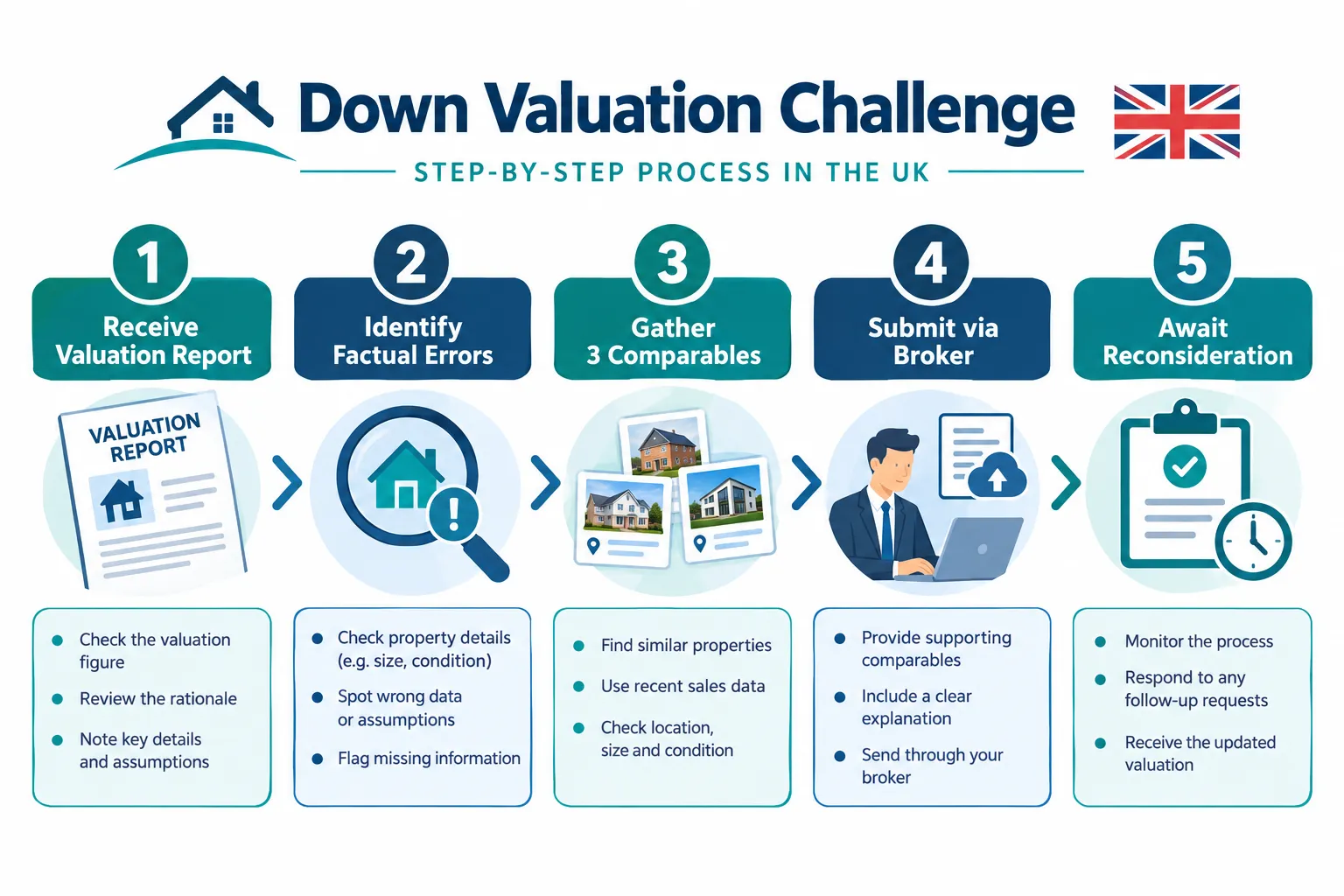
Step 1: Obtain the Valuation Report and Identify Errors
Request a copy of the valuation report from your lender as soon as the down valuation is confirmed. Review it carefully for factual inaccuracies: incorrect bedroom count, wrong floor area, missing extensions, or a failure to note recent refurbishments. A Financial Ombudsman decision involving NatWest illustrates the standard criteria: factual errors in the valuation instruction, or for new-build properties, clear evidence of recent comparable sales on the same development.
Factual errors are the strongest grounds for a reconsideration. If the report lists three bedrooms when the property has four, or omits a recently converted loft, the surveyor has assessed a different property from the one being purchased.
Step 2: Gather Recent Completed Comparable Sales
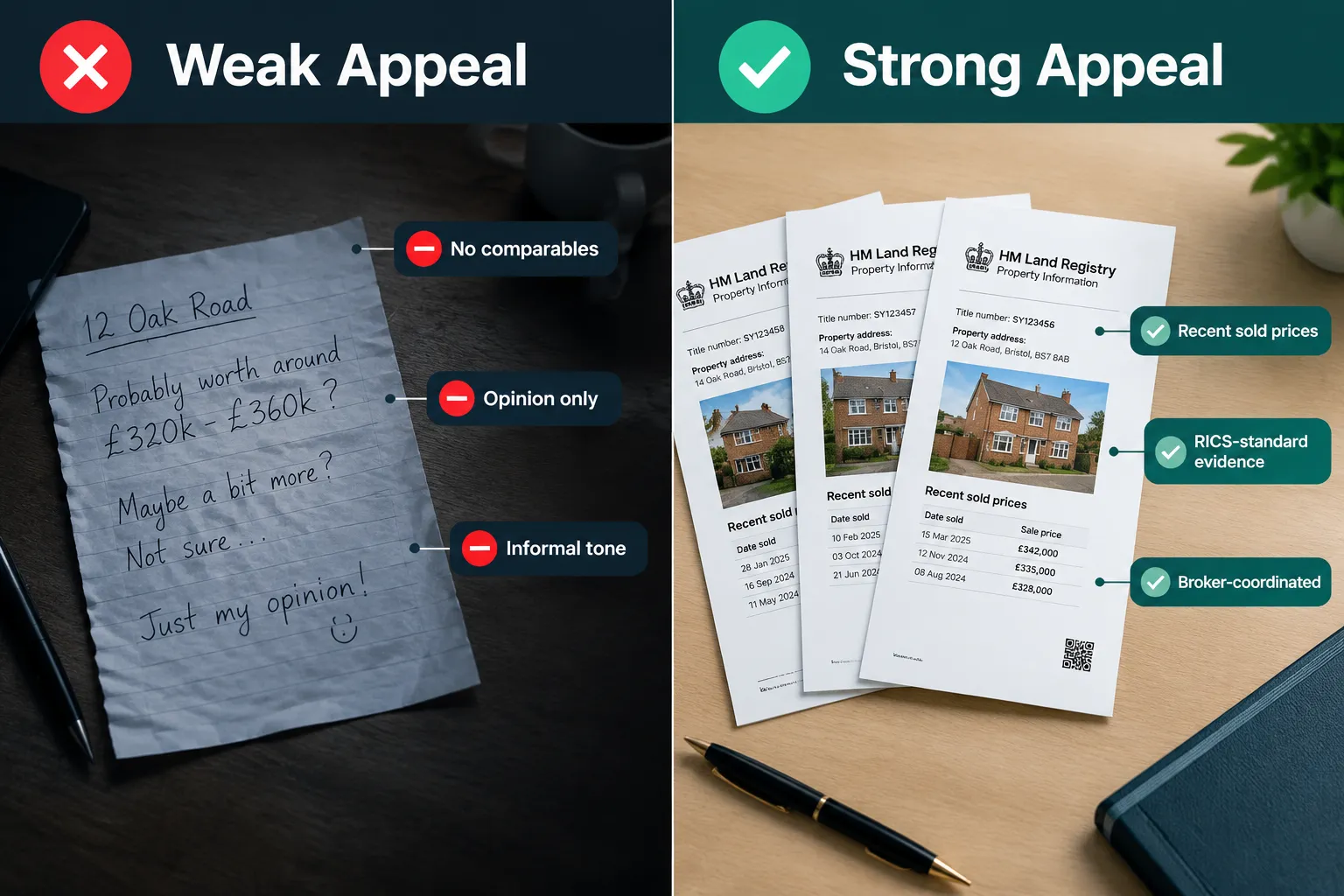
This is where most appeals succeed or fail. Lenders and surveyors require evidence of recent completed sales, not asking prices, not estate agent opinions, and not valuations from other surveyors. The standard expectation is three comparable properties that meet all of the following criteria:
| Criteria | What It Means in Practice |
|---|---|
| Similar property type | Same style (terraced, semi, flat) and approximate size |
| Same local area | Ideally the same street or within a quarter mile |
| Recent sale date | Completed within the last three to six months |
| Verified sold price | Confirmed via HM Land Registry, not Rightmove estimates |
| Higher or equal sold price | Demonstrates market support for the agreed purchase price |
There is a recognised tolerance in valuations. Courts and regulators typically accept valuation differences of up to approximately 15% as falling within normal professional judgement. Disputes below this threshold are unlikely to be upheld unless a factual error can be demonstrated. This means a challenge based purely on the buyer "feeling" the valuation is low has very little prospect of success.
Step 3: Submit the Appeal Through Your Broker
Do not contact the lender directly to dispute the valuation. Most lenders require the reconsideration request to be submitted through the mortgage broker who placed the application. The broker coordinates the submission, ensures it reaches the correct department, and presents the evidence in the format the lender expects.
The appeal package should include:
- A concise covering letter identifying the specific grounds for reconsideration (factual error or comparable evidence)
- Printed HM Land Registry records for each comparable property
- Floor plans or estate agent particulars showing comparable size and specification
- Any planning permission or completion certificates for improvements not noted in the original report
One submission, one chance. Submitting a weak package and then trying to supplement it later is rarely possible. The evidence must be complete before the appeal is lodged.
Step 4: Understand the Review Timeline
The original surveyor typically reviews the reconsideration request. Most lenders aim to respond within five to ten working days, though this varies. During this period, the mortgage offer remains in place unless the lender's risk assessment changes for another reason. Submitting a formal reconsideration does not, by itself, cancel or suspend the offer.
Regulatory Rights: What the FCA and FOS Can and Cannot Do
Understanding the regulatory framework helps buyers avoid wasting time on the wrong complaint channel.
Complaints about the lender's conduct, for example, how it handled the valuation instruction or communicated the outcome, fall under FCA dispute-resolution rules. These give structured rights: the buyer must first complain directly to the lender and can escalate to the Financial Ombudsman Service (FOS) if dissatisfied with the response [10]. The FOS will examine whether the lender followed fair procedures, not whether the valuation figure itself was correct [10].
Complaints about the surveyor's professional standards are a separate matter. The FOS generally cannot deal with complaints about independent surveyors and will direct buyers to the Royal Institution of Chartered Surveyors (RICS). If the surveyor is RICS-registered and the complaint relates to professional conduct, not just a disagreement over the figure, RICS is the correct body.
"Using formal complaint channels does not automatically cancel your mortgage offer, but the lender can still change or withdraw it if its risk assessment changes." [10]
This distinction is critical. Escalating a complaint about the surveyor to the FOS will not produce a revised valuation. It may produce an apology or a process remedy, but the lender's loan-to-value calculation will not change as a result.
How to Challenge a Building Survey Valuation in the UK Without Jeopardising Your Mortgage Offer: Protecting the Offer During the Process
The phrase "without jeopardising your mortgage offer" is not rhetorical. Buyers who handle the reconsideration process poorly can create new problems: antagonising the lender, introducing delays that push past an offer expiry date, or triggering a fresh credit check.
Practical safeguards during the challenge period:
- Communicate exclusively through the broker, not directly with the lender's valuation team.
- Do not apply to a second lender simultaneously unless the first offer has formally expired or been withdrawn, dual applications can affect credit scoring.
- Keep the seller and their solicitor informed of the timeline so they do not withdraw the property or accept another offer.
- Avoid making any financial changes (new credit applications, job changes) that could alter the lender's risk assessment while the reconsideration is live.
- Set a clear internal deadline: if the appeal is not resolved within a defined period, move to the fallback strategy rather than allowing the transaction to stall indefinitely.
When the Appeal Fails: Practical Alternatives That Preserve the Transaction
Industry data is sobering. Valuation challenges represent only a tiny fraction of total mortgage instructions, and successful revisions are a fraction of those. Buyers who enter the process expecting a high success rate are likely to be disappointed. The challenge should be pursued, but it must be part of a wider strategy.

Renegotiate the Purchase Price
The lender's valuation is a powerful negotiating tool. Presenting the surveyor's figure to the seller demonstrates that an independent professional has assessed the property at a lower price. Many sellers, particularly those who have been on the market for some time or who face their own time pressures, will reduce the price rather than lose the sale.
The seller can also assist by providing their own comparable evidence to the buyer's broker, who submits it to the lender. If the lender finds the seller's evidence compelling, it may revise the valuation and reinstate the original loan amount without requiring a price reduction.
Increase the Deposit
If the shortfall is modest and the buyer has accessible savings, bridging the gap with additional deposit funds is often the fastest resolution. This avoids the uncertainty of an appeal and keeps the transaction on track. The trade-off is a higher upfront cash commitment and a reduced loan-to-value ratio, which may actually improve the mortgage rate available.
Switch Lender for a Fresh Valuation
Different lenders use different surveying panels. A property that one surveyor values conservatively may receive a higher valuation from a surveyor on a different panel. Switching lender means a new application, a new credit check, and additional time, but it is a legitimate route when the appeal process has been exhausted and the seller will not reduce the price.
Before switching, consider:
- Whether the new application will affect the credit file materially
- Whether the new lender's product rate and fees remain competitive after accounting for any arrangement costs
- Whether the completion timeline can absorb the additional weeks a new application requires
Build Deposit Contingency Before You Apply
The most effective protection against a down valuation is preparation before the mortgage application is submitted. Market commentary in 2026 consistently advises buyers to test "mortgageability, saleability and valuation" as a single integrated plan, not three separate considerations. Buyers who enter a purchase with a deposit buffer above the minimum required have far more flexibility if the valuation comes in low.
The Role of an Independent RICS Survey
Commissioning an independent RICS survey, a Level 2 or Level 3 HomeBuyer Report or Building Survey, does not directly influence the lender's mortgage valuation. The lender's surveyor is appointed by the lender, and the lender is not obliged to accept a third-party report as grounds for revision.
However, an independent survey serves two useful purposes in a down valuation dispute:
- It may identify factual errors in the lender's valuation that form the basis of a formal reconsideration request.
- It strengthens the buyer's negotiating position with the seller, particularly if the independent survey supports a higher value and includes comparable market data.
The independent survey will only influence the lender if the underlying comparable sales data supports a higher value. A report that simply states a higher opinion of value without comparable evidence will not move the lender's position.
Conclusion: A Disciplined Approach Produces the Best Outcomes
Knowing how to challenge a building survey valuation in the UK without jeopardising your mortgage offer requires discipline, preparation, and realistic expectations. The formal reconsideration process is available, but it is narrow: factual errors and strong comparable evidence are the only reliable grounds. Appeals based on opinion, emotion, or a different surveyor's view rarely succeed.
Actionable next steps for buyers facing a down valuation in 2026:
- Obtain the full valuation report immediately and review it for factual errors.
- Source three recent HM Land Registry-verified comparable sales that support the agreed price.
- Coordinate the formal reconsideration submission through your broker, one submission, fully evidenced.
- Simultaneously open a negotiation with the seller using the valuation figure as leverage.
- Identify whether a deposit top-up or lender switch is viable, so you are not dependent on the appeal succeeding.
- If the lender's conduct is in question, use the FCA complaints process; if the surveyor's professional standards are in question, escalate to RICS [10].
- Build deposit contingency into future purchases so a conservative valuation does not become a crisis.
A down valuation is not a verdict. It is the start of a negotiation, one that buyers who are well-prepared and well-advised can navigate without losing their mortgage offer or their purchase.
References
[1] Disp1s4 – handbook.fca.org.uk
[10] Your Rights Financial Services – fca.org.uk