Only 22% of homebuyers in the UK commission a survey beyond a basic mortgage valuation, yet surveys routinely uncover defects that cost tens of thousands of pounds to fix. When buyers do seek quotes, many compare the headline figure alone, and end up either overpaying for a service they did not need, or discovering after the fact that their "comprehensive" survey excluded the very items that mattered most. A proper building survey quote comparison: how to read UK surveyor proposals and avoid hidden extras is not complicated, but it does require knowing exactly what to look for.
Key Takeaways
- RICS Level 1, 2, and 3 surveys have different scopes, always confirm which level you are actually buying before comparing prices.
- VAT is the single most common source of quote confusion; always request VAT-inclusive totals.
- Common exclusions, drains, roofs, specialist damp/timber tests, are frequently upsold as paid add-ons after you have already committed.
- Regional variation and property value both affect price significantly; a like-for-like comparison requires matching property type, size, and location.
- Online benchmarking tools and RICS fee calculators provide a useful sanity check before accepting any quote.
Understanding the Three RICS Survey Levels and Their Price Bands
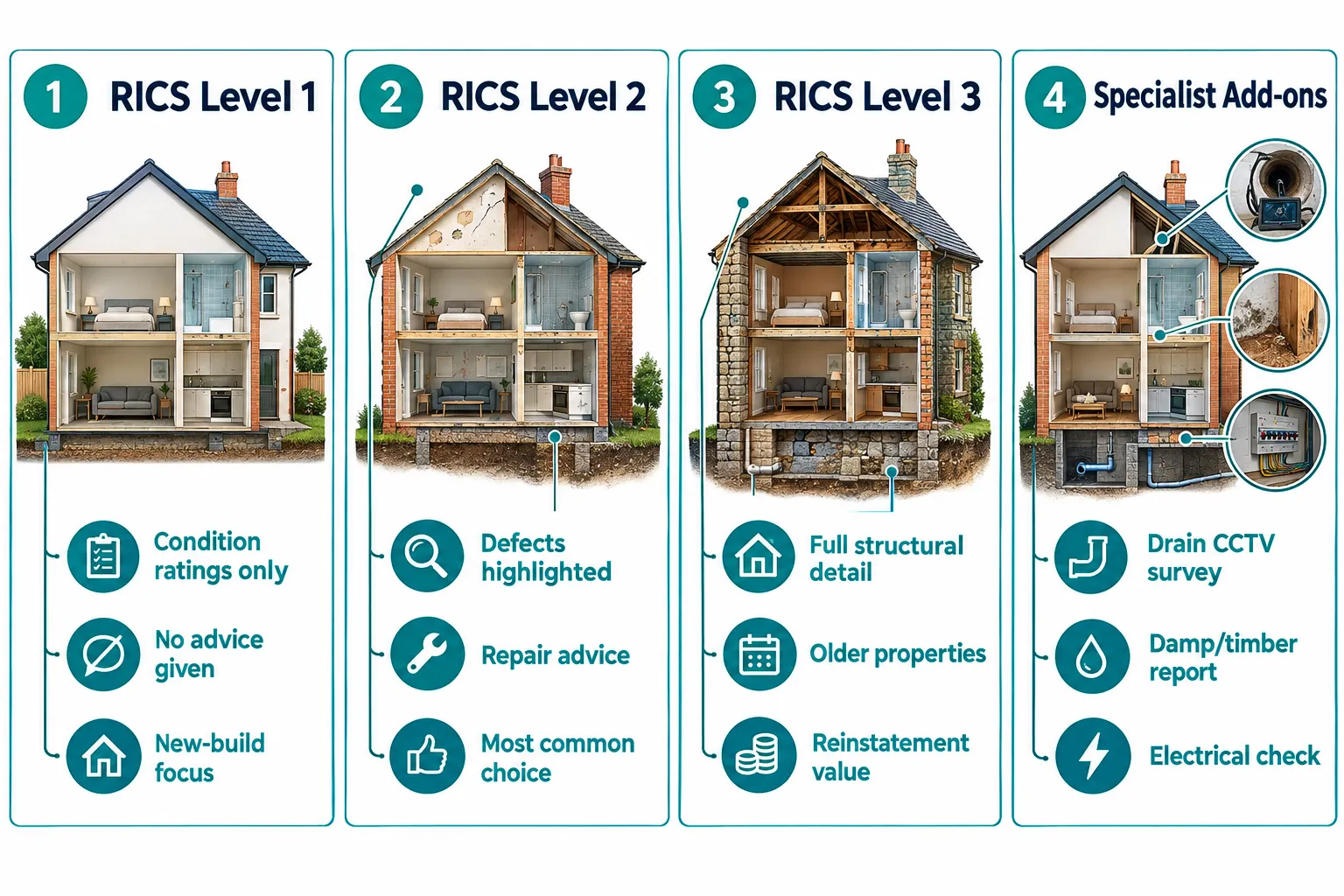
The Royal Institution of Chartered Surveyors (RICS) governs the three standard survey types used across the UK. Understanding what each level covers is the essential first step in any building survey quote comparison.
RICS Level 1, Condition Report
This is the most basic option. It provides a traffic-light condition rating for different parts of the property but offers no advice on repairs or maintenance. It is best suited to new-build or conventionally constructed modern homes. In 2026, typical costs range from around £300 to £500 depending on property value and location [1][5].
RICS Level 2, HomeBuyer Report (Survey only or Survey + Valuation)
This is the most widely purchased survey in the UK. It identifies significant defects, highlights urgent issues, and provides repair recommendations. The survey-only version typically costs between £400 and £900 for properties valued up to £500,000, with costs rising for higher-value homes [2][8]. Adding a market valuation from the same surveyor usually adds £100,£150 to the fee.
RICS Level 3, Building Survey (formerly Full Structural Survey)
This is the most thorough option, covering construction, condition, and defects in detail. It is strongly recommended for older properties (pre-1900), those with unusual construction, or any home showing visible signs of structural movement. Costs in 2026 typically start at around £600 for smaller properties and can exceed £1,500 for large period homes [3][7][8].
How the RICS Home Survey Standard Affects Proposals
In June 2026, RICS completed a review of its Home Survey Standard, which governs how surveys must be structured and reported. The revised standard places greater emphasis on clear scope statements within proposals, meaning surveyors are now expected to be more explicit about what is and is not included. This is good news for buyers: proposals issued after the review should be easier to compare. However, not all firms update their templates immediately, so it remains the buyer's responsibility to ask direct questions about scope.
The Most Common Hidden Extras in UK Surveyor Quotes
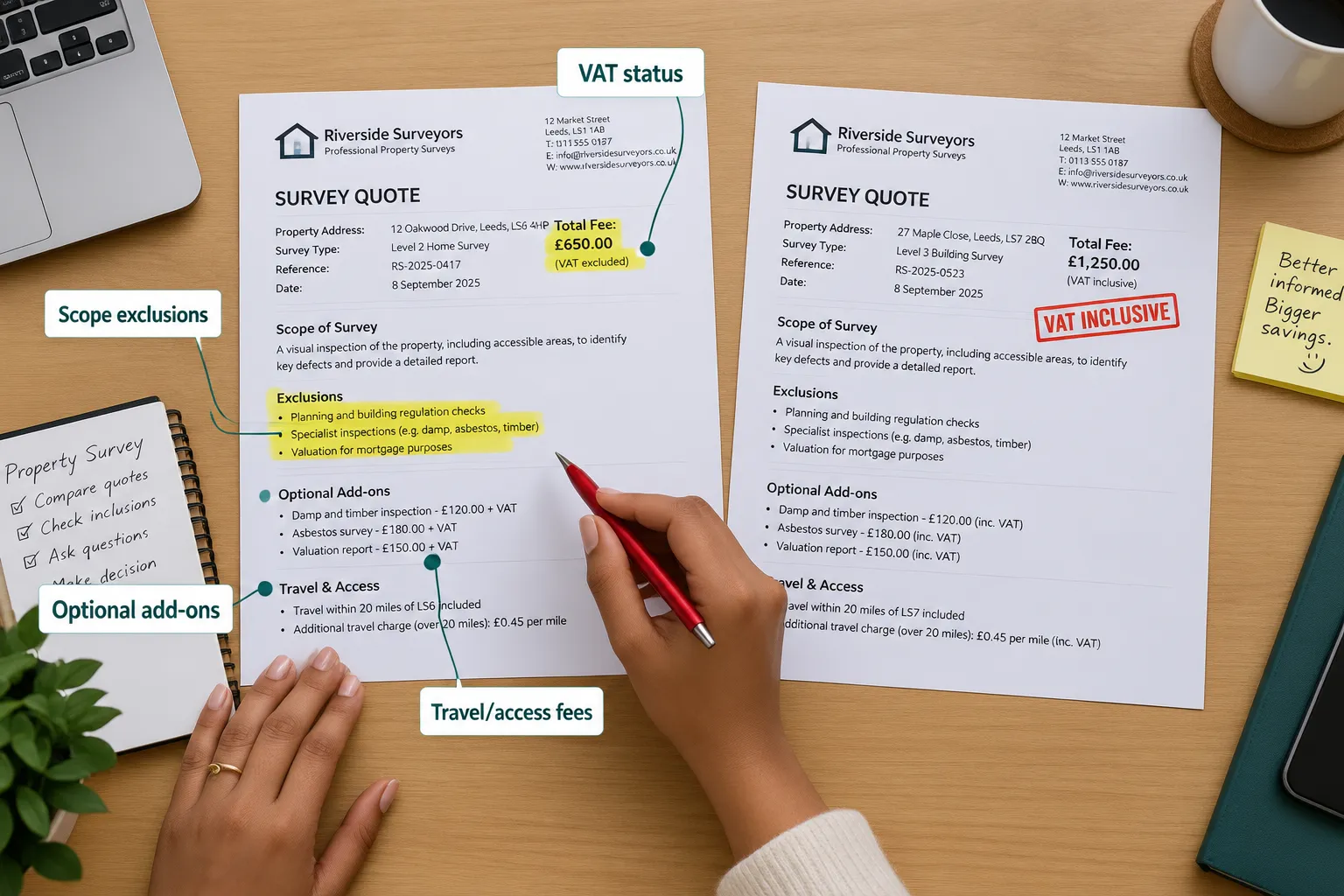
This is where a large proportion of buyers get caught out. A quote that looks competitive on the surface can become significantly more expensive once optional extras are added, sometimes after the buyer has already agreed to proceed.
VAT: The Most Frequent Source of Confusion
Many surveying firms, particularly sole traders and smaller practices, quote fees exclusive of VAT. A quote of £500 plus VAT becomes £600 once the 20% tax is applied. Always ask: "Is this figure VAT-inclusive?" Any reputable firm should be able to confirm this immediately. Nationwide firms and larger practices tend to publish VAT-inclusive figures, but this is not universal [4][10].
Specialist Reports Sold as Add-Ons
A standard Level 2 or Level 3 survey does not include:
- Drain CCTV surveys, typically £150,£300 extra; essential for older properties
- Damp and timber specialist reports, often £150,£250; sometimes triggered by the main survey
- Electrical installation condition reports (EICR), usually £150,£300 depending on property size
- Gas safety certificates, around £60,£120
- Asbestos surveys, £200,£500 for a management survey
- Japanese knotweed assessments, £150,£300
The problem is not that these reports exist, it is that some firms quote a low headline fee knowing they will recommend several of these add-ons after the inspection. The buyer, already committed emotionally and financially to the property, rarely pushes back.
"The cheapest quote on paper is rarely the cheapest survey in practice. The gap between the headline fee and the final invoice is where the real cost comparison happens."
Roof and Subfloor Access Limitations
Most standard surveys include a visual inspection only. If the roof space is inaccessible, or if the surveyor cannot lift floorboards, these areas may be noted as "not inspected" rather than triggering a specialist referral. This is a legitimate scope limitation, but buyers must understand it before commissioning the survey, not after receiving the report.
Ask every firm: "What happens if you cannot access the roof space or subfloor? Will you note it as uninspected, or arrange a specialist?"
Travel and Access Fees
Some firms, particularly those operating across wide geographic areas, charge a travel supplement for properties outside their primary catchment. This is rarely advertised in the headline quote. For rural properties or those in remote areas, this can add £50,£150 to the final bill [6].
How to Compare Quotes Like-for-Like: A Practical Framework
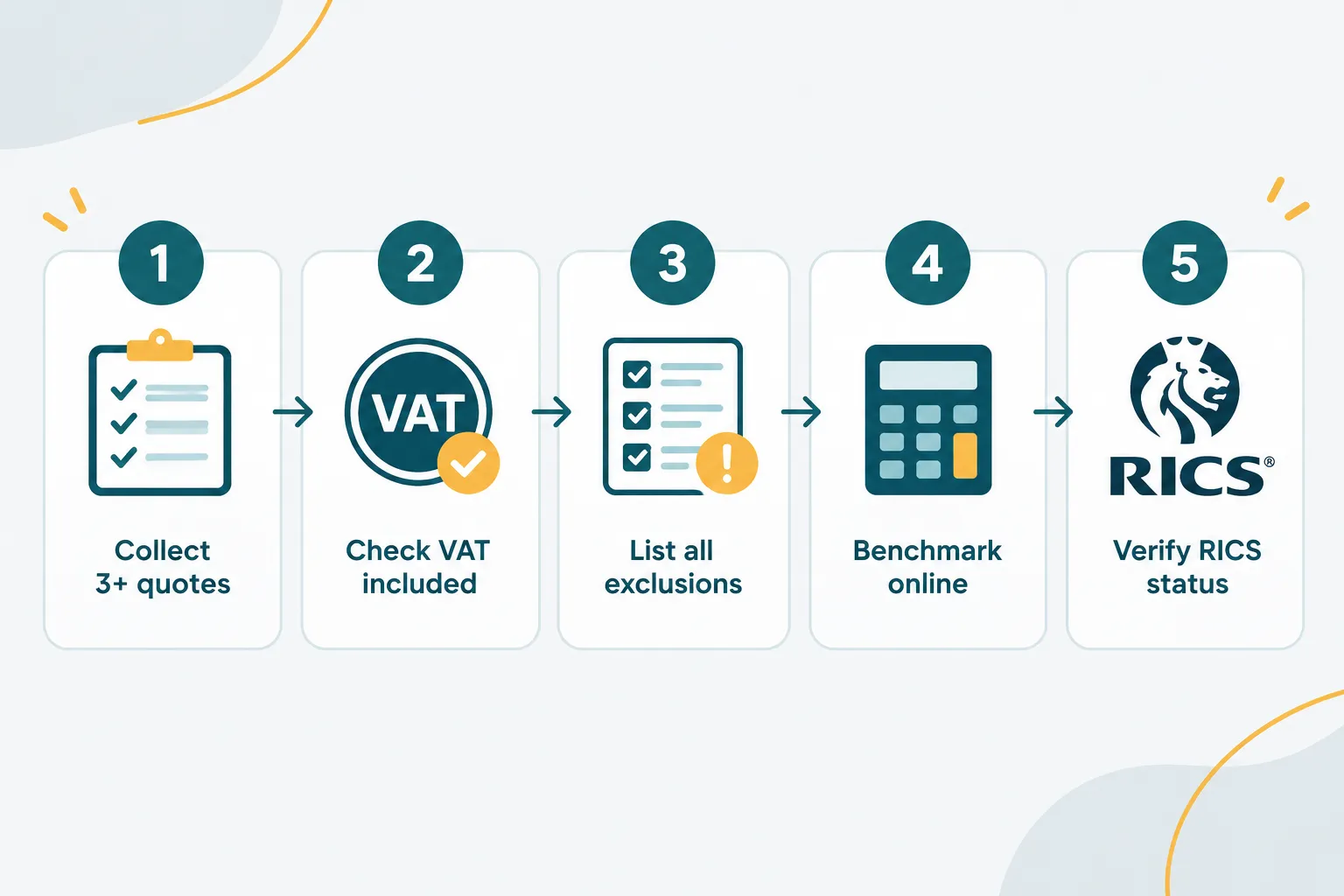
Effective building survey quote comparison, how to read UK surveyor proposals and avoid hidden extras, comes down to a structured process. The table below outlines the key variables to verify before treating any two quotes as directly comparable.
| Variable | What to Confirm | Why It Matters |
|---|---|---|
| Survey level | RICS Level 1, 2, or 3? | Scope differs significantly |
| VAT status | Inclusive or exclusive? | 20% difference in real cost |
| Valuation included | Survey only, or survey + valuation? | Adds £100,£150 typically |
| Drain inspection | Included or separate quote? | Common upsell, £150,£300 |
| Roof access | Visual only or physical inspection? | Affects defect detection |
| Travel supplement | Any additional travel charge? | Relevant for rural properties |
| RICS membership | Is the surveyor RICS-regulated? | Ensures professional standards |
| Turnaround time | How many days for the report? | Affects exchange timeline |
Regional Variation: Why Location Changes Everything
Survey costs are not uniform across the UK. London and the South East consistently attract the highest fees, reflecting both higher property values and greater operating costs for surveyors. A Level 2 survey on a £350,000 property in London may cost £650,£800, while the same survey on an equivalent property in the North East or Wales might be priced at £450,£550 [6][7].
This means that comparing a quote from a London-based firm against one from a regional firm, without adjusting for location, produces a misleading result. Always benchmark against regional averages, not national averages.
Using Online Calculators to Benchmark Quotes
Several independent tools now allow buyers to generate benchmark fee ranges based on property value, type, location, and survey level. These include dedicated house survey cost calculators and comparison platforms [5][10]. These tools are not perfect, they cannot account for unusual construction types or access difficulties, but they provide a useful sanity check.
If a quote falls more than 20% below the regional benchmark for the same survey level, ask the firm to explain why. Unusually low quotes sometimes reflect:
- VAT being excluded from the headline figure
- A narrower scope than the standard RICS template
- A less experienced surveyor (not necessarily a problem, but worth confirming qualifications)
- A volume-discount model that may affect report quality
The Narrow Band Observation
Market data from 2026 suggests that most quotes for standard Level 2 and Level 3 surveys now sit within a fairly narrow price band for any given property value and region [8][9]. This is partly a result of RICS standardisation and partly competitive market pressure. What this means in practice: if you are receiving quotes that vary by more than 25-30% for the same scope, the most likely explanation is a difference in what is actually included, not a difference in surveyor quality.
Practical Steps to Avoid Being Caught Out
The following checklist consolidates the most important actions a buyer can take when comparing building survey proposals.
Before requesting quotes:
- Confirm the property's approximate age, construction type, and any known issues
- Decide whether you need a valuation included (useful if your mortgage lender does not require a separate one)
- Identify whether the property has any features that typically require specialist inspection (flat roof, basement, timber frame, suspected asbestos)
When requesting quotes:
- Ask for a written, itemised proposal, not just a verbal figure
- Request the VAT-inclusive total explicitly
- Ask whether the quote includes or excludes drain inspection, damp/timber assessment, and roof space inspection
- Confirm the surveyor's RICS membership number (verifiable on the RICS Find a Surveyor tool)
When comparing proposals:
- Use the table above to align each quote on the same variables
- Cross-reference against a regional benchmark calculator [5][6][10]
- Do not automatically choose the cheapest, a survey that misses a £15,000 structural defect because of scope limitations is far more expensive than one costing £200 more upfront
When reviewing the final report:
- Note any sections marked "not inspected" or "access not possible"
- Review the list of recommended specialist referrals, these will carry additional costs
- Check whether the surveyor has recommended a drain survey or damp investigation; factor these into your overall due diligence budget
Conclusion
A building survey quote comparison, how to read UK surveyor proposals and avoid hidden extras, is ultimately about translating a simple-looking price into a complete picture of what you are actually buying. The difference between a well-structured proposal and a misleading one often comes down to four things: VAT clarity, scope definition, exclusion transparency, and the presence or absence of upsell triggers.
Actionable next steps:
- Request a minimum of three written, itemised, VAT-inclusive quotes before committing.
- Use a regional benchmark calculator to verify that each quote is within a reasonable range for your property type and location [5][10].
- Confirm RICS membership for every surveyor you consider.
- Ask directly about drain, damp, timber, and roof access before signing, not after.
- Budget an additional £300,£500 for specialist reports that the main survey may recommend, regardless of which firm you choose.
The RICS Home Survey Standard review of June 2026 is pushing the industry toward greater transparency, and standardisation is likely to increase further in the coming years. For now, however, the onus remains on the buyer to ask the right questions. The firms that answer them clearly and in writing are almost always the ones worth trusting.
References
[1] How Much Does A House Survey Cost – hoa.org.uk
[2] Surveying A House – myjobquote.co.uk
[3] How Much Does A House Survey Cost – cjbloor.co.uk
[4] How Much Does A Home Survey Cost – mickleson.co.uk
[5] House Survey Costs 2026 – movingcompared.co.uk
[6] House Survey Cost By Region – housesurveycostcalculator.co.uk
[7] House Survey Cost Guide 2026 – ukpropertylooker.com
[8] House Surveyor Cost 2026 Level2 Level3 – bookabuilderuk.com
[9] House Survey Cost 2026 Level2 Level3 – bookabuilderuk.com
[10] House Survey Cost – surveyorlocal.co.uk