More than one in three agreed UK property sales collapses before completion, and survey-highlighted structural issues are among the leading triggers for those failures [6]. Yet walking away is not always the right call. Understanding the difference between a defect that destroys value and one that simply demands a sharper negotiation is the skill that separates buyers who secure good deals from those who either overpay or miss out unnecessarily.
This guide on structural defects in UK building surveys covers what surveyors actually find, how to classify severity using established standards, and how to build a clear decision framework for the two hardest choices in property buying: walking away or renegotiating hard.
Key Takeaways
- Over 27% of failed UK house sales collapse at the survey or valuation stage, making structural findings one of the most consequential moments in any transaction [6]
- The BRE Digest 251 crack classification (Categories 0-5) gives buyers an objective benchmark for judging whether movement is cosmetic or genuinely structural
- Defects in Categories 0-2 are almost always grounds for renegotiation, not withdrawal; Categories 4-5 and active subsidence are strong candidates for walking away
- Damp affects roughly 1.4 million English dwellings and is frequently misread as catastrophic when it is often remedial [1]
- Building safety defects in mid-rise blocks (11-18m) require particular scrutiny, as lenders may refuse to lend and remediation costs can be enormous [43]
What UK Building Surveys Actually Find
When a RICS-qualified surveyor inspects a property, the findings fall into a predictable hierarchy of concern. Understanding that hierarchy is the first step in deciding whether structural defects in UK building surveys represent a deal-breaker or a bargaining chip.
The most common findings, in rough order of frequency, include:
- Rising and penetrating damp
- Roof covering defects (missing tiles, failed flashings, sagging)
- Timber defects including wet rot, dry rot, and woodworm
- Cracking and structural movement
- Failed or missing cavity wall insulation
- Defective or outdated electrical and heating systems
- Drainage problems
The English Housing Survey 2024-25 reports that 6% of all surveyed homes had a recorded damp problem [4]. Extrapolated across England's housing stock, that represents approximately 1.4 million dwellings [1]. Damp is therefore not a rare finding – it is a near-routine one. The question is always whether it is superficial condensation, manageable rising damp, or a symptom of something structurally serious.
Cracking is similarly ubiquitous. Almost every older property has some degree of movement cracking. The critical skill is distinguishing between thermal and seasonal movement (which is normal and self-arresting) and progressive structural movement caused by subsidence, heave, or failed foundations.
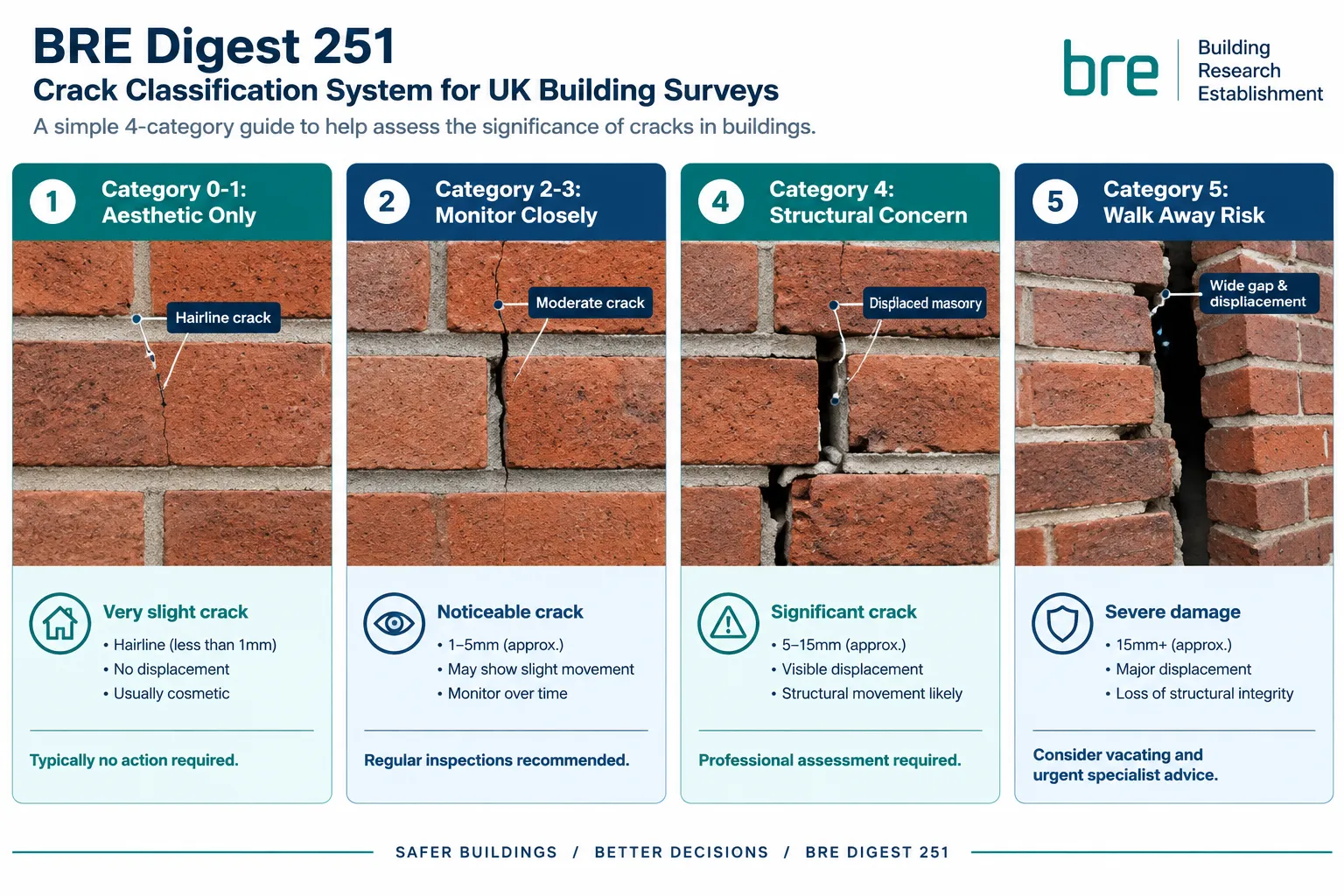
The BRE Digest 251 Crack Classification
UK surveyors use the Building Research Establishment's Digest 251 as the standard reference for categorising crack severity. This framework gives buyers an objective language for discussing findings with surveyors, structural engineers, and vendors.
| Category | Crack Width | Description | Typical Action |
|---|---|---|---|
| 0 | Less than 0.1mm | Hairline, invisible without magnification | Cosmetic only – no action |
| 1 | Up to ~1mm | Fine cracks, easily filled | Decorative repair |
| 2 | Up to ~5mm | Slight – visible externally | Monitor; specialist opinion advisable |
| 3 | 5-15mm | Moderate – may need repointing | Structural engineer recommended |
| 4 | 15-25mm | Severe – brickwork distorted | Structural engineer essential |
| 5 | Over 25mm | Very severe – stability affected | Strong case for walking away |
Categories 0 and 1 are purely aesthetic. Category 2 warrants monitoring but rarely threatens structural integrity. Categories 3 and above demand a specialist structural engineer's report before any decision is made. Categories 4 and 5 represent serious risk, particularly where movement is confirmed as active rather than historic.
The Main Structural Defects That Trigger Survey Alerts
Understanding what causes structural movement helps buyers assess risk more accurately. The four most significant causes in UK residential property are subsidence, heave, failed lintels, and building safety defects in flatted developments.
Subsidence
Subsidence occurs when the ground beneath a building's foundations loses load-bearing capacity, causing the structure to sink unevenly. The most common causes in the UK are:
- Clay shrinkage during dry summers, particularly in London and the South East
- Tree root activity drawing moisture from clay soils
- Leaking drains washing away fine particles beneath foundations
- Mining legacy in parts of the Midlands, Yorkshire, and South Wales
The key question with subsidence is whether it is historic (movement has stopped and been remediated) or active (movement is ongoing). Historic subsidence that has been properly underpinned and is supported by a structural engineer's sign-off and an insurance history is often manageable. Active subsidence is a different matter entirely.
"A property with a documented, resolved subsidence history is not automatically unsellable – but a property with active, unmonitored movement is a financial liability until proven otherwise."
Heave
Heave is the upward movement of foundations, typically caused by clay soils expanding as they absorb moisture after a period of drought or following tree removal. It is less common than subsidence but can be equally damaging. Heave is particularly difficult to remediate because conventional underpinning can make the problem worse by adding weight to already-expanding soil.
Failed Lintels
Lintels span openings in walls – doors, windows, and garage entrances – and carry the load of the structure above. When a lintel fails, the masonry above can crack, bow, or collapse inward. Signs include diagonal cracking from the corners of window and door openings, stepped cracking in brickwork, and visible bowing of the brickwork course above an opening.
Failed lintels are common in properties built between roughly 1920 and 1970, where mild steel lintels were used without adequate corrosion protection. Replacement is a defined, costed repair – typically between £300 and £1,500 per lintel depending on span and access – making this a renegotiation issue rather than a walk-away trigger in most cases [3].
Building Safety Defects in Flats
For buyers of flats in buildings between 11 and 18 metres in height, building safety defects represent a distinct and serious category of risk. Government technical analysis from 2026 estimates that between 4.7% and 9.4% of buildings in this height band require remediation for safety defects including cladding, fire-stopping, and related structural issues [43].
These defects are particularly problematic because lenders frequently impose conditions or decline to lend on affected properties, making them difficult or impossible to sell until remediation is complete [27]. Before proceeding with any flat purchase, buyers should obtain a copy of the building's EWS1 form (External Wall System assessment) and confirm whether a remediation plan is in place, who bears the cost, and what the timeline looks like.
Walk Away vs Renegotiate: A Decision Framework
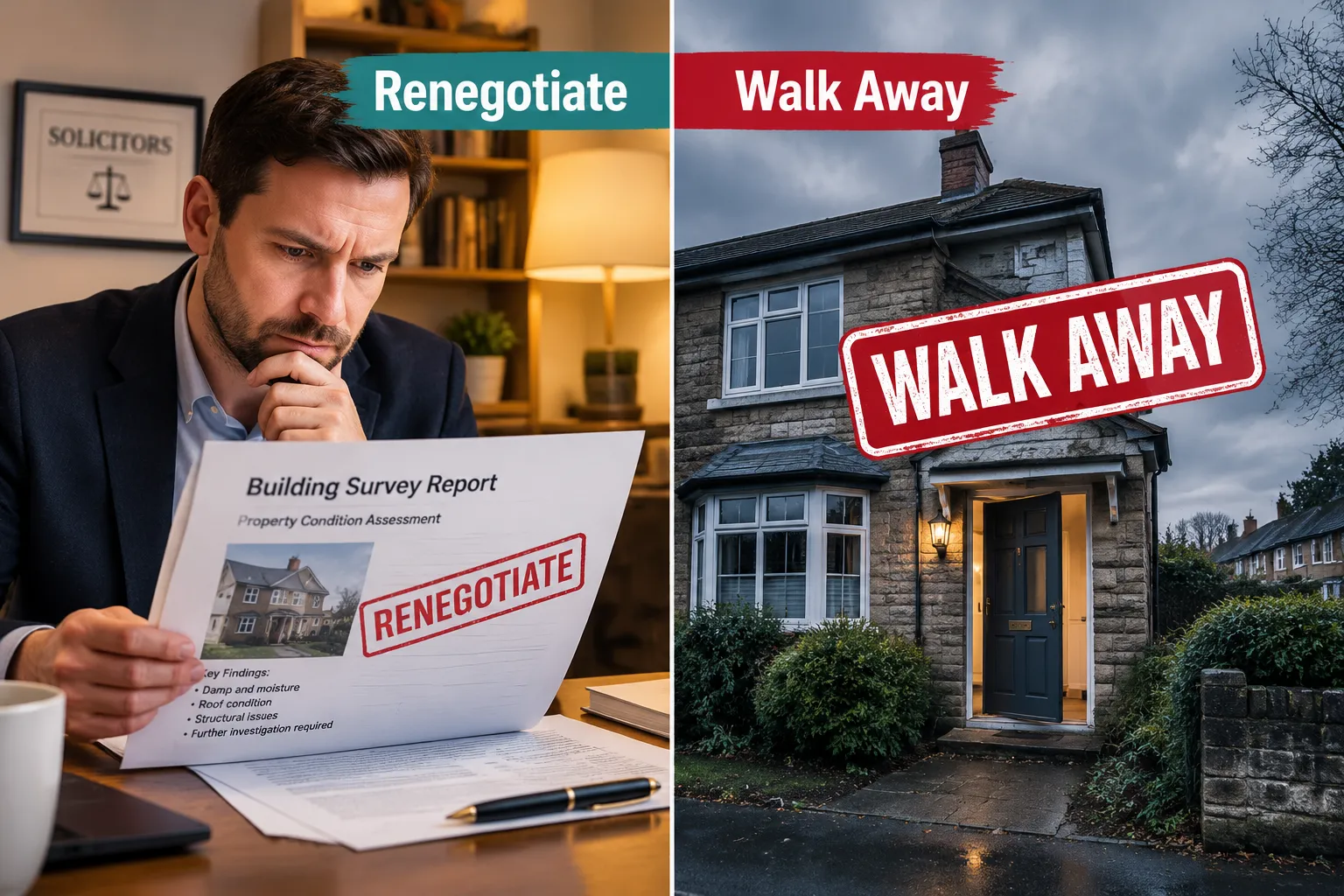
The central question in structural defects in UK building surveys is not simply "is there a defect?" but "what is the defect's nature, cost, and impact on lendability?" The following framework structures that decision.
When to Walk Away
Walking away is the appropriate response when one or more of the following conditions apply:
- Active structural movement – A structural engineer confirms that movement is ongoing and the cause has not been identified or addressed
- Category 4 or 5 cracking – Particularly where accompanied by distorted door frames, sloping floors, or visible wall separation
- Dry rot with extensive spread – Dry rot (Serpula lacrymans) can spread through masonry and requires complete removal of affected timber plus treatment of surrounding structure; costs can run to tens of thousands of pounds
- Building safety defects with no remediation plan – Where an EWS1 is failed, no developer or freeholder has accepted liability, and no government scheme applies
- Lender refusal – Where the survey triggers a mortgage valuation condition that cannot be satisfied or causes the lender to withdraw the offer entirely
- Vendor refuses any renegotiation – Where the defect is material, the cost is significant, and the vendor will not reduce the price or fund repairs
Quick Move Now's Q2 2026 data shows that 27% of failed sales collapsed specifically at the survey or valuation stage [6], confirming that walking away is a common and sometimes necessary outcome.
When to Renegotiate Hard
Renegotiation is the right approach when the defect is:
- Defined and costed – A structural engineer or specialist contractor can provide a clear repair specification and a fixed price
- Non-progressive – Movement is historic and stable, confirmed by monitoring or engineering sign-off
- Lender-acceptable – The mortgage lender's valuer is satisfied that the property provides adequate security once the defect is disclosed
- Proportionate to the property's value – The repair cost is a meaningful but not catastrophic percentage of the purchase price
The renegotiation should be grounded in evidence, not emotion. Obtain at least two independent repair quotes before approaching the vendor. Present the quotes alongside the surveyor's report section that identifies the defect. A price reduction equivalent to the midpoint of the repair range is a reasonable opening position [5].
Renegotiation tactics that work:
- Request a reduction equivalent to 100-110% of the median repair quote to account for disruption and contingency
- Ask the vendor to carry out the repairs before exchange, with a retention held by solicitors pending sign-off
- Agree a retention in the completion funds held by solicitors until repair evidence is provided
- Use the survey findings to reopen the entire price conversation if the original offer was made without survey information
A 2026 analysis by ValuQ drawing on Quick Move Now data found that survey or condition problems accounted for 37.5% of failed sales in early 2026 [34], which means vendors are well aware that a poor survey result threatens their sale. That awareness is leverage.
Commissioning Further Reports: The Middle Path
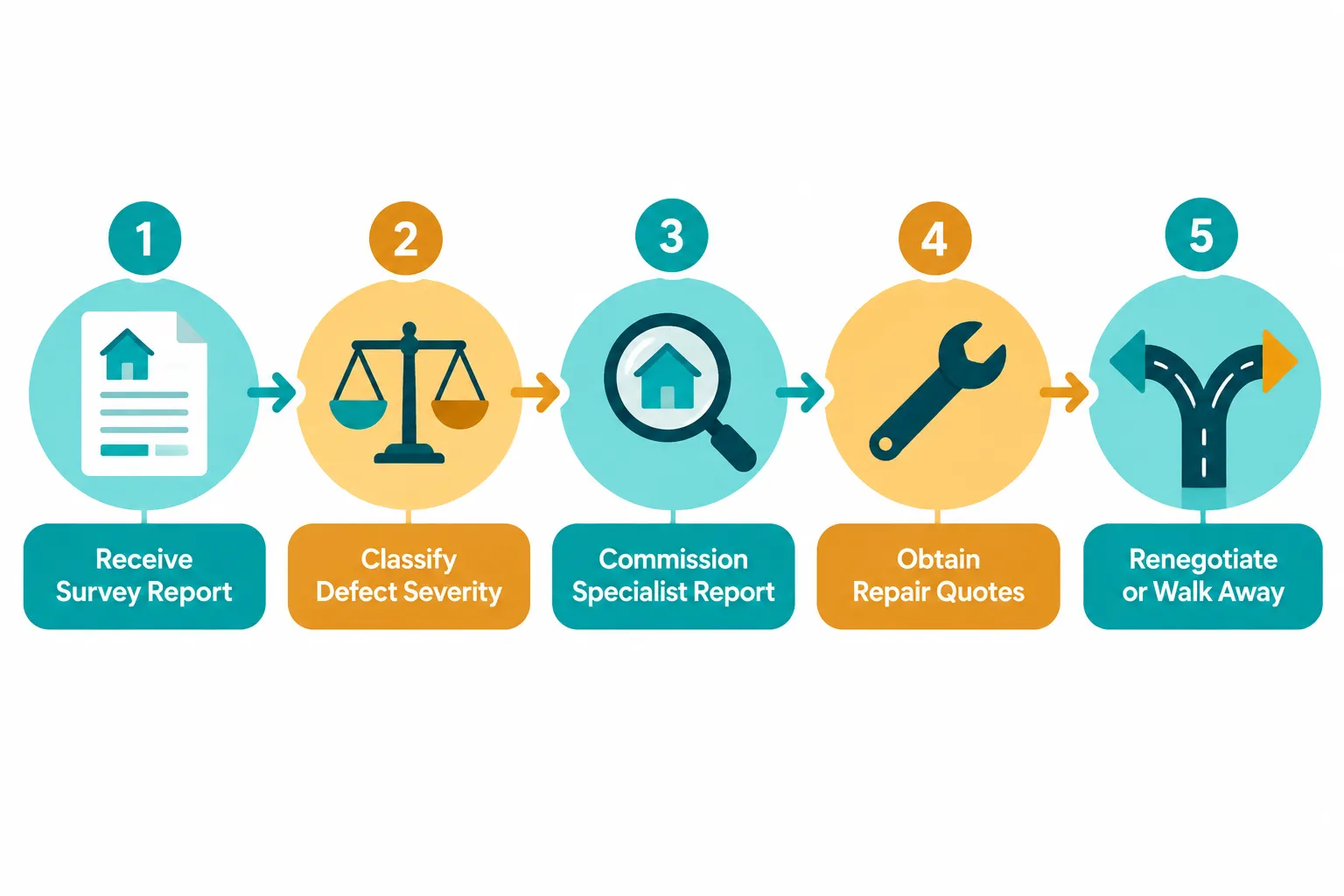
Between walking away immediately and proceeding with a renegotiation, there is a third option that is frequently underused: commissioning a specialist report before making any decision.
A RICS Level 3 Building Survey (formerly the Full Structural Survey) will identify defects but will not always quantify repair costs or confirm whether movement is active or historic. For that, buyers need specialist input.
When to commission a specialist structural engineer's report:
- Any crack rated Category 2 or above by the surveyor
- Any reference to subsidence, heave, or foundation movement in the survey
- Any evidence of significant differential settlement (one part of the building moving differently from another)
- Any property where the surveyor has flagged the need for further investigation
When to commission a timber and damp specialist:
- Any reference to dry rot, wet rot, or significant damp penetration
- Any property with a cellar or basement
- Any older property where the surveyor has flagged timbers as inaccessible
When to commission a drainage survey (CCTV):
- Any property with large trees close to the house
- Any property where the surveyor has noted cracking consistent with drainage-related subsidence
- Any property where the drains are old, clay-jointed, or in a poor state of repair
The cost of specialist reports – typically £300 to £800 each – is modest relative to the risk of proceeding without adequate information. These reports also serve a dual purpose: they either confirm the defect is manageable (enabling a confident renegotiation) or confirm it is serious (providing clear grounds for withdrawal) [9].
Using Defects to Renegotiate Safely in a Flat or Falling Market
In a market where prices are flat or declining, structural defects carry additional weight as negotiating tools. Vendors in a slow market face a genuine risk that a collapsed sale will result in a lower offer from the next buyer, or no offer at all. That dynamic shifts leverage toward the buyer [9].
The key principle is to anchor the renegotiation to documented evidence rather than subjective concern. A vendor is far more likely to accept a price reduction supported by two contractor quotes and a structural engineer's letter than one based on a buyer's anxiety about a survey report.
Practical Checklist: After Receiving a Survey with Structural Concerns
Before making any decision following a survey that flags structural defects, work through the following steps:
- Read the full survey report carefully, noting the surveyor's condition ratings (1, 2, or 3 in RICS terminology) for each element
- Identify which findings relate to structural integrity versus cosmetic or maintenance issues
- Contact the surveyor directly to clarify any findings that are ambiguous or described in technical language
- Obtain specialist reports for any Category 2+ cracks, any movement references, or any timber/damp issues flagged as significant
- Obtain at least two repair quotes from qualified contractors for each identified defect
- Instruct the solicitor to raise enquiries with the vendor about the history of any defects, previous insurance claims, and any remediation work carried out
- Check whether the property is in a known subsidence risk area (many insurers and local authority searches will flag this)
- Confirm with the mortgage lender whether the survey findings affect the valuation or the lending conditions
Conclusion
Structural defects in UK building surveys are not inherently deal-breakers, but they demand a disciplined, evidence-based response. The BRE Digest 251 classification system provides an objective starting point: Categories 0-2 are almost always renegotiation territory, while Categories 4-5 and active movement are genuine grounds for withdrawal. Between those poles, specialist reports are the tool that converts uncertainty into actionable information.
Actionable next steps for buyers facing a challenging survey:
- Do not make any decision based on the survey report alone – commission specialist reports where the surveyor has flagged the need
- Obtain written repair quotes before approaching the vendor
- Use the documented cost of defects as the basis for a price reduction request, not as an emotional argument
- Confirm lendability with the mortgage lender before investing further in legal and specialist fees
- If the vendor refuses any renegotiation on a material defect, treat that refusal as important information about the transaction and the vendor's awareness of the property's condition
- Remember that walking away, while costly in terms of survey and legal fees already spent, is always cheaper than completing on a property with unresolved structural problems
The data confirms that surveys kill or reshape a significant proportion of UK property transactions every year [6]. Buyers who understand the framework for evaluating structural findings are better positioned to make the right call – whether that means walking away cleanly or securing a meaningfully better price.
References
[1] Most Common House Survey Problems – surveyorlocal.co.uk
[2] Buying Selling Homes Research – assets.publishing.service.gov.uk
[3] Common Survey Problems South Coast 2025 – bartleywest.co.uk
[4] English Housing Survey 2024 To 2025 Perceptions And Impacts Of Housing Quality – gov.uk
[5] Renegotiating After Homebuyer Survey – ashallsurveyors.co.uk
[6] What Percentage Of House Sales Fall Through – propertyrescue.co.uk
[9] Building Surveys In A Flat Or Falling Market How Buyers Can Use Defects To Renegotiate Safely – princesurveyors.co.uk