Over 2.3 million privately rented homes in England fail to meet the Decent Homes Standard — and from 2026, landlords who ignore excess cold, fire, and electrical hazards face a legal landscape that will directly erode the value of their assets. Valuation adjustments for excess cold and fire hazards in PRS: Awaab's Law 2026 extensions and surveyor evidence standards are no longer abstract compliance concerns. They are live financial variables that surveyors, landlords, and lenders must account for in every assessment.
This article explains precisely what Phase 2 of Awaab's Law means for private rental sector (PRS) valuations, how surveyors must document hazard evidence to meet emerging legal standards, and what landlords and investors need to do now to protect both tenants and property values.
Key Takeaways 📌
- Phase 2 of Awaab's Law is expected to extend compliance requirements in 2026 to cover excess cold, fire, electrical hazards, falls, and structural collapse — moving well beyond Phase 1's damp and mould focus [1][2].
- Valuation adjustments for hazardous PRS properties are becoming a formal part of RICS-compliant assessments, with measurable percentage discounts applied to market value.
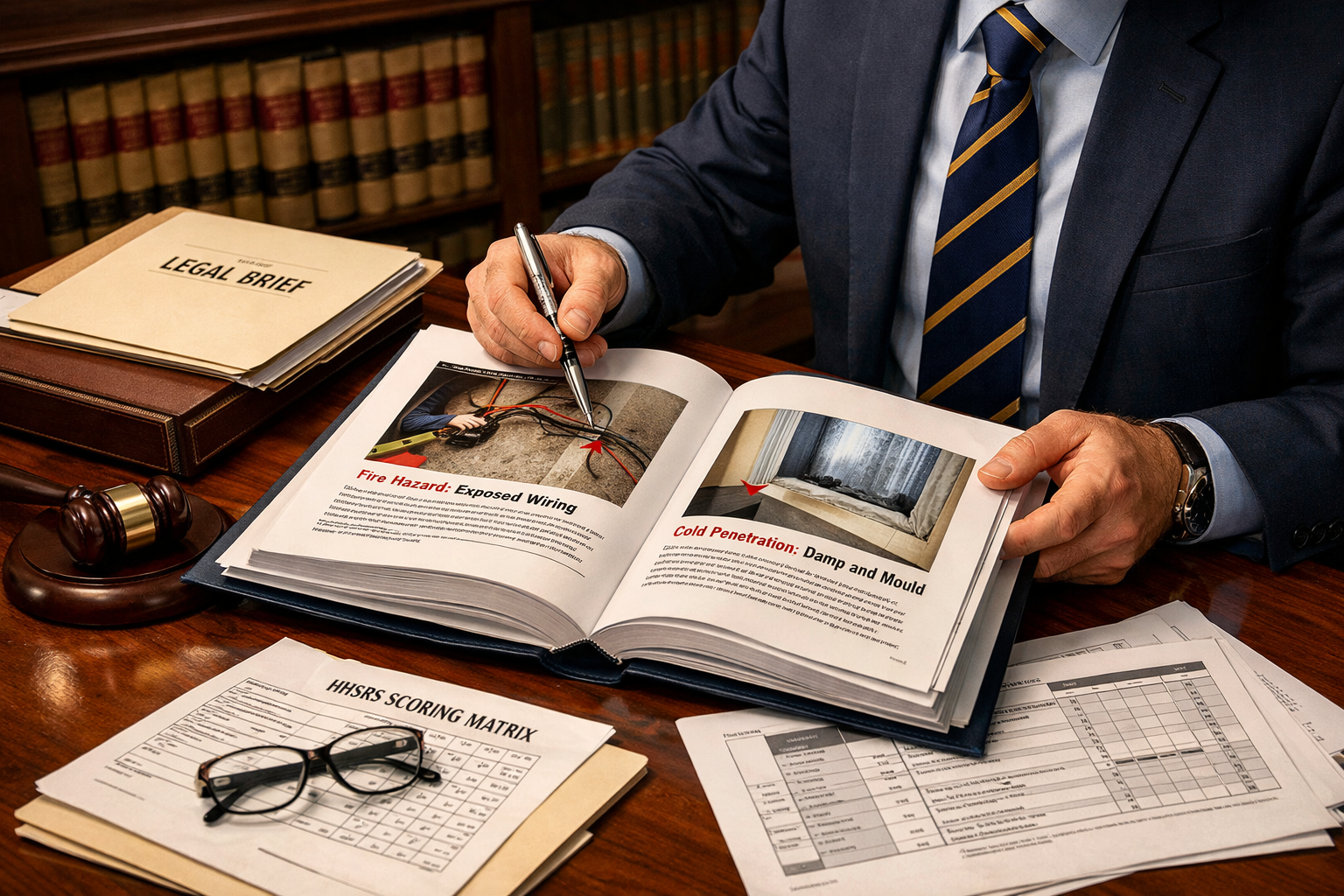
- Surveyors must now produce robust, evidence-based reports that can withstand tribunal and court scrutiny, using HHSRS scoring and thermal/photographic documentation.
- Non-compliance can trigger enforcement orders, tenant compensation, legal cost liability, and loss of rental income [2].
- Expert witness preparation using RICS frameworks is increasingly critical as PRS disputes over hazard-related rent reductions escalate.
What Awaab's Law Phase 2 Means for the Private Rental Sector in 2026
From Social Housing to the PRS: The Regulatory Shift
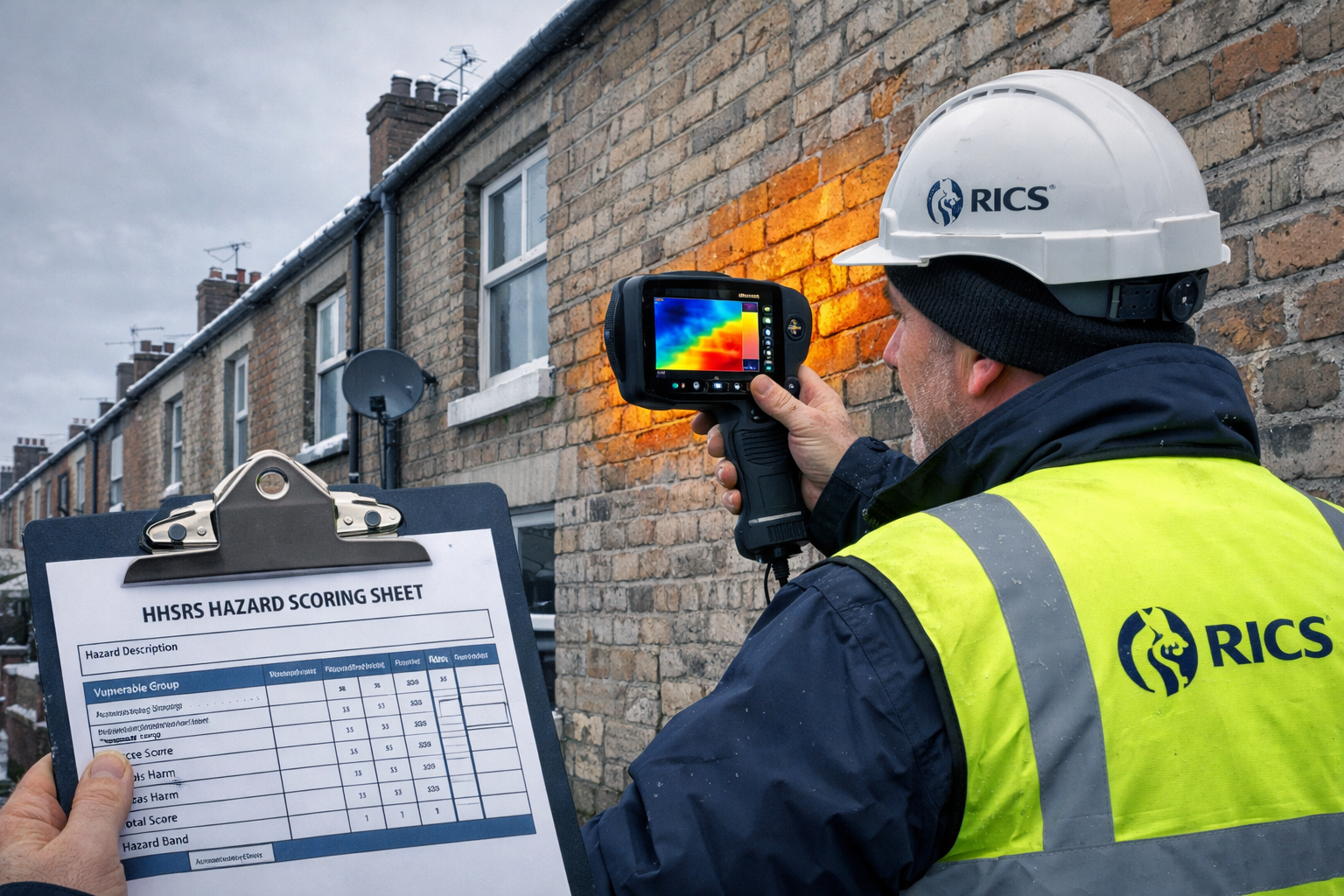
Awaab's Law — named after two-year-old Awaab Ishak, who died in 2020 from respiratory illness caused by chronic mould exposure in social housing — entered Phase 1 on 27 October 2025. Phase 1 applies to social housing and focuses on damp and mould remediation timelines [1][3].
Phase 2, which the Ministry of Housing, Communities and Local Government (MHCLG) intends to introduce in 2026, is expected to dramatically widen the scope of hazard categories covered [2]. The anticipated extension includes:
| Hazard Category | Phase 1 | Phase 2 (Expected 2026) |
|---|---|---|
| Damp and mould | ✅ Covered | ✅ Continued |
| Excess cold | ❌ Not covered | ✅ Expected |
| Excess heat | ❌ Not covered | ✅ Expected |
| Fire hazards | ❌ Not covered | ✅ Expected |
| Electrical hazards | ❌ Not covered | ✅ Expected |
| Falls on stairs/surfaces | ❌ Not covered | ✅ Expected |
| Structural collapse | ❌ Not covered | ✅ Expected |
| Domestic hygiene | ❌ Not covered | ✅ Expected |
⚠️ Important note: As of April 2026, MHCLG has signalled Phase 2 intent but has not confirmed a specific implementation date. Landlords and surveyors should treat 2026 as the active preparation window [2].
Why the PRS Is Particularly Exposed
While Phase 1 targets social landlords, the regulatory direction of travel is unmistakable: the PRS will follow. Several local authorities already use the Housing Health and Safety Rating System (HHSRS) to prosecute PRS landlords for excess cold and fire hazards under the Housing Act 2004. Phase 2 will formalise timelines and remediation duties that currently exist only as enforcement discretion.
For PRS landlords, this creates a two-pronged risk:
- Legal liability — failure to remediate within statutory timeframes
- Asset value erosion — hazardous properties attract formal valuation discounts
Understanding valuation costs and how assessments are structured is therefore essential groundwork before any hazard-related valuation is commissioned.
Valuation Adjustments for Excess Cold and Fire Hazards in PRS: How Surveyors Calculate the Impact
The HHSRS Framework as a Valuation Input
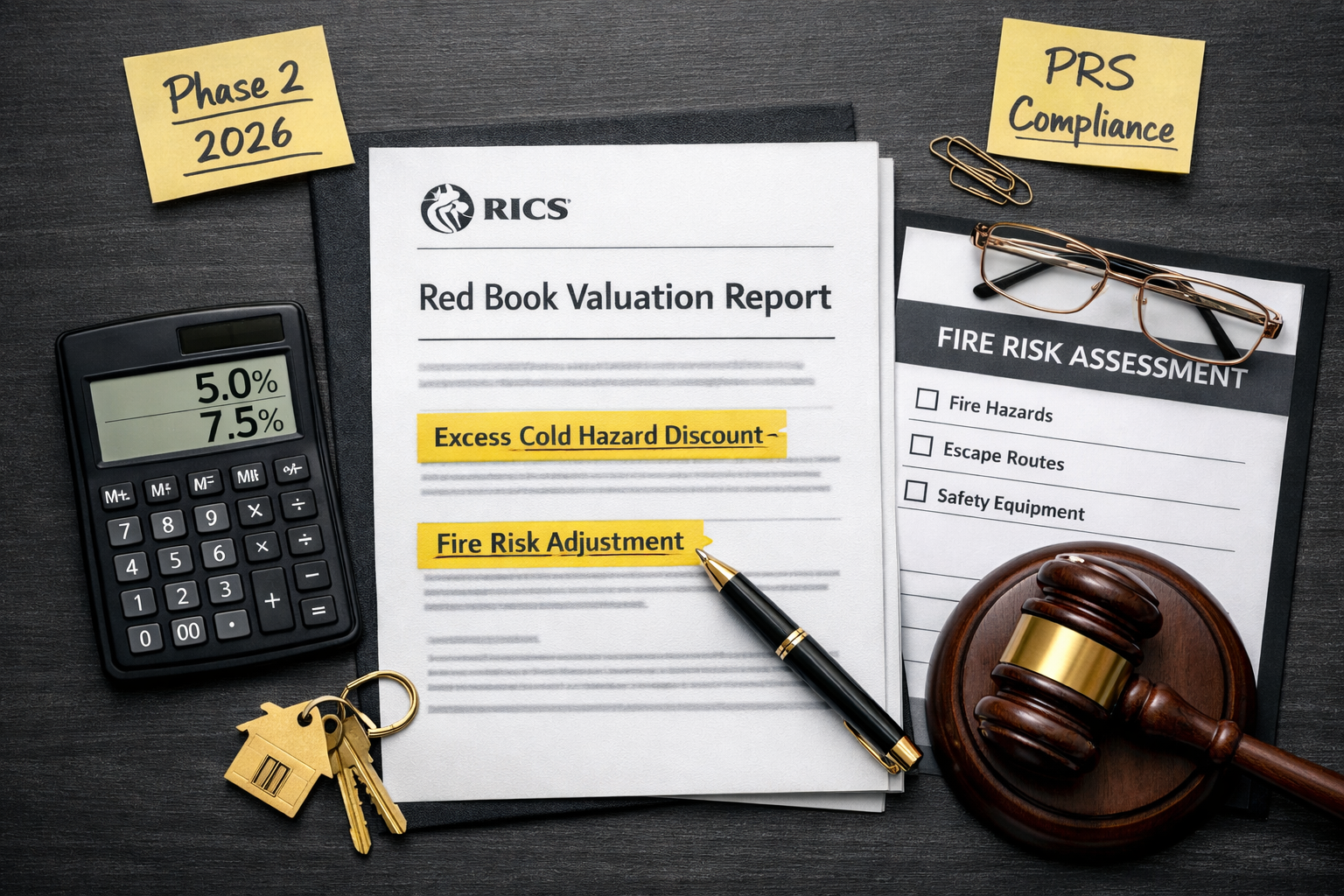
The HHSRS assigns a numerical score to each hazard based on likelihood of harm and severity of outcome. Category 1 hazards (score above 1,000) trigger mandatory enforcement action. Category 2 hazards (below 1,000) allow discretionary intervention.
For valuation purposes, a Category 1 excess cold or fire hazard does not simply flag a maintenance issue — it signals a legally impaired asset. RICS-registered valuers must reflect this in their Red Book assessments.
How excess cold hazards affect value:
Excess cold is defined under HHSRS as indoor temperatures below 16°C (or 18°C for vulnerable occupants) caused by inadequate heating systems, poor insulation, or cold bridging. Properties with this hazard typically see:
- 5–15% market value discount depending on severity and remediation cost
- Reduced rental yield due to tenant turnover and void periods
- Lender caution — some mortgage products are withheld pending remediation
How fire hazards affect value:
Fire hazards under HHSRS include inadequate means of escape, missing smoke detection, faulty electrical installations, and unsafe cooking facilities. A Category 1 fire hazard can result in:
- Prohibition orders making the property unlettable
- 10–25% valuation discount where a prohibition order is in force or imminent
- Insurance complications affecting reinstatement valuation accuracy
For a detailed understanding of how insurance reinstatement valuations interact with hazard-related property conditions, specialist advice is strongly recommended.
Adjusting the Comparable Evidence Base
RICS Red Book (RICS Valuation — Global Standards) requires valuers to use market evidence adjusted for material differences. When a subject property carries a Category 1 excess cold or fire hazard, the valuer must:
- Identify comparable sales of similarly affected properties (if available)
- Apply a negative adjustment where comparables are hazard-free
- Estimate remediation costs and deduct from gross value
- Consider holding costs during the remediation period
For landlords seeking a RICS Red Book valuation on a Manchester property, it is critical to disclose all known hazards upfront. Failure to do so can invalidate the valuation and expose the landlord to professional negligence claims.
Awaab's Law Enforcement Penalties as a Valuation Variable
Non-compliance with Awaab's Law remediation timelines introduces additional financial liabilities that a competent valuer must factor in [2]:
- 🔴 Enforcement orders — legal costs and remediation obligations
- 🔴 Tenant compensation — awards can run to thousands of pounds
- 🔴 Rent repayment orders — up to 12 months' rent returned to tenants
- 🔴 Uninhabitable designation — complete loss of rental income
These liabilities are contingent but material. Under RICS standards, a valuer aware of non-compliance exposure must reflect this in the valuation, typically through a special assumption or an explicit deduction.
Surveyor Evidence Standards for Hazard Assessment and Expert Witness Preparation
What "Robust Evidence" Means in 2026
As Awaab's Law disputes begin reaching tribunals and courts — particularly rent repayment order applications at the First-tier Tribunal (Property Chamber) — the quality of surveyor evidence is under unprecedented scrutiny. A well-prepared expert witness report can be the difference between a landlord retaining rental income and facing a five-figure compensation order.
The core components of a defensible hazard assessment report include:
✅ HHSRS scoring methodology — documented step-by-step, not just a conclusion
✅ Thermal imaging evidence — for excess cold, infrared photography showing cold bridging and U-value deficiencies
✅ Photographic schedule — timestamped, geotagged images of every hazard
✅ Remediation cost estimates — from qualified contractors, not desk estimates
✅ Tenancy history — linking hazard exposure to tenant complaints and medical evidence
✅ Compliance timeline analysis — showing when the landlord knew and what action was taken
RICS Professional Standards for PRS Hazard Surveys
RICS members conducting hazard assessments for PRS properties in 2026 must align with:
- RICS Home Survey Standard (2019, updated guidance 2024) — setting minimum inspection requirements
- RICS Valuation — Global Standards (Red Book Global 2022, updated 2024) — governing how hazards are reflected in value
- RICS Professional Statement: Surveying Safely — governing site inspection protocols
For properties where fire or cold hazards are suspected, a building survey rather than a basic homebuyer report is the appropriate instruction level. A Level 3 building survey provides the depth of investigation required to identify hidden cold bridging, concealed electrical deficiencies, and inadequate means of escape.
Landlords and buyers uncertain about which level of assessment is appropriate can use a guide to comparing different types of survey to make an informed decision before instructing a surveyor.
Expert Witness Preparation: A Practical Framework 🎯
When a PRS dispute escalates to tribunal level, the surveyor transitions from fact witness to expert witness. This requires a fundamentally different approach to report preparation.
Step 1: Establish independence
The expert must be able to demonstrate that their opinion is impartial and not shaped by the instructing party's preferred outcome. RICS guidance and Civil Procedure Rules Part 35 both require this.
Step 2: Apply a structured HHSRS assessment
Every hazard must be scored using the published HHSRS Operating Guidance (DLUHC, 2006, as updated). The likelihood and harm outcome scores must be documented with reference to the specific property condition, not generic assumptions.
Step 3: Quantify the valuation impact
The expert must translate the HHSRS finding into a financial figure — either as a remediation cost deduction, a rental value impairment, or a market value adjustment. This requires cross-disciplinary competence in both building pathology and property valuation.
Step 4: Address Phase 2 compliance obligations
From 2026 onwards, expert witnesses will increasingly be asked whether a property would comply with anticipated Phase 2 Awaab's Law requirements [1]. Surveyors who cannot answer this question authoritatively will find their evidence challenged.
Step 5: Prepare for cross-examination
Tribunal panels and judges will test the methodology. Every assumption must be documented, every measurement recorded, and every comparable cited with source data.
💡 Pull quote: "A surveyor who cannot explain their HHSRS scoring methodology under cross-examination is not an expert witness — they are a liability to their instructing party."
Specific Defect Surveys and Their Role in Hazard Documentation
Where a single hazard — such as a defective heating system causing excess cold, or a compromised fire door installation — is the subject of dispute, a specific defect survey provides a focused, cost-effective assessment that can be directly deployed as expert evidence.
This type of report concentrates entirely on the identified defect, its cause, its severity under HHSRS, and the remediation required. It is particularly useful in Awaab's Law compliance disputes where the hazard category is agreed but the severity and landlord liability are contested.
Practical Steps for Landlords and Investors in 2026
The convergence of Awaab's Law Phase 2 expectations, rising tribunal activity, and tightening mortgage lender standards means that proactive hazard assessment is now a financial strategy, not just a compliance obligation.
Recommended actions for PRS landlords in 2026:
- 🔍 Commission a HHSRS-based property assessment — identify Category 1 and 2 hazards before tenants or councils do
- 🌡️ Install thermal monitoring — continuous temperature logging provides defensible evidence of heating adequacy
- 🔥 Conduct a formal fire risk assessment — required for HMOs, strongly advisable for all PRS properties
- 📋 Maintain a remediation log — document every repair request and response with dates and costs
- 💷 Obtain a current RICS valuation — understand the current market value impact of any known hazards
- ⚖️ Instruct a surveyor experienced in expert witness work — before a dispute arises, not after
For landlords with portfolios across multiple regions, understanding valuation reports specific to your local market ensures that regional price variations and local enforcement patterns are properly reflected in any assessment.
Conclusion: Act Now Before Phase 2 Makes Compliance Mandatory
Valuation adjustments for excess cold and fire hazards in PRS: Awaab's Law 2026 extensions and surveyor evidence standards represent a structural shift in how rental property is assessed, valued, and legally managed. The regulatory direction is clear: hazardous rental properties will face increasing financial penalties, and the evidence standards required to defend or prosecute those cases are rising sharply.
For landlords, the window to address excess cold and fire hazards proactively — before Phase 2 enforcement timelines are confirmed — is open now. For surveyors, the obligation to produce HHSRS-compliant, tribunal-ready evidence has never been more demanding.
Actionable next steps:
- ✅ Instruct a RICS chartered building surveyor to conduct a full HHSRS assessment of your PRS portfolio
- ✅ Obtain a current Red Book valuation that reflects any known hazard discounts
- ✅ Ensure all fire risk assessments are current and documented
- ✅ Review heating system performance against HHSRS excess cold thresholds before winter 2026
- ✅ If a dispute is emerging, instruct a surveyor with formal expert witness experience immediately
The cost of a professional survey today is a fraction of the cost of a rent repayment order, enforcement action, or contested tribunal tomorrow.
References
[1] Awaabs Law Phase 2 Is Coming What Social Landlords Need To Know About Additional Hazard Compliance In 2026 – https://www.mobysoft.com/resources/blogs/awaabs-law-phase-2-is-coming-what-social-landlords-need-to-know-about-additional-hazard-compliance-in-2026/
[2] Awaabs Law Comes Into Force What Does It Mean For Construction – https://www.trowers.com/insights/2025/november/awaabs-law-comes-into-force-what-does-it-mean-for-construction
[3] Awaabs Law Technical Compliance Hvac Ventilation – https://www.arm-environments.com/resources/awaabs-law-technical-compliance-hvac-ventilation