{"cover":"Professional landscape format (1536×1024) hero image with bold text overlay: 'Whole Life Carbon Assessment in Building Surveys: RICS PAS 2080:2023' in extra large 70pt white bold sans-serif font with dark semi-transparent background panel, centered upper third. Background shows a modern UK commercial building exterior with green sustainability overlays, carbon lifecycle diagram elements, and RICS branding tones. Color scheme: deep forest green, charcoal grey, white accents. Editorial magazine quality, high contrast, authoritative professional aesthetic.","content":["Landscape format (1536×1024) infographic-style illustration showing four lifecycle stages of a building carbon assessment: upfront construction (A), operational in-use phase (B), end-of-life demolition (C), and beyond-boundary benefits (D), each represented as a circular node connected by arrows in a horizontal flow diagram. Color-coded green-to-grey gradient per stage, with carbon CO2 molecule icons, building silhouettes, and data annotation labels. Clean white background, professional surveying context, RICS standard visual language.","Landscape format (1536×1024) showing a professional RICS-accredited chartered building surveyor in hard hat and hi-vis vest using a tablet displaying a whole life carbon assessment dashboard on a UK construction site, with scaffolding and partially renovated brick building in background. Screen shows PAS 2080:2023 compliance checklist, carbon module labels (A0, B8, D1, D2), and reporting charts. Warm natural daylight, realistic photographic quality, depth of field focus on the tablet screen and surveyor's hands.","Landscape format (1536×1024) depicting a global coalition meeting scene with diverse professionals around a modern conference table, large screen displaying 'CLEAR Initiative 2026 – RICS Global Carbon Reporting Framework' with world map and carbon benchmarking data visualizations. Foreground shows printed WLCA reports, PAS 2080 standard documents, and laptops with circular economy diagrams. Professional boardroom lighting, international collaboration atmosphere, clean corporate aesthetic with green sustainability accent colors."]
The built environment accounts for approximately 39% of global carbon emissions — and yet, until recently, most building surveys captured only a fraction of a property's true carbon story. The convergence of the RICS Whole Life Carbon Assessment (WLCA) Professional Standard 2nd Edition and PAS 2080:2023 has fundamentally changed what surveyors are expected to measure, report, and act upon. For professionals operating in 2026, understanding Whole Life Carbon Assessment in Building Surveys: RICS PAS 2080:2023 Standards and Practical Application for Surveyors is no longer optional — it is a professional and regulatory imperative [1].
This guide breaks down the standards, the lifecycle stages, the new reporting modules, and the practical steps surveyors need to take to embed carbon assessment into everyday practice.
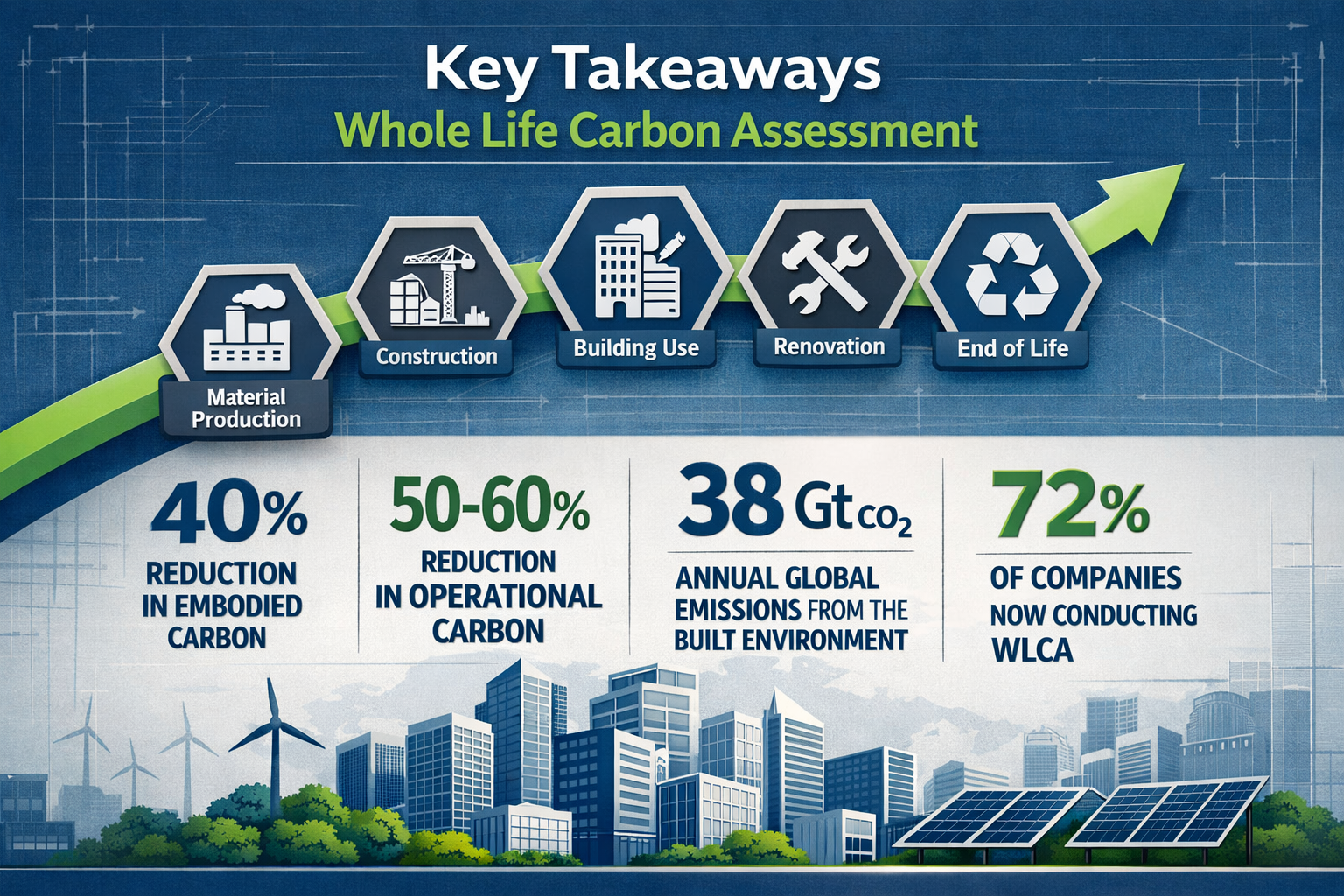
Key Takeaways
- 📋 The RICS WLCA 2nd Edition came into effect 1 July 2024, expanding scope to all buildings and infrastructure across the full lifecycle [4].
- 🌍 PAS 2080:2023 and RICS WLCA 2nd Edition are now aligned, creating a consistent framework for carbon measurement in the UK and internationally [1].
- 🏗️ Four core lifecycle stages — A (upfront), B (in-use), C (end-of-life), D (beyond boundary) — form the backbone of every assessment [3].
- 🚀 New reporting modules including A0, B8, D1, and D2 give surveyors greater precision in capturing carbon data [3].
- 🌐 The CLEAR initiative, launched in April 2026, signals a global push toward harmonised whole-life carbon reporting across the built environment [2].
Understanding the Framework: RICS WLCA 2nd Edition and PAS 2080:2023
A Brief History of RICS Whole Life Carbon Assessment
The RICS first introduced its Whole Life Carbon Assessment standard in 2017, recognising that operational energy efficiency alone could not deliver the carbon reductions the sector needed. The standard was updated in November 2023 and the 2nd Edition formally came into effect on 1 July 2024 [3].
This evolution was not incremental — it was transformational. The 2nd Edition expanded the standard's application from buildings alone to all built assets and infrastructure projects, aligning with International Cost Management Standards (ICMS) 3rd Edition and the Built Environment Carbon Database (BECD) [3].
What PAS 2080:2023 Adds to the Picture
PAS 2080 is BSI's standard for managing infrastructure carbon. Its 2023 revision brought it into closer alignment with lifecycle thinking and circular economy principles. When read alongside the RICS WLCA 2nd Edition, the two standards create unprecedented clarity and consistency in how carbon is assessed, reported, and benchmarked across the built environment [1].
💬 "The alignment of RICS WLCA 2nd Edition with PAS 2080:2023 creates a shared language for carbon — one that surveyors, clients, and policymakers can all work from." [1]
For RICS chartered building surveyors, this alignment means that carbon assessment is no longer a specialist add-on. It is embedded in the professional standard of care.
The Four Core Lifecycle Stages Every Surveyor Must Know
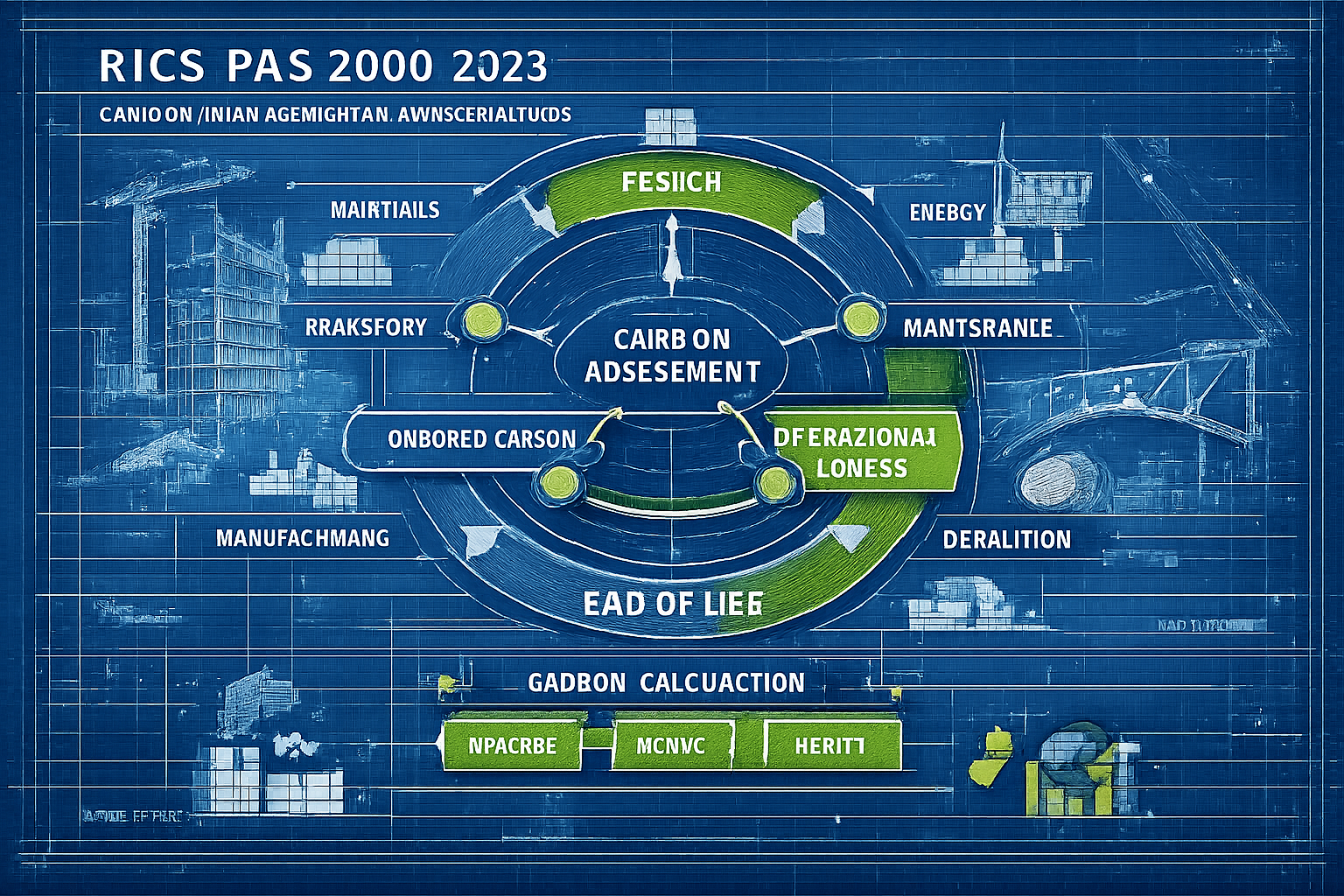
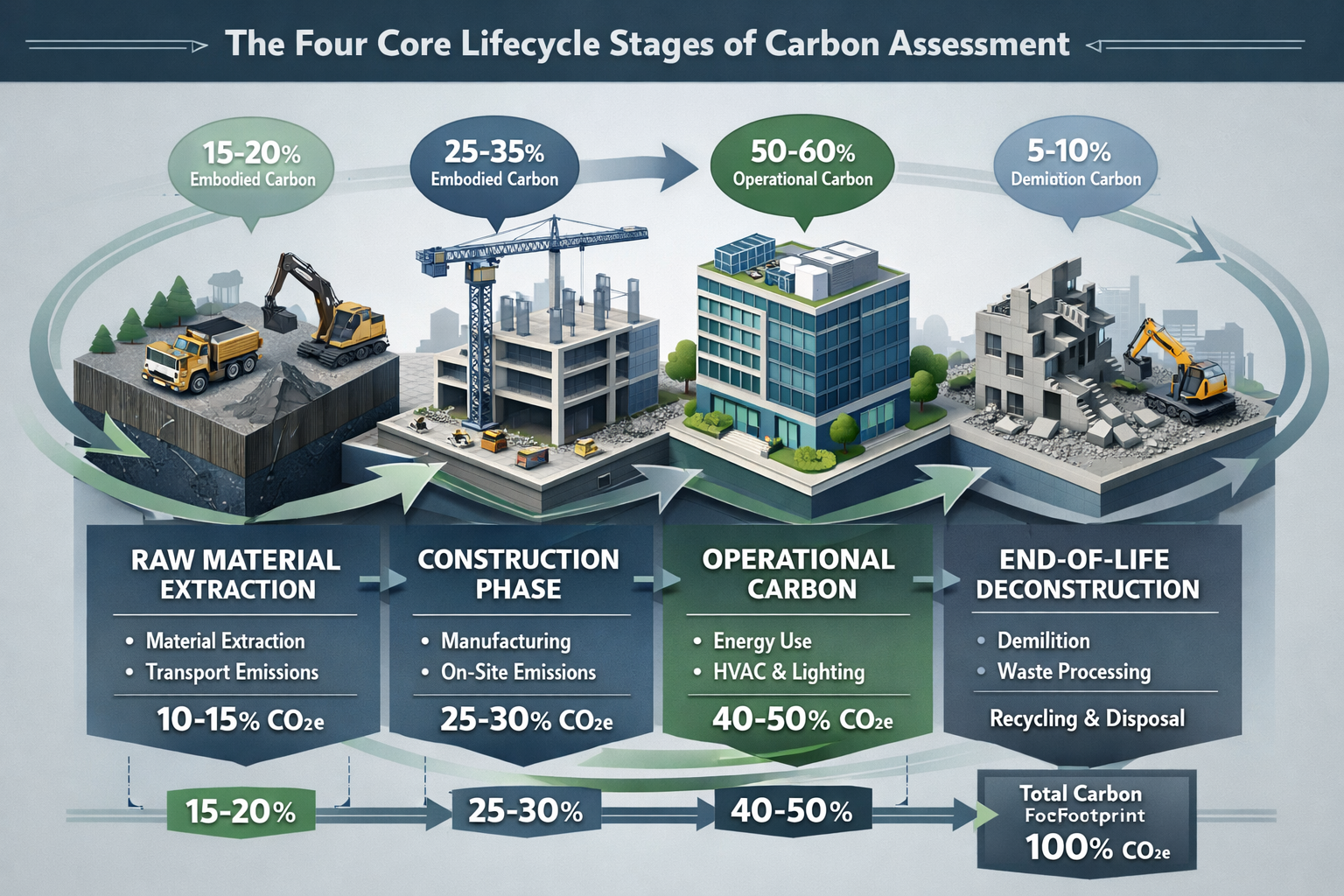
Whole Life Carbon Assessment in Building Surveys: RICS PAS 2080:2023 Standards and Practical Application for Surveyors is built around a four-stage lifecycle model. Each stage captures a distinct phase of a building's carbon journey [3].
| Stage | Name | What It Covers |
|---|---|---|
| A | Upfront Carbon | Construction activities, materials, manufacturing, transport to site |
| B | In-Use Carbon | Operational energy, maintenance, replacement of components |
| C | End-of-Life Carbon | Deconstruction, demolition, waste processing, disposal |
| D | Beyond Boundary | Benefits and loads outside the system boundary (e.g., material reuse) |
Stage A: Upfront Carbon 🏗️
This is the carbon emitted before a building is even occupied. It includes:
- Raw material extraction and processing
- Manufacturing of building products
- Transport to site
- Construction and installation activities
The new A0 module (introduced in the 2nd Edition) captures preconstruction and design survey activities — a recognition that carbon decisions made at the drawing board have the greatest impact on a project's total footprint [3].
Stage B: In-Use Carbon ⚡
Stage B covers the entire operational life of a building. The 2nd Edition introduced B8, which accounts for employee commute and vehicle emissions — a significant addition for commercial and mixed-use assessments [3].
For surveyors conducting RICS Level 3 Building Surveys, Stage B data informs recommendations on insulation, heating systems, and renewable energy integration.
Stage C: End-of-Life Carbon 🔄
Often overlooked, Stage C captures the carbon cost of eventually demolishing or deconstructing a building. This includes waste transport, landfill, and processing. With circular economy principles now embedded in both PAS 2080:2023 and the RICS WLCA 2nd Edition, surveyors are expected to consider design for deconstruction as part of their assessments [3].
Stage D: Beyond Boundary Benefits 🌱
Stage D is unique — it sits outside the system boundary but must still be reported. The 2nd Edition separated this into:
- D1: Benefits from material reuse (e.g., reclaimed structural steel)
- D2: Utility benefits such as exported electricity from on-site renewables [3]
This separation gives clients a much clearer picture of the net carbon benefit their project delivers beyond its own lifecycle.
Practical Application for Surveyors: Embedding Carbon Assessment in Day-to-Day Practice
Where Does Carbon Assessment Fit in a Building Survey?
The practical integration of Whole Life Carbon Assessment in Building Surveys: RICS PAS 2080:2023 Standards and Practical Application for Surveyors depends on the type of instruction and the stage of a project. Here is how it maps across common survey types:
- Pre-acquisition surveys: Carbon risk should be flagged alongside structural and legal risks. High upfront carbon assets may face future regulatory penalties or reduced market value.
- Stock condition surveys: Ideal for capturing Stage B data across housing portfolios, particularly for social landlords with net-zero obligations.
- Dilapidation surveys: End-of-lease assessments can incorporate Stage C considerations, especially where significant reinstatement works are planned.
- Structural engineering assessments: Material choices and structural interventions carry significant embodied carbon implications that must be quantified.
New Reporting Modules: What Surveyors Must Now Include
The 2nd Edition's refined reporting modules require surveyors to go beyond traditional scope. Key additions include:
| New Module | Description | Practical Implication |
|---|---|---|
| A0 | Preconstruction/design surveys | Carbon cost of survey activities themselves |
| B8 | Employee commute and vehicle emissions | Relevant for large commercial or campus projects |
| D1 | Material reuse benefits | Incentivises specification of reclaimed materials |
| D2 | Utility benefits (e.g., exported electricity) | Supports business case for on-site renewables |
Handling Uncertainty: The Contingency Allowance Requirement 📊
One of the most significant practical changes in the 2nd Edition is the mandatory contingency allowance for early-stage assessments [3]. At RIBA Stage 1 or 2, carbon data is inherently uncertain. The standard now requires surveyors to apply a documented contingency — typically expressed as a percentage range — to acknowledge this uncertainty and avoid false precision in reporting.
This mirrors established cost planning practice and gives clients a more honest picture of carbon risk at early project stages.
Biogenic Carbon and Retrofit Projects
The 2nd Edition provides enhanced guidance on two areas of growing importance:
Biogenic carbon 🌳 refers to carbon stored in biological materials such as timber. The standard now provides clearer rules on how to account for carbon sequestration in timber structures — a critical consideration as mass timber construction grows in popularity.
Retrofit projects receive dedicated guidance, recognising that the carbon calculus for refurbishment is fundamentally different from new build. Surveyors working on non-standard construction or historic buildings will find this guidance particularly valuable, as retrofit typically delivers significantly lower upfront carbon than demolition and rebuild.
The CLEAR Initiative: A Global Shift in Carbon Reporting (2026)
In April 2026, RICS and global partners launched CLEAR — the Coalition for Life Cycle Emissions Alignment and Reporting — at the Sustainable Buildings and Construction Summit in Lausanne, Switzerland [2].
CLEAR's mission is to harmonise whole-life carbon measurement and reporting across the built environment globally. In its first year, the coalition will focus on:
- 🤝 Coalition building across industry, government, and professional bodies
- 🔍 Analysing existing methodologies to identify gaps and overlaps
- 📚 Developing resources for both industry practitioners and policy stakeholders [2]
The long-term ambition is a harmonised global framework that enables more effective reporting, stronger benchmarking, and more confident carbon-related decision-making [2]. CLEAR builds on existing frameworks including RICS WLCA guidance, International Cost Management Standards (ICMS), and International Property Measurement Standards [2].
For UK surveyors, CLEAR signals that the standards landscape will continue to evolve. Professionals who build competency in WLCA and PAS 2080:2023 now will be well-positioned as global harmonisation accelerates.
Carbon Assessment and Property Valuation: The Emerging Link
Carbon performance is beginning to influence property values in measurable ways. As 2026 sustainability mandates tighten — including Minimum Energy Efficiency Standards (MEES) and evolving planning requirements — buildings with poor whole-life carbon profiles face:
- ⬇️ Reduced market liquidity as institutional investors apply ESG screens
- 💰 Green premium erosion for assets that cannot demonstrate carbon compliance
- ⚠️ Stranded asset risk for energy-intensive commercial stock
Surveyors advising clients on acquisition or disposal should now consider carbon data as part of their broader factors of valuation analysis. A building's whole-life carbon profile is increasingly a material consideration — not just an environmental one.
For professionals conducting RICS valuations, integrating carbon risk into valuation reports is an emerging area of professional responsibility that the CLEAR initiative is likely to formalise further.
Common Challenges and How to Overcome Them
🔴 Challenge 1: Data Availability
Whole-life carbon assessment requires material quantities, energy consumption data, and end-of-life assumptions. For existing buildings, this data is often incomplete.
Solution: Use the Built Environment Carbon Database (BECD) for material carbon factors, and apply the contingency allowance framework where data gaps exist [3].
🔴 Challenge 2: Client Awareness
Many clients still view carbon assessment as a "nice to have" rather than a core deliverable.
Solution: Frame carbon risk in financial terms. Stranded asset risk, future regulatory costs, and green financing advantages are compelling business cases.
🔴 Challenge 3: Scope Creep
The expanded scope of the RICS WLCA 2nd Edition — covering all built assets, not just buildings — can make scoping complex.
Solution: Agree the system boundary with the client at the outset and document it clearly in the assessment report. The standard provides clear guidance on system boundary definition [6].
🔴 Challenge 4: Keeping Up with Standards Evolution
PAS 2080:2023, RICS WLCA 2nd Edition, and now CLEAR represent a rapidly evolving landscape.
Solution: Engage with RICS CPD resources, monitor CLEAR coalition outputs, and build relationships with specialist carbon consultants for complex projects.
Conclusion: Actionable Next Steps for Surveyors in 2026
The integration of Whole Life Carbon Assessment in Building Surveys: RICS PAS 2080:2023 Standards and Practical Application for Surveyors into mainstream practice is no longer a future aspiration — it is the present standard of care. The RICS WLCA 2nd Edition, aligned with PAS 2080:2023 and supported by the emerging CLEAR global framework, gives surveyors the tools, the methodology, and the professional mandate to assess carbon across the full property lifecycle [1][2][3].
✅ Actionable Next Steps
- Audit your current survey templates — identify where lifecycle carbon data can be captured and reported.
- Complete RICS CPD on WLCA 2nd Edition — ensure familiarity with new modules A0, B8, D1, and D2.
- Incorporate carbon risk into client reports — even where a full WLCA is not commissioned, flag material carbon risks.
- Build relationships with carbon data specialists — the BECD and specialist consultants can fill data gaps.
- Monitor CLEAR coalition outputs — the first-year deliverables (due through 2026-2027) will shape the next generation of reporting requirements.
- Review your survey scope agreements — ensure carbon assessment responsibilities are clearly defined and appropriately priced.
The surveyors who invest in whole-life carbon competency today will be the trusted advisors their clients need as sustainability mandates intensify. The standards are clear. The direction of travel is set. The time to act is now.
References
[1] Whole Life Carbon Assessment In Building Surveys Rics Pas 2080 2nd Edition And Valuation Resilience In 2026 – https://nottinghillsurveyors.com/blog/whole-life-carbon-assessment-in-building-surveys-rics-pas-2080-2nd-edition-and-valuation-resilience-in-2026
[2] Rics And Global Partners Launch Clear – https://www.rics.org/news-insights/rics-and-global-partners-launch-clear
[3] Understanding The Rics Whole Life Carbon Assessment Standard – https://www.tsariley.com/news/understanding-the-rics-whole-life-carbon-assessment-standard/
[4] Watch (RICS WLCA 2nd Edition) – https://www.youtube.com/watch?v=_48g6KJZgvg
[5] Help Infrastructure Reduce Carbon Through Standards – https://www.ice.org.uk/news-views-insights/inside-infrastructure/help-infrastructure-reduce-carbon-through-standards
[6] Whole Life Carbon Assessment – https://www.rics.org/profession-standards/rics-standards-and-guidance/sector-standards/construction-standards/whole-life-carbon-assessment
[7] RICS Launches Global Initiative To Align Whole Life Carbon Reporting – https://www.pbctoday.co.uk/news/energy-news/rics-launches-global-initiative-align-whole-life-carbon-reporting-across-built-environment/161242/
[8] WLCA Construction Projects: What You Need To Know – https://circularecology.com/wlca-construction-projects-what-you-need-to-know.html