Social housing landlords face a compliance crisis: Phase 2 of Awaab's Law, effective October 2026, expands mandatory hazard remediation beyond damp and mould to include fire safety, electrical hazards, excess cold, and structural risks—triggering immediate property valuation impacts across the private rented sector. For chartered surveyors, this legislative shift demands urgent protocol updates as remediation costs ranging from £15,000 to £45,000 per property now directly influence market valuations in an already cautious Q2 property market.
Understanding Valuation Adjustments for Awaab's Law 2026 Hazard Expansions: Surveyor Protocols for Fire, Electrical, and Excess Cold Risks has become essential for RICS professionals navigating this regulatory transformation. The expansion represents the most significant change to housing health and safety compliance in over a decade, requiring surveyors to quantify previously overlooked hazards within formal valuation frameworks[2].
Key Takeaways
- 🔥 Phase 2 expansion (October 2026) extends Awaab's Law compliance to fire, electrical, excess cold, falls, and structural hazards beyond initial damp/mould focus
- 📊 Property valuations must reflect remediation costs ranging £15,000-£45,000 for multi-hazard properties, with adjustments documented in RICS Red Book reports
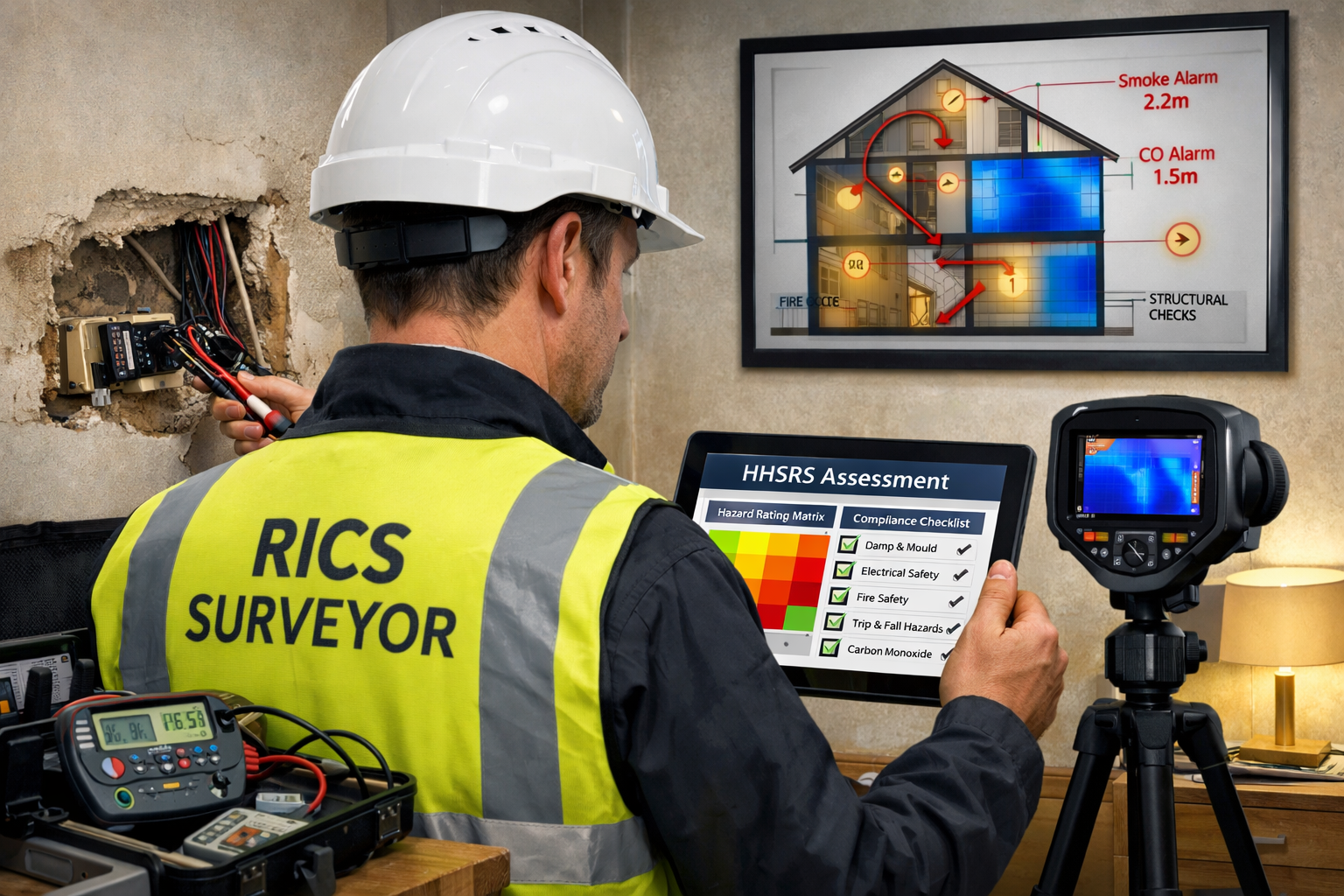
- ⚡ Surveyor protocols now require HHSRS competency across expanded hazard categories, with thermal imaging, electrical testing, and fire safety assessment capabilities
- 📋 Evidence-based accountability replaces intent-based compliance, demanding auditable hazard tracking and documented decision-making pathways
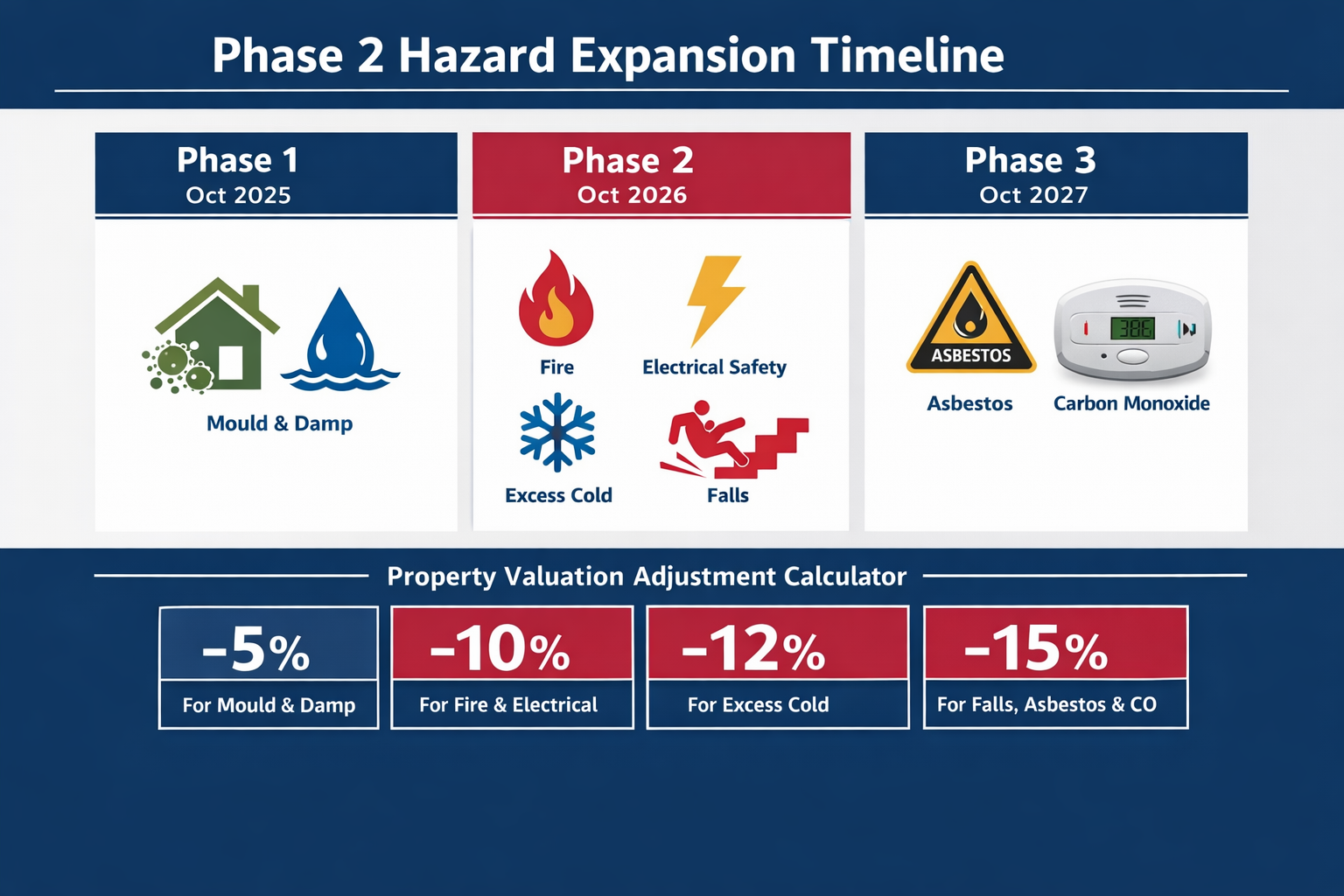
- 💰 Market impact accelerates in cautious Q2 2026, with properties showing significant hazards experiencing 5-15% valuation adjustments depending on remediation scope
Understanding Awaab's Law Phase 2: The 2026 Hazard Expansion Framework
Awaab's Law originated from the tragic death of two-year-old Awaab Ishak in 2020, whose death was directly attributed to prolonged exposure to damp and mould in social housing. Phase 1, which commenced on October 27, 2025, established mandatory repair timeframes specifically for emergency hazards and damp/mould conditions[4]. However, the legislative framework always envisioned a phased rollout addressing the full spectrum of Housing Health and Safety Rating System (HHSRS) hazards.
Phase 2 represents a seismic shift in compliance scope, expanding requirements to cover:
- Excess cold and excess heat (thermal comfort hazards)
- Fire safety deficiencies (inadequate detection, escape routes, or fire-resistant materials)
- Electrical hazards (faulty wiring, inadequate earthing, outdated consumer units)
- Falls associated with stairs, baths, and level surfaces
- Structural instability and collapse risks
- Domestic hygiene and sanitation hazards[3]
Defining "Significant Hazards" Under the 2026 Framework
The legislation introduces a critical threshold concept: a "significant hazard" is defined as one presenting significant risk of harm to tenant health or safety—specifically, a risk that a reasonable landlord would treat as requiring urgent action[2]. This definition shifts compliance from a purely technical HHSRS scoring exercise to a reasonable-person standard, creating both clarity and interpretation challenges for surveyors.
For valuation purposes, this means properties with documented significant hazards face immediate marketability concerns. RICS valuation surveyors must now assess whether identified defects meet the "significant hazard" threshold and quantify the financial impact of mandatory remediation.
Timeline and Compliance Phases
| Phase | Effective Date | Hazard Categories | Surveyor Impact |
|---|---|---|---|
| Phase 1 | October 27, 2025 | Emergency hazards, damp, mould | Baseline protocols established |
| Phase 2 | October 2026 | Fire, electrical, excess cold, falls, structural | Major protocol expansion required |
| Phase 3 | October 2027 | Asbestos, mineral fibres, CO, combustion products | Full HHSRS coverage |
The phased approach provides landlords with implementation windows, but surveyors must immediately integrate Phase 2 hazards into valuation methodologies as the October 2026 deadline approaches. Properties inspected in Q2 2026 require forward-looking assessments accounting for imminent compliance obligations.
Valuation Adjustments for Awaab's Law 2026 Hazard Expansions: Quantifying Remediation Costs
The core challenge for surveyors lies in translating hazard identification into defensible valuation adjustments. Unlike cosmetic defects or deferred maintenance, Awaab's Law hazards carry statutory remediation requirements with defined timeframes, creating calculable cost impacts that directly affect market value.
Surveyor Protocols for Fire Risk Assessment
Fire safety hazards under Phase 2 encompass multiple dimensions requiring specialist assessment protocols:
Detection and Alarm Systems
- Absence or inadequacy of smoke/heat detectors in circulation spaces
- Non-compliant detector positioning relative to sleeping areas
- Outdated or non-functional alarm systems requiring replacement
Means of Escape
- Inadequate escape routes from upper floors
- Obstructed or non-compliant fire exits
- Insufficient fire-resistant separation between units
Structural Fire Protection
- Lack of fire doors or inadequate fire-resistant construction
- Compromised compartmentation allowing fire spread
- Non-compliant cladding or external wall systems
Surveyors must document each deficiency category and obtain specialist fire safety consultant input for complex cases. Remediation costs for fire safety deficiencies typically range from £8,000 to £25,000 per property, depending on the extent of required upgrades[1].
When conducting homebuyer surveys or more comprehensive RICS building surveys, professionals must now include fire safety compliance within their standard assessment protocols.
Electrical Hazard Protocols and Testing Requirements
Electrical hazards represent one of the most technically complex Phase 2 categories, requiring surveyors to either possess electrical competency or engage qualified electricians for detailed testing.
Key Assessment Areas:
- Consumer unit compliance: Outdated fuse boxes, lack of RCD protection, inadequate circuit capacity
- Wiring condition: Perished insulation, exposed conductors, inadequate earthing
- Socket and fixture safety: Overloaded circuits, damaged outlets, non-compliant installations
- Periodic inspection status: Properties requiring Electrical Installation Condition Reports (EICR)
Valuation Impact Methodology:
For properties requiring full electrical rewiring, surveyors should apply adjustments of £6,000-£12,000 for typical two-bedroom properties, with proportional increases for larger units. Partial remediation (consumer unit replacement, circuit additions) may warrant £2,000-£5,000 adjustments.
The factors affecting property valuation now explicitly include electrical compliance status, particularly for properties built or last rewired before 2000.
Excess Cold Risk: Thermal Performance Assessment
Excess cold hazards require surveyors to assess thermal performance using both qualitative observation and quantitative measurement:
Assessment Protocol Components:
- Thermal imaging surveys identifying cold bridging and insulation deficiencies
- Heating system adequacy evaluation (output capacity, efficiency, controllability)
- Insulation levels in walls, roofs, floors, and glazing
- Ventilation balance preventing heat loss while maintaining air quality
RICS expert witness protocols now include evidence standards specific to excess temperature hazards, requiring surveyors to document thermal performance with calibrated equipment and comparative data[1].
Properties failing to maintain minimum temperatures (18°C in living areas, 16°C in bedrooms) face remediation costs including:
- Boiler replacement: £3,000-£5,000
- Central heating installation: £5,000-£8,000
- Insulation upgrades: £2,000-£6,000
- Double glazing replacement: £4,000-£12,000
Combined thermal remediation for severely deficient properties may exceed £20,000, requiring substantial valuation adjustments. For properties requiring insurance reinstatement valuations, thermal upgrade costs must be factored into replacement cost assessments.
Structural and Falls Hazard Assessment
Falls hazards and structural instability require traditional surveying expertise but with enhanced focus on compliance thresholds:
Falls Risk Categories:
- Stairway deficiencies (inadequate handrails, non-compliant risers/treads, poor lighting)
- Bathroom hazards (slippery surfaces, inadequate grab rails, poor layout)
- Level surface issues (trip hazards, uneven floors, inadequate lighting)
Structural Concerns:
- Foundation movement or settlement
- Wall/ceiling cracking indicating structural stress
- Roof structural deficiencies
- Damp-related structural deterioration
For properties requiring comprehensive structural assessment, surveyors should recommend structural engineering reports to quantify remediation scope. Structural remediation costs vary dramatically (£5,000-£50,000+) depending on severity, making accurate assessment critical for defensible valuations.
Implementing RICS-Compliant Valuation Adjustments in Practice
Evidence-Based Accountability Framework
The 2026 expansion shifts compliance from intent-based to evidence-based accountability, requiring surveyors to maintain rigorous documentation standards[3]. This transformation affects valuation practice in several critical ways:
Documentation Requirements:
- ✅ Photographic evidence of each identified hazard
- ✅ Measurement data (thermal readings, electrical test results, structural measurements)
- ✅ Specialist report integration (electricians, fire safety consultants, structural engineers)
- ✅ Remediation cost quotations from qualified contractors
- ✅ Compliance timeline analysis relative to statutory deadlines
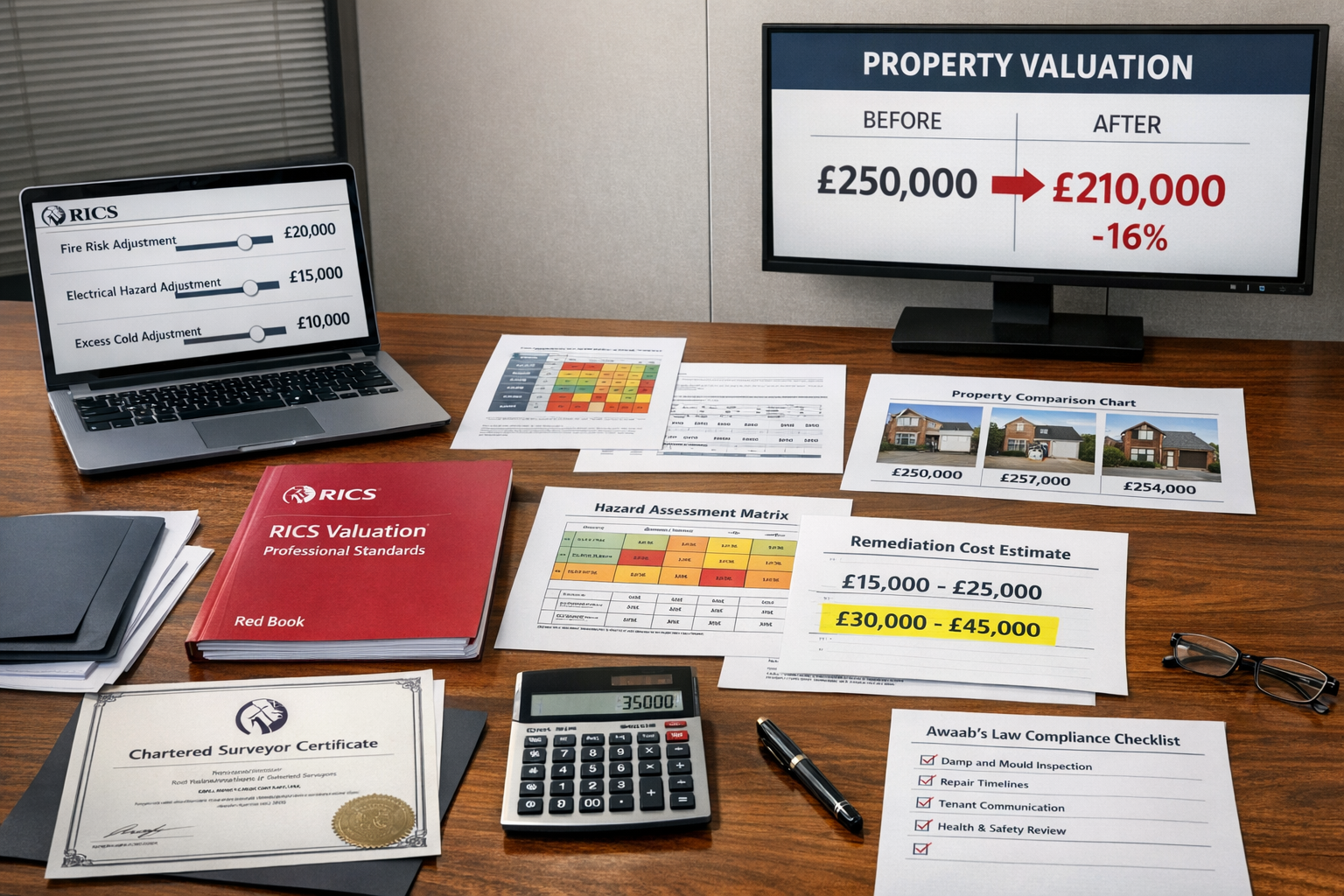
When preparing RICS Red Book valuations, surveyors must explicitly reference Awaab's Law Phase 2 compliance status and quantify associated valuation impacts within the assumptions and special assumptions sections.
Valuation Methodology: Direct Cost vs. Market Impact Approaches
Surveyors face a methodological choice when quantifying Awaab's Law impacts:
Direct Cost Approach
- Calculate total remediation costs for identified hazards
- Apply adjustment reducing market value by remediation cost plus contingency (typically 10-15%)
- Appropriate for properties with clear, quantifiable deficiencies
Market Impact Approach
- Assess comparable sales of properties with similar hazard profiles
- Analyze market discount applied to non-compliant properties
- Consider marketability constraints and buyer perception
- More appropriate in established markets with transaction evidence
In practice, most surveyors employ a hybrid approach, using direct costs as the baseline but adjusting for market perception and transaction evidence. For mortgage valuation purposes, lenders increasingly require explicit Awaab's Law compliance statements.
Practical Adjustment Ranges by Hazard Severity
Based on emerging market data and remediation cost analysis, suggested adjustment frameworks include:
Minor Compliance Issues (5-7% adjustment)
- Single hazard category requiring limited remediation
- Example: Consumer unit upgrade, partial insulation improvement
- Typical cost: £2,000-£5,000
Moderate Compliance Issues (8-12% adjustment)
- Multiple hazard categories or significant single-category deficiency
- Example: Full electrical rewire plus heating system upgrade
- Typical cost: £8,000-£15,000
Severe Compliance Issues (13-15%+ adjustment)
- Multiple significant hazards requiring comprehensive remediation
- Example: Fire safety upgrades, electrical rewire, thermal improvements, structural repairs
- Typical cost: £20,000-£45,000+
Properties with severe issues may face additional marketability discounts beyond direct cost adjustments, particularly in cautious market conditions where buyers prioritize move-in readiness.
Integration with Existing Valuation Frameworks
Awaab's Law adjustments must integrate with existing valuation considerations rather than operating in isolation. Surveyors should consider:
- Cumulative adjustment limits: Total adjustments (including Awaab's Law, general condition, location factors) should not exceed property's underlying value proposition
- Repair vs. replacement decisions: Properties requiring extensive remediation may justify demolition/rebuild analysis
- Tenure considerations: Leasehold properties may face additional complications regarding responsibility for remediation
- Planning constraints: Listed buildings or conservation areas may face elevated remediation costs due to planning restrictions
For properties requiring lease extension valuations or matrimonial valuations, Awaab's Law compliance status affects both current market value and future value projections.
Market Context: Valuation Adjustments in Q2 2026's Cautious Property Market
The implementation of Awaab's Law Phase 2 occurs against a backdrop of cautious property market conditions in Q2 2026. House price growth has moderated, with buyers increasingly selective and focused on property condition and compliance status[5].
Buyer Behavior Shifts
Market intelligence indicates several behavioral changes affecting valuation practice:
- Increased survey uptake: Buyers commissioning more comprehensive surveys to identify compliance issues before commitment
- Negotiation leverage: Awaab's Law deficiencies providing buyers with strengthened negotiation positions
- Lender caution: Mortgage providers requiring explicit compliance confirmation or retention of remediation funds
- Insurance implications: Some insurers adjusting premiums or coverage for properties with identified hazards
These factors amplify the market impact of Awaab's Law compliance issues beyond direct remediation costs, justifying the additional marketability discounts applied by experienced surveyors.
Geographic Variation in Impact
Valuation adjustments show geographic variation reflecting:
- Housing stock age: Older properties (pre-1980) face higher incidence of electrical and thermal deficiencies
- Regional building practices: Areas with historically poor insulation standards face elevated excess cold remediation costs
- Local market liquidity: Tight markets may absorb compliance costs more readily than oversupplied markets
- Social housing concentration: Areas with high social housing percentages see broader market awareness of compliance requirements
Surveyors operating across multiple regions should develop location-specific adjustment frameworks reflecting local market conditions and housing stock characteristics.
Forward-Looking Valuation Considerations
As the October 2026 deadline approaches, surveyors must adopt forward-looking valuation perspectives:
- Pre-remediation valuations: Properties inspected in Q2 2026 should assume Phase 2 compliance requirements even if not yet enforced
- Remediation timeline impact: Properties with planned remediation may warrant reduced adjustments if work is scheduled and funded
- Compliance certificates: Properties with recent compliance certifications (EICR, fire safety assessments) may command premium valuations
- Phase 3 anticipation: Forward-thinking buyers may already consider Phase 3 hazards (asbestos, carbon monoxide) despite October 2027 implementation date
Training and Competency Requirements for Surveyors
The expanded hazard scope requires significant surveyor training investment to maintain competency across Phase 2 categories[3]. Professional development priorities include:
Technical Skills Development
- Thermal imaging certification: Competency in thermal camera operation and interpretation
- Electrical awareness training: Understanding of electrical systems sufficient for hazard identification
- Fire safety fundamentals: Recognition of fire safety deficiencies and escape route adequacy
- HHSRS assessment methodology: Formal training in Housing Health and Safety Rating System application
Practical Assessment Protocols
Surveyors must develop systematic inspection protocols ensuring comprehensive hazard identification:
- Pre-inspection research: Review property age, construction type, previous survey reports
- Systematic room-by-room assessment: Checklist-based approach covering all hazard categories
- Equipment deployment: Thermal imaging, moisture meters, electrical testing (where qualified)
- Specialist referral protocols: Clear criteria for engaging electricians, fire safety consultants, structural engineers
- Documentation standards: Photographic evidence, measurement records, compliance checklists
Organizations providing stock condition surveys for social housing landlords must ensure their surveying teams possess comprehensive Phase 2 competency.
Quality Assurance and Peer Review
Given the compliance stakes and valuation impacts, firms should implement:
- Peer review processes for valuations involving significant Awaab's Law adjustments
- Specialist consultation protocols ensuring appropriate expert engagement
- Continuing professional development tracking demonstrating ongoing competency maintenance
- Insurance coverage review ensuring professional indemnity policies cover expanded scope of practice
Landlord Implications: From Surveyor Findings to Compliance Action
While surveyors focus on valuation impacts, understanding landlord compliance obligations provides essential context for assessment work.
Statutory Investigation and Remediation Requirements
Phase 2 establishes mandatory investigation and remediation timeframes for significant hazards:
- Emergency hazards: 24-hour response requirement
- Significant hazards: Investigation within defined timeframes, remediation according to hazard severity
- Documentation obligations: Auditable records of hazard reports, investigations, and remediation actions
Surveyors identifying significant hazards should advise clients of these statutory obligations, particularly for landlord clients who face regulatory enforcement risk.
Data Management as Compliance Asset
Modern compliance requires treating repairs and hazard data as strategic assets[3]:
- Linking hazards to individual properties within asset management systems
- Tracking investigation and resolution timelines against statutory requirements
- Evidencing decision-making rationale for prioritization and remediation approaches
- Maintaining audit trails for regulatory inspection
Surveyors can add value by providing clients with structured hazard reports compatible with property management systems, facilitating compliance tracking.
Preventive vs. Reactive Compliance Models
The legislation drives a fundamental shift from reactive repair models to preventive hazard management:
- Regular hazard assessments: Proactive identification before tenant reports
- Predictive maintenance: Addressing potential hazards before they become significant
- Stock condition surveys: Systematic portfolio assessment identifying compliance risks
- Investment planning: Multi-year remediation programs addressing identified hazards
For portfolio valuations and investment analysis, surveyors should assess whether landlords have implemented preventive compliance frameworks, as this affects future capital expenditure requirements and value sustainability.
Conclusion: Navigating the New Valuation Landscape
The October 2026 implementation of Awaab's Law Phase 2 represents a fundamental transformation in property valuation practice, requiring surveyors to integrate fire safety, electrical, excess cold, and structural hazard assessment into standard protocols. With remediation costs ranging from £15,000 to £45,000 for multi-hazard properties, the valuation impacts are substantial and immediately relevant in Q2 2026's cautious market environment.
Valuation Adjustments for Awaab's Law 2026 Hazard Expansions: Surveyor Protocols for Fire, Electrical, and Excess Cold Risks demands rigorous evidence-based assessment, systematic documentation, and defensible adjustment methodologies. Surveyors must balance direct remediation cost quantification with market perception analysis, applying adjustments ranging from 5% for minor issues to 15%+ for severe multi-hazard properties.
Actionable Next Steps for Surveying Professionals
✅ Invest in technical training: Obtain thermal imaging certification, electrical awareness training, and HHSRS assessment competency before the October deadline
✅ Update inspection protocols: Integrate Phase 2 hazard checklists into standard survey procedures, ensuring systematic assessment of fire, electrical, thermal, and structural risks
✅ Develop adjustment frameworks: Establish firm-specific valuation adjustment guidelines based on local market conditions and remediation cost data
✅ Strengthen specialist networks: Build relationships with qualified electricians, fire safety consultants, and structural engineers for complex assessment referrals
✅ Enhance documentation standards: Implement photographic evidence protocols, measurement recording systems, and compliance tracking compatible with client management systems
✅ Review professional indemnity coverage: Ensure insurance policies adequately cover expanded scope of practice and potential compliance-related claims
✅ Monitor market intelligence: Track comparable sales of properties with Awaab's Law compliance issues to refine market impact assessments
The legislative framework will continue evolving through Phase 3 (October 2027), but the October 2026 expansion represents the most significant immediate challenge for valuation practice. Surveyors who proactively develop comprehensive hazard assessment competency and defensible adjustment methodologies will provide superior client value while managing professional liability exposure in this transformed regulatory environment.
For properties requiring professional assessment in light of these new requirements, engaging RICS-certified experts with demonstrated Phase 2 competency ensures compliance-aware valuations that protect both buyer and lender interests in an increasingly regulated market.
References
[1] Expert Witness Protocols For Excess Temperature Hazards Under Awaabs Law 2026 Rics Evidence Standards In Prs Disputes – https://nottinghillsurveyors.com/blog/expert-witness-protocols-for-excess-temperature-hazards-under-awaabs-law-2026-rics-evidence-standards-in-prs-disputes
[2] How Awaabs Law Will Be Stress Tested In 2026 – https://theintermediary.co.uk/2026/02/how-awaabs-law-will-be-stress-tested-in-2026/
[3] Awaabs Law Phase 2 Is Coming What Social Landlords Need To Know About Additional Hazard Compliance In 2026 – https://www.mobysoft.com/resources/blogs/awaabs-law-phase-2-is-coming-what-social-landlords-need-to-know-about-additional-hazard-compliance-in-2026/
[4] Awaabs Law Guidance For Social Landlords Timeframes For Repairs In The Social Rented Sector – https://www.gov.uk/government/publications/awaabs-law-guidance-for-social-landlords/awaabs-law-guidance-for-social-landlords-timeframes-for-repairs-in-the-social-rented-sector
[5] Valuation Adjustments For March 2026 Rics Survey Navigating Softer House Prices And Middle East Conflict Impacts – https://nottinghillsurveyors.com/blog/valuation-adjustments-for-march-2026-rics-survey-navigating-softer-house-prices-and-middle-east-conflict-impacts