
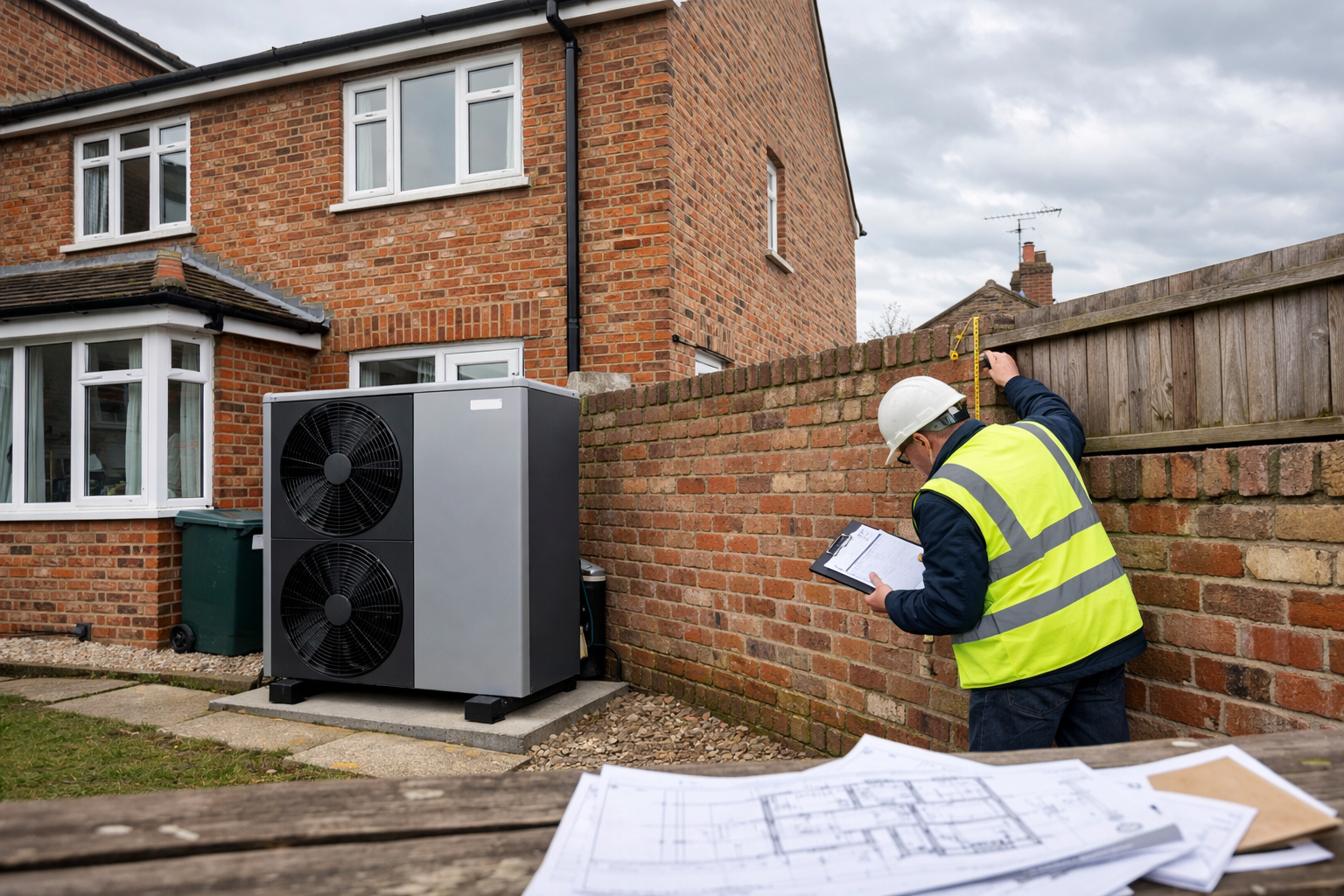
By 2026, an estimated one in eight UK homeowners living in terraced or semi-detached properties is exploring a heat pump retrofit — yet fewer than a third fully understand when the Party Wall etc. Act 1996 applies to their project. That knowledge gap is expensive. Missed notices, disputed boundaries, and poorly drafted awards can stall a green energy upgrade for months and expose homeowners to legal liability. Party Wall Surveys for Heat Pump Retrofits in 2026: RICS Notices and Awards Amid Green Energy Mandates sits at the intersection of property law, building surveying, and the UK's accelerating net-zero agenda — and getting it right matters more than ever.
Key Takeaways 🔑
- Not all heat pump retrofits trigger the Party Wall etc. Act 1996, but ground-source installations and certain air-source placements near shared boundaries often do.
- RICS launched a major consultation on updated party wall guidance in April 2026, with the draft 8th edition of Party Wall Legislation and Procedure open for stakeholder feedback. [1]
- A Schedule of Condition recorded before works begin is one of the most effective tools for avoiding neighbour disputes during retrofit projects.
- Stricter EPC requirements anticipated for 2027–2028 are driving a surge in heat pump installations in 2026, increasing the volume of party wall matters surveyors must handle. [2]
- Serving the correct notice at the right time — typically two months before works commence — is the single most important step a building owner can take.
Why Heat Pump Retrofits Are Colliding With Party Wall Law in 2026
The UK's green energy mandates have moved from aspiration to urgency. With stricter Energy Performance Certificate (EPC) requirements expected to take effect for landlords and homeowners from 2027–2028, 2026 has become the year many property owners are acting [2]. The government's push toward heat pump adoption — including potential mandatory installation requirements for certain property types — means surveyors across England and Wales are fielding an unprecedented volume of retrofit-related enquiries [2].
The challenge is structural. The UK's housing stock is dominated by terraced and semi-detached homes — properties that share walls, foundations, and sometimes drainage with neighbours. Installing an air-source heat pump (ASHP) or ground-source heat pump (GSHP) in these homes is rarely a simple bolt-on exercise. Works frequently involve:
- Penetrating or building against a party wall
- Excavating near shared foundations for ground loops
- Routing pipework through or close to party structures
- Modifying external walls that form part of a shared boundary
Each of these activities may engage the Party Wall etc. Act 1996, making professional party wall surveying not just advisable but legally required.
💬 "The intersection of green energy mandates and party wall legislation is creating a new category of complexity that neither homeowners nor their contractors are always prepared for."
Understanding the Party Wall etc. Act 1996 in a Retrofit Context
The Party Wall etc. Act 1996 applies in England and Wales and governs works to shared walls, boundary walls, and excavations near neighbouring buildings. For heat pump retrofits, three sections of the Act are most relevant:
| Act Section | Trigger | Typical Retrofit Scenario |
|---|---|---|
| Section 1 | New wall on or at the boundary | External wall modification for ASHP mounting |
| Section 2 | Works to an existing party wall | Penetrations for pipework, structural alterations |
| Section 6 | Excavations within 3m or 6m of a neighbour's structure | Ground-source heat pump loop installation |
When Does a Heat Pump Retrofit Require a Party Wall Notice?
Not every heat pump installation triggers the Act. A standalone ASHP unit placed on a garden patio well away from any shared boundary, for example, is unlikely to require a notice. However, the following scenarios almost certainly do:
✅ Ground-source heat pump borehole or trench excavated within 3 metres of a neighbouring building's foundations (Section 6 notice required)
✅ Pipework penetrations through a party wall to connect indoor and outdoor units (Section 2 notice required)
✅ New external wall construction or significant modification at the boundary line (Section 1 notice required)
✅ Structural alterations to accommodate a wet/water-based heating system — the type required for heat pump compatibility — that affect a shared wall [3]
It is worth noting that heat pump retrofits specifically require wet, water-based heating systems with piped radiators rather than dry electric systems [3]. This technical requirement often means more extensive internal pipework modifications, which can increase the likelihood of party wall implications.
For a detailed overview of the full party wall process, the party wall FAQ covers the most common questions homeowners face before starting any notifiable works.
RICS Notices, Awards, and the 2026 Guidance Update
The April 2026 RICS Consultation: What's Changing?
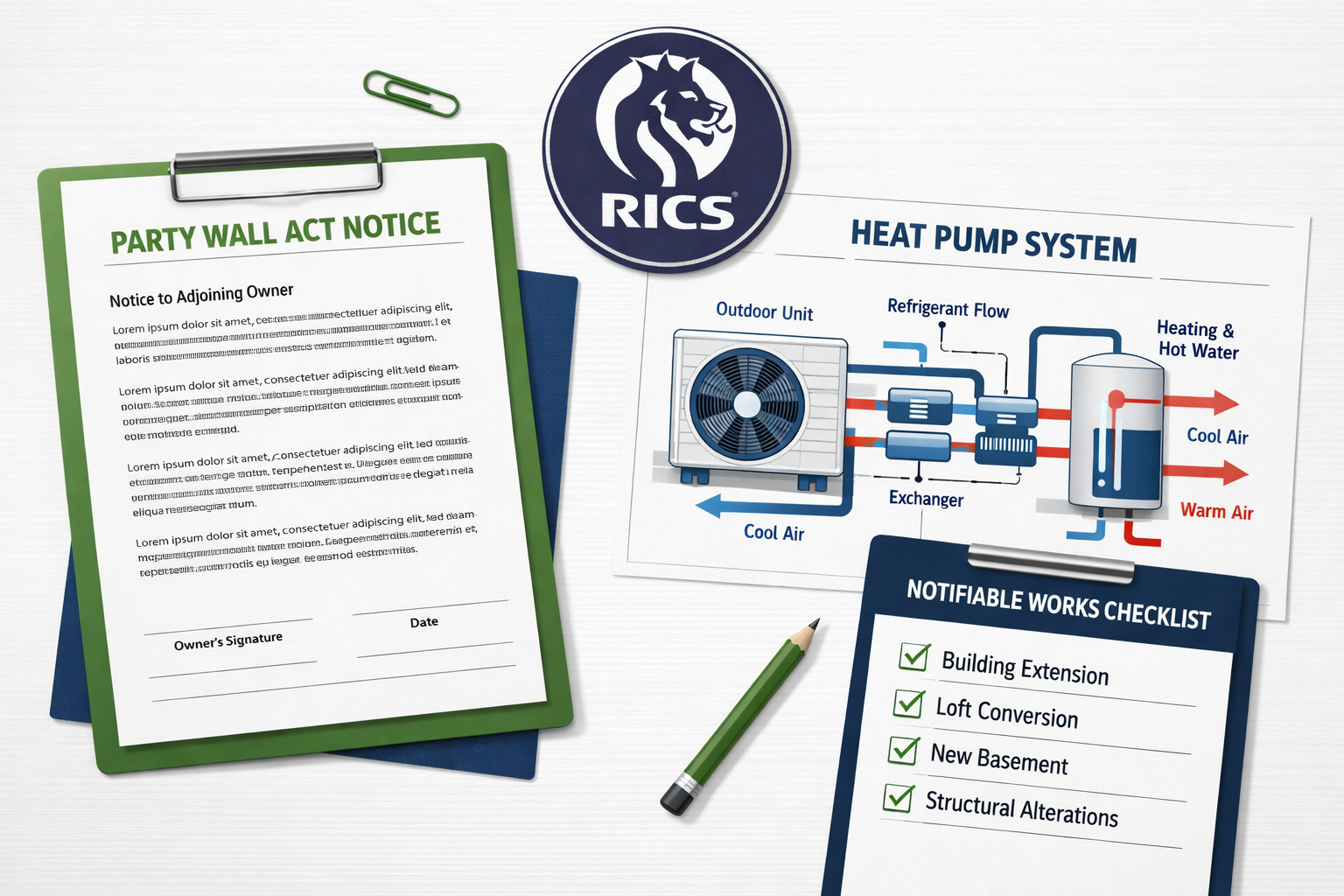
In April 2026, RICS launched a significant consultation on the updated 8th edition of Party Wall Legislation and Procedure, its primary practice guidance note for surveyors handling party wall matters [1]. The consultation, open through approximately May 2026, targeted surveyors, legal professionals, and dispute resolution practitioners across England and Wales [1].
While the full text of the 8th edition is pending finalisation, the consultation signals that RICS recognises the need to modernise guidance in light of:
- Increased retrofit activity driven by net-zero mandates
- New construction methods and materials used in green energy installations
- Evolving dispute resolution practices in a post-pandemic property market
For homeowners and contractors, this means that party wall surveyors working on heat pump projects in 2026 are operating against a backdrop of transitional guidance — making it even more important to engage a qualified, RICS-accredited professional who is current with the latest standards.
The Three-Step Party Wall Process for Heat Pump Retrofits
Step 1: Serve the Correct Notice
The building owner (the person carrying out the works) must serve written notice on all adjoining owners before works begin. Timelines vary:
- Section 1 works: 1 month's notice
- Section 2 works: 2 months' notice
- Section 6 excavations: 1 month's notice
Failing to serve notice is a serious legal issue — learn more about the consequences of no party wall notice being served before proceeding with any retrofit work.
Step 2: Obtain Consent or Appoint Surveyors
The adjoining owner has 14 days to respond. They can:
- Consent in writing (works can proceed)
- Dissent and agree to use a single agreed surveyor
- Dissent and appoint their own surveyor (triggering a two-surveyor process)
Understanding party wall consent and what it means legally is essential before assuming a neighbour's silence equals agreement.
Step 3: The Party Wall Award
If surveyors are appointed, they produce a Party Wall Award — a legally binding document that sets out:
- The works permitted and their scope
- The method and timing of construction
- Access rights for inspection
- Compensation provisions if damage occurs
Schedule of Condition: The Retrofit Homeowner's Best Protection
One of the most practical tools in any party wall matter is the Schedule of Condition — a photographic and written record of the adjoining property's condition before works begin. For heat pump retrofits involving excavation or wall penetration, this document is invaluable.
A properly prepared schedule of condition protects both the building owner and the adjoining owner by establishing a clear baseline. If a neighbour later claims that a crack appeared because of the ground-source loop installation, the Schedule of Condition either confirms or refutes that claim with documented evidence.
Notifiable Works Checklist for Heat Pump Retrofits 📋
Use this checklist to determine whether a party wall notice is likely required for a specific heat pump installation:
Air-Source Heat Pump (ASHP)
- Is the unit being mounted on an external wall that is also a party wall? → Section 2 notice likely required
- Does installation involve drilling through a party wall for refrigerant lines or pipework? → Section 2 notice required
- Is a new external wall or structure being built at the boundary to house the unit? → Section 1 notice required
- Is the unit sited more than 1 metre from any shared boundary with no structural works? → Notice may not be required (verify with a surveyor)
Ground-Source Heat Pump (GSHP)
- Is any excavation planned within 3 metres of the neighbouring property's foundations? → Section 6 notice required
- Is any excavation planned between 3–6 metres deep and below the neighbour's foundation level? → Section 6 notice required
- Does the ground loop trench run parallel to or beneath a shared boundary wall? → Section 6 notice likely required
⚠️ Important: Planning authority consultation is also mandatory for heat pump installations. Property owners must verify local planning conditions affecting the siting of any unit before works begin [3]. Party wall compliance and planning permission are separate requirements — both must be satisfied.
RICS offers a free initial 30-minute consultation on party wall matters through its residential service line (02476 868 555), which can help homeowners determine whether their specific retrofit project triggers the Act [3].
Avoiding Disputes: Practical Guidance for Building Owners and Neighbours

Common Dispute Triggers in Heat Pump Retrofit Projects
Heat pump retrofits generate a specific set of party wall disputes that differ from traditional construction works. The most frequent include:
- Vibration complaints from ASHP units mounted on shared walls — noise and vibration can affect the adjoining property
- Damage claims following GSHP excavations near shared foundations
- Access disputes when surveyors need to inspect the adjoining property
- Disagreements over the Award's scope when works expand beyond the original notice
Understanding what constitutes obstruction in a party wall matter — and what rights each party holds — can prevent minor disagreements from escalating into costly legal disputes.
The Role of a Chartered Surveyor in Green Energy Retrofit Projects
Engaging a chartered surveyor early in the retrofit planning process delivers multiple benefits:
- Pre-notice assessment: Identifying which sections of the Act apply before any notice is served
- Notice drafting: Ensuring notices are correctly worded and served on all relevant parties
- Award preparation: Producing a legally robust Party Wall Award that protects all parties
- Post-works inspection: Confirming no damage has occurred to the adjoining property
For homeowners who are also considering the structural implications of a heat pump retrofit — particularly where internal modifications are required for wet heating systems — a RICS Level 3 Building Survey can identify any pre-existing vulnerabilities in the building fabric before works commence.
Key Timelines at a Glance ⏱️
| Milestone | Timeframe |
|---|---|
| Engage party wall surveyor | 3–4 months before works |
| Serve Section 2/6 notice | 2 months before works |
| Adjoining owner response period | 14 days from notice |
| Schedule of Condition survey | Before works begin |
| Party Wall Award issued | Before works commence |
| Post-works inspection | Within agreed period after completion |
Party Wall Surveys for Heat Pump Retrofits in 2026: Navigating the Regulatory Landscape
The convergence of Party Wall Surveys for Heat Pump Retrofits in 2026: RICS Notices and Awards Amid Green Energy Mandates with evolving UK energy policy creates a regulatory landscape that demands careful navigation. Several factors are shaping the environment this year:
EPC Pressure and the 2026 Retrofit Surge
Anticipated EPC requirements for 2027–2028 are already influencing homeowner behaviour in 2026 [2]. Landlords facing potential minimum EPC rating requirements are fast-tracking heat pump installations, often without fully understanding the party wall implications. This is creating a pipeline of retrospective disputes — cases where works have already begun without proper notices being served.
Retrospective party wall agreements are possible but significantly more complex and costly than proactive compliance. The message for 2026 is clear: act early, serve notices correctly, and engage qualified surveyors before breaking ground.
Green Energy Mandates and Shared Ownership Properties
The party wall considerations become even more complex in shared ownership or leasehold properties, where the freeholder's consent may also be required alongside party wall compliance. Homeowners in these situations should seek specialist advice that addresses both the party wall process and any lease-specific obligations simultaneously.
The RICS 8th Edition: What to Watch For
As the RICS 8th edition of Party Wall Legislation and Procedure moves toward publication following the April 2026 consultation [1], practitioners and homeowners should monitor for:
- Updated guidance on retrofit-specific works and how they interact with existing party wall categories
- Revised dispute resolution timelines that may affect Award preparation
- New provisions for green energy installations that reflect the scale of retrofit activity across England and Wales
The full party wall services overview provides a comprehensive starting point for understanding all aspects of party wall compliance in 2026.
Conclusion: Act Early, Survey Properly, Retrofit Confidently
The green energy transition is reshaping how the UK's terraced and semi-detached housing stock is managed, maintained, and modified. Party Wall Surveys for Heat Pump Retrofits in 2026: RICS Notices and Awards Amid Green Energy Mandates is not a niche legal concern — it is a mainstream property issue affecting millions of homeowners who are responding to real regulatory and financial pressure.
Actionable Next Steps ✅
-
Determine applicability early: Before finalising any heat pump installation plan, consult a party wall surveyor to assess whether the Act applies to the specific works proposed.
-
Serve notices on time: Allow at least two months before planned works for Section 2 and Section 6 notices. Late or defective notices can invalidate the entire process.
-
Commission a Schedule of Condition: Protect against spurious damage claims by documenting the adjoining property's condition before any works begin.
-
Stay current with RICS guidance: Monitor the publication of the 8th edition of Party Wall Legislation and Procedure following the April 2026 consultation for any changes affecting retrofit projects [1].
-
Verify planning requirements separately: Party wall compliance does not replace planning permission. Both must be in place before a heat pump installation proceeds [3].
-
Engage a chartered surveyor early: For complex retrofits involving ground-source systems or significant structural modifications, early professional engagement saves time, money, and neighbourly goodwill.
The path to a compliant, effective heat pump retrofit in a shared-boundary property is clear — but it requires professional guidance, proper documentation, and respect for the legal framework that protects both building owners and their neighbours.
References
[1] Rics Launches Consultation On Updated Party Wall Practice Guidance – https://www.rics.org/news-insights/rics-launches-consultation-on-updated-party-wall-practice-guidance
[2] Party Wall Surveys For Heat Pump Retrofits Rics Compliance In 2026s Net Zero Retrofit Surge – https://nottinghillsurveyors.com/blog/party-wall-surveys-for-heat-pump-retrofits-rics-compliance-in-2026s-net-zero-retrofit-surge
[3] Domestic Air Source Heat Pumps – https://www.rics.org/consumer-guides/domestic-air-source-heat-pumps
[4] Party Wall Surveys For Heat Pump And Solar Retrofit Projects Navigating 2026 Net Zero Mandates On Shared Boundaries – https://nottinghillsurveyors.com/blog/party-wall-surveys-for-heat-pump-and-solar-retrofit-projects-navigating-2026-net-zero-mandates-on-shared-boundaries