A property that scores poorly on whole-life carbon metrics can lose measurable market value — yet fewer than half of UK projects currently include any carbon calculation at all. That gap between risk and practice is precisely what makes understanding Valuation Adjustments for Whole Life Carbon Ratings: RICS Techniques Post-2025 Sustainability Report so urgent for surveyors, investors, and property owners in 2026.
The RICS 2025 Sustainability Report, drawn from surveys of more than 3,500 professionals across 36 countries, confirmed that the Sustainable Building Index remains in positive territory — but momentum is stalling [3]. At the same time, RICS has launched new global initiatives and updated guidance that directly reshape how valuers must account for carbon performance in their assessments. This article unpacks those techniques, the data behind them, and the practical steps surveyors can take right now.
Key Takeaways 📌
- 60%+ of professionals report that carbon calculations are conducted in fewer than half of all projects — creating significant valuation risk [3].
- RICS's new CLEAR framework aims to harmonize whole-life carbon measurement globally, giving valuers a consistent methodology [1].
- The CRREM pathway allows valuers to model CAPEX and OPEX adjustments for transition and stranding risks directly within cashflow analysis [2].
- Poor carbon performance is increasingly linked to measurable price discounts, while certified low-carbon buildings attract documented premiums.
- Regulatory pressure is building: RICS recommends mandatory carbon assessment reporting backed by stronger building regulations [4].
Why Carbon Performance Now Directly Affects Property Values
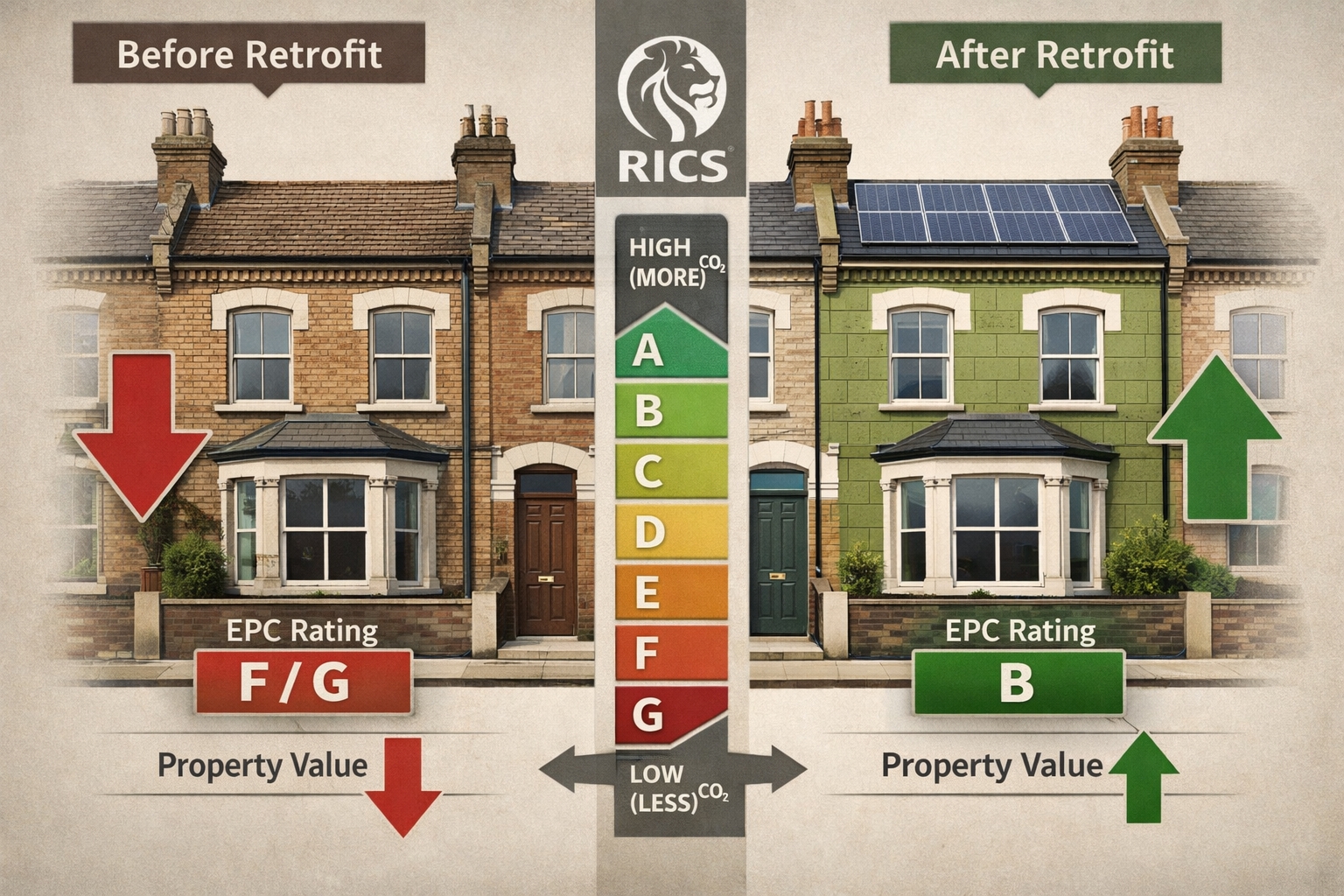
The relationship between energy efficiency and market value is not new. What is new — post-2025 — is the precision with which RICS guidance expects valuers to quantify that relationship using whole-life carbon data rather than proxy measures like EPC ratings alone.
The Implementation Gap Is a Valuation Risk
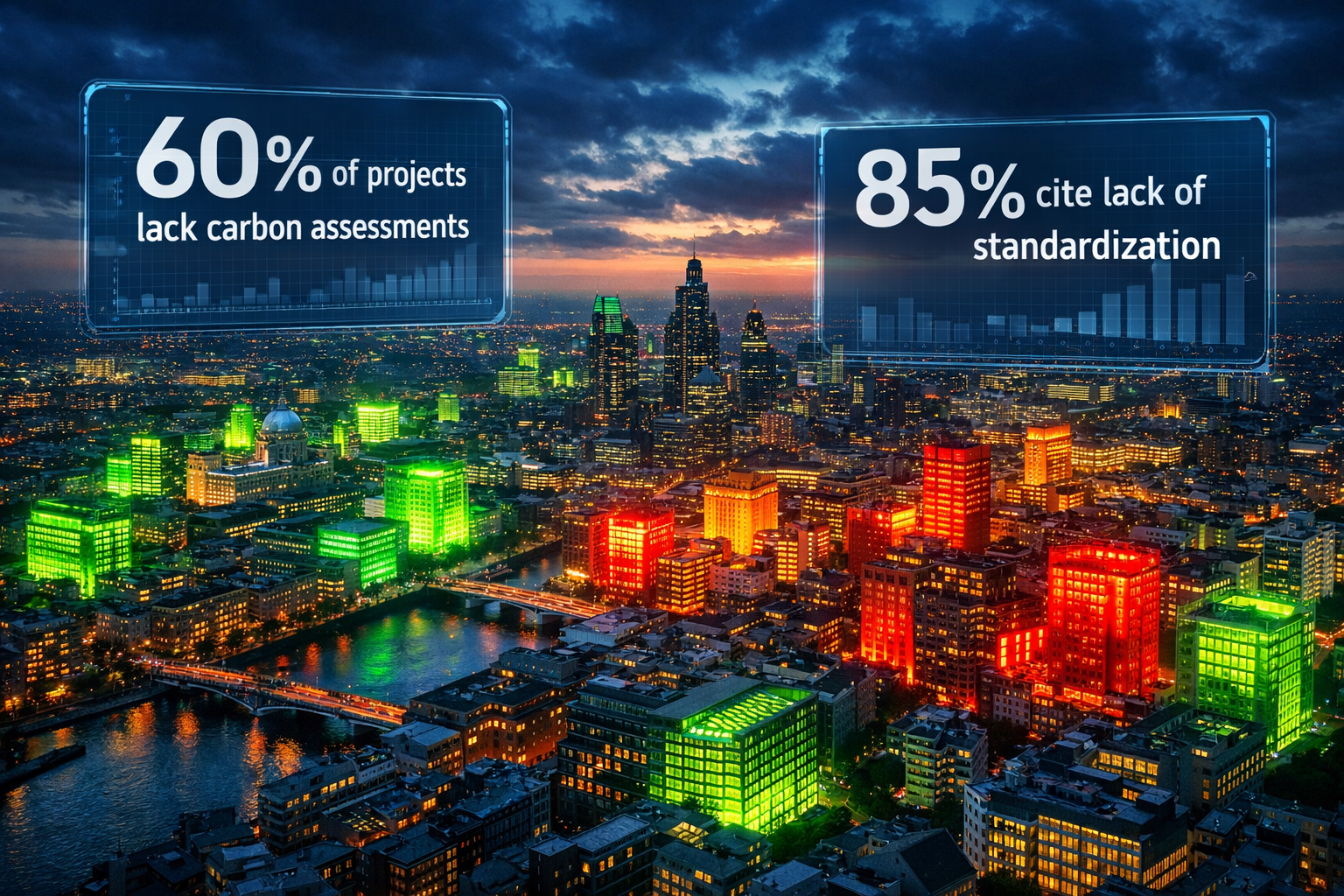
The RICS 2025 Sustainability Report revealed a striking implementation gap: 60% or more of professionals report that carbon calculations and climate resilience assessments are conducted in less than half of projects, or not at all [3]. For valuers, this is not just a sustainability concern — it is a professional liability issue.
When a valuation fails to account for the cost of bringing a property to net-zero compliance, it may materially misrepresent the asset's future cash flows. Lenders, investors, and regulators are increasingly aware of this. The result is a growing "brown discount" — a measurable reduction in the market value of high-carbon assets — alongside a "green premium" for buildings with verified low-carbon credentials.
💬 "Momentum in sustainable practice adoption is stalling despite the Sustainable Building Index remaining in positive territory." — RICS Sustainability Report 2025 [3]
What "Whole-Life Carbon" Actually Means
Whole-life carbon (WLC) covers all carbon emissions associated with a building across its entire lifespan, including:
| Carbon Category | What It Covers |
|---|---|
| Embodied carbon (upfront) | Materials, manufacturing, transport, construction |
| Embodied carbon (in-use) | Maintenance, repair, replacement of components |
| Operational carbon | Energy used for heating, cooling, lighting |
| End-of-life carbon | Demolition, waste, disposal |
Traditional valuations focused almost exclusively on operational energy costs. Post-2025 RICS guidance requires valuers to consider the full picture — particularly embodied carbon, which can account for 50–80% of a new building's lifetime emissions.
For surveyors conducting a RICS Red Book valuation, ignoring embodied carbon is no longer defensible in a market where institutional buyers routinely commission whole-life carbon assessments before transacting.
RICS Techniques for Valuation Adjustments for Whole Life Carbon Ratings: RICS Techniques Post-2025 Sustainability Report
The CLEAR Framework: A Global Standard Takes Shape
In a landmark move, RICS and global partners launched CLEAR (Carbon Lifecycle Emissions Assessment and Reporting) at the Sustainable Buildings and Construction Summit in Lausanne [1]. CLEAR is designed to:
- Analyze existing approaches to carbon assessment across different markets
- Identify points of difference between national methodologies
- Develop a globally relevant framework that valuers can apply consistently
- Provide practical tools, technical resources, and an online platform to build professional capability [1]
For UK-based surveyors, CLEAR represents the most significant methodological development since the introduction of EPC requirements. It means that by the time CLEAR is fully embedded, valuers will be expected to apply a standardized whole-life carbon lens to every relevant instruction — not just green-certified buildings.
The 85% of architecture, engineering, and construction professionals who cite lack of regulation and standardization as the primary barrier to carbon reporting [6] will find that CLEAR directly addresses this concern.
The CRREM Pathway: Quantifying Transition Risk in Cashflows
One of the most technically significant tools now available to RICS valuers is the Carbon Risk Real Estate Monitor (CRREM) pathway. RICS guidance enables valuers to calculate and adjust both capital expenditure (CAPEX) and operating expenditure (OPEX) using CRREM's science-based decarbonization trajectories, which are aligned with the Paris Climate Agreement [2].
In practical terms, this means:
- Identify the building's current carbon intensity (kgCO₂e/m²/year)
- Plot it against the CRREM pathway for its asset class and geography
- Calculate the "stranding date" — the point at which the building's carbon performance falls below the pathway threshold
- Model the CAPEX required to retrofit the building to stay on-pathway
- Adjust the Discounted Cash Flow (DCF) or income capitalisation to reflect these costs
This approach transforms carbon risk from a qualitative footnote into a quantified cashflow adjustment — exactly the kind of rigour that lenders and institutional investors now demand [2].
Practical Valuation Adjustment Techniques
Here is how RICS-qualified valuers are applying these techniques in 2026:
🏠 Residential Properties
- EPC band adjustment: Properties at EPC band D or below face increasing financing restrictions. Valuers should model the cost of upgrading to band C (minimum) or band B (optimal) and apply this as a deduction from gross value.
- Retrofit cost modelling: A RICS building survey can identify the specific defects and fabric issues that drive poor carbon performance — from uninsulated cavity walls to single glazing. These costs feed directly into the valuation adjustment.
- Green premium quantification: Certified low-carbon homes (Passivhaus, BREEAM Excellent, or equivalent) can command premiums of 5–15% in comparable market analysis, depending on location and buyer profile.
🏢 Commercial Properties
- CRREM stranding risk discount: For commercial assets, the stranding date calculation is central. A building stranding in 2031 carries a materially different risk profile than one stranding in 2040.
- CAPEX/OPEX cashflow adjustment: Anticipated retrofit costs are modelled as future CAPEX within the DCF, reducing the Net Present Value (NPV) of the income stream.
- Void risk uplift: High-carbon commercial buildings face growing occupier resistance. Valuers should consider increased void allowances in income projections for assets with poor WLC ratings.
For complex commercial instructions, a specialist RICS valuation report should explicitly address carbon transition risk as a material valuation consideration.
ESG Factors in Valuation: The Updated Global Standard
RICS has also published an updated global standard on Environmental, Social, and Governance (ESG) factors in commercial property valuation [1]. This standard provides a practical framework for reflecting sustainability characteristics — including whole-life carbon — in valuation advice worldwide.
Key requirements under the updated ESG standard include:
- Disclosure of data limitations: Where whole-life carbon data is unavailable, valuers must state this explicitly and explain its potential impact on the valuation.
- Market evidence analysis: Valuers must actively seek transaction evidence of green premiums and brown discounts in the relevant market.
- Forward-looking risk assessment: The valuation must consider regulatory trajectory, not just current compliance status.
Barriers, Priorities, and the Road Ahead
What the 2025 Data Tells Us About the Profession
The RICS 2025 Sustainability Report paints a nuanced picture of where the profession stands [3]:
| Sustainability Practice | Adoption Rate |
|---|---|
| Waste reduction and data-sharing tracking | ~40% (highest) |
| Carbon calculations on projects | <50% of projects |
| Climate resilience assessments | <50% of projects |
| Whole-life carbon assessment integration | Significantly below target |
Only 40% of professionals track waste reduction and data-sharing regularly — the single highest-performing sustainability metric [3]. Everything else, including carbon calculations, lags significantly behind. This is not a niche problem; it is a sector-wide readiness gap.
Regulatory Pressure Is Accelerating
The RICS 2025 report explicitly recommends that governments mandate carbon assessment reporting and implement stronger building regulations [4]. This signals that the current voluntary framework is expected to become compulsory — and valuers who are not already fluent in WLC techniques will face a steep learning curve when that happens.
For context, the EU's Energy Performance of Buildings Directive (EPBD) recast already requires whole-life carbon reporting for new buildings above certain thresholds in member states. The UK is under similar pressure to align its regulatory framework, and RICS guidance is positioning the profession to be ready.
💬 "Developing professional skills and knowledge in carbon assessment is essential for meaningful progress." — RICS Sustainability Report 2025 [3]
Skills Development: The Critical Enabler
The report is unambiguous: professional skills development is the critical enabler for meaningful progress [3]. For surveyors, this means:
- ✅ Completing CPD on whole-life carbon assessment methodologies
- ✅ Familiarising with CRREM tools and CLEAR framework outputs
- ✅ Understanding how to commission and interpret Life Cycle Assessment (LCA) reports
- ✅ Building relationships with energy consultants and sustainability specialists
- ✅ Integrating carbon data requests into standard pre-valuation information gathering
Surveyors conducting RICS Level 3 building surveys are particularly well-placed to identify the physical fabric issues that drive poor carbon performance — making them natural partners in the whole-life carbon assessment process.
Strategies for Quantifying Retrofit Costs and Premium Uplifts
For surveyors looking to operationalise Valuation Adjustments for Whole Life Carbon Ratings: RICS Techniques Post-2025 Sustainability Report guidance in day-to-day practice, the following framework is recommended:
Step 1 — Gather Carbon Data
Request EPC certificates, any existing LCA reports, operational energy bills, and building fabric specifications. For older stock, a RICS specific defect survey can identify fabric performance issues not captured in EPCs.
Step 2 — Model Retrofit Costs
Use BCIS or specialist retrofit cost databases to estimate the cost of upgrading the building to the required carbon standard. Common measures include:
- External wall insulation: £8,000–£25,000+ per dwelling
- Heat pump installation: £8,000–£15,000
- Triple glazing: £5,000–£15,000
- Solar PV and battery storage: £6,000–£12,000
Step 3 — Apply the CRREM Pathway
For commercial assets, plot current carbon intensity against the CRREM pathway. Calculate the stranding date and model the NPV of required CAPEX.
Step 4 — Adjust the Valuation
- For income-producing assets: Adjust the DCF to reflect retrofit CAPEX, increased void risk, and potential rental discount for high-carbon space.
- For residential assets: Apply a direct deduction for retrofit costs, cross-referenced against comparable evidence of green premiums in the local market.
- For reinstatement cost assessments: Note that RICS reinstatement cost valuations should increasingly reflect the cost of rebuilding to current carbon standards, not historic build specifications.
Step 5 — Document and Disclose
Under RICS Red Book requirements, all material assumptions — including carbon-related adjustments — must be clearly documented. Where data is insufficient, this limitation must be explicitly stated.
Conclusion: Actionable Next Steps for Surveyors in 2026
The evidence is clear: carbon performance is becoming a material valuation factor, and the profession's tools to measure it are advancing rapidly. The RICS 2025 Sustainability Report, the launch of CLEAR, and the integration of CRREM pathway analysis collectively represent a step-change in how Valuation Adjustments for Whole Life Carbon Ratings: RICS Techniques Post-2025 Sustainability Report guidance is applied in practice [1][2][3].
The implementation gap — with 60%+ of projects still lacking carbon calculations — is not just a sustainability failure; it is a growing source of valuation risk [3]. As regulatory mandates approach and market evidence of brown discounts strengthens, surveyors who cannot quantify carbon transition risk will be at a professional disadvantage.
Actionable next steps:
- 🎯 Audit your current practice: How many of your recent valuations explicitly addressed whole-life carbon or transition risk? If the answer is few or none, prioritise CPD immediately.
- 📊 Learn the CRREM tool: Familiarise yourself with CRREM pathway analysis for the asset classes you most commonly value.
- 🔗 Build your network: Identify energy consultants and LCA specialists you can collaborate with on complex instructions.
- 📋 Update your information-gathering checklists: Add carbon data requests (EPC, LCA reports, energy bills) as standard pre-valuation requirements.
- 📖 Monitor CLEAR developments: As the CLEAR framework matures, ensure your methodology aligns with its evolving standards.
- 💼 Speak to clients proactively: Many property owners do not yet understand how carbon performance affects their asset's value. Educating clients is both a professional duty and a business development opportunity.
For those seeking expert RICS valuation support that incorporates the latest sustainability guidance, explore the full range of RICS valuation services available from qualified chartered surveyors.
References
[1] Rics And Global Partners Launch Clear – https://www.rics.org/news-insights/rics-and-global-partners-launch-clear
[2] 19498276.2025 – https://www.tandfonline.com/doi/full/10.1080/19498276.2025.2580052
[3] Sustainability Report 2025 – https://www.rics.org/news-insights/current-topics-campaigns/sustainability/sustainability-report-2025
[4] Sustainability Report 2025 Royal Institution Chartered Surveyors – https://build-up.ec.europa.eu/en/resources-and-tools/publications/sustainability-report-2025-royal-institution-chartered-surveyors
[5] Sustainability Report 2025 – https://www.rics.org/content/dam/ricsglobal/documents/reports/Sustainability-report-2025.pdf
[6] Rics Launches Clear To Align Whole Life Carbon Reporting Across Construction – https://oneclicklca.com/en/resources/articles/rics-launches-clear-to-align-whole-life-carbon-reporting-across-construction?hs_amp=true