Around £6,600. That is the approximate average rise in North West house prices over the past year, according to Zoopla's latest index, while four in five homes in London and the South East now sit in postcodes where prices are actually falling. Manchester and Greater Manchester buyers are living through a sharp regional split, and it arrives just one day before a Bank of England decision widely expected to deliver the first rate rise since August 2023.
This November 2026 update for Manchester buyers looks at what the numbers really mean, why a rising market is not a green light to skip due diligence, and what buyers, sellers and landlords across Salford, Stockport, Trafford and Bury should do next.
Key Takeaways
- The North West leads UK regional house price growth, with average prices around £6,600 higher than a year ago, per Zoopla's 27 October 2026 index.
- Nationally, prices are flat: Nationwide reported 0.5% annual growth in October, the weakest since January 2024.
- Mortgage approvals and transactions are falling, and the Bank of England's Monetary Policy Committee decides on Thursday 5 November 2026, with a rise from 3.75% to 4% widely expected.
- A rising regional market still carries risk of overpaying on momentum, independent surveys and valuations matter more, not less.
- Manchester's housing stock (Victorian terraces, 1930s semis, new apartments) each carry distinct defect risks that a desktop valuation will not catch.
North West House Prices Rising: The November 2026 Data in Context
Zoopla's House Price Index, published 27 October 2026, confirmed that outside London and the South East, house prices have risen over the past year, with the North West leading price growth outside London and the South East. That roughly £6,600 average increase stands in sharp contrast to the picture further south, where four in five homes in London and the South East sit in areas where prices are falling.
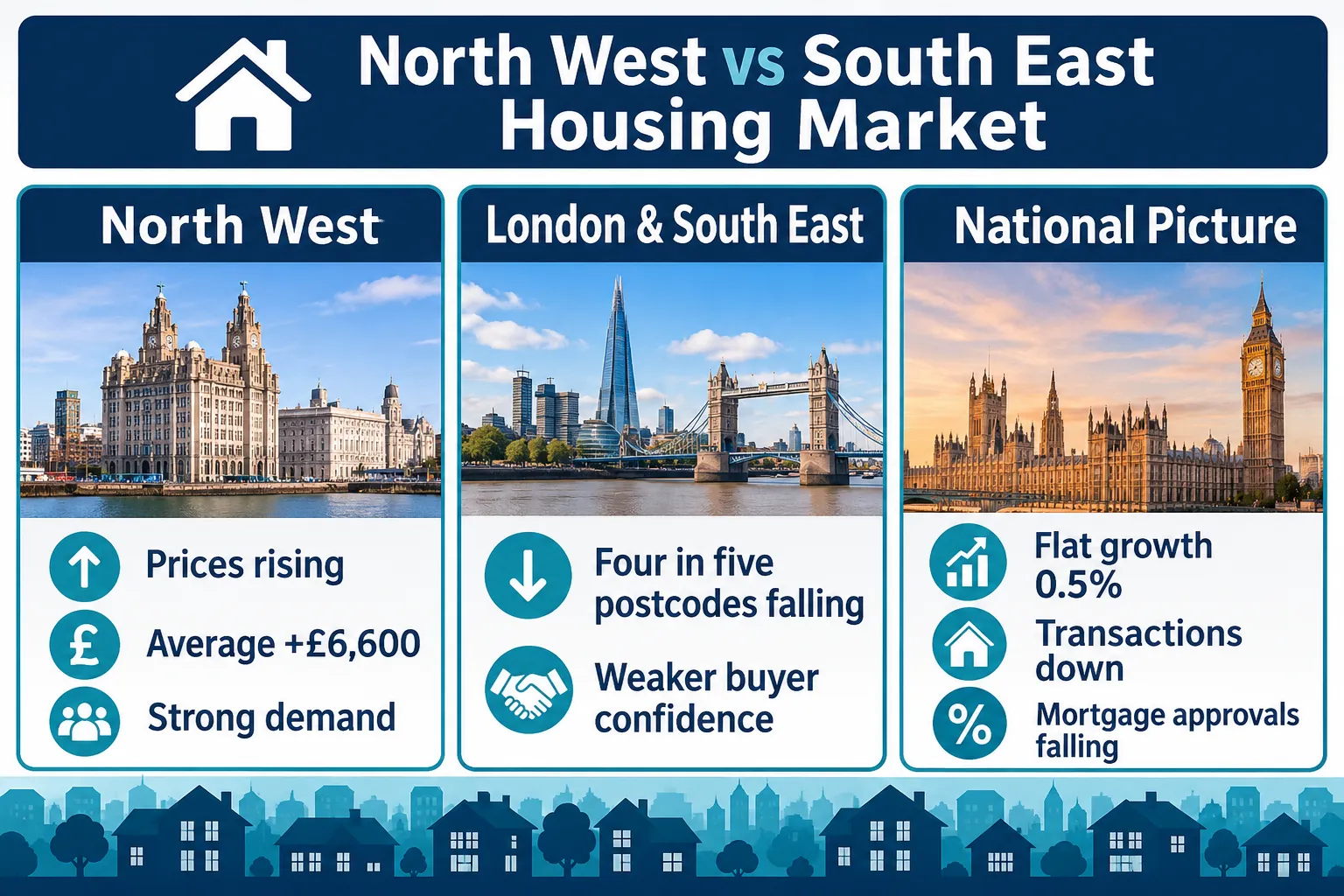
The national picture is more complicated than a simple north-south split suggests. More than a third of homes across the UK are now in postcode areas with falling prices, up from just 12% a year earlier. Sales volumes fell 7% over the year, while the number of homes for sale rose 7%, a classic sign of a market where sellers are more plentiful than confident buyers.
Zoopla's Richard Donnell has noted that buyers are being more selective, though well-priced homes are still selling as quickly as they did last year. He expects activity to strengthen once mortgage rates fall below 5%, and estimates that higher mortgage rates have already cut buyer purchasing power by around 15%, contributing to roughly 100,000 fewer UK transactions in 2026 compared with 2025. Propertymark's Nathan Emerson has described the market as increasingly localised, exactly the dynamic playing out between Manchester's resilient suburbs and softer southern markets.
For readers tracking the region's trajectory, this builds on patterns covered in our North West house price growth update for September 2026 and the October 2026 Zoopla data breakdown.
Why a Rising Market Still Needs an Independent Survey
It is tempting to assume that a rising North West market means less risk for buyers. The opposite is often true. When prices climb and competition returns to popular postcodes, buyers can feel pressure to move fast, skip detailed checks, or trust a lender's valuation as proof the property is sound.
Lender valuations are not full surveys. They exist to protect the lender's loan amount, not the buyer's interests. In a localised market like Greater Manchester, a lender's automated or drive-by valuation can lag behind genuinely strong streets, or, just as commonly, exceed the true condition-adjusted value of a property with hidden defects. Relying on this figure alone, especially against a backdrop of regional momentum, is one of the most common and costly mistakes buyers make.
An independent RICS survey strips out market sentiment and focuses purely on the physical condition of the building. This matters across all three major property types common in Greater Manchester:
Victorian terraces (common in Salford, Stockport and inner Manchester): solid-wall damp issues, ageing roof coverings, historic movement cracks, and outdated electrics hidden behind period features.
1930s semis (widespread in Trafford and Bury): roughcast rendering defects, original single-glazed windows replaced inconsistently, and loft insulation that may not meet current standards.
City-centre apartments: cladding and EWS1 fire safety certification status, escalating service charges, communal roof and lift maintenance liabilities, and leasehold terms that affect resale.
More background on how building condition assessments are evolving nationally is available in our guide to mandatory property condition assessments.
RICS Level 2 vs Level 3: Choosing the Right Survey
A RICS Level 2 Survey (Homebuyer Report) suits conventional properties in reasonable condition, many 1930s semis and well-maintained terraces fall into this category. It identifies significant issues without exhaustive detail.
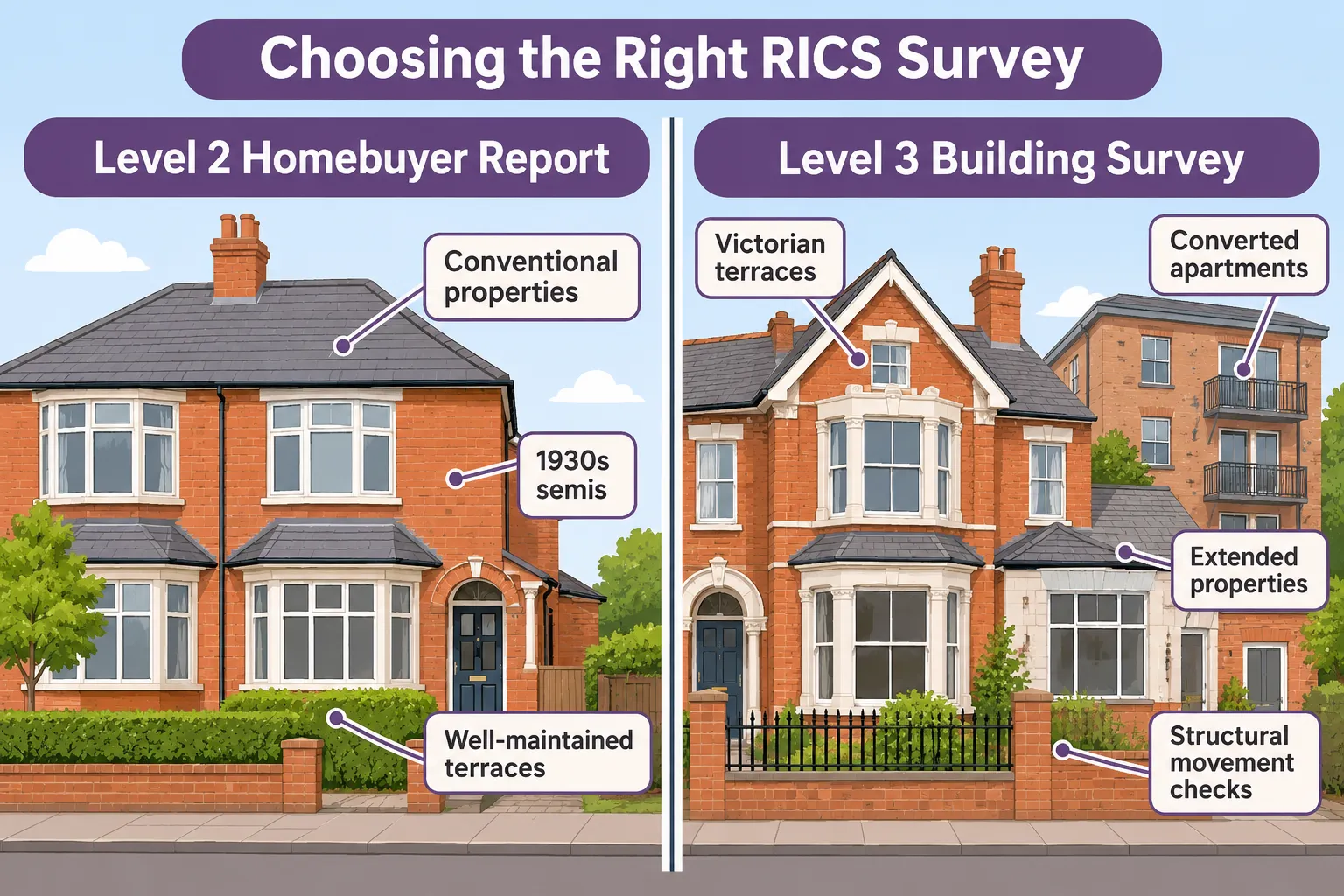
A RICS Level 3 Survey (Building Survey) is more appropriate for older Victorian terraces, properties that have been extended or altered, apartments in converted buildings, or any home where structural movement, damp, or non-standard construction is suspected. It provides a full technical assessment and is the stronger choice when buying into a rising market where emotional pressure to proceed quickly is highest.
Buyers should also be aware that survey costs and scope have shifted recently, see our analysis of building survey price trends in a high-stock market for current expectations.
What This Means for Landlords in Salford, Stockport, Trafford and Bury
Investors buying in the North West's stronger-performing postcodes still need independent valuations to avoid overpaying against momentum, particularly with transaction volumes falling nationally. An accurate, defect-adjusted valuation protects rental yield calculations and supports realistic refinancing decisions. Our coverage of buy-to-let rental yields across the North West and independent property valuations in a cooling market explain why impartial reports matter for landlords.
The Bigger Picture: Rates, Transactions and the 5 November Decision
The wider economic backdrop explains much of the caution buyers are showing nationally, even in a rising region like the North West.
| Indicator | Latest Figure | Source/Date |
|---|---|---|
| North West average price rise (year) | ~£6,600 | Zoopla, 27 Oct 2026 |
| UK average house price | £273,566 (0.5% annual growth) | Nationwide, 30 Oct 2026 |
| UK transactions (Sept 2026) | 94,800, down 4% YoY | HMRC, 2 Nov 2026 |
| Mortgage approvals (Sept 2026) | 53,400, lowest since Dec 2023 | Bank of England |
| Base rate decision | Expected rise 3.75% to 4% | MPC, 5 Nov 2026 |
| Average 2-year fixed mortgage | 5.97% | Moneyfacts, 4 Nov 2026 |
With CPI inflation at 3.5% in September, the Monetary Policy Committee is widely expected to raise the base rate on Thursday, the first increase since August 2023. Combined with five-year fixed mortgage rates already above 6%, this explains why national transaction numbers and mortgage approvals continue to fall even as the North West outperforms on price growth.
Frequently Asked Questions
Is now a good time to buy in Manchester given rising North West prices?
Rising regional prices do not remove the need for careful due diligence. Well-priced homes are still selling at last year's pace, according to Zoopla, but an independent survey remains essential.
Will the Bank of England's 5 November decision affect my mortgage offer?
If the base rate rises as expected, new fixed-rate deals may become more expensive. Existing offers at locked rates are typically unaffected until renewal.
Do I need a Level 3 survey for a Manchester apartment?
Apartments often need specific checks on cladding, EWS1 status and service charges rather than a full structural survey, though a Level 3 may still be advisable for converted period buildings.
Why are national transactions falling while North West prices rise?
Higher mortgage rates have reduced buyer affordability nationally by an estimated 15%, cutting transaction volumes even in regions where prices are still climbing.
Conclusion
The North West's position at the front of regional house price growth is genuine, but it sits within a national market defined by falling transactions, rising supply, and an imminent interest rate decision. Buyers, sellers and landlords across Manchester, Salford, Stockport, Trafford and Bury should treat regional momentum as context, not certainty, independent surveys and valuations remain essential to avoid overpaying or missing structural issues in Victorian terraces, 1930s semis, and city-centre apartments alike.
Contact Manchester Surveyors today to arrange a RICS Level 2 or Level 3 survey, or an independent valuation, before you make your next move in this fast-changing market.