UK average house prices fell 0.2% in August 2026 to approximately £298,468, the first annual decline recorded by the Lloyds House Price Index since November 2023 [1]. That single data point marks a turning point. For anyone buying, selling, lending, or litigating over property, independent property valuations in a cooling UK market: why impartial surveyor reports matter more than ever is not an abstract question. It is a practical, financial, and sometimes legal one.
When markets rise steadily, a rough valuation rarely causes serious harm. When prices are falling, diverging by region, and being reported differently by every major index, the gap between an optimistic estimate and a defensible, evidence-based figure can cost buyers tens of thousands of pounds, cause mortgage applications to collapse, and unravel entire transaction chains.
Key Takeaways
- UK house prices are cooling across multiple indices in 2026, with Lloyds recording the first annual fall since 2023 and asking prices posting their steepest August drop since 2018.
- Different indices, Lloyds, Nationwide, ONS, Rightmove, tell meaningfully different stories, making independent surveyor judgement essential to reconcile conflicting data.
- RICS surveyors are bound by professional standards that require documented methodology, comparable evidence, and impartiality, qualities that protect lenders, buyers, and courts alike.
- Regional divergence is sharp: London asking prices fell roughly 3.1% annually while parts of northern England still show modest growth, meaning national averages can actively mislead.
- In a flat or declining market, an overvalued property risks chain failure, mortgage rejection, and potential legal liability, making impartial reports a financial safeguard, not a formality.
Why the 2026 Market Shift Changes the Valuation Calculus
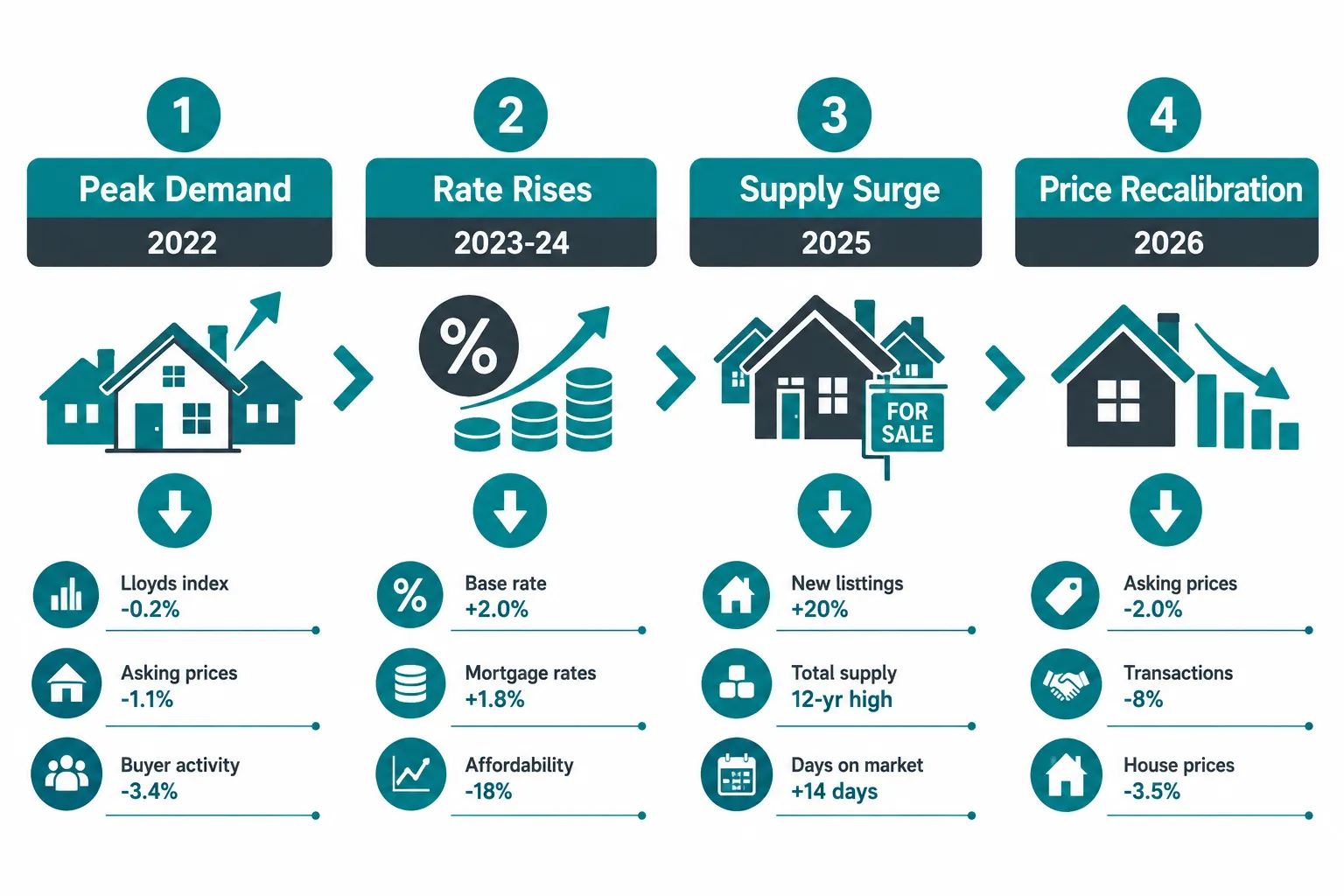
For most of the post-pandemic period, rising prices created a forgiving environment. Even a valuation that was slightly generous tended to be validated by the next sale along the street. That cushion has now been removed.
Asking prices for newly listed homes dropped 2.0% in the four weeks to 8 August 2026, taking the average to approximately £364,999, the steepest August fall in eight years and well above the typical 10-year August decline of 1.3% [2][3]. Rightmove reports that average asking prices are now around 1.0% lower than a year ago and that supply has reached a 12-year high [9]. More homes competing for fewer buyers is a structural shift, not a seasonal blip.
The Royal Institution of Chartered Surveyors (RICS) July 2026 UK Residential Market Survey reinforces this picture. New buyer enquiries registered a net balance of -28% and agreed sales reached -30%, both firmly in negative territory [7]. The national house price balance improved only marginally to -30% from -32% in June and -35% in April [7]. These are not the numbers of a market that is merely pausing.
What this means for valuations:
- Thin transaction volumes reduce the pool of reliable comparable sales.
- Sellers' expectations, shaped by the boom years, often exceed achievable prices.
- Lenders stress-testing loan-to-value ratios need conservative, defensible figures, not optimistic ones.
- Buyers negotiating in a buyer's market need an independent anchor to justify offers below asking price.
Market commentators have described August 2026 as a "summer price recalibration", noting that the 2% drop in asking prices is creating meaningful negotiation leverage for active buyers and aligning more closely with softer completed-sale data [8]. Where asking prices lag behind achievable sale prices, impartial surveyor reports bridge the gap by providing evidence-based valuations that support realistic offers and underpin mortgage approvals [8].
The Index Divergence Problem: Why No Single Headline Figure Is Enough
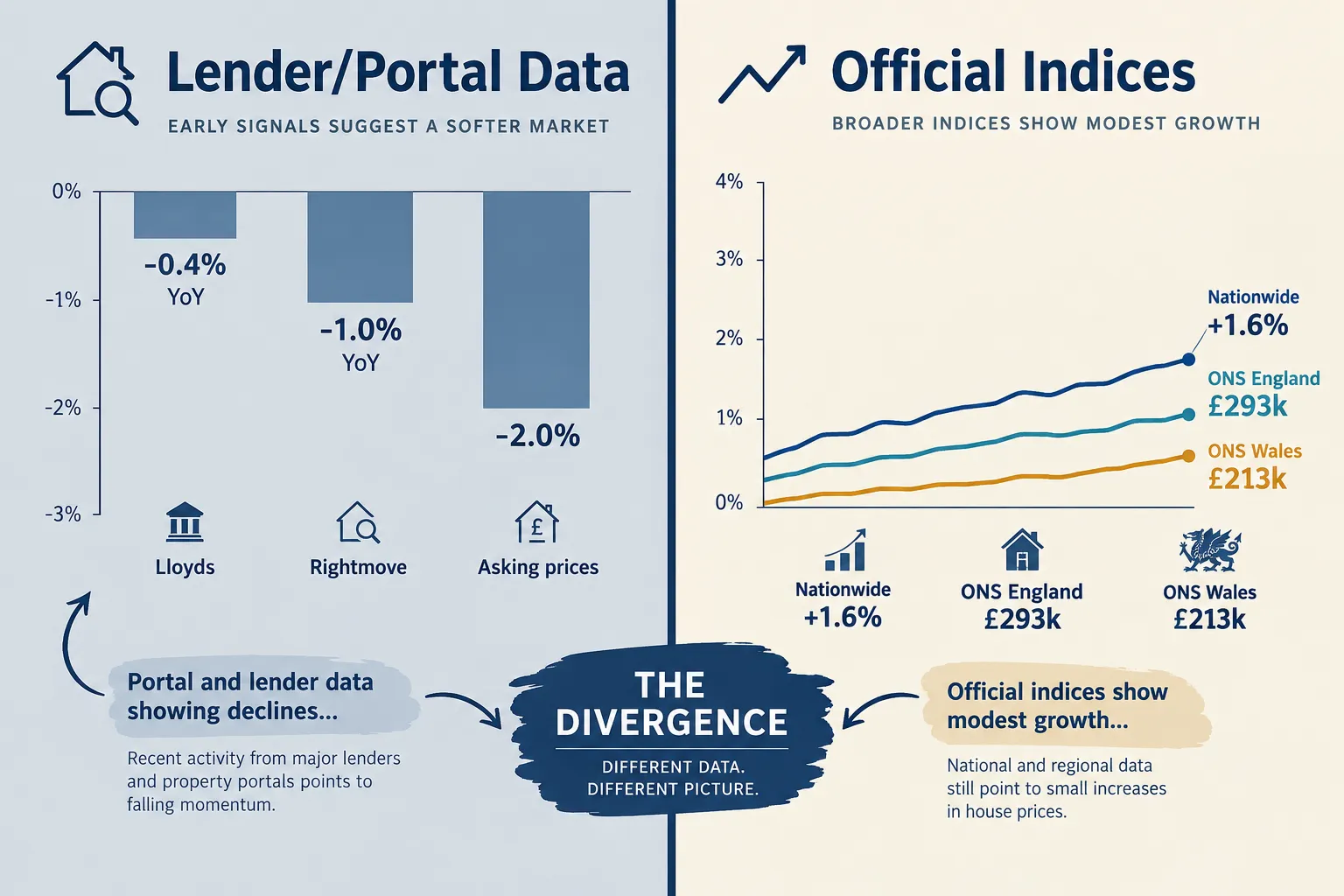
One of the most significant challenges facing valuers in 2026 is that the major indices are not telling the same story, and the differences are large enough to matter.
| Index | August 2026 Figure | Annual Change |
|---|---|---|
| Lloyds House Price Index | £298,468 | -0.4% |
| Nationwide | £275,465 | +1.6% |
| ONS (England) | £293,000 | +1.8% |
| Rightmove (asking prices) | £364,999 | -1.0% |
Sources: [1][5][6][9]
The Nationwide index recorded annual UK house price growth of 1.6% in August 2026, a 0.2% monthly rise, and an average price of roughly £275,465 [5]. The ONS August 2026 bulletin records average house prices of £293,000 in England, £213,000 in Wales, and £195,000 in Scotland, all up approximately 1.8-2.3% over the latest 12-month period [6]. Meanwhile, Lloyds shows the first annual fall since 2023 [1].
These divergences arise from methodology. Lloyds and Nationwide draw on mortgage approvals at the point of offer; the ONS uses completed Land Registry transactions, which lag by weeks or months; Rightmove captures listed asking prices, which are aspirational rather than transacted. Each measures something real but different.
A valuer who simply quotes the most favourable index is not providing an independent valuation, they are providing advocacy dressed as analysis.
For lenders, this distinction is critical. Mortgage underwriters need to know what a property would achieve in a forced sale within a reasonable timeframe, not what the seller hoped to achieve when they listed it. For buyers, the same logic applies: paying a price anchored to a rising-market index in a falling-market environment is a direct financial risk.
Regional divergence compounds the problem. London is seeing some of the sharpest asking-price falls, around a 3.1% annual decline, while parts of northern England still record modest growth [3][12]. A national average is, in many cases, the least useful number a valuer can reach for. Independent surveyor valuations grounded in comparable evidence and local insight are increasingly vital to avoid over-reliance on headline indices that may misrepresent a property's true marketability [7].
Rightmove and associated market commentators have also downgraded their 2026 house price forecasts from around 2% growth to a range between 0% and -2% [2][3][9]. These are forecast expectations rather than observed outcomes, and valuers must weigh them alongside actual sales evidence when advising lenders on loan-to-value ratios and stress-testing security in a potentially falling market [3][8].
How RICS Surveyors Evidence Impartiality, Handle Pressure, and Document for Lenders and Courts

The professional framework that governs RICS-registered valuers exists precisely for markets like this one. Understanding what that framework requires, and why it matters, helps buyers, sellers, and lenders make better decisions about whose valuation to trust.
The RICS Red Book Standard
RICS valuations conducted for secured lending purposes must comply with the RICS Valuation, Global Standards (commonly called the Red Book). This requires valuers to:
- Declare all conflicts of interest before accepting an instruction.
- Select and document comparable evidence from actual completed sales, not asking prices or index averages.
- Apply adjustments transparently, explaining why one comparable is weighted more heavily than another.
- State the basis of value clearly, typically Market Value, defined as the estimated amount for which a property should exchange on the date of valuation between a willing buyer and a willing seller.
- Sign and take personal professional responsibility for the opinion expressed.
These are not optional enhancements. They are minimum standards. A valuation that does not meet them is not a Red Book valuation, regardless of what the document claims.
Handling Client Pressure in a Cooling Market
One of the least-discussed risks in a declining market is valuer pressure. Sellers want high valuations to justify their asking price. Some estate agents have a commercial interest in inflated figures. Lenders processing high volumes of applications may favour valuers who rarely down-value.
A RICS member who inflates a valuation to satisfy a client is in breach of professional standards and potentially liable for negligence. The documented methodology requirement is, in part, a protection against this: if every comparable, every adjustment, and every conclusion is written down, the reasoning is auditable. A valuer who cannot show their working cannot defend their figure.
In practice, this means a robust independent valuation report will typically include:
- A schedule of comparable sales, with addresses, sale dates, prices, and brief property descriptions.
- An explanation of how each comparable was weighted or discounted relative to the subject property.
- Commentary on current market conditions, including, in 2026, the supply surge, falling demand metrics, and regional price trends.
- A clear statement of the assumptions made and any caveats that apply.
- The valuer's RICS membership number and professional indemnity insurance confirmation.
Valuations in Legal and Dispute Contexts
Courts and tribunals regularly rely on RICS valuation evidence in property disputes, matrimonial proceedings, probate, compulsory purchase, and professional negligence claims. The independence and documentation requirements that make a valuation credible for a mortgage lender are the same qualities that make it defensible before a judge.
In a cooling market, the stakes in these contexts rise. A property valued at £350,000 for probate purposes in early 2026 may have achieved only £320,000 by the time it was sold six months later. Whether that gap represents negligent over-valuation or a legitimate market movement depends entirely on the quality of the documented methodology at the time of valuation.
The thin evidence base created by low transaction volumes, highlighted by the RICS survey's -30% agreed sales balance [7], makes the judgement and independence of surveyors more critical when selecting comparables. With fewer recent sales to draw on, the valuer's professional reasoning carries more weight, not less.
What Buyers and Lenders Should Look For
Not all valuation reports are equal. When commissioning or reviewing an independent valuation in the current market, the following questions are worth asking:
- Is the valuer RICS-registered and subject to Red Book requirements?
- Does the report include a schedule of comparable sales with dates and prices?
- Does it explicitly address current market conditions, including falling demand and supply levels?
- Is the basis of value clearly stated?
- Has the valuer disclosed any relationship with the seller, agent, or lender?
A report that answers "yes" to all five is materially more reliable than one that simply states a figure with a brief description.
Conclusion: Actionable Steps for Navigating Valuations in a Cooling Market
The synthesis of Nationwide, Lloyds, Rightmove, and ONS data in 2026 describes a market that is cooling but not crashing, one where some indices still show low positive growth while lender and portal data turn negative [1][5][6][9]. That ambiguity is precisely why independent property valuations in a cooling UK market: why impartial surveyor reports matter more than ever is the right framing for anyone transacting in property right now.
The practical steps that follow from the evidence are straightforward:
For buyers: Commission a RICS Red Book valuation before exchanging contracts, not just the lender's mortgage valuation. The lender's survey protects the lender; a full independent report protects the buyer. In a market where asking prices are running above achievable sale prices [8], an independent figure provides negotiating evidence.
For sellers: Instruct an independent RICS valuer before setting an asking price. Estate agent appraisals are not valuations; they are marketing estimates. In a market where supply is at a 12-year high [9] and buyer enquiries are in negative territory [7], an overpriced listing will simply sit unsold while the market drifts lower beneath it.
For lenders and mortgage brokers: Require documented comparable evidence in every valuation report, and scrutinise reports that rely heavily on index averages rather than local transacted sales. With forecasts ranging from 0% to -2% for the remainder of 2026 [3], stress-testing loan-to-value ratios against a modest further decline is prudent risk management.
For legal professionals: In any matter where property value is in dispute, instruct a RICS-registered expert who can produce a fully documented Red Book report. The methodology trail is what makes the opinion defensible.
The market will eventually stabilise. Until it does, the combination of falling demand, divergent indices, regional price splits, and a thin evidence base makes the independence, methodology, and professional accountability of a qualified surveyor the most valuable element of any property transaction.
References
[1] Uk House Prices Fall August Interest Rates Lloyds – theguardian.com
[2] British House Prices Fall Burnham Interest Rates Oil Bank Taxes Stock Markets Live Updates – theguardian.com
[3] Asking Prices Uk Homes Show Biggest August Fall 8 Years 2026 08 16 – reuters.com
[4] August House Price Fall Signals More Than A Normal Summer Slowdown – mortgagesolutions.co.uk
[5] House Price Growth Remained Subdued In August – nationwide.co.uk
[6] August2026 – ons.gov.uk
[7] Uk Residential Market Survey July 2026 – rics.org
[8] August – samconveyancing.co.uk
[9] Rightmove Hpi 17th August 2026 – rightmove.co.uk
[10] Uk Residential Market Survey – rics.org