One number stands out in Savills' latest five-year outlook: 23.3%. That is the projected house price growth for the North West of England by 2031, the strongest of any UK region, even as the national market is forecast to dip 1.5% in 2027. For anyone buying or selling property in Greater Manchester, this Savills house price forecast North West Manchester data, published on 4 November 2026, deserves close attention.
Savills' revised residential forecasts paint a picture of a two-speed market. Southern England faces a soft patch next year. The North West, by contrast, is tipped to pull ahead on the back of affordability and economic momentum. But regional averages hide a lot of street-level reality, and that is where careful, evidence-based thinking matters most.
Key Takeaways
- Savills forecasts UK house prices to be flat (0.0%) in 2026, fall 1.5% in 2027, then recover from 2028 onwards, totalling +15.8% growth over five years.
- The North West is forecast to rise 23.3% between now and 2031, the strongest of any UK region, driven by relative affordability.
- London, the South East and the East of England are each expected to fall 3.5% in 2027 as higher-value markets stay stretched.
- Savills names Manchester, Leeds, Liverpool and Bristol as likely outperformers thanks to strong employment and investment prospects.
- These are projections from one research firm, not guarantees. Buyers and sellers should still rely on independent valuation evidence for individual properties.
Understanding the Savills House Price Forecast North West Manchester Outlook
Savills' research team has revised its five-year forecast in light of persistently high mortgage rates. The firm expects Bank Rate to sit at 4.00% by the end of 2026, edging up slightly to 4.25% at the end of 2027, before falling to 3.25% in 2028 and settling at 3.00% thereafter. Average mortgage rates are expected to stay above 5% until early 2028, only easing to 5.09% by end-2027 and 4.23% by end-2028.
Emily Williams, director of residential research at Savills, said: "The drawn-out conflict in the Middle East has pushed back the prospect of meaningful mortgage-rate relief. We expect this will suppress activity and put pressure on prices next year." She added, however, that "this is unlikely to trigger a sharper correction," with Savills predicting a peak-to-trough fall of only around 3% nationally.
This Savills house price forecast North West Manchester narrative hinges on affordability. Average property prices across northern England, Wales and Scotland sit below six times average earnings, compared with 11.3 times in London. That gap is exactly why Savills expects northern regions, including the North West, to outperform over the coming five years.
Year-by-Year Forecast Comparison
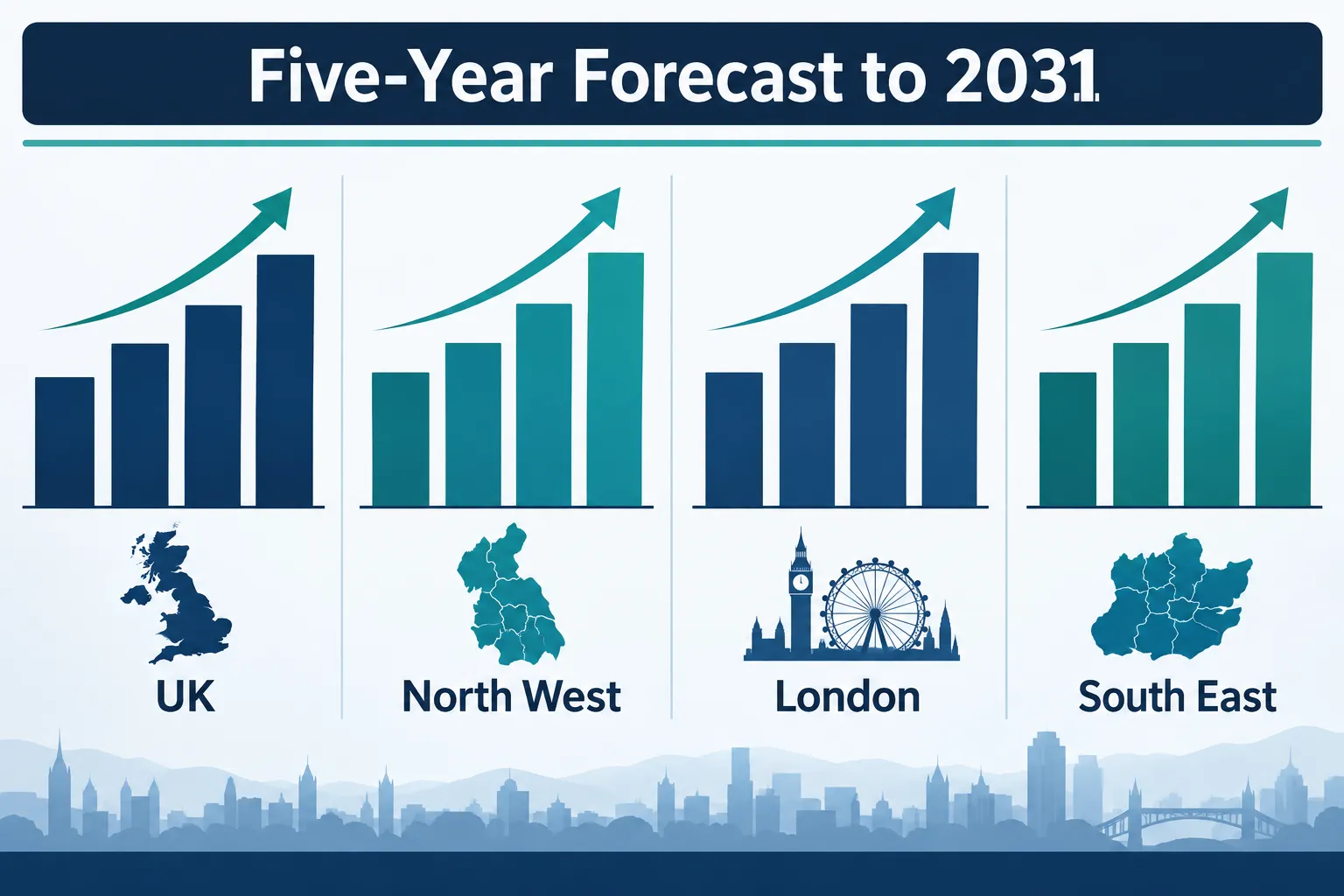
The table below compares Savills' forecasts for the UK overall, the North West, London and the South East. Savills expects UK prices to be flat across 2026 before the following year-by-year movements take effect.
| Year | UK | North West | London | South East |
|---|---|---|---|---|
| 2027 | -1.5% | +1.0% | -3.5% | -3.5% |
| 2028 | +3.5% | +5.0% | +2.0% | +2.0% |
| 2029 | +5.0% | +6.0% | +3.5% | +4.0% |
| 2030 | +5.0% | +6.0% | +3.5% | +4.0% |
| 2031 | +3.0% | +3.5% | +2.5% | +2.5% |
| 5-Year Total | +15.8% | +23.3% | +8.1% | +9.1% |
For context, other regions' five-year totals include the North East at 22.2%, Scotland at 21.6%, Yorkshire and The Humber at 21.0%, Wales at 21.0%, the West Midlands at 16.3%, the East Midlands at 15.7%, the South West at 13.5%, and the East of England at 10.7%. Growth across the five years is also forecast to outpace CPI inflation (9.8%) and nominal income growth (14.4%), reinforcing the affordability story behind the North West's projected outperformance.
Dan Hill, residential research associate at Savills, summed up the logic: "Markets combining relative affordability with strong employment and investment prospects are expected to outperform." He also noted that "as a result, we expect houses to continue outperforming flats," a point with direct relevance for Greater Manchester buyers weighing up apartment living against traditional houses.
What the Savills House Price Forecast Means for Manchester Buyers and Sellers
Savills specifically names Manchester, alongside Leeds, Liverpool and Bristol, as cities likely to outperform the wider regional trend due to strong employment and investment activity. That is encouraging for the local market, but it is a forecast, not a promise. These are one firm's forecasts, built on economic assumptions that can change, particularly around mortgage rates and global events.
A few practical implications stand out for anyone active in the Manchester market right now:
- Transactions may dip before recovering. Savills expects transaction volumes to fall in 2027 before picking up from 2028, meaning patience may be needed for sellers listing in the short term.
- First-time buyers are gaining ground. Savills forecasts first-time buyers could overtake cash buyers as the largest buyer group by 2029, a shift that could change competition dynamics for certain property types.
- Buy-to-let remains subdued. Investor activity is expected to stay below its long-term average, which may ease some competitive pressure for owner-occupiers.
- Houses are tipped to outperform flats. This matters for anyone comparing a terraced house against an apartment in the same postcode.
Why Averages Do Not Tell the Whole Story
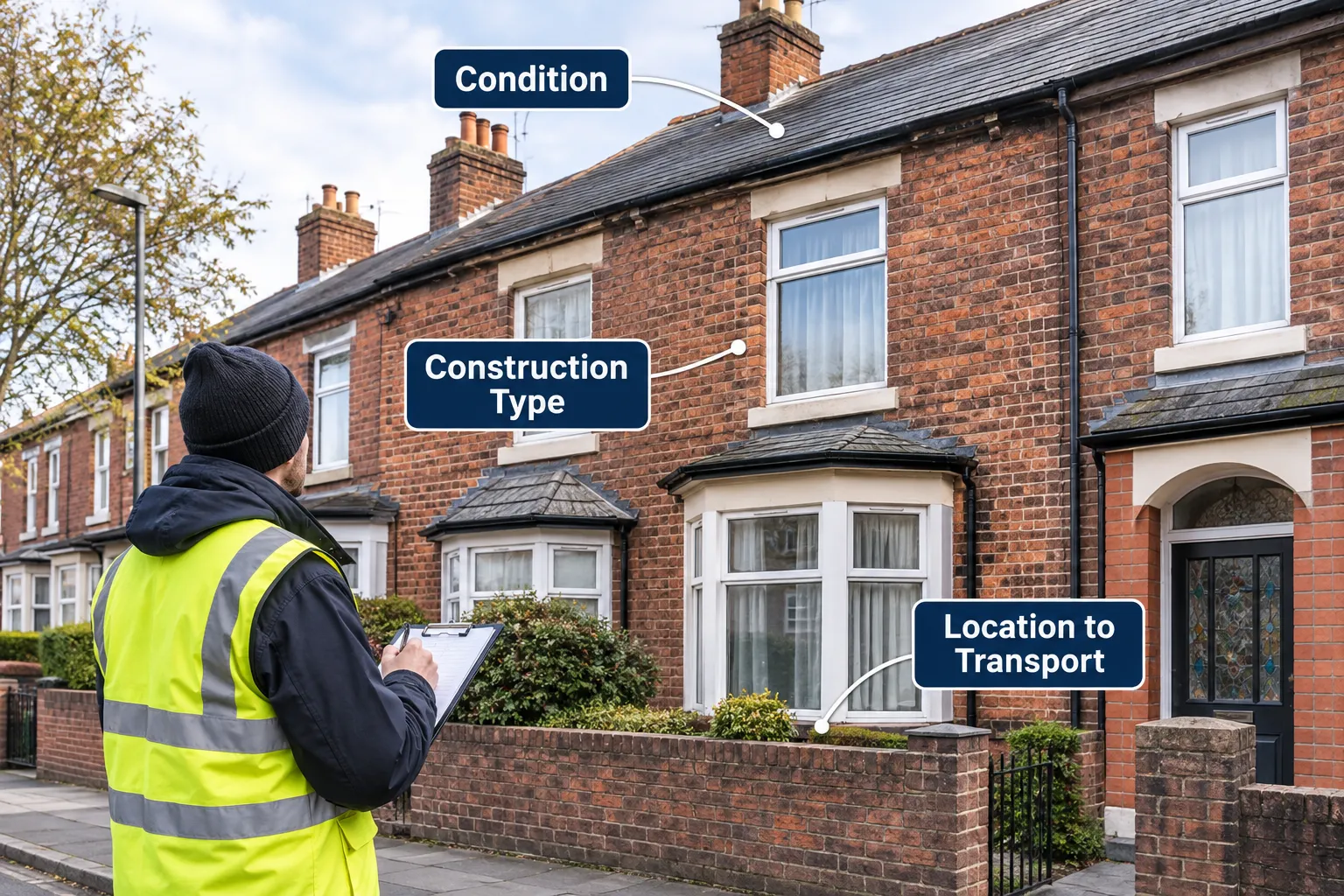
A regional growth figure like 23.3% is useful for understanding broad direction, but it says nothing about an individual street, building, or flat. Within any Greater Manchester postcode, condition, construction type, cladding status, lease terms and location to transport links can create wide swings in value that a regional average simply cannot capture.
This is exactly where independent property advice earns its keep. A RICS Home Survey, paired with solid valuation evidence, protects buyers from overpaying even in a rising market, and it gives sellers a credible, defensible basis for their asking price. Forecasts describe trends across thousands of transactions. A survey describes the one property someone is actually buying.
Caveats Every Buyer and Seller Should Keep in Mind
Savills is one of several forecasting firms, and its figures reflect a specific set of assumptions about interest rates, inflation and the broader economy. Geopolitical shocks, policy changes, or shifts in lending conditions could all alter the path described above. Treat the Savills house price forecast North West Manchester figures as a useful planning tool, not a certainty.
It is also worth remembering that forecasts are regional, not street-level. Manchester covers dozens of distinct micro-markets, from city-centre apartments to suburban family homes, each with its own supply and demand dynamics that a regional percentage cannot fully reflect.
FAQ: Savills House Price Forecast North West Manchester
Does the 23.3% figure apply specifically to Manchester?
No. It is a North West regional average. Savills separately names Manchester as a likely outperformer within that region, but no Manchester-specific price statistic was published.
Why does Savills expect the UK to fall in 2027 while the North West rises?
Savills links the 2027 UK dip mainly to high mortgage rates weighing on higher-priced southern markets. The North West's greater affordability is expected to cushion it against the same pressure.
Should sellers price above asking based on this forecast?
No. Forecasts describe multi-year regional trends, not next month's local market. Pricing should still be based on comparable evidence and, ideally, independent valuation advice.
Will mortgage rates fall soon?
Savills expects average mortgage rates to stay above 5% until early 2028, easing gradually rather than dropping sharply in the near term.
Is buy-to-let still a good strategy under this forecast?
Savills expects buy-to-let activity to remain below its long-term average through the forecast period, suggesting a more measured investor landscape than in previous cycles.
How reliable are five-year house price forecasts?
They are useful directional guides based on current assumptions, but unforeseen economic or political events can change outcomes. No forecast should replace a proper survey or valuation for an individual purchase.
Conclusion
The Savills house price forecast North West Manchester headline of 23.3% growth by 2031 offers a genuinely encouraging backdrop for the regional market, especially against a UK picture clouded by a forecast 2027 dip. Affordability, employment strength and investment activity all support the case for the North West, and Manchester specifically, to outperform.
That said, regional forecasts are a starting point, not a substitute for due diligence. Buyers should commission a RICS Home Survey before committing to a purchase, and sellers should price using solid comparable evidence rather than headline regional percentages. Speaking with a qualified chartered surveyor remains the most reliable way to turn a national forecast into a sound, property-specific decision.