Every £150 added to a typical mortgage payment this year has quietly reshaped who can afford to buy in Greater Manchester, and the new Zoopla and Nationwide figures published this week confirm that the North West is absorbing that shock far better than almost anywhere else in England. The latest Manchester house prices October 2026 Zoopla North West data, released on 1 October and covering activity to the end of August, shows a region still growing while London shrinks. For buyers, sellers and investors across Greater Manchester, understanding why, and what comes next, matters more than ever.
Key Takeaways
- Zoopla's October 2026 index puts North West annual growth at +3.1%, the strongest of any English region, against a UK average of +0.8% (£273,000).
- Nationwide's parallel index records +3.9% North West growth, second only to Northern Ireland, even as its UK monthly figure fell 0.2% in September.
- Listings are up 5% year-on-year but agreed sales are down 9%, tilting negotiating power towards buyers who do their homework.
- Terraced and semi-detached homes are outperforming, while flats nationally fell 1.3% in value.
- Mortgage costs (average two-year fix 5.93%) and the 28 October Budget are the key risks to watch before year end.
The Headline Numbers: Manchester House Prices October 2026 Zoopla North West Data
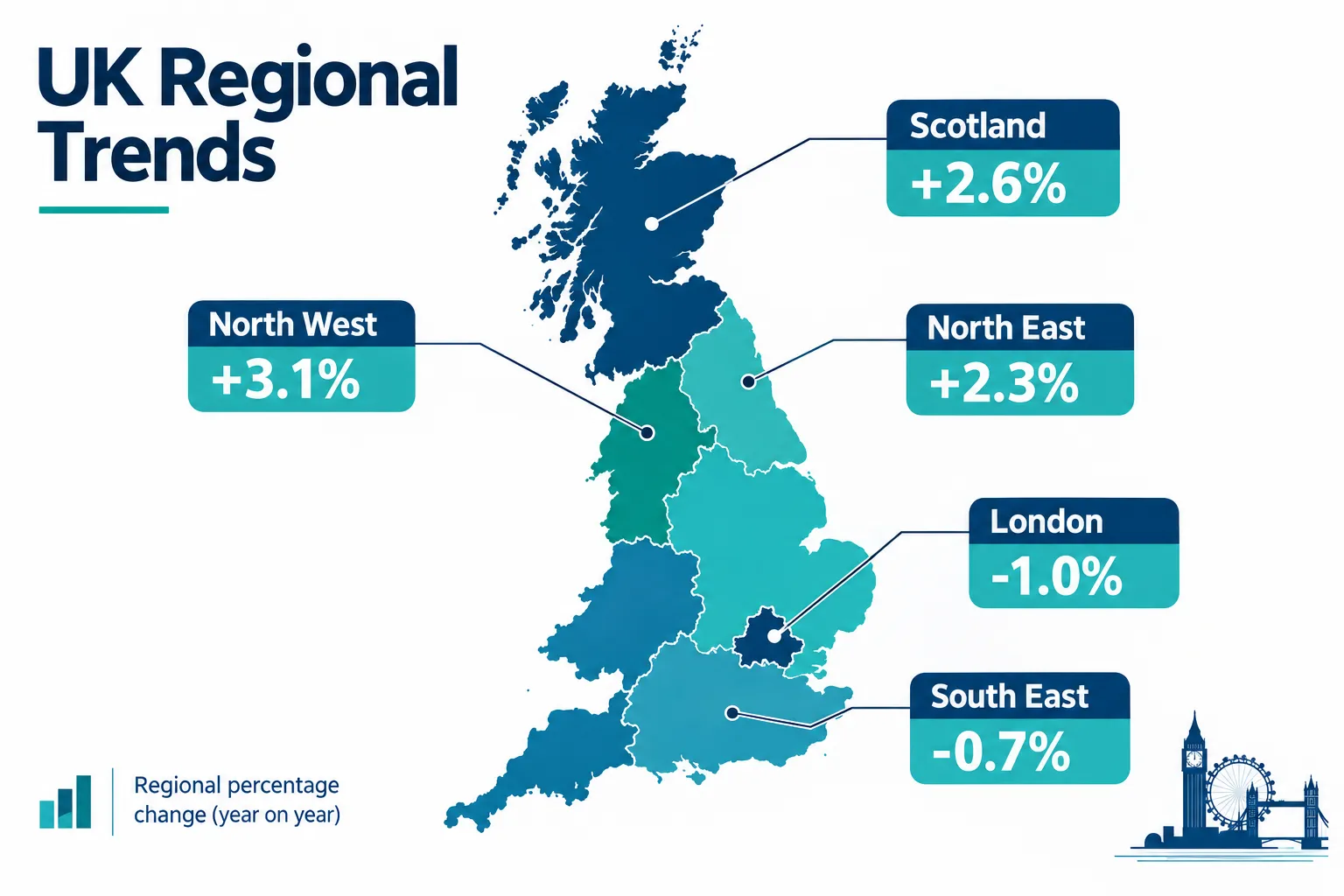
Zoopla's House Price Index, published 1 October 2026 using data to August, puts the average UK home at £273,000, up 0.8%, or roughly £2,160, over the year. That annual growth rate has been cooling steadily, down from 1.3% in June and 0.9% in July. Against that national slowdown, the North West stands out: +3.1% annual growth, the strongest of any English region, ahead of Scotland (+2.6%), the North East (+2.3%) and Wales (+1.8%). London fell 1.0% and the South East dropped 0.7%.
Nationwide's own index, also released 1 October, tells a similar story from a different angle. It records North West annual growth of 3.9%, second nationally only to Northern Ireland's 5.9%. The UK average Nationwide figure sits at £274,251, up 0.8% annually but down 0.2% in September alone, a reminder that momentum is fragile even where growth continues. Nationwide's chief economist Robert Gardner noted that earnings are now rising faster than house prices, a dynamic that is gradually repairing affordability without requiring price falls.
City-level detail reinforces the North West story. Liverpool led all English and Scottish cities tracked by Zoopla at +4.3%, with Newcastle (+2.7%) and Glasgow (+2.6%) also outpacing the national average. Manchester sits within this broader North West strength, benefiting from the same demand fundamentals driving its neighbours forward. For context on how this divergence has built over recent months, see our analysis of Manchester and North West house price growth trends through September.
Why the North West Keeps Outperforming London
The gap between North West growth and London's decline is not a one-month blip. Relative affordability is doing much of the work: with the UK average mortgage rate around 5.2%, up from 4% at the start of 2026, buyers everywhere are stretched, but North West price points leave more room to absorb higher borrowing costs than London's far larger loan sizes. A £150-a-month increase in repayments is proportionally smaller against a North West mortgage than a London one.
Earnings growth outpacing price growth, as Nationwide's Robert Gardner highlighted, is also rebuilding affordability specifically in regions where wages have kept closer pace with local living costs. London and the South East, by contrast, are still working through stretched price-to-income ratios built up over the previous decade.
Richard Donnell, Zoopla's executive director of research, expects borrowing costs to stay elevated and UK-wide price growth to settle around 0.5% by year end, with roughly 1.1 million sales completing across 2026. That national caution makes the North West's resilience even more notable, growth here is not being driven by cheap money, but by demand that has simply not caught up with it yet. Our recent regional divergence report covers this pattern in more depth.
Supply Up, Sales Down: What It Means for Negotiating
Nationally, homes for sale are up 5% year-on-year while sales agreed are down 9%. That combination, more choice, fewer completed deals, is the clearest signal yet that the market has shifted from seller-led to a genuine negotiation. Sellers who priced optimistically through the spring are increasingly competing against a deeper pool of alternatives, and buyers who are mortgage-ready and patient have more leverage than at any point in the past two years.
For Greater Manchester specifically, this shift doesn't erase the region's outperformance, it simply means growth is happening more slowly and selectively, property by property, rather than across the board. Our September market update traced the early stages of this rebalancing, and the latest figures confirm it is continuing into autumn.
Property Type Split: Terraces and Semis Lead, Flats Lag
Zoopla's breakdown by property type shows a clear hierarchy. Semi-detached homes rose 1.7% to an average £282,200, and terraced houses climbed 1.4% to £242,200, both comfortably ahead of the 0.8% national average. Detached homes grew more modestly at 0.8%, averaging £458,700. Flats were the outlier, falling 1.3% to £191,800, continuing a longer-running softness in the apartment segment linked to higher service charges, leaseholder costs and tighter mortgage criteria for flats in blocks above certain heights.
For Manchester, where Victorian terraces and inter-war semis make up a huge share of the housing stock, this split is encouraging for typical family-home sellers but a note of caution for anyone holding or buying a city-centre flat purely for capital growth. Investors should weigh this against current rental demand; our coverage of Manchester landlords' rental market conditions sets out how yields are holding up even where capital values are flat.
Risks on the Horizon: Rates and the Budget
Two dates deserve attention. The Bank of England's next rate decision falls on 5 November 2026, with Bank Rate currently at 3.75% and markets pricing in a rise to 4%. Average two-year fixed mortgage rates are already at 5.93%, the highest since July 2024, so any further tightening will feed directly into affordability calculations for new buyers and anyone remortgaging.
Before that, the Budget on 28 October 2026 carries its own uncertainty. Property taxation, stamp duty thresholds and landlord-focused measures are all plausible areas for change, and buyers and sellers negotiating through October would be wise to build contingency into timelines in case terms shift mid-transaction.
Practical Advice for Manchester Buyers
"A survey does not just confirm a property's condition, it gives buyers hard evidence to renegotiate the price before exchange."
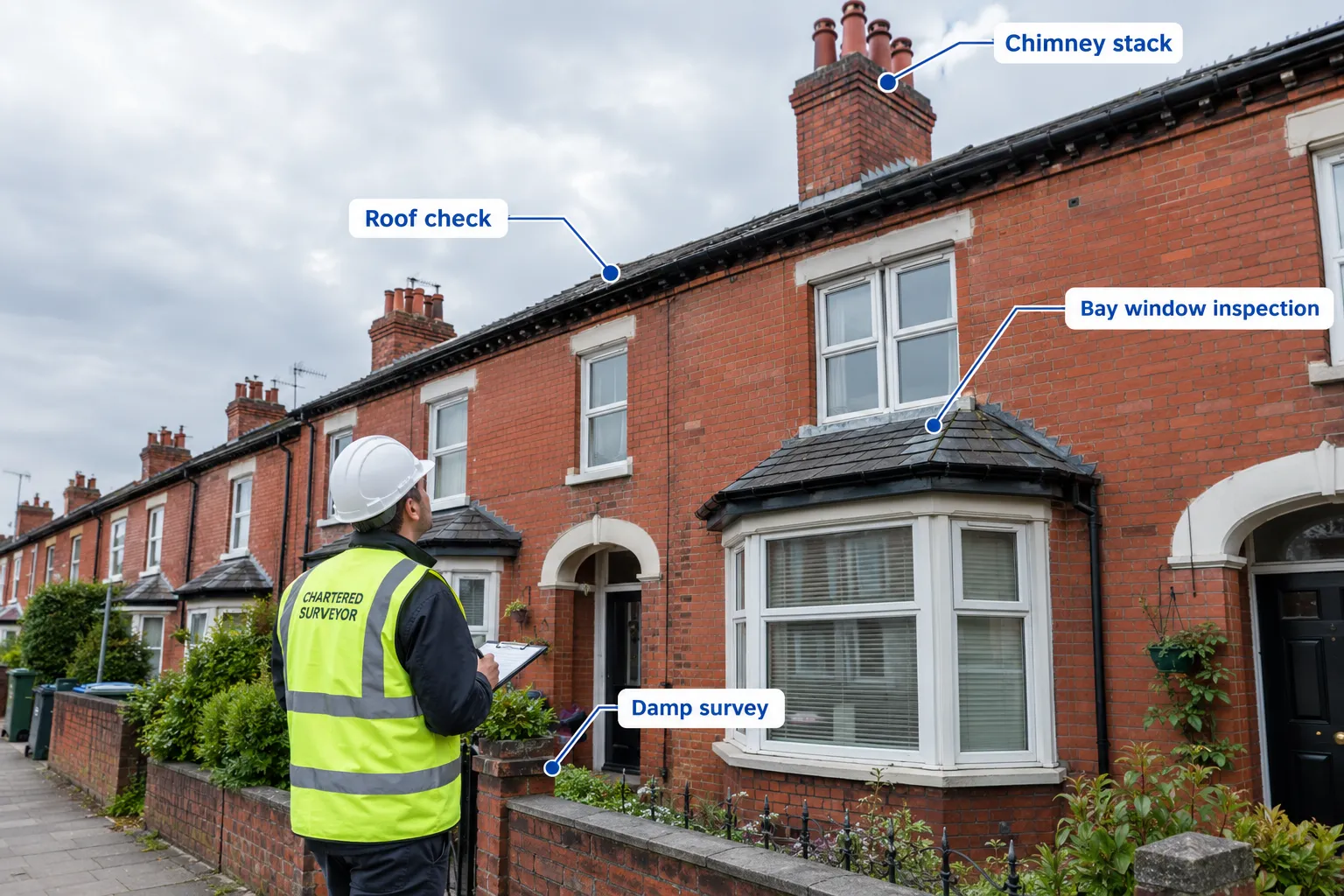
With more stock on the market and sales agreed falling, buyers have genuine room to use independent evidence in negotiations. A RICS Level 2 Home Survey (HomeBuyer Report) suits most standard semis and modern homes, while a Level 3 Building Survey is strongly recommended for older Victorian terraces, properties with visible alterations, or anything showing signs of movement or damp. Commissioning a chartered surveyor in Manchester before exchange is one of the most cost-effective steps a buyer can take in this market.
Common defects to watch for include:
- Victorian terraces: rising damp, ageing chimney stacks, inadequate loft insulation, and lead or outdated electrics.
- 1930s semis: solid-wall damp issues, original single-glazed windows, and roof coverings nearing the end of their lifespan.
- Flats in older conversions: fire safety compliance, lease length, and service charge liabilities tied to communal repairs.
Buyers should also compare any mortgage valuation against the agreed asking price, a gap between the two is useful leverage. Our comparison of online valuations versus RICS valuations explains why a formal inspection carries far more weight in a negotiation than an automated estimate.
Advice for Sellers: Pricing Realistically
With listings up 5% nationally and Manchester buyers facing average mortgage rates above 5%, sellers who price against last spring's market risk being overlooked by buyers comparing a wider pool of options. Realistic pricing, informed by recent comparable sales rather than aspirational figures, now sells faster and closer to asking price than optimistic marketing. A professional valuation report ahead of listing can anchor expectations credibly; our guide to Manchester Red Book valuations explains how chartered valuers reach defensible figures. Sellers should also anticipate buyers arriving with survey findings in hand, understanding likely defects in advance, as covered in our note on rising building survey costs and due diligence trends, helps avoid late-stage price chipping.
Frequently Asked Questions
Is now a good time to buy a house in Manchester?
The North West is outperforming most of the UK on price growth, but higher mortgage rates mean affordability still needs careful checking. Increased stock levels give buyers more negotiating room than a year ago.
Why are Manchester and the North West growing faster than London?
Relative affordability, wage growth outpacing prices locally, and smaller mortgage sizes mean North West buyers are better insulated from rate rises than those in London and the South East.
Should I get a RICS survey before buying in Manchester?
Yes. A Level 2 or Level 3 RICS survey identifies defects and can be used to renegotiate price, particularly important for Victorian terraces and older semis common across Greater Manchester.
Will the Budget on 28 October 2026 affect house prices?
It could. Potential changes to property taxation or stamp duty create uncertainty, so buyers and sellers mid-transaction should build flexibility into their timelines.
Are flats a good investment in Manchester right now?
Flat values fell 1.3% nationally in the latest Zoopla data, reflecting higher costs and stricter lending criteria. Investors should weigh rental yield alongside capital growth expectations.
Conclusion
The October 2026 data confirms what Greater Manchester buyers and sellers have sensed through the autumn: the North West remains the strongest-performing English region even as the national market cools and mortgage rates bite. That resilience is real, but it is not unconditional, rising stock levels, a looming Budget, and the possibility of a further Bank Rate rise on 5 November all warrant caution. Buyers should use the current negotiating environment to their advantage, backed by a proper RICS survey, while sellers should price against today's comparable evidence rather than yesterday's market. For tailored guidance on valuations, surveys or negotiating strategy in Greater Manchester, Manchester Surveyors can help you move forward with confidence.
Manchester house prices, North West property market, Zoopla House Price Index, Nationwide House Price Index, Greater Manchester housing, RICS survey Manchester, mortgage rates 2026, property investment North West, house price growth 2026, Manchester Surveyors, UK housing market 2026, Budget 2026 property