Fewer than one in ten property disputes that reach the expert witness stage are resolved without a formal report — yet the quality of that report often determines whether a case succeeds or collapses before it reaches a judge. Residential Expert Witness Services: Surveyor Roles in Boundary, Party Wall, and Valuation Court Cases sit at the intersection of technical surveying knowledge and strict legal obligation, making the choice of expert one of the most consequential decisions a property litigant can make.
This guide explains what chartered surveyor expert witnesses actually do, how they are regulated, and what property owners, solicitors, and developers need to understand before instructing one.
Key Takeaways
- A surveyor acting as an expert witness owes an overriding duty to the court or tribunal, not to the client who is paying the fee.
- RICS professional standards, updated in February 2023, require expert reports to comply with CPR Part 35 and include a signed statement of truth.
- Chartered surveyors provide expert evidence across boundary disputes, party wall matters, and residential valuation cases.
- A well-prepared CPR Part 35 report, and a credible joint statement, can significantly narrow the issues in dispute before a hearing.
- Instructing a specialist with direct experience in the relevant property type and dispute category is essential for a credible, court-ready opinion.
What Is a Residential Expert Witness Surveyor?
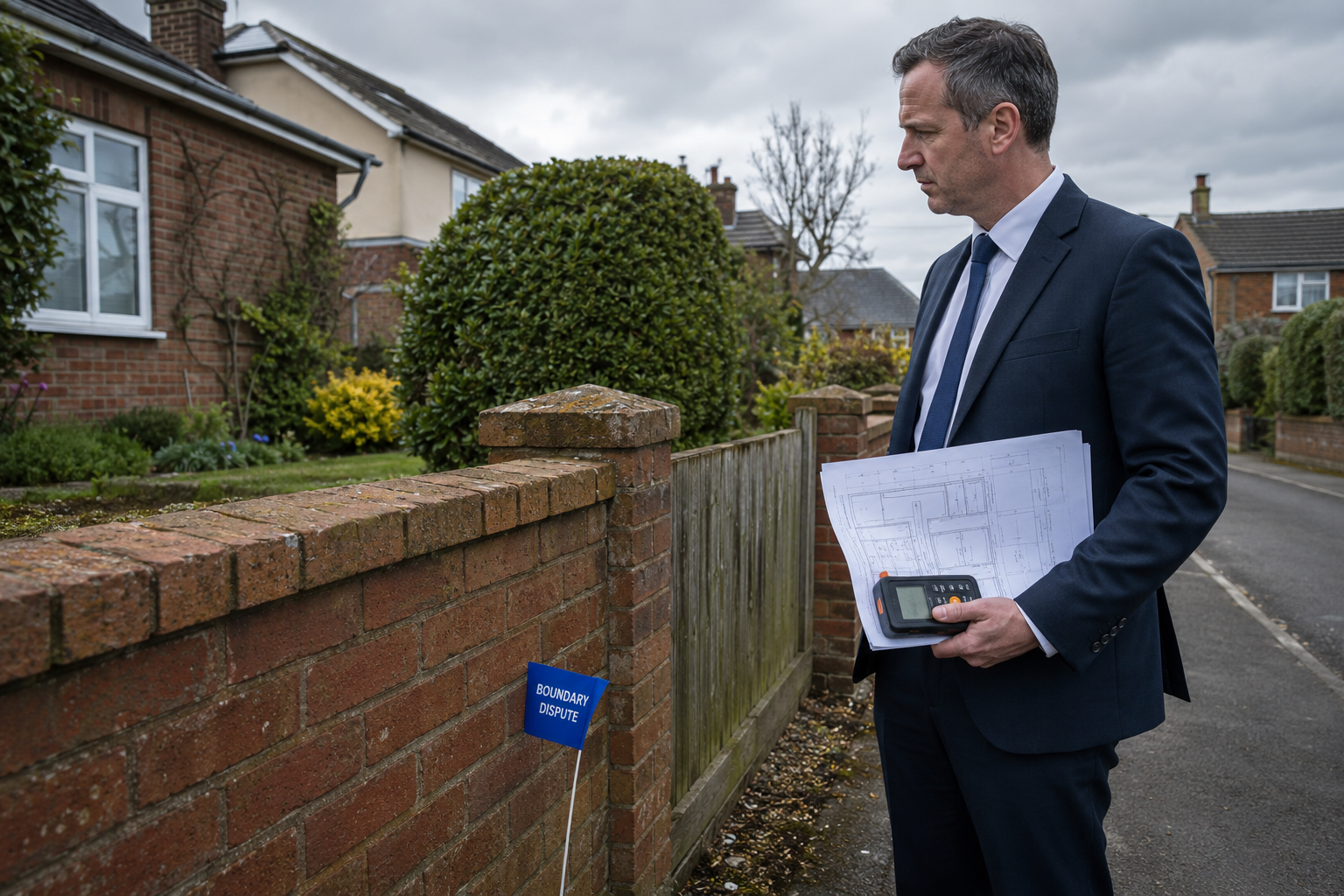
An expert witness is a person with specialist knowledge, skill, or experience whose opinion is admissible in legal proceedings. In property litigation, that person is almost always a chartered surveyor — specifically one holding RICS membership and practising within the area of dispute.[1]
Unlike a factual witness, who can only describe what they personally observed, an expert witness is permitted to give an opinion. That opinion must, however, be independent and impartial. The RICS professional statement "Surveyors acting as expert witnesses", last amended in February 2023, makes this duty explicit: the expert's overriding obligation is to the tribunal, and that obligation overrides any contractual duty owed to the instructing client.[4]
This distinction matters enormously in practice. A surveyor who shades their opinion to favour the party paying their fee risks being discredited in cross-examination, and may face disciplinary action from RICS. Courts have become increasingly alert to "hired gun" experts, and judges are entitled to reject expert evidence they find partial or unreliable.
Who Instructs a Surveyor Expert Witness?
Expert witnesses are typically instructed by:
- Solicitors acting for claimants or defendants in civil litigation
- Parties in person who are representing themselves in the First-tier Tribunal (Property Chamber)
- Mediators seeking a neutral technical opinion to facilitate settlement
- Courts directly, where a single joint expert (SJE) is appointed
The RICS client guide on expert witness services notes that the expert's report must conclude with a signed statement of truth, confirming the expert understands and accepts their duty to the court.[5] This is not optional — it is a mandatory requirement under CPR Practice Direction 35.
The Regulatory Framework: CPR Part 35 and RICS Standards
Understanding the legal framework is essential before instructing any expert. Two overlapping sets of rules govern how surveyor expert witnesses must behave in England and Wales.
Civil Procedure Rules Part 35
CPR Part 35 and its accompanying Practice Direction set out the procedural requirements for expert evidence in civil proceedings. Key obligations include:
| Requirement | Detail |
|---|---|
| Duty to the court | Overrides duty to the instructing party |
| Written report format | Must comply with PD 35 structure |
| Statement of truth | Must be signed by the expert personally |
| Questions to experts | Opposing party may submit written questions |
| Joint statement | Experts from each side must meet and produce a statement of agreed and disputed issues |
Failure to comply with CPR Part 35 can result in the report being excluded from evidence entirely — a catastrophic outcome for the instructing party.[2]
RICS Professional Statement (February 2023 Update)
The RICS professional statement requires surveyors to present facts fully and give truthful, impartial, and independent opinions.[4] It applies to all RICS members acting as expert witnesses, regardless of the type of tribunal or court involved. This includes the County Court, the High Court, the First-tier Tribunal (Property Chamber), the Upper Tribunal (Lands Chamber), and arbitration proceedings.
"The expert's overriding duty is to the tribunal. This duty overrides any obligation to the person from whom the expert has received instructions or by whom the expert is paid." — RICS Professional Statement, February 2023 [4]
Surveyors who breach this standard face not only professional sanctions but also the risk of costs orders being made against them personally by the court.
Boundary Disputes: How Surveyors Establish the Legal Line
Boundary disputes are among the most emotionally charged and technically complex matters in residential property law. A disagreement over a few centimetres of land can generate years of litigation and tens of thousands of pounds in legal costs.
A chartered surveyor instructed as a boundary expert will typically:
- Review title deeds and Land Registry documents — including the filed plan, conveyance plans, and any historic deeds predating Land Registry registration
- Carry out a measured survey of the site — using total station equipment or GPS to produce an accurate scaled plan
- Examine physical features — walls, fences, hedges, ditches, and other boundary indicators
- Research historical evidence — Ordnance Survey maps, aerial photographs, and planning records
- Produce a CPR Part 35 compliant report — setting out the evidence and giving a reasoned opinion on the legal boundary position
The expert's role is not to advocate for one party's version of events. It is to analyse all available evidence and give the court an honest, reasoned opinion.[3] Where two experts are instructed — one by each side — they will be required to meet and produce a joint statement identifying the issues they agree on and those they do not.
For property owners in London and the South East, local chartered surveyors with specific knowledge of regional conveyancing practices and historic mapping can be particularly valuable. Firms serving areas such as North London and Islington will be familiar with the dense, complex boundary patterns common in Victorian terraced housing stock.
Party Wall Disputes: Surveyor Expert Witness Roles Under the Party Wall Act
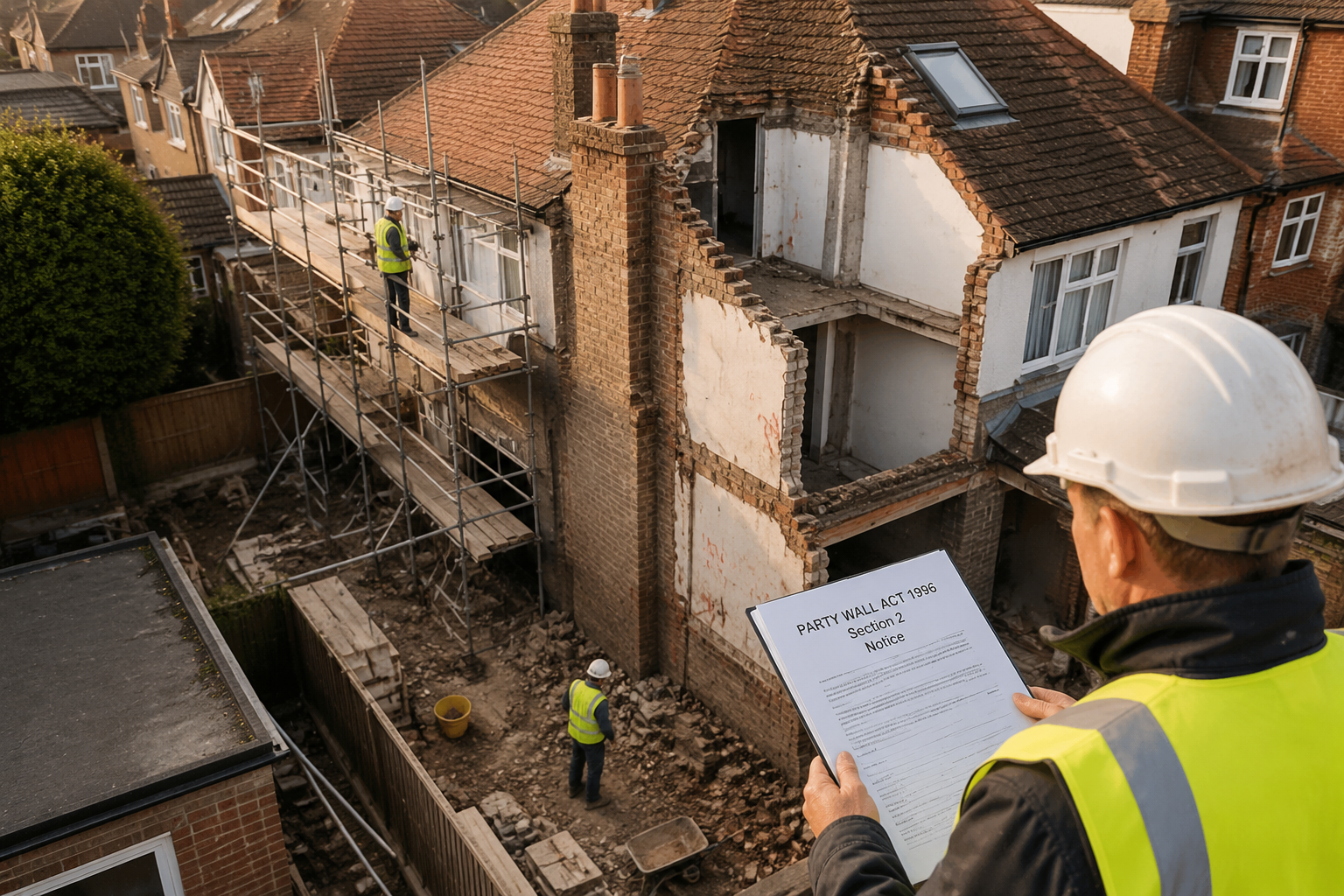
The Party Wall etc. Act 1996 creates a specific statutory framework for resolving disputes between adjoining owners. Most party wall matters are resolved through the appointment of surveyors under the Act itself — but when those processes break down, or when one party alleges negligence or damage arising from party wall works, the matter may escalate to court proceedings requiring formal expert evidence.
When Party Wall Matters Reach Court
Common scenarios where party wall issues require an expert witness include:
- Damage claims — where an adjoining owner alleges that notifiable works caused structural damage to their property
- Negligence claims — where a party wall surveyor is alleged to have acted improperly or outside their statutory powers
- Injunction applications — where works are being carried out without a valid party wall agreement
- Appeals — against a party wall award in the County Court
Understanding what a party wall dispute involves is the essential starting point. If a neighbour is carrying out works without a party wall agreement, the aggrieved owner may need both a party wall surveyor and a separate expert witness surveyor — roles that must remain distinct to preserve independence.
A surveyor acting as expert witness in a party wall case will typically assess:
- Whether the correct notices were served under the Act
- Whether the works carried out fell within the scope of the agreed award
- The nature, cause, and extent of any alleged damage
- The cost of remediation, supported by evidence
For a thorough understanding of the award process, the party wall award guidance sets out how awards are structured and what they must contain. This background knowledge is directly relevant to any expert instructed to comment on whether an award was properly made or followed.
Monitoring Surveys and Pre-Works Schedules of Condition
One of the most valuable preventative tools in party wall disputes is a schedule of condition — a detailed photographic and written record of an adjoining property's condition before works begin. When damage is later alleged, this document becomes critical evidence. Monitoring surveys can also track structural movement during and after works, providing objective data that an expert witness can rely on in their report.
Valuation Disputes: Expert Evidence in Residential Property Cases
Valuation disputes arise in a wide range of residential property contexts, and chartered surveyor expert witnesses are regularly instructed to provide independent opinions on market value, diminution in value, and other valuation questions.[7]
Common Valuation Dispute Types
Lease extension and enfranchisement — The First-tier Tribunal (Property Chamber) regularly hears contested lease extension applications where the parties cannot agree on the premium. Each side typically instructs a RICS-registered valuer to produce a CPR Part 35 report. The tribunal will then consider both reports, the joint statement, and oral evidence before determining the premium. The lease extension valuation process involves complex calculations around marriage value, relativity, and deferment rates — all of which require specialist expert evidence.
Negligent valuation claims — Where a mortgage valuation or survey is alleged to have been negligent, the claimant must establish both that the valuation was wrong and that a competent valuer would have reached a different figure. This requires expert evidence from an independent RICS valuer.[8] It is worth noting that a mortgage valuation is not the same as a full survey, and the scope of the duty of care differs accordingly.
Compulsory purchase and compensation — Where land or property is acquired compulsorily, disputes over compensation are determined by the Upper Tribunal (Lands Chamber), which routinely receives expert valuation evidence.
Matrimonial and probate proceedings — Courts dealing with asset division or estate administration frequently require independent expert valuations of residential property.
Right to buy disputes — Challenges to the valuation of a property under the Right to Buy scheme may require expert evidence. RICS Right to Buy valuations must follow specific statutory guidance, and an expert instructed in this area must be familiar with both the valuation methodology and the legal framework.
What Makes a Strong Expert Witness Report?
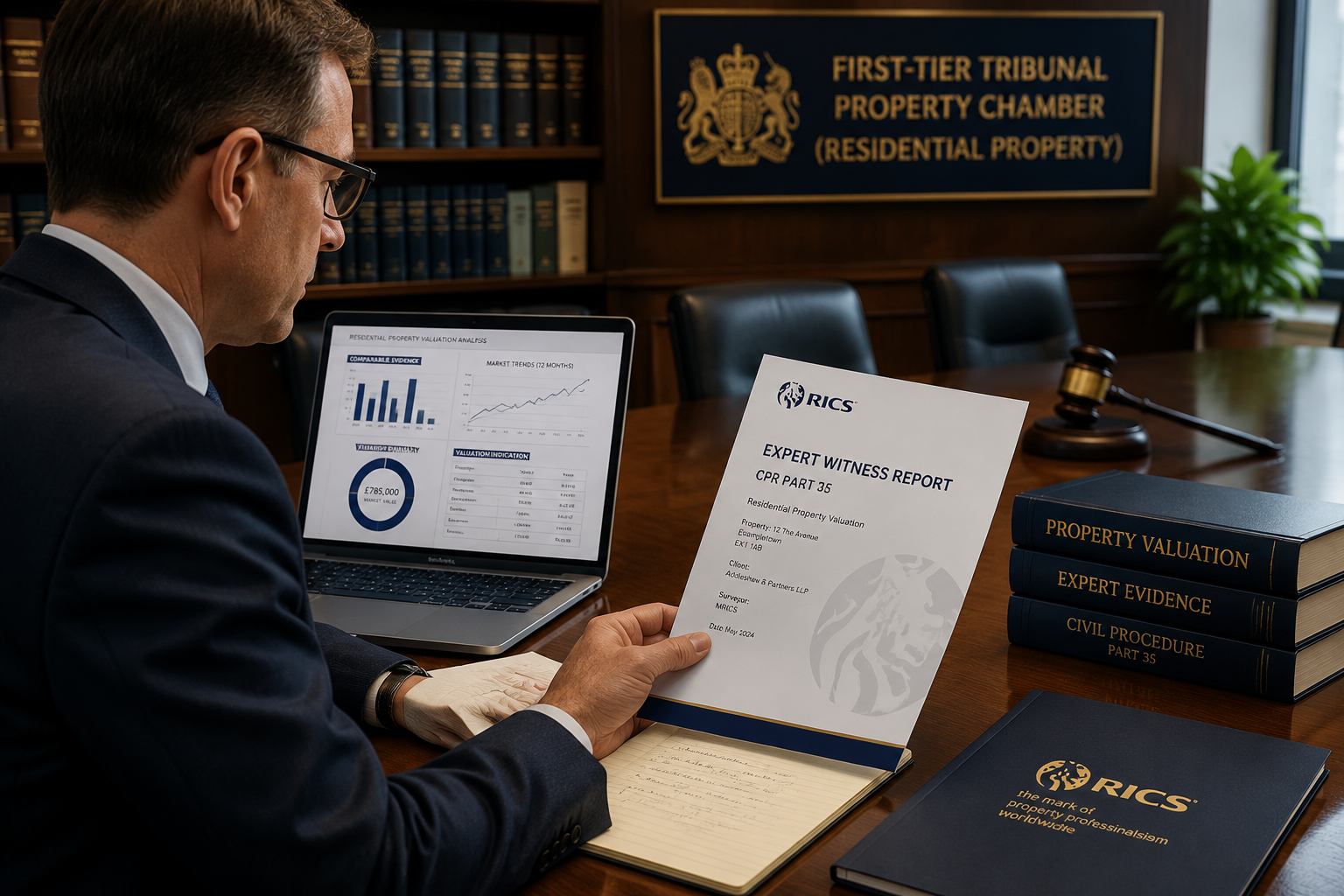
The quality of an expert witness report determines whether the expert's opinion will carry weight with the court. A well-drafted report will:
- Open with a clear statement of the expert's qualifications and experience
- Define the scope of the instructions received
- Set out the factual background, distinguishing clearly between facts and assumptions
- Summarise the evidence examined — documents, site inspections, comparable data
- Present a reasoned analysis, acknowledging any areas of uncertainty
- State a clear opinion, with reasons
- Address alternative interpretations and explain why they are rejected
- Conclude with a signed statement of truth in the precise form required by CPR PD 35
Reports that are poorly structured, that fail to distinguish fact from opinion, or that read as advocacy rather than independent analysis are routinely criticised by judges and can damage the instructing party's case.[2]
The Joint Statement Process
Where each party has instructed their own expert, the court will typically direct those experts to meet — without their clients or solicitors present — and produce a joint statement. This document must:
- List the issues on which the experts agree
- List the issues on which they disagree
- Summarise the reasons for any disagreement
The joint statement is often the most influential document in the entire case. When experts agree on the key issues, the court's task is greatly simplified. When they disagree, the reasons stated in the joint statement shape the cross-examination at trial.[3]
Experienced expert witnesses understand that the joint statement process requires genuine engagement, not defensive posturing. An expert who refuses to concede any point — regardless of the evidence — will lose credibility quickly.
Choosing the Right Expert for Residential Expert Witness Services: Surveyor Roles in Boundary, Party Wall, and Valuation Court Cases
Not every chartered surveyor is qualified to act as an expert witness, and not every expert witness surveyor has the right specialism for every case. The following checklist helps solicitors and property owners identify the right expert.
Qualifications and membership
- RICS membership (MRICS or FRICS) in the relevant discipline
- Specific experience in the type of dispute (boundary, party wall, or valuation)
- Familiarity with CPR Part 35 and RICS professional statement requirements
Track record
- Experience of producing reports for the relevant tribunal or court
- Experience of giving oral evidence and being cross-examined
- Participation in joint statement meetings
Independence
- No prior involvement with the property or the parties
- No commercial relationship that could compromise impartiality
Geographic knowledge
- Familiarity with local market conditions (for valuation cases)
- Knowledge of local conveyancing practices and mapping (for boundary cases)
Firms operating across London and the Home Counties — including those serving Ealing, Bromley, and Hertfordshire — will have direct familiarity with the property types and local market dynamics most relevant to residential disputes in those areas.
Single Joint Experts vs. Party-Appointed Experts
Courts increasingly encourage the use of a single joint expert (SJE), particularly in lower-value cases. An SJE is appointed by both parties and reports to the court alone. This reduces costs but means neither party has the benefit of a privately instructed expert reviewing the SJE's conclusions.
In higher-value or more technically complex cases, each party will typically instruct their own expert. The costs are higher, but the ability to challenge the opposing expert's methodology and conclusions through cross-examination can be decisive.
Residential Expert Witness Services: Surveyor Roles in Boundary, Party Wall, and Valuation Court Cases — Practical Considerations
Several practical points are worth emphasising for anyone considering instructing an expert witness surveyor in 2026.
Early instruction matters. Courts set tight timetables for the exchange of expert reports. Instructing an expert at the last minute risks a rushed, inadequate report or a missed deadline. Early instruction also allows the expert to advise on the strength of the technical case before significant legal costs are incurred.
Costs proportionality. Expert witness fees must be proportionate to the value of the dispute. In lower-value cases, the court may limit the recoverable expert costs even if the report is excellent. Discuss fee structures and likely recoverable costs with the instructing solicitor at the outset.
Without prejudice meetings. The joint statement meeting between experts is conducted on a without prejudice basis. Clients and solicitors should not attempt to influence what the expert concedes or maintains in that meeting — doing so risks undermining the expert's independence and, in serious cases, could constitute contempt of court.
Scope of expertise. A surveyor must only give opinions within their area of expertise.[1] A building surveyor instructed in a boundary dispute should not stray into legal interpretation of title documents; a valuer instructed in a negligent survey case should not opine on structural engineering matters outside their competence.
Conclusion
Residential Expert Witness Services: Surveyor Roles in Boundary, Party Wall, and Valuation Court Cases represent a highly specialised area of practice that demands both deep technical knowledge and a thorough understanding of procedural law. The stakes are high: a poorly prepared expert report can lose a case that the underlying evidence would otherwise support, while a rigorous, impartial report from a credible expert can resolve a dispute before it ever reaches a hearing.
Actionable next steps for property owners and solicitors:
- Identify the right specialism early — boundary, party wall, or valuation disputes each require different expertise. Do not assume that any RICS member can serve all three roles equally well.
- Review the expert's CPR Part 35 experience — ask specifically whether they have produced reports for the relevant court or tribunal and whether they have given oral evidence.
- Instruct early — court timetables are unforgiving, and a rushed report is rarely a good report.
- Understand the joint statement process — brief the expert clearly on the issues in dispute, then allow them to engage independently in the joint meeting.
- Consider proportionality — match the level of expert instruction to the value and complexity of the dispute.
For those seeking an expert witness surveyor with experience across residential dispute types, instructing a firm with a demonstrable track record in CPR Part 35 reporting, tribunal appearances, and joint statement meetings is the surest foundation for a well-presented case.
References
[1] Require An Expert Witness Property Surveyor – https://charteredsurveyorlondon.com/require-an-expert-witness-property-surveyor
[2] How A Building Surveyor Expert Witness Can Assist With Your Court Case – https://www.expertcourtreports.co.uk/blog/how-a-building-surveyor-expert-witness-can-assist-with-your-court-case/
[3] Surveyors in Court – https://www.plsc.net/docs/(Pehr)_SurveyorInCt.pdf
[4] Surveyors Acting as Expert Witnesses (February 2023 Amendment) – https://www.rics.org/content/dam/ricsglobal/documents/standards/Surveyors%20acting%20as%20expert%20witnesses_Feb2023amend.pdf
[5] Surveyors Acting As Expert Witnesses Client Guide – https://www.rics.org/content/dam/ricsglobal/documents/standards/Surveyors_Acting_As_Expert_Witnesses_Client_Guide.pdf
[7] Why You Might Need An Expert Witness Report: A Guide From Daw Surveyors – https://www.dawsurveyors.co.uk/home-survey-blog/why-you-might-need-an-expert-witness-report-a-guide-from-daw-surveyors
[8] RICS Expert Witness – https://www.dawsurveyors.co.uk/rics-expert-witness