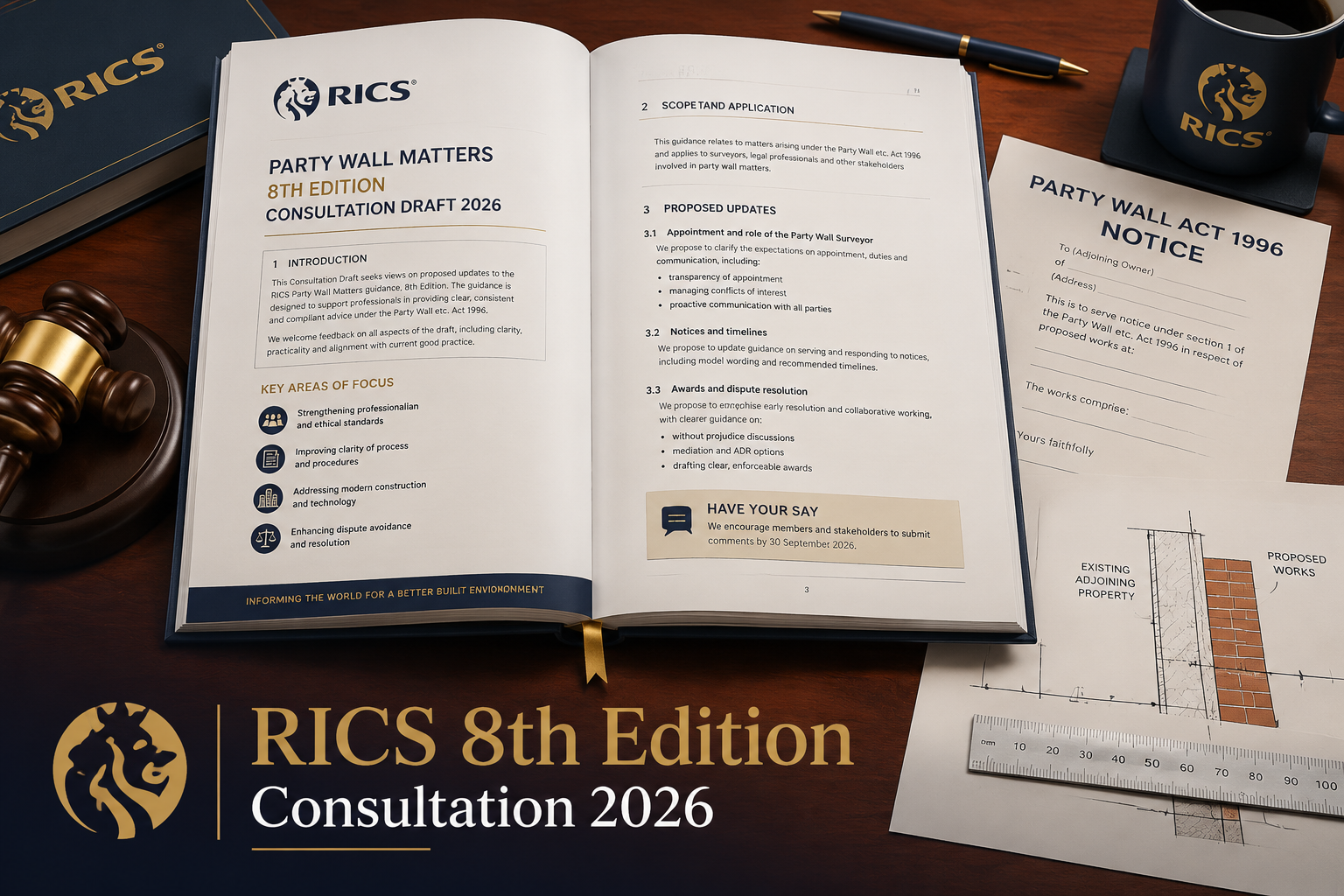
Over 90% of party wall disputes in England and Wales involve some form of procedural error — a striking figure that reveals just how much pressure the system is under, and why the arrival of the RICS 8th edition guidance matters so profoundly. [4] For professionals grappling with Party Wall Surveyor Independence Under RICS 8th Edition: Navigating Client Pressures and Statutory Duties in 2026 Projects, the stakes are both legal and reputational. A surveyor who yields to client demands — even subtly — risks not only an invalidated award but a formal conduct complaint. The RICS launched an eight-week public consultation in April and May 2026 on the draft 8th edition of "Party Wall Legislation and Procedure," signalling a decisive shift toward tighter standards, clearer jurisdiction rules, and stronger protections for impartiality. [1]
Key Takeaways
- The RICS 8th edition draft, consulted on in 2026, reinforces that a party wall surveyor's appointment is statutory and personal — not subject to client override.
- Surveyors must now satisfy dual obligations: statutory duties under the Party Wall etc. Act 1996 and the RICS Rules of Conduct.
- Updated award templates and letters of appointment reduce procedural errors and strengthen jurisdiction clarity.
- Developer pressure is a documented risk; surveyors must document their reasoning and act within their granted powers at all times.
- The Third Surveyor mechanism and revised fee guidance are key tools for maintaining fairness in contested 2026 projects.
Why Surveyor Independence Is the Cornerstone of the Party Wall Process
The Party Wall etc. Act 1996 does not simply create a dispute resolution mechanism — it creates a quasi-judicial function. When a surveyor accepts an appointment under the Act, whether as an agreed surveyor or as one of two appointed surveyors, that appointment is personal and statutory. The client does not retain the right to direct the surveyor's decisions, override their findings, or terminate their appointment to secure a more favourable outcome.
The draft 8th edition makes this explicit. It reinforces that RICS members must adhere not only to their statutory duties under the Act but also to the RICS Rules of Conduct and broader professional and ethical standards. [2] This dual obligation is not merely procedural. It reflects the reality that party wall surveyors operate in an environment where financial interests are significant, timelines are tight, and the pressure to "move things along" can be intense.
The Dual Obligation Framework
| Obligation | Source | Practical Implication |
|---|---|---|
| Statutory duty | Party Wall etc. Act 1996 | Must act within powers granted by the Act |
| Professional conduct | RICS Rules of Conduct | Must maintain integrity, competence, impartiality |
| Ethical standards | RICS Global Professional and Ethical Standards | Cannot be directed by client financial interests |
This framework means that a surveyor appointed by a building owner is not that owner's advocate. They are a statutory officer whose award must be capable of withstanding legal scrutiny. Understanding this distinction is essential for every professional navigating Party Wall Surveyor Independence Under RICS 8th Edition requirements in 2026 projects.
Client Pressures in Practice: Case Studies from 2026 Projects
The gap between theory and practice is where independence is truly tested. The following scenarios illustrate the types of pressure surveyors face — and how the 8th edition guidance equips them to respond.
Case Study 1: The Developer Who Wanted a Faster Award
A large residential developer in the North West commissioned a loft conversion project on a mid-terrace property. The building owner's surveyor was instructed — informally, through a project manager's email — to issue the award within five days, before a full schedule of condition had been completed for the adjoining owner's property.
The surveyor declined. Under the 8th edition draft, surveyors are reminded that procedural shortcuts can invalidate awards entirely. [4] The schedule of condition is not a formality — it is the evidential baseline that protects both parties if damage is later alleged. Issuing an award without it would have exposed the developer to far greater liability, not less.
The lesson: Client urgency does not create legal authority. A surveyor who rushes an award to satisfy a developer's programme risks producing a document that courts will set aside.
Case Study 2: Pressure to Exclude the Third Surveyor
In a commercial redevelopment project in Central London, the building owner's appointed surveyor and the adjoining owner's surveyor reached an impasse over the method of temporary support for a shared chimney stack. The building owner's solicitor suggested that the Third Surveyor mechanism was "unnecessary" and that the surveyors should simply agree a compromise.
The 8th edition guidance is clear: the Third Surveyor is a statutory appointment, and their role cannot be sidelined by informal agreement between parties' surveyors when a genuine dispute exists. [1] The guidance provides strengthened directives on the use of the Third Surveyor specifically to prevent this kind of procedural erosion. For more on party wall shared chimneys and the complexities they introduce, the technical issues alone justify independent determination.
The lesson: The Third Surveyor is not a last resort to be avoided — they are a statutory safeguard to be used when surveyors cannot agree.
Case Study 3: The Retroactive Instruction
A surveyor acting as agreed surveyor on a basement excavation project received a retrospective instruction from the building owner asking them to revise a condition in an already-issued award. The building owner argued the original wording was "commercially inconvenient."
This request directly conflicts with the 8th edition's emphasis on jurisdiction. [5] Once an award is issued, a surveyor cannot unilaterally amend it at a client's request. The proper route is an appeal to the county court within 14 days of service. A surveyor who rewrites an award under client pressure exceeds their jurisdiction and potentially voids the entire document.
For projects involving excavation notices under the Party Wall Act, jurisdiction boundaries are especially important because the Act's provisions for foundation and excavation work carry specific statutory thresholds that cannot be negotiated away.
What the RICS 8th Edition Changes: Key Procedural Updates
The draft 8th edition, developed through the 2026 RICS consultation process, introduces several concrete updates that directly affect how surveyors protect their independence and manage their appointments. [6]
Revised Letters of Appointment
The updated guidance includes new template letters of appointment designed to make the surveyor's statutory role explicit from the outset. These templates clarify:
- That the appointment is personal and cannot be transferred or overridden by the appointing party
- That the surveyor's duties run to the Act and to RICS standards, not to the client's commercial interests
- That the surveyor retains the right to act independently in making their determination
This is a significant practical tool. When a developer later attempts to pressure a surveyor, a well-drafted letter of appointment provides a documented reference point that the surveyor's role was always independent.
Updated Award Templates
The revised award templates reduce the risk of procedural errors by providing clearer structure for the core components of a valid award. [4] Surveyors working on loft conversions and party wall matters will find the updated templates particularly useful, as loft conversion awards often involve complex conditions around working hours, noise, and temporary support that are easy to draft inconsistently.
Strengthened Fee Guidance
One area where client pressure often manifests is in fee disputes. The 8th edition provides more robust directives on fee practices, including how fees are to be determined and by whom. [1] The guidance makes clear that:
- Fees are determined by the surveyor based on reasonable professional rates
- The building owner is generally liable for reasonable costs of the adjoining owner's surveyor
- Fee disputes that cannot be resolved between surveyors should be referred to the Third Surveyor
This removes the leverage that some building owners attempt to use — threatening to dispute fees as a way of pressuring surveyors into more favourable determinations.
Jurisdiction: The Line Surveyors Must Never Cross
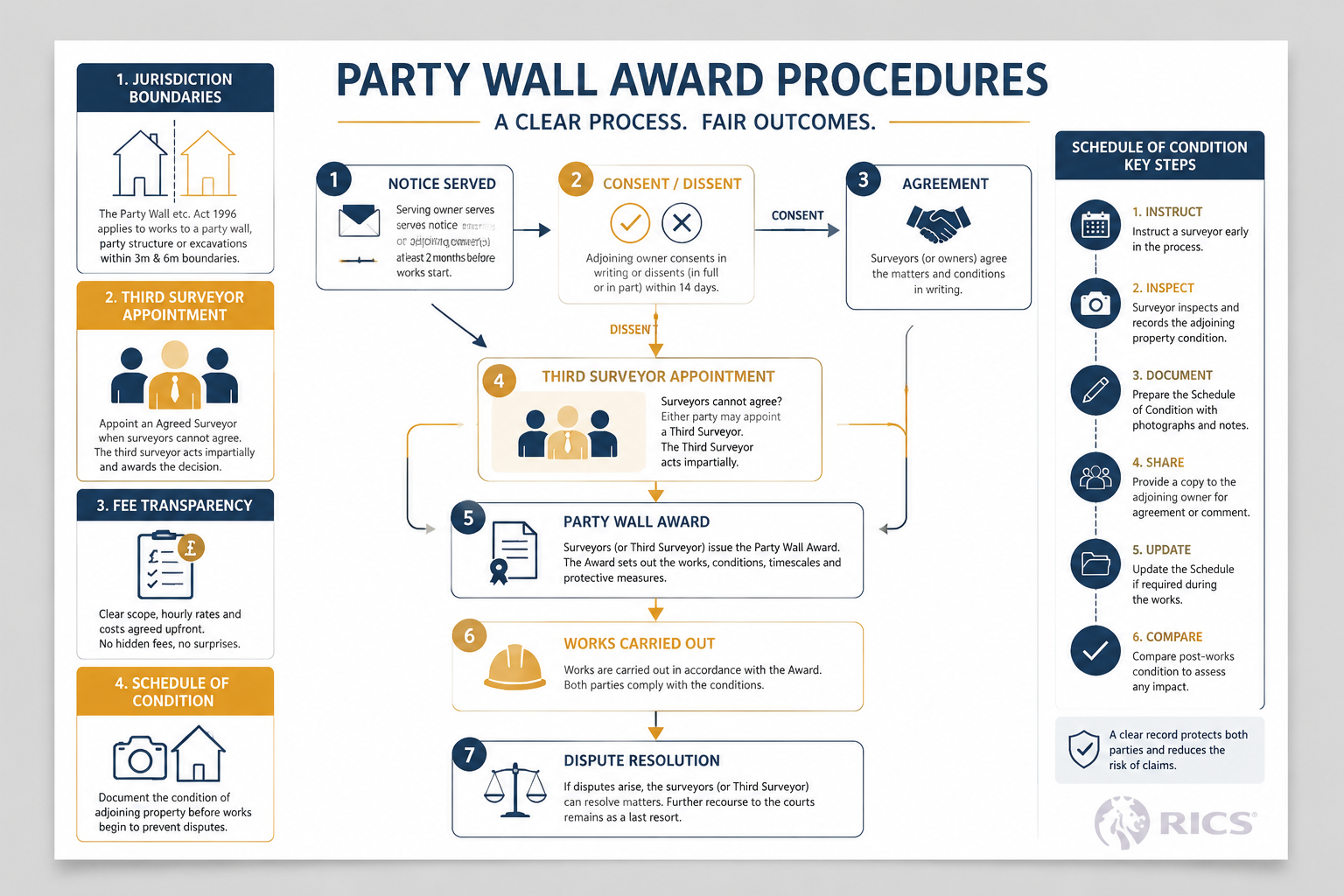
Perhaps the most technically demanding aspect of Party Wall Surveyor Independence Under RICS 8th Edition: Navigating Client Pressures and Statutory Duties in 2026 Projects is the question of jurisdiction. The Act grants surveyors specific powers — and no others. Exceeding those powers does not produce a more comprehensive award; it produces an award that can be challenged and set aside by the courts. [5]
What Falls Within Jurisdiction
Surveyors acting under the Act may:
- Determine the right to execute works notifiable under the Act
- Specify the time, manner, and conditions under which those works are carried out
- Award compensation for damage caused by notifiable works
- Determine access rights for the purposes of carrying out notifiable works
What Falls Outside Jurisdiction
Surveyors may not:
- Determine disputes about ownership or title
- Award compensation for works that fall outside the Act's scope
- Make determinations about planning permission or building regulations compliance
- Resolve boundary disputes (which require separate boundary survey processes)
The 8th edition's emphasis on jurisdiction is a direct response to a pattern of awards being challenged in the courts on the grounds that surveyors had strayed beyond their statutory powers. [5] Developers, in particular, sometimes pressure surveyors to include conditions that are commercially useful but legally unauthorised. Resisting that pressure is not obstructionism — it is professional competence.
Practical Jurisdiction Checklist
Before finalising any award, surveyors should confirm:
- Every condition in the award relates directly to notifiable works under the Act
- No condition purports to determine matters of title, planning, or building regulations
- The award does not attempt to resolve disputes that pre-date the notice
- The award does not grant rights that the Act does not confer
If a condition fails this checklist, it should be removed or referred to the appropriate authority. A party wall dispute that escalates to court because of an overreaching award is far more costly for all parties than a properly scoped determination.
Protecting Independence: Practical Steps for Surveyors in 2026
The 8th edition guidance does not simply describe the problem of client pressure — it provides tools to manage it. Surveyors working on 2026 projects should adopt the following practices.
Document every instruction and response. When a client makes a request that touches on the surveyor's independence, respond in writing. Acknowledge the request, explain why it cannot be accommodated, and record the exchange. This creates a paper trail that protects the surveyor if a conduct complaint is later made.
Use the updated appointment templates. The new letters of appointment in the 8th edition are not optional extras — they are the foundation of a defensible appointment. Surveyors who continue to use informal or outdated appointment letters leave themselves exposed.
Refer fee disputes promptly. Do not allow fee disputes to fester. Unresolved fee disputes create leverage for clients who want to pressure surveyors. The Third Surveyor mechanism exists precisely to resolve these situations.
Engage RICS guidance proactively. The 8th edition was developed through active consultation with surveyors, legal professionals, and other stakeholders. [6] It reflects real-world practice. Surveyors who engage with it proactively — rather than waiting for a complaint — are better positioned to defend their decisions.
Know when to decline an appointment. If a client makes it clear, before appointment, that they expect the surveyor to act in their interests rather than independently, that is grounds to decline. Accepting an appointment under those terms creates a conflict that cannot be resolved.
For surveyors working across a range of property types, understanding the full scope of RICS chartered building surveyor services provides important context for how party wall duties fit within the broader professional framework.
The Consultation Process and What Comes Next
The RICS 8th edition consultation, which ran for eight weeks in April and May 2026, sought feedback from a wide range of stakeholders. [6] The aim was to ensure that the updated guidance supports competence, consistency, and confidence across party wall practice. The consultation process itself reflects a recognition that the 7th edition, while valuable, had not kept pace with the complexity of modern development projects.
Key themes that emerged from the consultation process include:
- The need for clearer guidance on digital service of notices
- Greater consistency in how schedules of condition are prepared and recorded
- Stronger protections for adjoining owners who are not legally represented
- Clearer guidance on what constitutes a valid appointment
The finalised 8th edition is expected to address these themes directly. For surveyors working on projects now, the draft guidance already provides a strong framework for managing independence and jurisdiction issues.
Conclusion
Party Wall Surveyor Independence Under RICS 8th Edition: Navigating Client Pressures and Statutory Duties in 2026 Projects is not an abstract professional principle — it is a practical requirement with direct legal consequences. Surveyors who allow client pressure to influence their determinations risk invalidated awards, conduct complaints, and reputational damage. The 8th edition draft provides the clearest guidance yet on how to prevent this.
The actionable steps are straightforward:
- Adopt the updated appointment templates to establish independence from the outset.
- Apply the jurisdiction checklist to every award before it is issued.
- Use the Third Surveyor mechanism without hesitation when genuine disputes arise.
- Document all client communications that touch on the surveyor's independence.
- Engage with the finalised 8th edition when published and update practice procedures accordingly.
Party wall work is among the most technically and ethically demanding areas of surveying practice. The RICS 8th edition does not make that work easier — it makes it clearer. For surveyors committed to professional standards, that clarity is a significant asset in managing the pressures that 2026 projects inevitably bring.
References
[1] RICS Launches Consultation On Updated Party Wall Practice Guidance – https://www.rics.org/news-insights/rics-launches-consultation-on-updated-party-wall-practice-guidance?utm_source=openai
[2] ViewCompoundDoc (Professional Conduct Guidelines) – https://consultations.rics.org/party_walls_8th_edition_guidance/viewCompoundDoc?docid=16799988&partId=16800404&sessionid=&voteid=&utm_source=openai
[3] ViewCompoundDoc (Surveyor Independence) – https://consultations.rics.org/party_walls_8th_edition_guidance/viewCompoundDoc?docid=16799988&partid=16800244&pfv=y&utm_source=openai
[4] RICS 8th Edition Party Wall Guidance Key Updates And Practical Implications For Surveyors In 2026 – https://kingstonsurveyors.com/rics-8th-edition-party-wall-guidance-key-updates-and-practical-implications-for-surveyors-in-2026/?utm_source=openai
[5] ViewCompoundDoc (Jurisdiction) – https://consultations.rics.org/party_walls_8th_edition_guidance/viewCompoundDoc?docid=16799988&partid=16802324&pfv=y&utm_source=openai
[6] ConsultationHome – https://consultations.rics.org/party_walls_8th_edition_guidance/consultationHome?utm_source=openai