Nearly 40% of party wall disputes in England and Wales escalate beyond the initial notice stage, with a significant proportion resulting in formal damage claims that require professional valuation evidence. When construction work causes cracking, subsidence, or loss of amenity to a neighbouring property, the gap between what a building owner believes they owe and what an adjoining owner believes they are owed can be enormous. Closing that gap is precisely where valuation surveyor roles in 2026 party wall disputes become indispensable.
This article examines how RICS-qualified valuation experts assess neighbourly damage from construction works, which methodologies they apply to quantify diminution claims, and how pre-agreement valuations can prevent costly litigation before it begins.
Key Takeaways
- Valuation surveyors provide independent, evidence-based assessments of property damage caused by party wall works, going beyond structural repair costs to capture true diminution in value.
- RICS Red Book methodology forms the gold standard for quantifying damage claims in 2026 party wall disputes, ensuring defensible and court-ready valuations.
- A Schedule of Condition, prepared before works begin, is the single most powerful document for resolving damage disputes quickly and fairly.
- Pre-agreement valuations and early settlement tactics can reduce dispute resolution costs by a substantial margin compared to tribunal or court proceedings.
- Appointing a surveyor with dual competence in both party wall procedure and property valuation provides the strongest protection for both building owners and adjoining owners.
Why Valuation Expertise Matters in Party Wall Disputes
The Party Wall etc. Act 1996 gives adjoining owners the right to compensation for damage caused by notifiable works. However, the Act itself says very little about how that compensation should be calculated. It simply states that the building owner shall make good all damage occasioned by the works. In practice, this creates a vacuum that is filled by professional valuation opinion.
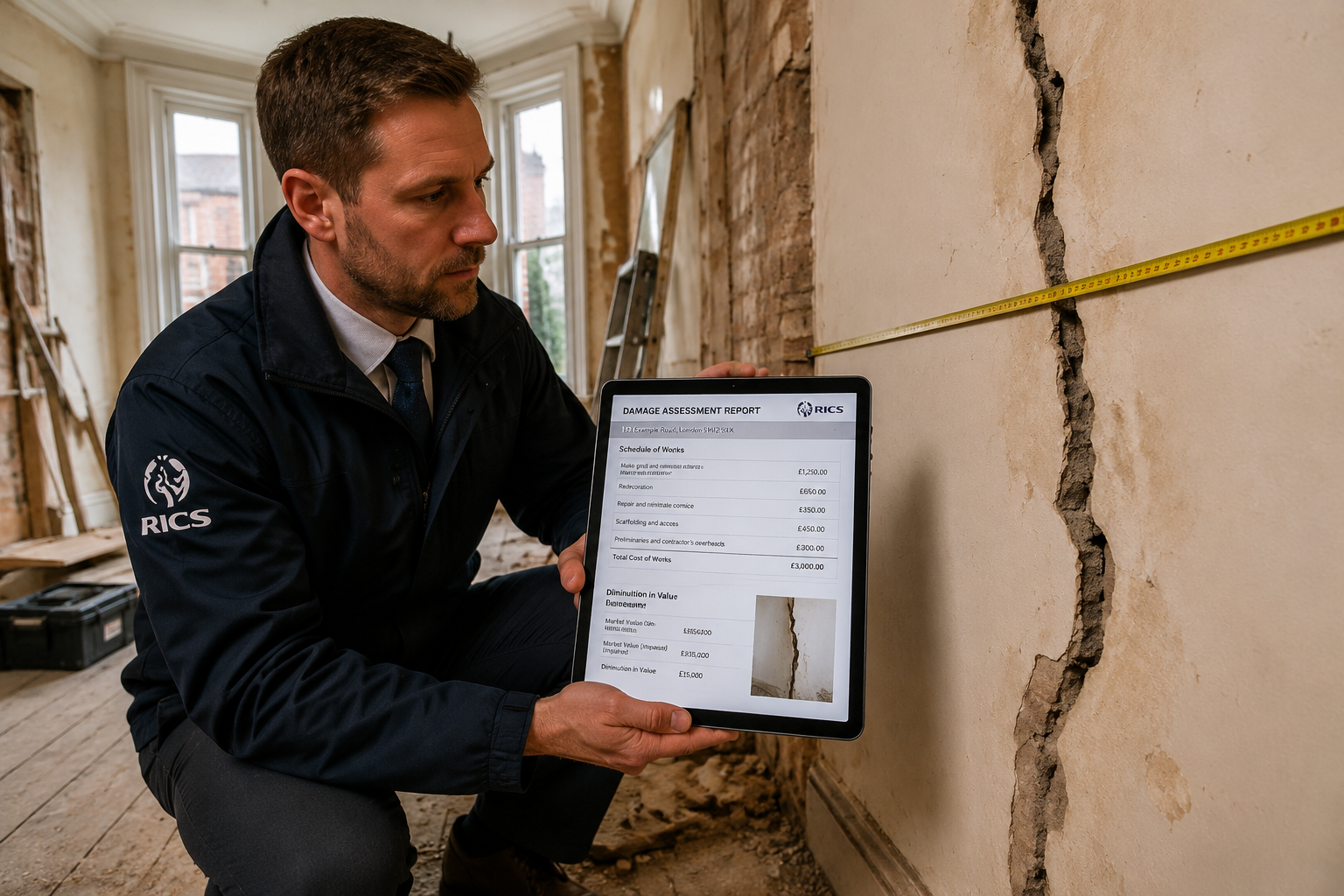
A structural surveyor can confirm that a crack exists and estimate the cost to repair it. A valuation surveyor does something different and arguably more important: they assess whether the property has suffered a diminution in market value that exceeds, or is separate from, the physical repair cost. These are two distinct measures of loss, and confusing them is one of the most common and expensive mistakes made in party wall disputes.
Consider a scenario where a loft conversion causes minor but visible cracking to a neighbouring Victorian terrace. The repair bill might be £3,000. Yet if a prospective buyer, on learning the history of the crack, reduces their offer by £15,000, the true financial loss to the adjoining owner is far greater than the repair cost alone. Only a qualified valuation surveyor can articulate and evidence that broader loss.
For properties in active markets, understanding RICS valuation standards and Red Book methodology is essential background knowledge for any party pursuing or defending a damage claim.
The Distinction Between Repair Costs and Diminution in Value
| Measure | What It Covers | Who Assesses It |
|---|---|---|
| Repair / Reinstatement Cost | Physical works to restore the property to its pre-damage condition | Building / structural surveyor |
| Diminution in Value | Reduction in open market value attributable to damage or its history | Valuation surveyor |
| Loss of Amenity | Disruption, noise, dust, temporary loss of use during works | Party wall surveyor / valuation surveyor |
| Consequential Losses | Delayed sales, additional mortgage costs, temporary accommodation | Valuation surveyor / solicitor |
Adjoining owners who rely solely on a builder's repair quote when making a compensation claim routinely under-recover. Conversely, building owners who accept inflated repair estimates without independent valuation advice routinely overpay. Both outcomes are avoidable.
How Valuation Surveyors Quantify Damage Claims Under the 2026 Party Wall Framework
The core methodology used by valuation surveyors in 2026 party wall disputes draws on RICS Valuation – Global Standards (commonly called the Red Book), supplemented by case law and the specific provisions of the Party Wall etc. Act 1996.
Step 1: Establishing the Pre-Works Baseline
Before any damage can be quantified, the surveyor must establish what the property was worth, and in what condition it existed, before the notifiable works commenced. This is where the Schedule of Condition becomes critical.
A Schedule of Condition is a detailed photographic and written record of the adjoining property's state immediately before works begin. When one exists, the valuation surveyor has an objective baseline. When one does not exist, the surveyor must reconstruct the pre-works condition from estate agent records, mortgage valuations, and comparable evidence – a far more contentious and expensive exercise.
"The absence of a Schedule of Condition is the single most avoidable cause of protracted party wall damage disputes. It transforms a straightforward comparison exercise into a battle of expert opinions."
If a neighbour is already carrying out works without a party wall agreement in place, the window for capturing a pre-works baseline may already be closing. Understanding the urgency of that situation is covered in detail in guidance on what to do when a neighbour carries out works without a party wall agreement.
Step 2: Identifying and Categorising Damage
Valuation surveyors work alongside structural engineers and building surveyors to categorise damage using the BRE Digest 251 classification system:
- Category 0-1: Hairline cracks, negligible or very slight damage
- Category 2: Slight damage, cracks up to 5mm
- Category 3: Moderate damage, cracks 5-15mm
- Category 4-5: Severe to very severe structural damage
The valuation impact of each category differs significantly. Category 0-1 damage, once repaired, typically leaves no residual diminution. Category 3-5 damage, particularly in areas with active property markets, can leave a stigma value – a persistent reduction in market value even after full physical repair.
Step 3: Applying RICS Red Book Methodology to Diminution Claims
The Red Book requires that diminution in value be assessed on the basis of open market value – what a willing buyer would pay a willing seller with full knowledge of the property's history. In practice, valuation surveyors use three primary approaches:
- Comparable Sales Analysis: Identifying sales of similar properties with and without a damage history to isolate the value differential attributable to the works.
- Residual Valuation: Used where damage affects development potential or lettable floor area, calculating the impact on the property's income-producing capacity.
- Depreciated Replacement Cost: Applied in cases of unusual or listed properties where market comparables are limited.
For commercial properties affected by party wall works, the valuation methodology can become considerably more complex, often requiring analysis of rental income, yield impact, and tenant covenant strength. Professionals handling commercial property valuation will recognise these additional layers of complexity.
Step 4: Quantifying Loss of Amenity and Consequential Losses
Beyond diminution in value, a complete damage claim in 2026 party wall disputes should address:
- Loss of amenity during works: Assessed by reference to the duration of disruption, the nature of the works, and the degree of interference with the adjoining owner's quiet enjoyment.
- Delayed property transactions: If an adjoining owner was in the process of selling their property when damage occurred, any reduction in sale price or costs of delay are recoverable.
- Additional financing costs: Where damage forces the adjoining owner to remain in the property longer than planned, additional mortgage interest or rental costs may be claimable.
- Professional fees: The reasonable cost of obtaining valuation evidence is itself a recoverable head of loss.
Settlement Tactics: How Valuation Surveyor Roles in 2026 Party Wall Disputes Prevent Litigation
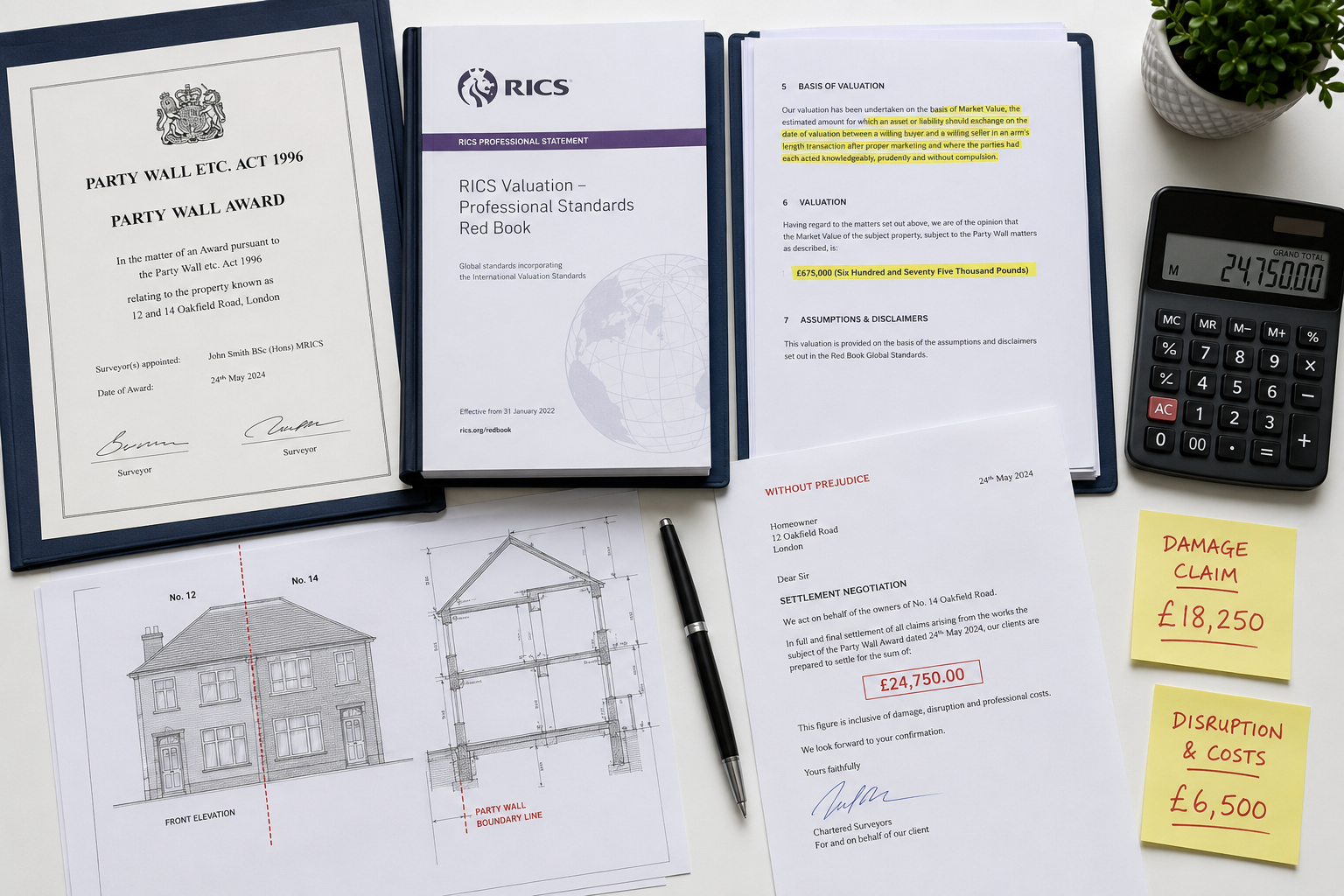
The most effective use of valuation surveyor expertise is not in preparing evidence for tribunal – it is in structuring early settlements that avoid tribunal altogether. The costs of formal dispute resolution under the Party Wall etc. Act 1996 are disproportionate to the sums in dispute in the majority of cases. A well-structured settlement, supported by credible valuation evidence, almost always produces a better outcome for both parties.
Pre-Agreement Valuations: The Proactive Approach
A pre-agreement valuation is commissioned before notifiable works begin, with the specific purpose of establishing an agreed baseline value for the adjoining property. Both parties commission their own surveyor, or agree on a single agreed surveyor, to record the property's current open market value and condition.
The benefits are substantial:
- Eliminates retrospective disputes about pre-works value
- Provides a clear framework for calculating any post-works diminution
- Demonstrates good faith by the building owner, which courts and tribunals regard favourably
- Reduces the cost and duration of any subsequent dispute
This approach mirrors the logic behind dilapidations surveying, where a schedule of condition at lease commencement prevents disproportionate disputes at lease end. The same principle applied to party wall works produces the same efficiency gains.
Negotiation Frameworks Used by Experienced Valuation Surveyors
Experienced valuation surveyors use several tactical approaches to achieve early settlement:
Without Prejudice Meetings
Surveyors for both parties meet informally to exchange valuation evidence before any formal award or claim is made. This allows each side to test the strength of their position without committing to a formal stance.
Agreed Expert Appointments
Where both parties trust the process, a single jointly-instructed valuation surveyor can provide a binding or persuasive opinion on quantum. This dramatically reduces costs and the risk of adversarial escalation.
Structured Settlement Offers
Rather than a single lump sum, experienced surveyors often structure settlements to include a repair fund held in escrow, a monitoring period for latent damage, and a final settlement payment once all works are complete and any residual diminution can be accurately measured.
Mediation Support
Where direct negotiation fails, valuation surveyors frequently support formal mediation, providing the mediator with clear, accessible evidence on quantum. The surveyor's role here is to translate technical valuation concepts into terms that non-specialists can evaluate and act on.
When Settlement Fails: Preparing Valuation Evidence for Tribunal
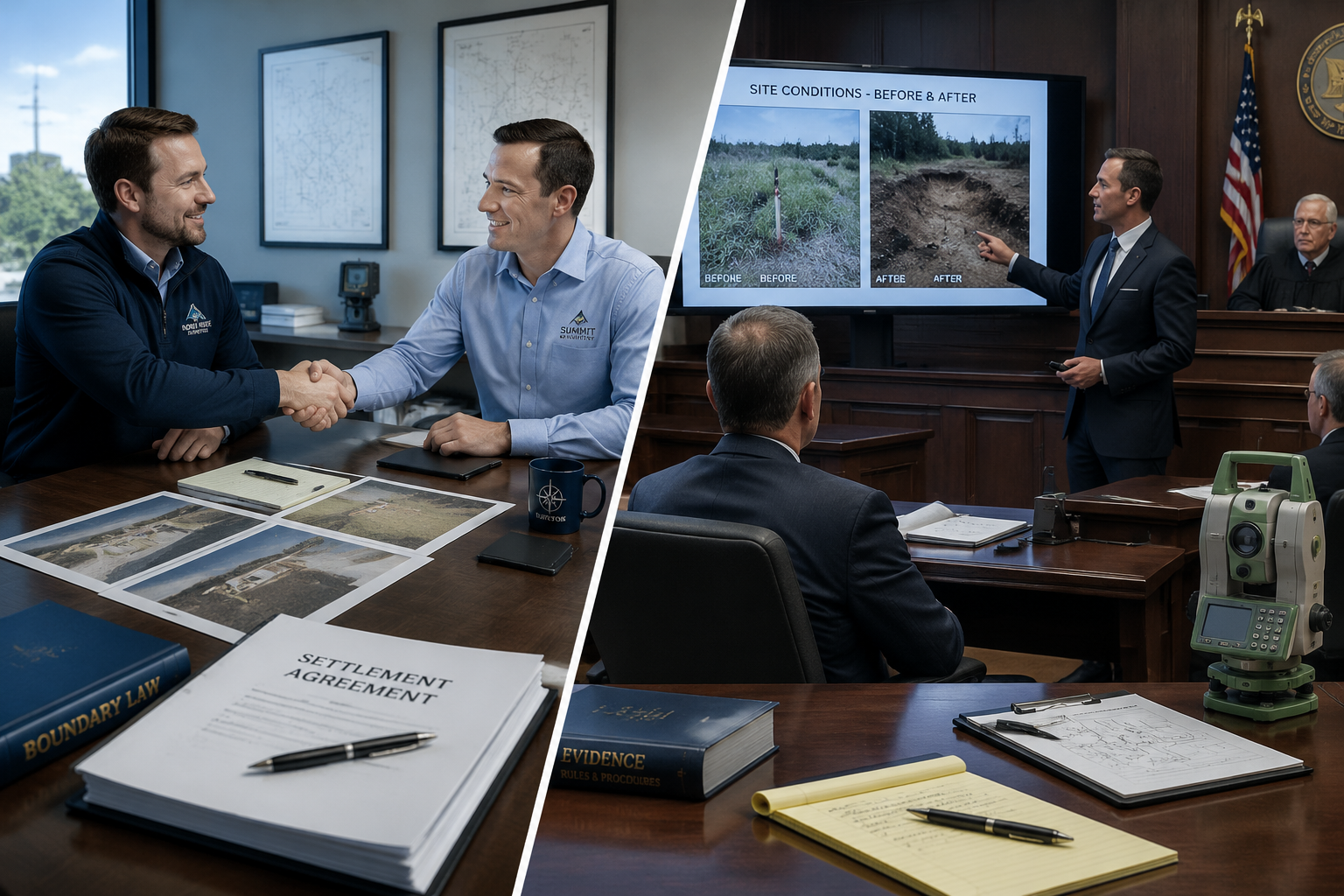
Despite best efforts, some disputes proceed to the tribunal or county court. In these cases, the valuation surveyor transitions into an expert witness role, with specific obligations under CPR Part 35 to assist the court rather than advocate for their instructing party.
Key requirements for court-ready valuation evidence include:
- A clear statement of the methodology used and why it was selected
- Full disclosure of comparable evidence, including comparables that do not support the surveyor's conclusion
- A sensitivity analysis showing how the valuation changes under different assumptions
- A signed declaration of independence and compliance with RICS professional standards
Surveyors who have not prepared expert witness reports before often underestimate the procedural rigour required. Instructing a surveyor with prior tribunal or court experience is strongly advisable when formal proceedings appear likely.
Choosing the Right Valuation Surveyor for a Party Wall Damage Claim
Not every valuation surveyor has the specific competencies needed to handle party wall damage claims effectively. The ideal appointment combines:
- RICS membership with active compliance with Red Book standards
- Party wall experience, ideally as an appointed surveyor under the 1996 Act
- Litigation support experience, including prior expert witness appointments
- Local market knowledge, since diminution in value is highly location-specific
For properties in London and the South East, where party wall disputes are most frequent due to high-density terraced and semi-detached housing stock, local expertise is particularly valuable. Chartered surveyors operating across South West London, North London, and East London bring the granular comparable evidence that makes the difference between a credible valuation and one that is easily challenged.
For properties outside London, regional expertise matters equally. Surveyors with deep knowledge of local markets in areas such as Surrey or Hertfordshire will have access to relevant comparable transactions that a generalist surveyor may lack.
Questions to Ask Before Appointing a Valuation Surveyor
- Have you previously prepared diminution in value reports in party wall disputes?
- Are you familiar with RICS PS 1 and PS 2 as they apply to litigation support work?
- Can you provide a Schedule of Condition as part of your pre-works service?
- Have you given evidence at a party wall tribunal or county court?
- Do you carry adequate professional indemnity insurance for expert witness work?
The Cost of Getting It Wrong
The financial consequences of inadequate valuation evidence in party wall disputes are significant in both directions.
For adjoining owners, under-evidenced claims result in settlements that fail to capture the full extent of loss. Stigma value, consequential losses, and professional fees are routinely omitted from claims prepared without specialist valuation input, leaving adjoining owners out of pocket even after a successful dispute.
For building owners, accepting inflated or poorly evidenced claims without independent valuation scrutiny can result in overpayment. In competitive development markets, where party wall works are a routine part of loft conversions, basement excavations, and extensions, the cumulative cost of unscrutinised damage claims can materially affect project viability.
The investment in a qualified valuation surveyor – typically a fraction of the sums in dispute – consistently produces better outcomes than attempting to navigate damage quantification without specialist expertise.
Conclusion
Valuation surveyor roles in 2026 party wall disputes have never been more important. As property values remain high and construction activity continues in dense urban areas, the stakes attached to damage claims are substantial. The difference between a repair cost estimate and a properly evidenced diminution in value assessment can run to tens of thousands of pounds on a single dispute.
Actionable next steps for adjoining owners:
- Commission a Schedule of Condition before any notifiable works begin on a neighbouring property.
- Appoint an RICS-accredited valuation surveyor as soon as damage is identified – do not wait for the building owner to make an offer.
- Ensure your valuation evidence addresses diminution in value, loss of amenity, and consequential losses separately.
- Explore pre-agreement valuation and mediation before committing to formal tribunal proceedings.
Actionable next steps for building owners:
- Instruct a pre-agreement valuation as part of your pre-works due diligence to establish a defensible baseline.
- Obtain independent valuation scrutiny of any damage claim before agreeing to settlement terms.
- Ensure your appointed party wall surveyor has access to valuation expertise, either personally or through a referral network.
- Document all works meticulously, including a photographic record of the party wall and adjoining property before, during, and after construction.
The combination of rigorous RICS methodology, early valuation evidence, and structured settlement tactics remains the most reliable path to resolving party wall damage claims efficiently, fairly, and without the disproportionate costs of litigation.