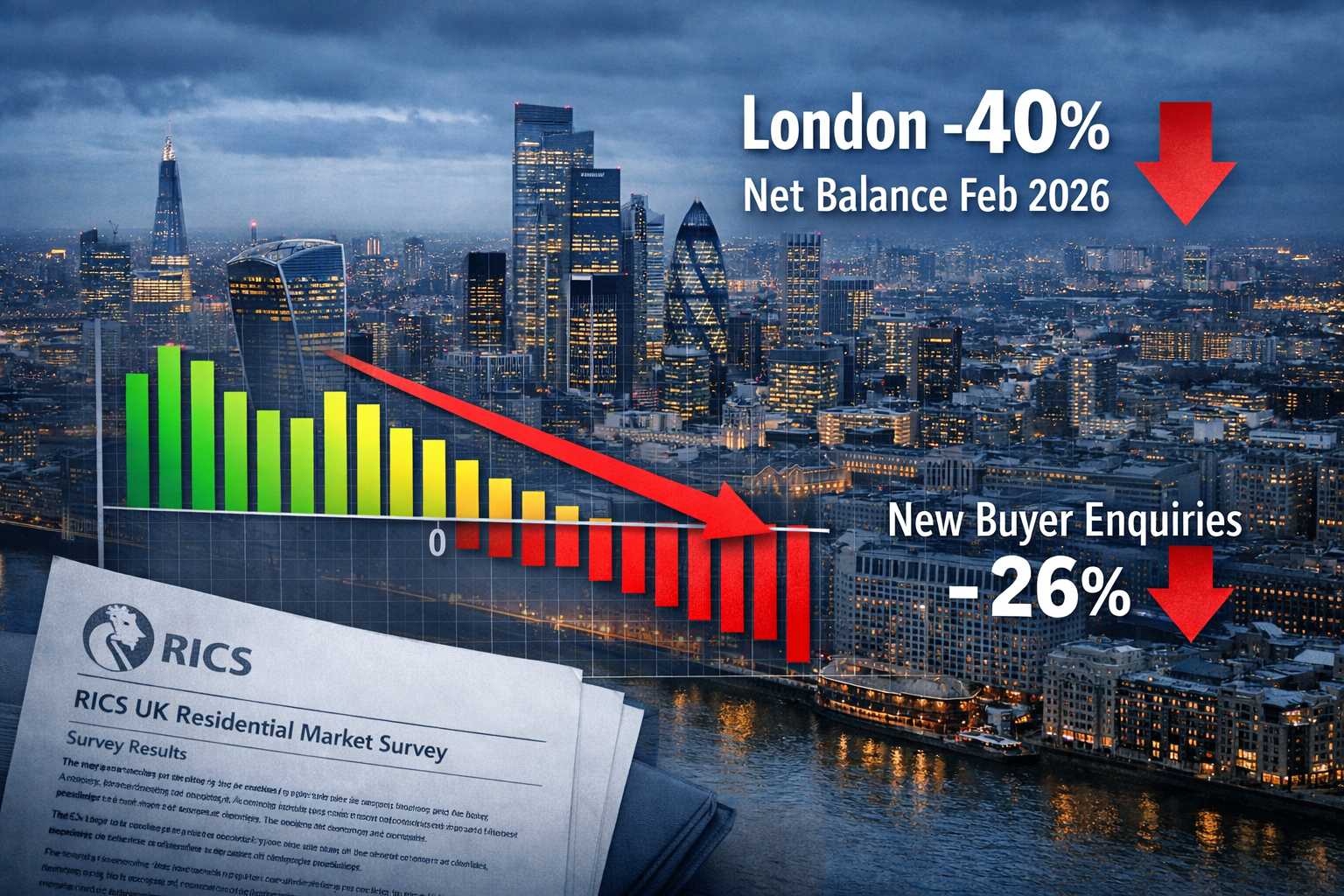
New buyer enquiries in the UK residential market fell to a net balance of -26% in February 2026 — the sharpest single-month confidence drop recorded since the post-Liz Truss mini-budget turbulence — and geopolitical tension, not domestic policy, was the primary culprit. [1] Understanding the Geopolitical Impacts on Spring 2026 Valuations: RICS February Survey Insights for Surveyor Risk Mitigation has become essential reading for every practising surveyor navigating this volatile spring market. The RICS February 2026 residential survey paints a clear picture: global headwinds, particularly Middle East conflict escalation and energy price volatility, are reshaping valuation assumptions, compressing buyer demand, and creating significant professional liability risk for surveyors who fail to document their reasoning with precision. [5]
Key Takeaways 📌
- Buyer demand collapsed to -26% net balance in February 2026, worsening to -39% by March, driven by geopolitical uncertainty and mortgage rate spikes. [1][2]
- London prices hit -40% net balance in February 2026, with regional disparities requiring granular, area-specific comparable evidence. [3]
- Mortgage rates jumped to 4.51% by mid-March 2026, directly constraining affordability assumptions in Red Book valuations. [6]
- Surveyors face heightened liability if valuations fail to explicitly reference market uncertainty conditions and geopolitical risk caveats.
- Robust comparable selection, explicit uncertainty caveats, and regional segmentation are the three pillars of defensible spring 2026 valuations.
Understanding the RICS February 2026 Data: What the Numbers Actually Mean
The RICS UK Residential Market Survey for February 2026 is not simply another monthly snapshot. It represents a structural shift in market psychology that directly affects how surveyors must approach evidence gathering, comparable selection, and valuation reporting. [5]
The Demand Collapse in Context
The -26% net balance for new buyer enquiries in February 2026 means that significantly more respondents reported falling demand than rising demand. [1] This figure then accelerated to -39% in March 2026, confirming that February was not a temporary blip but the beginning of a sustained demand contraction. [2]
For surveyors, this matters because:
- Comparable transactions from Q4 2025 and early Q1 2026 may no longer reflect current market conditions
- Agreed sale prices may not be achieved at completion, creating down-valuation risk
- Days on market are extending, meaning older comparables carry less evidential weight
💬 "When the market moves this fast in one direction, a comparable from even three months ago can misrepresent current value by a meaningful margin." — A principle consistently reinforced in RICS Red Book guidance on market uncertainty.
Price Sentiment: The -18% Caution Signal
Alongside demand weakness, RICS February 2026 data recorded a price sentiment net balance of -18%, indicating that respondents broadly expected prices to soften over the coming three months. [5] This forward-looking indicator is particularly important for surveyors conducting valuations for mortgage lending purposes, where lenders require confidence that the security value will hold through the loan term.
| Indicator | February 2026 Net Balance | Direction |
|---|---|---|
| New Buyer Enquiries | -26% | ⬇️ Falling |
| Price Expectations (3-month) | -18% | ⬇️ Falling |
| Agreed Sales | Negative | ⬇️ Falling |
| New Instructions | Marginally positive | ➡️ Stable |
Source: RICS UK Residential Market Survey, February 2026 [5]
The Geopolitical Trigger: Middle East and Energy Markets
RICS respondents in February 2026 explicitly cited global geopolitical uncertainty as a primary driver of market hesitation. [3] The Iran conflict escalation and associated energy market volatility created a dual shock:
- Consumer confidence erosion — households postponed major financial commitments
- Lender risk repricing — mortgage rates rose sharply, with the average two-year fixed rate reaching 4.51% by mid-March 2026, up from 4.24% just one week earlier [6]
This mortgage rate spike is not a minor adjustment. On a £350,000 property with a 75% LTV mortgage, a 0.27 percentage point rate increase adds approximately £47 per month to repayments — enough to push marginal buyers out of affordability thresholds and suppress transaction volumes further.
How Geopolitical Impacts on Spring 2026 Valuations Require Updated Surveyor Methodologies

The Geopolitical Impacts on Spring 2026 Valuations: RICS February Survey Insights for Surveyor Risk Mitigation demand a recalibration of standard valuation methodology. Surveyors relying on pre-2026 comparable databases and standard market condition assumptions face genuine professional liability exposure.
1. Comparable Evidence: Tighter Time Windows Required
In a stable market, comparables from the previous 12 months are generally acceptable. In the current environment, surveyors should:
- Prioritise comparables from the last 90 days wherever possible
- Weight recent evidence more heavily than older transactions, with explicit justification in the report
- Cross-reference asking prices against achieved prices, noting any gap widening as a market condition indicator
- Document failed sales and price reductions in the subject property's micro-market as supporting evidence of demand weakness
For RICS Red Book valuations, the requirement for transparency in comparable selection has never been more critical. Every adjustment made to a comparable must be defensible against the backdrop of documented market conditions.
2. Explicit Market Uncertainty Caveats
RICS Red Book Global Standards (VPS 3) permit — and in volatile conditions, effectively require — surveyors to include material uncertainty clauses in their reports. [4] Spring 2026 conditions meet the threshold for such caveats given:
- 📉 Demand indicators at multi-year lows
- 📈 Mortgage rates rising sharply mid-cycle
- 🌍 Ongoing geopolitical events with unresolved trajectories
- 🏘️ Regional price disparities creating thin comparable evidence in some markets
A well-drafted uncertainty caveat does not undermine the valuation — it protects the surveyor and provides the client with an accurate picture of evidential confidence levels.
3. Regional Segmentation Is Non-Negotiable
The RICS February 2026 data reveals stark regional divergence that makes national-level assumptions dangerous for individual valuations. [3]
| Region | February 2026 Price Net Balance |
|---|---|
| London | -40% |
| South East | -24% |
| East Anglia | -26% |
| Midlands | Marginally negative |
| North West | Less negative |
Source: Buy Association Group analysis of RICS February 2026 data [3]
London's -40% net balance is particularly striking. Surveyors operating across chartered surveyor services in London and surrounding areas including West London, Chelsea, and South West London must apply hyper-local analysis rather than relying on broader metropolitan averages.
4. Mortgage Valuation vs. Full Survey: Clarifying Client Expectations
In a falling market, the gap between a lender's mortgage valuation and a full structural assessment becomes critically important for buyers. Many clients do not understand that a mortgage valuation primarily protects the lender, not the buyer. Understanding the difference between a mortgage valuation and a survey is something surveyors should proactively communicate to clients in current market conditions, particularly where properties may have structural issues that could affect value in a softening market.
5. Reinstatement Cost Assessments in an Inflationary Context
Geopolitical disruption has also affected construction material costs through supply chain pressures. Surveyors conducting reinstatement cost valuations must account for:
- Energy-intensive material cost increases (steel, glass, concrete)
- Labour availability pressures in specific regions
- Extended rebuild timelines affecting insurance adequacy calculations
Outdated reinstatement figures in an inflationary, geopolitically disrupted environment create underinsurance risk for property owners — a liability issue that reflects directly on the surveyor who prepared the assessment.
Surveyor Risk Mitigation Strategies: Practical Steps for Spring 2026

The Geopolitical Impacts on Spring 2026 Valuations: RICS February Survey Insights for Surveyor Risk Mitigation point toward a clear set of professional best practices that distinguish defensible valuations from vulnerable ones.
Build a Documented Market Conditions File 📁
Every valuation file in spring 2026 should contain a market conditions memorandum that records:
- The RICS monthly survey data current at the date of valuation
- Prevailing mortgage rates and recent rate movement
- Any significant geopolitical events that have affected market sentiment
- Local estate agent feedback on demand levels and transaction volumes
This documentation transforms subjective market awareness into objective, auditable evidence — the foundation of any successful defence against a negligence claim.
Engage with Local Market Intelligence
National data tells only part of the story. Surveyors should actively engage with:
- Local estate agents for real-time demand feedback
- Land Registry transaction data filtered to the subject property's postcode district
- Auction results as a leading indicator of distressed market conditions
- Rightmove and Zoopla price reduction data for the micro-market
For surveyors working across diverse locations — from chartered surveyors in Essex to chartered surveyors in Bromley — the local intelligence networks will differ significantly, and maintaining active relationships with local agents is a competitive and professional necessity.
Apply Appropriate Valuation Bases for Distressed Conditions
Where market evidence is thin or contradictory, surveyors should consider whether the standard Market Value basis remains appropriate, or whether an Estimated Realisation Price or Restricted Realisation Price basis better reflects the client's circumstances and the prevailing market. [4]
This is particularly relevant for:
- 🏠 Shared ownership valuations where staircasing transactions may be delayed by market conditions — see RICS shared ownership valuations for specific guidance
- 🏛️ Right to buy valuations where statutory timelines create pressure to value in unfavourable conditions — RICS right to buy valuations require particular care in documenting market conditions
- 💼 Commercial property where tenant covenant strength may be affected by geopolitical economic impacts
Communicate Proactively with Clients and Lenders
Surveyors should not wait for clients to ask questions about market conditions. Proactive communication that explains:
- Why certain comparables have been weighted differently
- What the uncertainty caveat means in practical terms
- How geopolitical conditions have affected the valuation evidence base
…builds client trust and reduces the likelihood of complaints arising from misunderstood valuations.
Professional Indemnity: Review Coverage Limits
Given the elevated risk environment, surveyors should review their professional indemnity insurance coverage to ensure limits remain adequate for the current market. A valuation that seemed straightforward at instruction may become contested if prices fall further between valuation date and completion. Consulting with PI insurers about market-specific risk exposure is a prudent step for any practice operating at volume in spring 2026.
The Outlook: What Surveyors Should Monitor Through Summer 2026 🔭
The trajectory from February's -26% to March's -39% in new buyer enquiries suggests that spring 2026 will not be a recovery period unless geopolitical conditions stabilise meaningfully. [1][2] Surveyors should monitor:
- RICS monthly surveys (April and May 2026 releases will be critical indicators)
- Bank of England base rate decisions — any further holds or cuts will affect mortgage pricing
- Middle East conflict developments — energy price stabilisation would remove one major uncertainty factor
- Government housing policy announcements — any demand-side interventions could shift sentiment rapidly
- Transaction volume data from HMRC — the true measure of whether the market is functioning
Understanding the full range of factors affecting property valuation in this environment requires surveyors to maintain a genuinely multi-disciplinary awareness — economic, geopolitical, and structural — rather than relying solely on comparable transaction databases.
Conclusion: Turning Market Uncertainty into Professional Rigour ✅
The Geopolitical Impacts on Spring 2026 Valuations: RICS February Survey Insights for Surveyor Risk Mitigation present a clear professional challenge: the market is moving faster than standard valuation cycles, and surveyors who fail to adapt their methodology face both professional liability and reputational risk.
The RICS February 2026 data — with its -26% buyer enquiry net balance, -18% price sentiment, and stark regional divergences including London's -40% net balance — is not cause for alarm but for disciplined professional response. [1][5][3]
Actionable Next Steps for Surveyors 🎯
- Update your comparable selection criteria — restrict primary evidence to the last 90 days in active markets
- Draft a standard market conditions memorandum template for inclusion in all spring 2026 valuation files
- Review your material uncertainty clause language against current RICS Red Book requirements
- Engage local estate agents in each market area for real-time demand intelligence
- Audit your reinstatement cost assumptions against current construction material pricing
- Brief clients proactively on what geopolitical uncertainty means for their valuation
- Review PI insurance coverage to ensure it reflects current market risk levels
Surveyors who treat the current environment as an opportunity to demonstrate rigour, transparency, and professional excellence will emerge from spring 2026 with stronger client relationships and more defensible files. Those who apply pre-2026 methodologies to a fundamentally changed market will not.
For tailored guidance on RICS-compliant valuations in the current environment, explore our full range of assessment types and valuation services or get a quote from our team of chartered surveyors.
References
[1] UK Residential Survey February 2026 – https://www.rics.org/news-insights/uk-residential-survey-february-2026
[2] UK Residential Market Survey March 2026 – https://www.rics.org/content/dam/ricsglobal/documents/market-surveys/uk-residential-market-survey/UK-Residential-Market-Survey-March-2026.pdf
[3] Latest RICS Survey Reveals Global Headwinds Are Weighing On Housing Market Confidence – https://www.buyassociationgroup.com/en-gb/news/latest-rics-survey-reveals-global-headwinds-are-weighing-on-housing-market-confidence/
[4] RICS Survey 2026 – https://nottinghillsurveyors.com/blog/tag/rics-survey-2026
[5] UK Residential Market Survey February 2026 – https://www.rics.org/content/dam/ricsglobal/documents/market-surveys/uk-residential-market-survey/UK-Residential-Market-Survey_February-2026.pdf
[6] UK Residential Property Market Update Spring 2026 – https://www.vailwilliams.com/uk-residential-property-market-update-spring-2026/