Approximately 1.5 million tonnes of asbestos were installed into UK buildings before the 1999 ban — meaning the majority of pre-2000 housing stock still contains asbestos-containing materials (ACMs) today. For buyers, surveyors, and property professionals working with older stock in 2026, understanding the updated Building Survey Protocols for Asbestos in Pre-2000 Homes: 2026 RICS Updates Post-Regulatory Reviews is not simply best practice — it is a legal obligation with direct consequences for health, liability, and property value.
Key Takeaways 🔑
- Legal requirement: All pre-2000 properties must undergo formal ACM assessment under the Control of Asbestos Regulations 2012 — this is mandatory, not optional [1].
- RICS Level 3 surveys include visual asbestos identification but do not confirm ACMs through laboratory testing; a specialist survey is always recommended for older stock [2].
- Three survey types apply in 2026: Management Survey, Refurbishment and Demolition Survey, and Demolition Survey — each triggered by different property circumstances [3].
- Properties built 1950–1999 carry the highest risk; non-modernised homes are flagged as priority concerns during any RICS building survey [2].
- Remediation costs can significantly affect valuation and mortgage decisions — buyers should factor specialist asbestos survey costs into their due diligence budget.
Why Pre-2000 Homes Remain a Priority Concern in 2026
The UK's complete ban on asbestos importation and use came into force in 1999. Yet the sheer volume of material installed during the construction boom of the 1950s through 1980s means that millions of homes — terraced houses, bungalows, semi-detached properties, and flats — still contain ACMs within their fabric [1].
What makes 2026 different? Post-regulatory reviews conducted through RICS consultation processes have sharpened the obligations placed on surveyors and duty holders. The updated guidance reinforces that properties built or refurbished before 2000 must undergo formal assessment, and that surveyors who fail to flag suspected ACMs in their reports face professional and legal exposure [5].
💬 "Asbestos is not a legacy problem — it is a live risk in millions of homes that are being bought, sold, renovated, and occupied right now."
A critical nuance that 2026 guidance addresses: even some post-2000 properties may contain ACMs if they were constructed using pre-2000 refurbished materials or components [1]. This means the "built after 2000" assumption is no longer a safe default for surveyors.
The 1950–1999 High-Risk Window
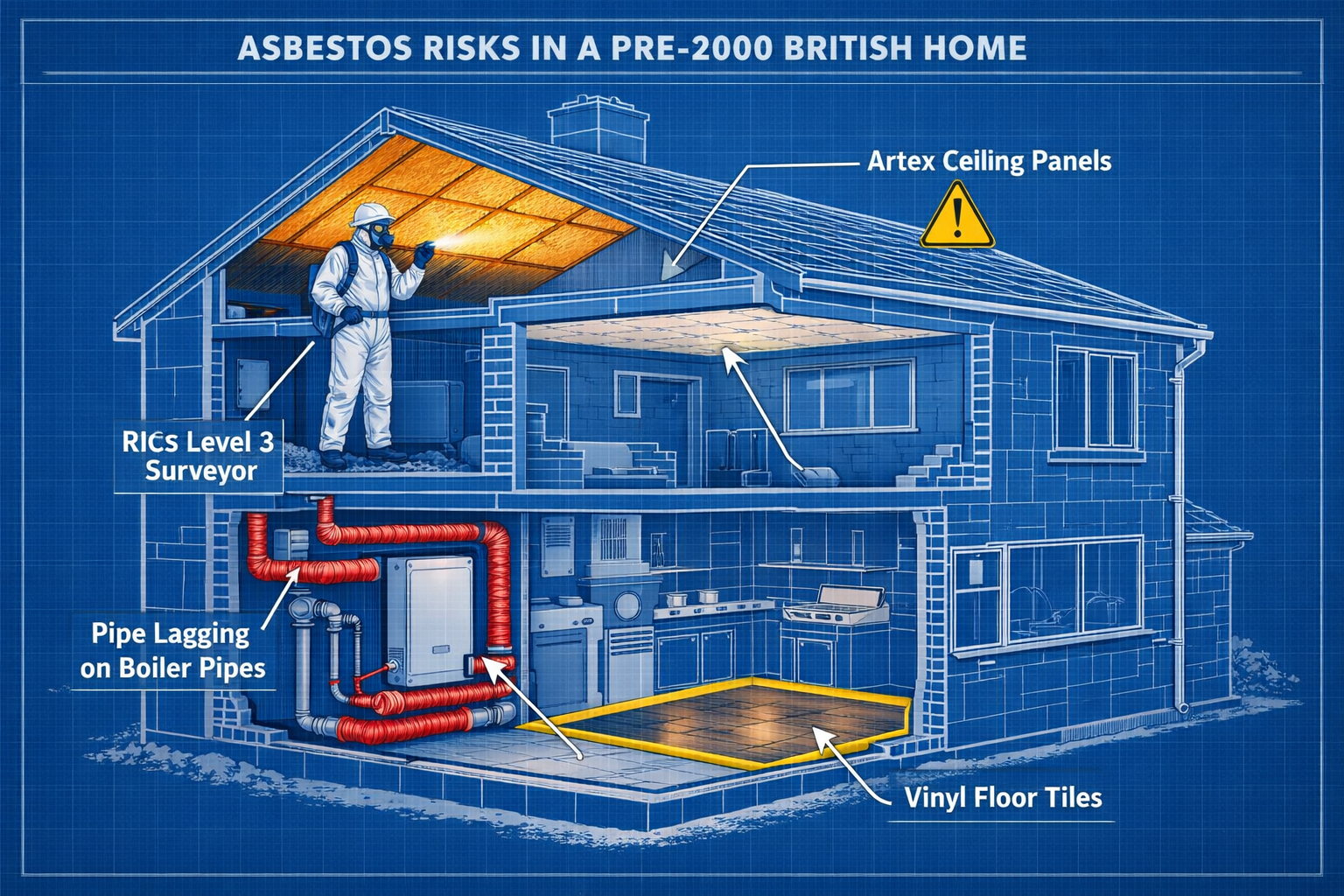
Properties built between 1950 and 1999 are classified as the highest-risk cohort. During this period, asbestos was used extensively in:
| Material Type | Common Location |
|---|---|
| Artex / textured coatings | Ceilings, feature walls |
| Pipe lagging | Boiler rooms, loft spaces |
| Insulation boards | Partition walls, soffits |
| Vinyl floor tiles | Kitchens, bathrooms |
| Boiler / heating insulation | Utility areas |
| Roof tiles and guttering | Exterior fabric |
Non-modernised properties that have not undergone significant refurbishment since construction are flagged as priority concerns during any Level 3 building survey [2].
Level 3 Inspection Techniques for Hidden Asbestos: Lofts, Ceilings, and Beyond
The updated Building Survey Protocols for Asbestos in Pre-2000 Homes: 2026 RICS Updates Post-Regulatory Reviews place particular emphasis on concealed ACM locations — areas where asbestos is most likely to be disturbed during renovation or maintenance without prior identification.
What RICS Level 3 Surveyors Look For
A RICS Level 3 building survey is the most comprehensive inspection available for residential properties. Under 2026 protocols, surveyors conducting Level 3 inspections must:
- Visually inspect all accessible areas — including loft spaces, underfloor voids, and service ducts — for materials consistent with known ACM profiles.
- Flag suspected materials explicitly in the survey report, noting location, condition, and estimated risk level.
- Recommend specialist follow-up where ACMs are suspected, rather than confirming or dismissing without laboratory evidence [2].
🔍 Critical limitation: RICS surveyors conducting Level 2 or Level 3 surveys do not conduct laboratory testing. Visual identification is the limit of their remit. Only a specialist asbestos surveyor can collect samples and submit them for certified laboratory analysis [2][4].
Loft Spaces: The Hidden Risk Zone
Loft spaces in pre-2000 homes present a disproportionately high ACM risk for several reasons:
- Pipe lagging around cold water tanks and heating pipes frequently contains chrysotile (white asbestos) or amosite (brown asbestos).
- Insulation boards used to line loft hatches or partition off water tank areas were a common asbestos application through the 1980s.
- Roof felt in properties built before 1980 may contain asbestos fibres.
- Loft spaces are often undisturbed — meaning ACMs may be in good condition but entirely unidentified.
A Level 3 surveyor accessing the loft will use a torch and inspection mirror to examine pipe lagging, tank insulation, and board materials. Any material with a fibrous, layered, or corrugated texture consistent with ACM profiles must be flagged [2].
Textured Ceilings and Artex
Artex and similar textured ceiling coatings applied before the mid-1980s routinely contained chrysotile asbestos. These coatings remain in millions of UK homes and are frequently disturbed during decoration or ceiling replacement works.
Under 2026 RICS guidance, surveyors must:
- Note the presence of textured coatings in all pre-1985 properties.
- Advise clients in writing that textured coatings should be presumed to contain asbestos until laboratory testing confirms otherwise.
- Recommend specialist sampling before any decoration, drilling, or ceiling works are undertaken.
⚠️ Sanding or scraping Artex without prior ACM confirmation is one of the most common causes of asbestos exposure in domestic settings.
The 2026 Three-Survey Framework and Duty-to-Manage Obligations
The Building Survey Protocols for Asbestos in Pre-2000 Homes: 2026 RICS Updates Post-Regulatory Reviews codify a structured three-tier survey framework that property professionals must understand and apply correctly [3].
The Three Mandatory Survey Types
1. Management Survey
The baseline survey for occupied or soon-to-be-occupied properties. It identifies ACMs that could be disturbed during normal occupancy — maintenance, minor repairs, and day-to-day use. This is the survey type typically commissioned as part of a Homebuyer Asbestos Survey during property transactions [3].
2. Refurbishment and Demolition Survey
Legally required before any works that disturb walls, ceilings, floors, or structural elements [1]. This includes:
- Kitchen and bathroom refits
- Loft conversions
- Extension works
- Rewiring or replumbing
This survey is intrusive — surveyors must access concealed areas and may need to open up fabric. It must be completed before contractors begin any work. Those considering a loft conversion or structural alteration must commission this survey as a legal prerequisite.
3. Demolition Survey
The most comprehensive survey type, required before full or partial demolition. Every ACM in the structure must be identified and removed by a licensed contractor before demolition commences [3].
The Five Pillars of the Duty-to-Manage Framework
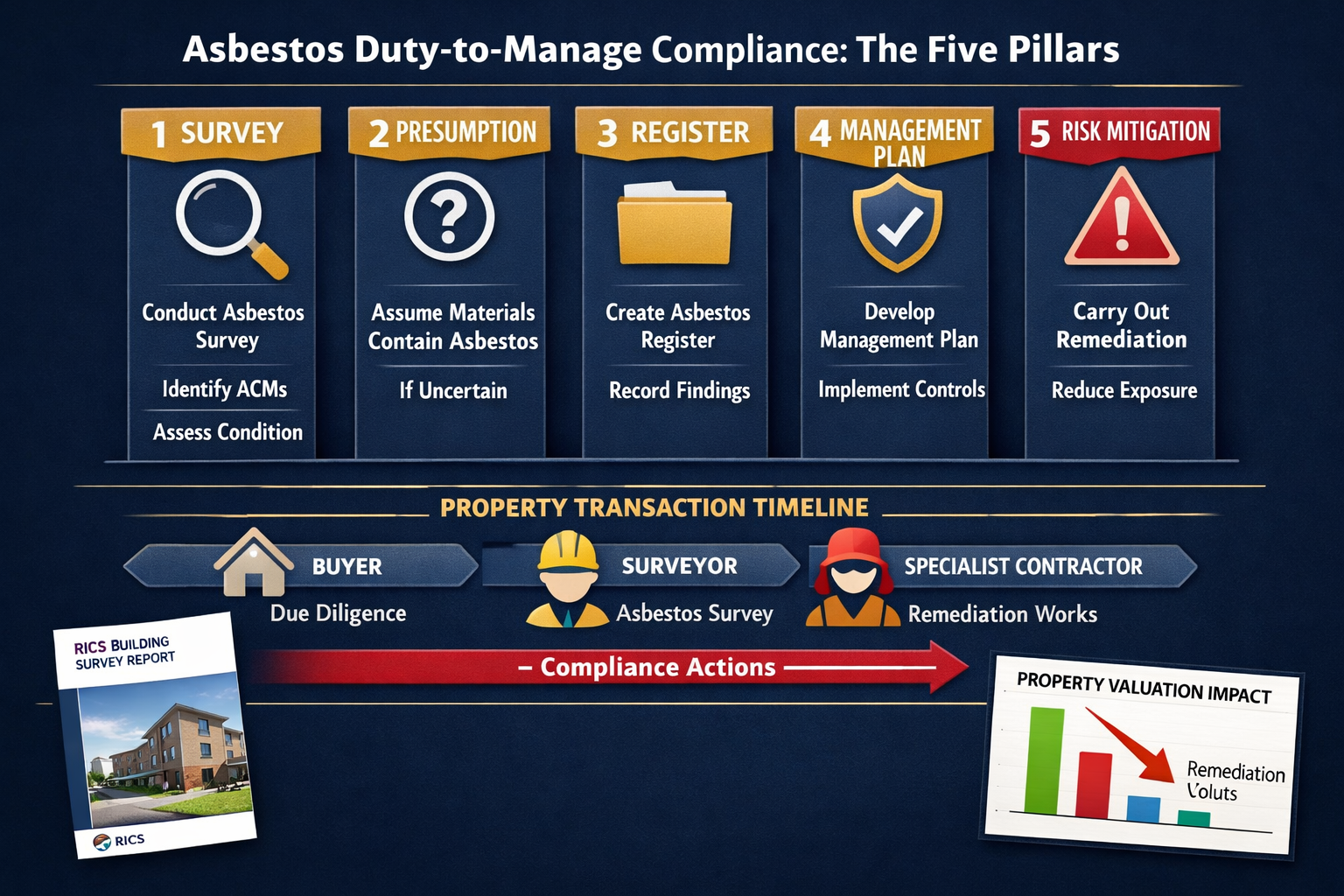
2026 guidance codifies five mandatory management steps for duty holders [3]:
| Pillar | Action Required |
|---|---|
| 1️⃣ Locate | Commission a Management Survey to identify suspect materials |
| 2️⃣ Presume | Treat all untested materials as containing asbestos |
| 3️⃣ Record | Maintain an up-to-date Asbestos Register |
| 4️⃣ Plan | Develop and implement an Asbestos Management Plan |
| 5️⃣ Mitigate | Assess risk and take proportionate action |
For residential buyers, the most immediately relevant pillars are Locate and Presume. Standard RICS homebuyer reports do not include asbestos testing — a dedicated Homebuyer Asbestos Survey is required to fulfil the Locate obligation [3].
Laboratory Confirmation: The Non-Negotiable Step
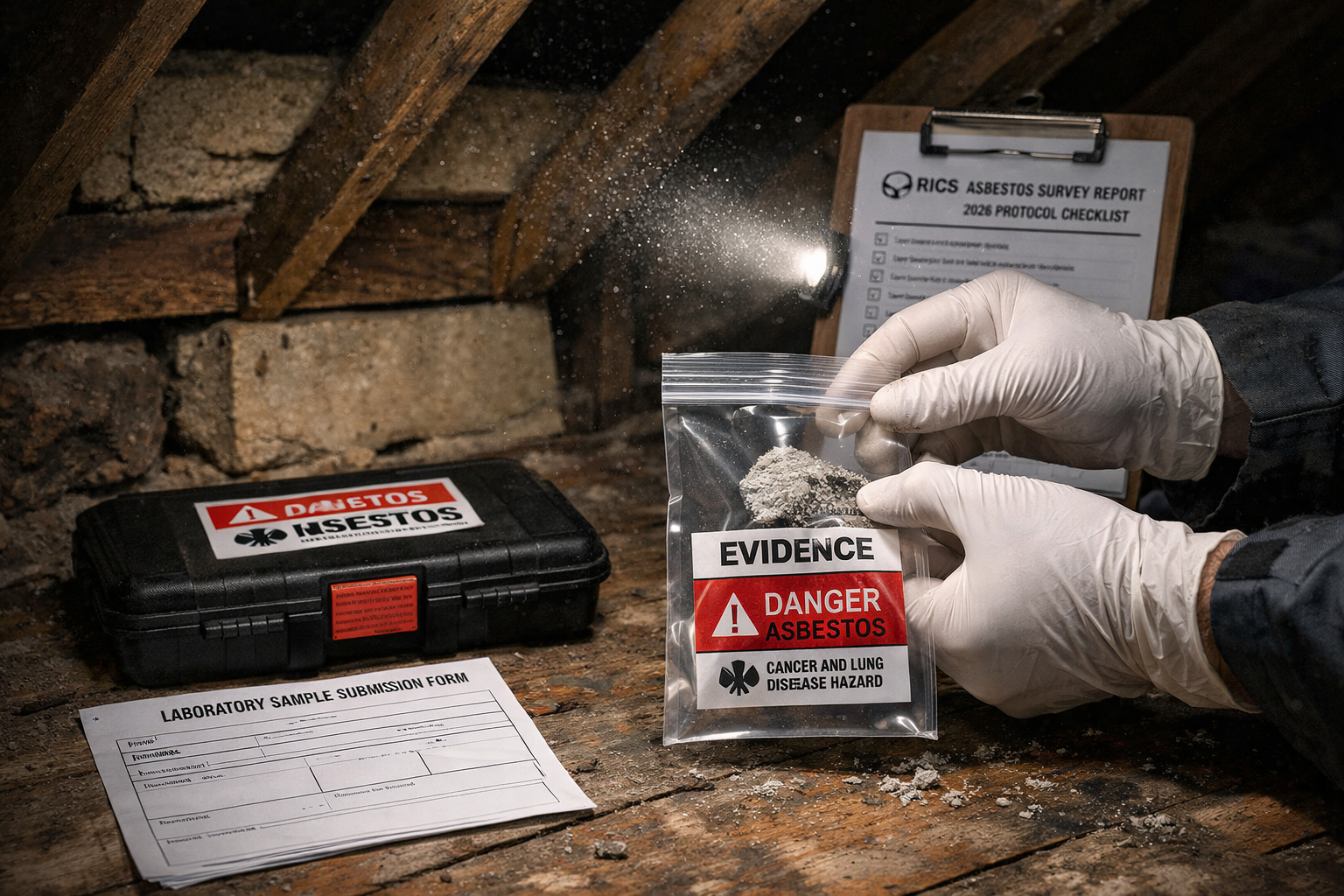
Visual inspection — however expert — cannot confirm ACM status. Only certified laboratory analysis can do so [4]. The 2026 protocol requires that:
- Samples are collected by a qualified asbestos surveyor wearing appropriate PPE.
- Samples are placed in sealed sandwich-type bags and labelled with location data.
- Samples are submitted to a UKAS-accredited laboratory for analysis.
- Results are documented in a formal report with fibre type identification.
This process is distinct from — and complementary to — the visual identification conducted during a RICS home survey [4].
Risk Valuation Adjustments and Legal Obligations for Buyers
The financial implications of ACM presence in a pre-2000 home are significant and increasingly well-understood by lenders, buyers, and valuers in 2026.
How Asbestos Affects Property Valuation
When a RICS building survey flags suspected ACMs, several valuation consequences follow:
- Mortgage lenders may require specialist asbestos reports before releasing funds on older properties.
- Valuers must factor estimated remediation costs into their assessments where ACMs are confirmed.
- Buyers gain legitimate grounds to renegotiate the purchase price — a dedicated Homebuyer Asbestos Survey explicitly provides cost-negotiation provisions [3].
- Remediation costs vary widely: encapsulation of Artex ceilings may cost £500–£2,000 per room; full removal of pipe lagging or insulation board by a licensed contractor can run to tens of thousands of pounds for a whole property.
Legal Obligations for Buyers and Owners
Under the Control of Asbestos Regulations 2012, the duty to manage asbestos falls on the person in control of the premises — which, after exchange of contracts, means the buyer [1][5].
Key obligations include:
- Commissioning a Management Survey if one does not already exist for the property.
- Maintaining an Asbestos Register and making it available to contractors.
- Ensuring contractors are informed of known or suspected ACMs before any work begins.
- Engaging licensed contractors for removal of high-risk ACMs (e.g., sprayed coatings, pipe lagging).
💡 Buyers who discover undisclosed ACMs after completion may have grounds for a claim against the seller — but prevention through pre-purchase surveying is always preferable.
Those commissioning a specific defect report on a targeted area of concern — such as a loft space or suspected asbestos ceiling — can obtain focused professional assessment without commissioning a full survey.
The Role of Dilapidations in Commercial Contexts
For commercial pre-2000 properties, ACM obligations intersect directly with lease obligations. A schedule of dilapidations must account for any asbestos remediation required to restore a property to its lease condition — a cost that can be substantial and is increasingly scrutinised by landlords and tenants alike.
Practical Steps for Buyers and Property Professionals in 2026
The updated protocols create a clear action pathway for anyone involved in the purchase, renovation, or management of pre-2000 property:
For Buyers 🏠
- ✅ Commission a RICS Level 3 Building Survey for any pre-2000 property — not a Level 2 Homebuyer Report, which provides less detail on construction materials.
- ✅ Request a dedicated Homebuyer Asbestos Survey alongside or following the RICS survey.
- ✅ Review the Asbestos Register if the property is commercial or has been previously surveyed.
- ✅ Factor specialist survey costs (typically £200–£500 for a residential management survey) into your budget.
- ✅ Use confirmed ACM findings to renegotiate the purchase price or request remediation before completion.
For Surveyors 📋
- ✅ Flag all materials consistent with ACM profiles in the survey report — do not omit or downplay.
- ✅ Recommend specialist follow-up explicitly and in writing.
- ✅ Note the construction date and modernisation history as context for ACM risk.
- ✅ Refer clients to RICS guidance on asbestos legal requirements and best practice [5].
- ✅ Stay current with RICS training — the RICS Asbestos Risk and Compliance webinar series provides CPD-accredited updates for practising surveyors [8].
For Renovators and Contractors 🔧
- ✅ Never disturb suspected ACMs without prior laboratory confirmation.
- ✅ Commission a Refurbishment and Demolition Survey before any intrusive works begin [1].
- ✅ Engage only licensed asbestos contractors for removal of high-risk materials.
- ✅ Ensure workers are briefed on the Asbestos Register before entering site.
Conclusion: Acting Now Protects Health, Value, and Legal Standing
The Building Survey Protocols for Asbestos in Pre-2000 Homes: 2026 RICS Updates Post-Regulatory Reviews represent a maturing of professional standards that reflects both the scale of the ACM challenge in UK housing and the rising costs of remediation when risks are left unmanaged.
For buyers entering the older housing market in 2026, the message is clear: a standard mortgage valuation is not sufficient, and even a Level 2 Homebuyer Report has limits. A RICS Level 3 building survey combined with a specialist asbestos inspection provides the most complete picture of risk — and the strongest negotiating position.
Actionable next steps:
- Book a Level 3 survey for any pre-2000 property before exchange of contracts.
- Commission a Homebuyer Asbestos Survey to identify and document ACMs formally.
- Presume asbestos is present in all untested materials in pre-2000 construction until laboratory analysis confirms otherwise.
- Engage licensed contractors only for any works that disturb the building fabric.
- Maintain an Asbestos Register from the point of ownership — it is a legal requirement and a practical asset for future sales and renovations.
The cost of getting this right is modest. The cost of getting it wrong — in health terms, legal liability, and property value — can be devastating.
References
[1] 2026 Guide To Asbestos Containing Materials – https://acmcontracts.co.uk/2026-guide-to-asbestos-containing-materials/
[2] Do Surveyors Check For Asbestos – https://surveymatch.co.uk/do-surveyors-check-for-asbestos/
[3] Asbestos Removal Surveys The Definitive 2026 UK Guide – https://www.aac.ltd/post/asbestos-removal-surveys-the-definitive-2026-uk-guide
[4] Types Of Asbestos Testing – https://www.oracleasbestos.com/blog/testing-sampling/types-of-asbestos-testing/
[5] May 2021 Asbestos Legal Requirements And Best Practice For Property Professionals And Clients 4th Edition – https://www.rics.org/content/dam/ricsglobal/documents/standards/May_2021_Asbestos_Legal_Requirements_And_Best_Practice_For_Property_Professionals_And_Clients_4th_Edition.pdf
[8] RICS Asbestos Risk And Compliance What Surveyors Need To Know Webinar – https://www.rics.org/training-events/online-training/scheduled/ukandi-asbestos-risk-and-compliance-what-surveyors-need-to-know-webinar