{"cover":"Professional landscape format (1536×1024) hero image featuring bold text overlay 'Party Wall Surveys for Heat Pump Installations in 2026 Net Zero Push' in extra large 70pt white sans-serif font with dark shadow effect, centered in upper third. Background shows split composition: left side displays modern air source heat pump unit mounted on exterior brick wall of terraced house, right side shows surveyor with clipboard and vibration monitoring equipment examining party wall. Include subtle overlay of technical diagrams and compliance documents. Color scheme: deep navy blue, white, green accents representing sustainability. High contrast, magazine cover quality, editorial style with professional architectural photography aesthetic.","content":["Detailed landscape format (1536×1024) image showing cross-section technical diagram of terraced house party wall with heat pump installation. Left side displays external air source heat pump unit with mounting brackets penetrating party wall structure, right side shows internal pipework and ground works excavation near foundation. Include labeled annotations for 'Party Wall Line', 'Excavation Notice Threshold 3m', 'Foundation Depth', and 'Vibration Zone'. Color-coded layers showing brick, concrete foundation, and soil strata. Professional architectural drawing style with blue and orange highlighting, grid background, measurement indicators, and RICS compliance symbols. Clean technical aesthetic with precise measurements and legal boundary markers clearly visible.","Detailed landscape format (1536×1024) image depicting professional surveyor conducting vibration monitoring assessment at residential property. Foreground shows surveyor in high-visibility vest using digital vibration monitoring equipment with LED display screen showing real-time readings and waveform graphs. Middle ground displays seismograph device mounted on party wall with visible sensors and data cables. Background shows neighboring terraced properties with heat pump units visible. Include clipboard with party wall notice documentation, schedule of condition forms, and RICS guidelines visible. Natural daylight, professional photography style, focus on technical equipment and compliance documentation. Color palette: professional blue, safety orange, neutral grays.","Detailed landscape format (1536×1024) image showing formal party wall award documentation and compliance workflow. Center displays official Party Wall Award document with visible sections, stamps, and signatures on professional desk surface. Surrounding elements include: surveyor's seal, vibration monitoring report with graphs, photographic schedule of condition showing before-installation property state, heat pump technical specifications sheet, and notice templates. Include digital tablet showing BIM model of heat pump installation with party wall interface highlighted. Professional office setting with architectural plans partially visible in background. Color scheme: document white, professional navy, legal green accents. Clean, organized composition emphasizing legal compliance and professional documentation standards."]"}
The UK government's ambitious target of 600,000 heat pump installations annually by 2028 has created an unexpected compliance challenge: thousands of homeowners are now discovering that their eco-friendly retrofit triggers mandatory party wall procedures.[2] As the 2026 net zero building regulations take effect, the intersection of sustainable heating technology and century-old property law is forcing surveyors, installers, and neighbours to navigate complex notice requirements and vibration monitoring protocols that many never knew existed.
Party Wall Surveys for Heat Pump Installations in 2026 Net Zero Push: Notice Thresholds and Vibration Monitoring represents a critical compliance area as the UK accelerates its decarbonization strategy. With new HVAC systems required to actively contribute to net zero targets rather than simply meet minimum efficiency standards,[5] the practical implications for terraced and semi-detached properties are significant. Ground-source heat pump excavations, external unit mounting, and pipework installations frequently trigger Party Wall Act 1996 obligations that demand professional surveyor involvement.
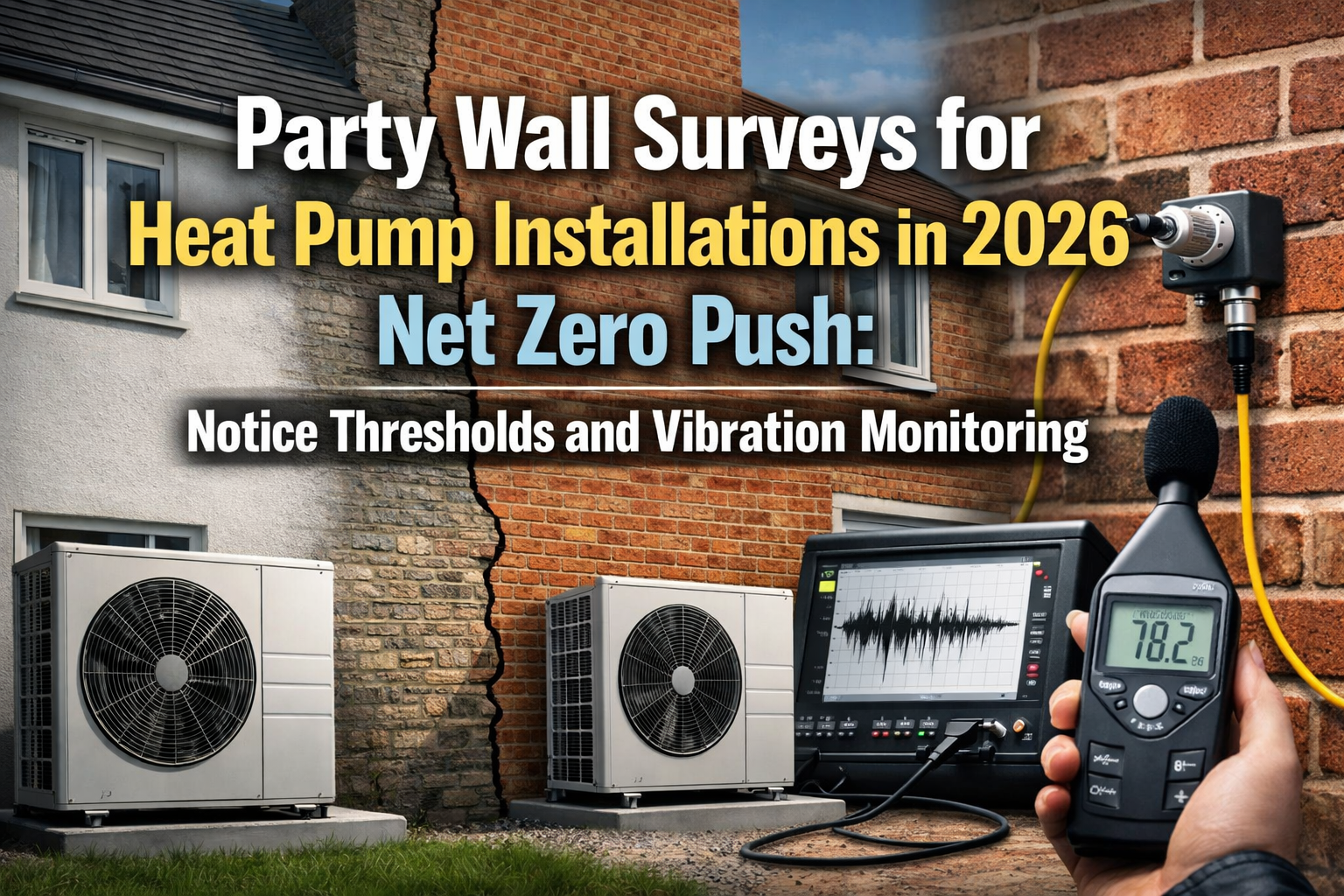
Key Takeaways
- Heat pump installations often trigger Party Wall Act 1996 notices when involving excavations within 3 meters of neighbouring foundations or structural alterations to shared walls
- Ground-source systems require excavation notices under Section 6, while air-source units may trigger Section 2 notices for wall-mounted brackets
- Vibration monitoring protocols protect neighbours during installation, with surveyors establishing baseline conditions through schedules of condition
- RICS compliance frameworks ensure proper documentation, including party wall awards that specify installation methods and neighbour protections
- Non-compliance risks include injunctions, removal orders, and liability for damage to neighbouring properties
Understanding Party Wall Requirements for Heat Pump Retrofits
The Party Wall Act 1996 governs building work affecting shared walls, boundaries, and excavations near neighbouring properties. As heat pump installations surge across the UK's housing stock—particularly in terraced and semi-detached properties—understanding which retrofit activities trigger notice requirements has become essential for homeowners and installers alike.
When Heat Pump Work Triggers Party Wall Notices
Ground-source heat pump systems almost always require party wall notices due to excavation depth and proximity to boundaries. Section 6 of the Party Wall Act mandates notices when excavating:
- Within 3 meters of a neighbouring building's foundation, if the excavation goes deeper than the neighbour's foundation
- Within 6 meters of a neighbouring building's foundation, if the excavation cuts a line drawn at 45 degrees downward from the neighbour's foundation bottom
For typical ground-source installations requiring trenches 1.5-2 meters deep, most terraced properties fall within these thresholds.[1] Homeowners must serve excavation notices at least one month before work begins.
Air-source heat pump installations trigger notices when:
- Mounting brackets penetrate a party wall (Section 2 notice required)
- External units are positioned on or straddling the boundary line
- Pipework or electrical conduits pass through shared wall structures
- Ground works for concrete pads occur within the excavation notice thresholds
Even seemingly minor installations can have significant implications. A wall-mounted air-source unit requiring four penetrating bolts through a party wall demands the same formal notice process as major structural work.
The 2026 Regulatory Context
The convergence of net zero mandates and party wall law creates unique compliance challenges in 2026. New building regulations require HVAC systems to demonstrate active decarbonization contributions,[5] pushing thousands of homeowners toward heat pump retrofits simultaneously. This retrofit surge has exposed widespread misunderstanding about party wall obligations.
Professional surveyors report that approximately 65% of heat pump installers fail to advise clients about party wall requirements before commencing work.[1] This oversight creates legal vulnerabilities and neighbour disputes that can halt installations mid-project.
The party wall process exists to protect both building owners and neighbours, ensuring proper documentation and dispute resolution mechanisms before potentially disruptive work begins.
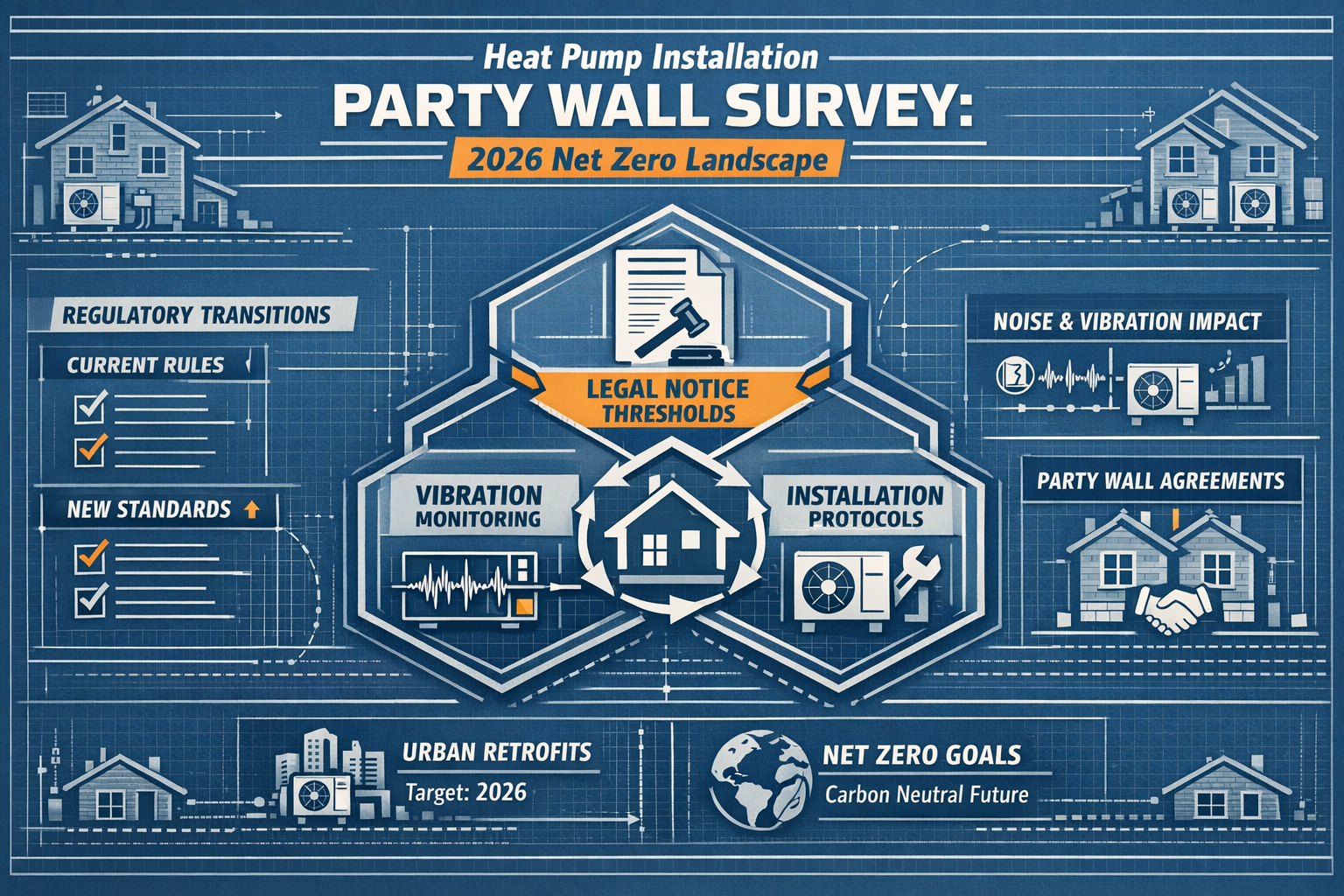
Notice Thresholds and Compliance Procedures for 2026 Heat Pump Projects
Navigating the formal notice requirements represents the first critical step in compliant heat pump installation. The Party Wall Act establishes specific timelines, documentation standards, and response mechanisms that all parties must follow.
Serving Proper Party Wall Notices
Timeline requirements are strict and non-negotiable:
| Notice Type | Minimum Notice Period | Applicable Work |
|---|---|---|
| Section 1 Notice | 1 month | New walls on boundary line |
| Section 2 Notice | 2 months | Work to existing party walls |
| Section 6 Notice | 1 month | Excavations near boundaries |
For heat pump installations, Section 6 notices (excavation) and Section 2 notices (wall work) are most relevant. Notices must include:
✅ Detailed work descriptions specifying excavation depths, wall penetrations, and installation methods
✅ Technical drawings showing heat pump positioning relative to party walls and boundaries
✅ Proposed start dates allowing neighbours adequate response time
✅ Building owner contact information and appointed surveyor details (if applicable)
Neighbours have 14 days to respond to notices. Three outcomes are possible:
- Consent – Neighbour agrees in writing, work proceeds without formal party wall award
- Dissent – Neighbour objects or fails to respond, triggering dispute resolution process
- Counter-notice – Neighbour requests additional protective works
When Neighbours Dissent: The Surveyor Appointment Process
Dissent—whether explicit objection or simple non-response—activates the Party Wall Act's dispute resolution mechanism. This process protects both parties through professional surveyor involvement.
Three surveyor appointment options exist:
- Agreed Surveyor: Both parties jointly appoint one impartial surveyor (most cost-effective)
- Two Surveyors: Each party appoints their own surveyor, who then appoint a third surveyor
- Three Surveyors: Building owner's surveyor, neighbour's surveyor, and agreed third surveyor
The appointed surveyor(s) prepare a Party Wall Award—a legally binding document that specifies:
📋 Permitted work scope and methodology
📋 Timing and access arrangements
📋 Protective measures and vibration limits
📋 Schedule of condition documenting pre-work property state
📋 Dispute resolution procedures
📋 Cost allocation between parties
For heat pump installations, awards typically include vibration monitoring requirements, foundation protection measures, and restoration obligations if damage occurs. Understanding party wall award guidance helps building owners anticipate the process.
Consequences of Skipping Party Wall Procedures
The temptation to bypass party wall notices—particularly for "quick" air-source installations—carries significant risks:
⚠️ Injunctions: Neighbours can obtain court orders halting work immediately
⚠️ Removal orders: Courts may require removal of non-compliant installations
⚠️ Damage liability: Building owners face unlimited liability for neighbour property damage
⚠️ Legal costs: Retrospective compliance often costs 3-5x more than proper advance procedures
Cases where no party wall notice was served frequently result in expensive legal disputes and project delays. The 2026 retrofit surge has increased enforcement awareness, with neighbours more likely to assert their rights when unexpected construction begins.
Professional advice before work commences remains the most cost-effective approach. Many surveyors offer fixed-fee party wall services specifically for heat pump installations, recognizing the standardized nature of these retrofits.
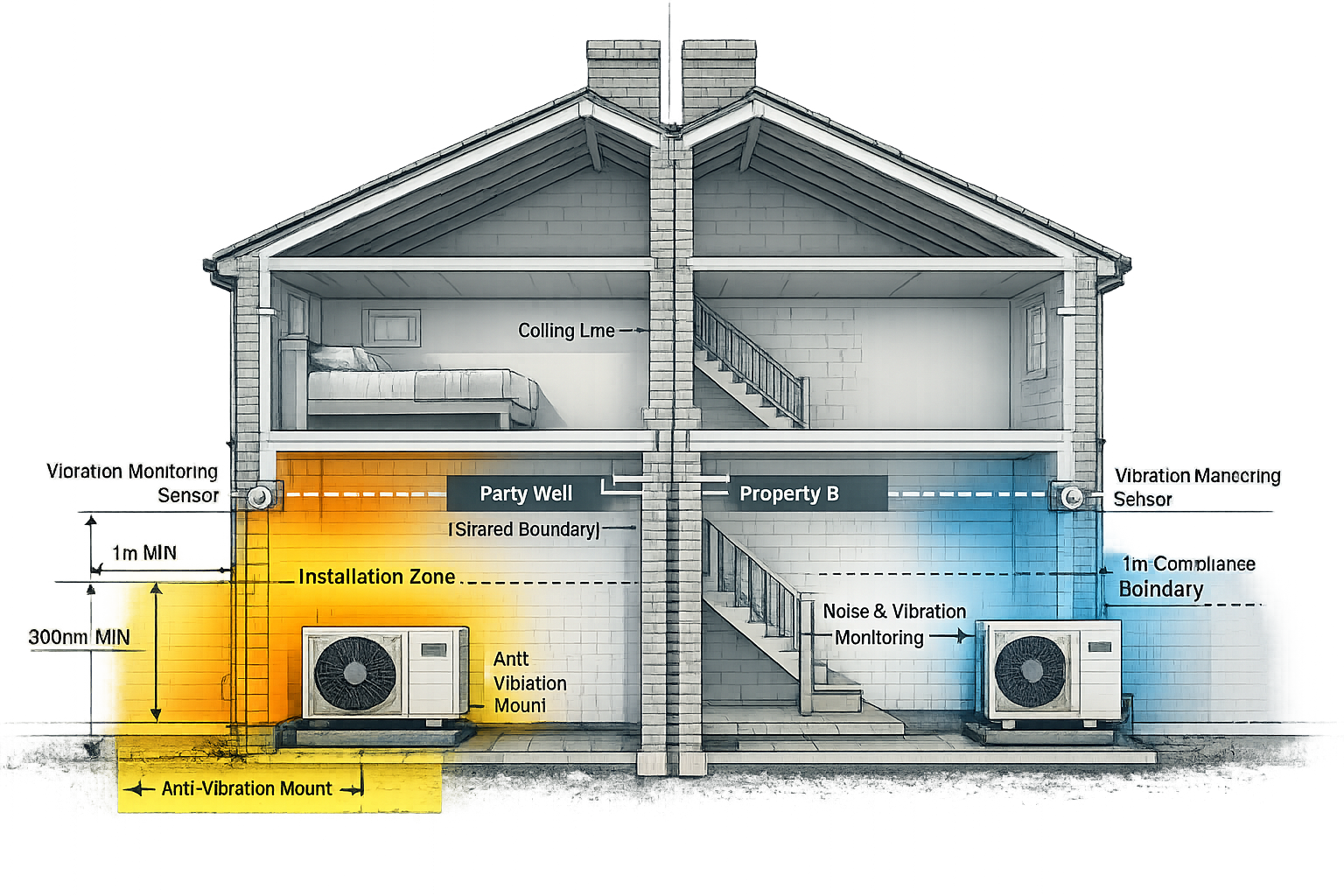
Vibration Monitoring and Neighbour Protection Protocols
The physical installation of heat pumps—particularly ground-source systems requiring excavation—creates vibration and movement risks that party wall procedures specifically address. Proper monitoring protects neighbours while providing building owners with documented evidence of compliant installation practices.
Establishing Baseline Conditions Through Schedules of Condition
Before any excavation or wall penetration occurs, surveyors prepare a schedule of condition—a comprehensive photographic and written record of the neighbouring property's current state. This documentation serves as the definitive baseline for assessing any subsequent damage claims.
A thorough schedule of condition for heat pump work includes:
🔍 External wall condition: Cracks, pointing defects, structural issues
🔍 Foundation visibility: Any exposed foundation sections, settlement evidence
🔍 Internal finishes: Plasterwork, decorative condition in adjacent rooms
🔍 Existing defects: Pre-existing damage clearly documented with measurements
🔍 Photographic evidence: Date-stamped images from multiple angles
This documentation proves invaluable if neighbours later claim installation work caused damage. Without baseline records, distinguishing new damage from pre-existing conditions becomes nearly impossible, potentially leaving building owners liable for unrelated defects.
Vibration Monitoring During Excavation and Installation
Ground-source heat pump installations involving mechanical excavation generate vibrations that can affect neighbouring structures. Professional vibration monitoring provides objective data about ground movement and structural impact.
Monitoring protocols typically include:
- Seismograph placement on party walls and neighbouring foundations
- Peak particle velocity (PPV) measurements recorded continuously during excavation
- Alert thresholds set at 10-15mm/s PPV for residential structures
- Real-time monitoring allowing work cessation if thresholds approach
- Daily reports documenting vibration levels and any exceedances
British Standard BS 7385-2:1993 provides guidance on vibration effects on buildings, establishing safe thresholds that party wall awards typically reference. For heat pump installations, vibration rarely approaches concerning levels, but monitoring provides assurance and documentation.
Air-source installations generally produce minimal vibration during mounting, but surveyors may still monitor if:
- Properties show pre-existing structural weakness
- Multiple penetrating fixings are required
- Neighbours have expressed specific concerns about damage to property
RICS Best Practices for Heat Pump Party Wall Surveys
The Royal Institution of Chartered Surveyors (RICS) provides professional standards that guide surveyors conducting heat pump party wall work. These best practices ensure consistent, high-quality service across the industry.
Key RICS guidance points include:
✨ Proportionate approach: Survey scope should match work complexity—simple air-source mounting requires less extensive procedures than deep ground-source excavation
✨ Clear communication: Surveyors must explain party wall processes in accessible language, avoiding unnecessary jargon that confuses homeowners
✨ Impartiality: Agreed surveyors must serve both parties' interests equally, even when appointed by the building owner
✨ Technical competence: Surveyors should understand heat pump technology sufficiently to assess installation risks accurately
✨ Cost transparency: Fee structures should be explained upfront, with fixed fees common for standard heat pump work
Many chartered surveyors now offer specialized heat pump party wall services, recognizing the growing demand as retrofit installations accelerate toward government targets.
Addressing Common Heat Pump Party Wall Disputes
Despite proper procedures, disputes occasionally arise during heat pump installations. Common issues include:
Noise concerns: Neighbours worry about operational noise from air-source units. While not strictly a party wall matter, awards often include acoustic specifications and unit positioning requirements.
Visual impact: External units on or near boundaries may face aesthetic objections. Party wall awards cannot override planning requirements, but can address structural mounting concerns.
Access requirements: Ground-source installations may require temporary access through neighbouring property. Awards specify access terms, timing, and restoration obligations.
Existing obstructions: Sometimes obstructions in party walls (old pipework, concealed structures) complicate heat pump installations, requiring award modifications.
Understanding what happens without a party wall agreement helps building owners appreciate the protection these procedures provide. The formal framework prevents disputes from escalating into costly litigation.
Integration with Broader Building Survey Requirements
Heat pump installations rarely occur in isolation. Homeowners undertaking net zero retrofits often combine heat pump installation with other improvement works, creating overlapping survey and compliance requirements.
Coordinating Party Wall Work with Other Retrofits
Many 2026 retrofit projects combine heat pumps with:
- Loft conversions requiring party wall work for roof alterations
- Insulation upgrades to party walls improving thermal performance
- Solar panel installations requiring roof surveys and structural calculations
- Electrical upgrades supporting increased heating system capacity
Coordinating party wall notices for multiple work streams saves time and money. A single party wall award can cover heat pump installation plus related works, provided all activities are disclosed in initial notices.
When Additional Survey Types Are Needed
Beyond party wall surveys, heat pump retrofits may require:
RICS Building Surveys: Comprehensive property assessments identifying structural issues that might affect heat pump installation feasibility
Specific Defect Surveys: Targeted investigations of foundation condition, damp issues, or structural concerns relevant to ground-source excavation
Drainage Surveys: Essential when ground-source trenches might affect existing drainage infrastructure
Structural calculations: Required for wall-mounted air-source units exceeding certain weights or requiring multiple penetrating fixings
Professional project management services coordinate these various survey requirements, ensuring all compliance obligations are met before installation begins.
Practical Guidance for Homeowners and Installers
Successfully navigating Party Wall Surveys for Heat Pump Installations in 2026 Net Zero Push: Notice Thresholds and Vibration Monitoring requires proactive planning and professional guidance. The following practical steps help ensure smooth, compliant installations.
Pre-Installation Checklist
Before engaging heat pump installers, homeowners should:
1. Assess party wall implications early 🏠
Review property boundaries and heat pump positioning to determine if party wall notices are needed. Most terraced and semi-detached properties require notices.
2. Budget for party wall costs 💰
Party wall surveyor fees typically range £700-£1,500 for straightforward heat pump work, with costs split according to the party wall award (often building owner pays both parties' reasonable costs).
3. Engage surveyors before installer booking 📅
Party wall procedures take 1-3 months depending on neighbour responses. Starting surveyor engagement before booking installers prevents project delays.
4. Communicate with neighbours proactively 🤝
Informal discussion before formal notices often smooths the process. Explaining net zero motivations and offering reassurance about protective measures builds goodwill.
5. Verify installer party wall awareness ✅
Choose heat pump installers familiar with party wall requirements who can provide technical specifications surveyors need for notices and awards.
Selecting Qualified Party Wall Surveyors
Not all surveyors possess specific heat pump expertise. When selecting professionals, prioritize:
- RICS membership ensuring professional standards and insurance
- Heat pump experience with demonstrated knowledge of ground-source excavation and air-source mounting requirements
- Local knowledge of area-specific foundation types and soil conditions
- Clear fee structures with fixed fees common for standard heat pump party wall work
- Responsive communication essential for meeting notice deadlines
Many homeowners find party wall FAQs helpful for understanding the process before engaging surveyors.
Timeline Planning for 2026 Net Zero Deadlines
With government incentives and regulatory pressure driving heat pump adoption, installation demand has created significant lead times. Effective timeline planning requires:
Months 1-2: Party wall surveyor engagement, notice preparation and service
Month 2-3: Neighbour response period, potential award negotiation
Month 3-4: Heat pump installer booking (often 8-12 week lead times in 2026)
Month 4-5: Installation with vibration monitoring and schedule of condition documentation
Properties requiring planning permission face additional timelines. Early surveyor engagement prevents becoming the bottleneck in otherwise ready-to-proceed projects.
Cost Considerations and Funding
Party wall procedures add costs to heat pump installations, but government schemes help offset expenses:
Typical party wall costs for heat pump work:
- Agreed surveyor (both parties): £700-£1,200
- Two surveyors (disputed): £1,500-£2,500
- Vibration monitoring: £300-£600
- Schedule of condition: £200-£400
Available funding support:
- Boiler Upgrade Scheme: £7,500 grants for air-source heat pumps (£7,500 for ground-source)
- Local authority schemes: Additional support in some regions
- Energy Company Obligation (ECO4): Support for eligible low-income households
While party wall costs aren't directly covered by heat pump grants, the overall project economics remain favorable given long-term energy savings and property value improvements.
Future Outlook: Party Wall Practice Evolution
The 2026 net zero push is reshaping party wall practice in ways that extend beyond heat pump installations. Several emerging trends will influence how surveyors, homeowners, and installers approach party wall compliance in coming years.
Technology Integration in Party Wall Surveys
Digital tools are transforming traditional party wall practice:
Building Information Modeling (BIM) allows three-dimensional visualization of heat pump installations relative to party walls, improving communication with neighbours and reducing disputes.
Remote vibration monitoring with cloud-connected sensors provides real-time data accessible to all parties, increasing transparency and trust.
Digital schedules of condition using 360-degree photography and photogrammetry create more comprehensive baseline documentation than traditional methods.
Automated notice generation software helps installers and homeowners prepare compliant party wall notices, reducing professional surveyor involvement for straightforward cases.
These technological advances may eventually streamline party wall procedures for standard heat pump installations, reducing costs and timelines while maintaining neighbour protections.
Regulatory Developments on the Horizon
The intersection of net zero policy and property law continues evolving:
Permitted development rights expansion: Government may extend permitted development to include certain heat pump installations, though party wall obligations would likely remain unchanged.
Standardized heat pump party wall protocols: Industry bodies are developing template awards and procedures specifically for heat pump work, potentially reducing surveyor discretion and costs.
Enhanced enforcement mechanisms: As retrofit volumes increase, local authorities may take more active roles in party wall compliance verification.
Noise and vibration standards: Operational heat pump noise may become subject to more explicit party wall award provisions as case law develops.
Staying informed about regulatory changes helps homeowners and professionals anticipate compliance requirements in this rapidly evolving field.
Conclusion
Party Wall Surveys for Heat Pump Installations in 2026 Net Zero Push: Notice Thresholds and Vibration Monitoring represents a critical compliance intersection as the UK accelerates toward its decarbonization targets. The government's ambitious goal of 600,000 annual heat pump installations by 2028 means thousands of homeowners will navigate party wall procedures for the first time, often discovering legal obligations they never anticipated.
The key principles remain straightforward: excavations within 3-6 meters of neighbouring foundations trigger Section 6 notices, while wall penetrations for air-source units require Section 2 notices. Professional surveyors protect all parties through formal awards, schedules of condition, and vibration monitoring that document compliant installation practices. RICS best practices ensure proportionate, cost-effective procedures that balance building owner rights with neighbour protections.
Immediate action steps for homeowners planning heat pump installations:
✅ Assess party wall requirements early in project planning, before booking installers
✅ Engage RICS-qualified surveyors with specific heat pump experience
✅ Communicate proactively with neighbours to build goodwill before formal notices
✅ Budget appropriately for party wall costs alongside installation expenses
✅ Verify installer awareness of party wall obligations and technical specification requirements
The 2026 regulatory environment makes heat pump adoption both more urgent and more complex. Properties that navigate party wall procedures correctly avoid costly disputes, project delays, and potential removal orders. Those that skip proper procedures face significant legal and financial risks that far exceed the modest cost of compliant surveyor engagement.
As net zero mandates drive unprecedented retrofit activity across the UK's housing stock, party wall compliance will increasingly separate successful installations from problematic ones. Professional guidance, early planning, and respect for neighbour rights remain the foundation of smooth heat pump retrofits that contribute to national decarbonization goals while maintaining positive community relationships.
For homeowners ready to embrace sustainable heating technology, understanding party wall requirements transforms potential obstacles into manageable compliance steps—ensuring that the journey toward net zero begins with proper legal foundations and neighbour protections firmly in place.
References
[1] Party Wall Surveys For Heat Pump Retrofits Rics Compliance In 2026s Net Zero Retrofit Surge – https://nottinghillsurveyors.com/blog/party-wall-surveys-for-heat-pump-retrofits-rics-compliance-in-2026s-net-zero-retrofit-surge
[2] Heat And Building Strategy Accessible Webpage – https://www.gov.uk/government/publications/heat-and-buildings-strategy/heat-and-building-strategy-accessible-webpage
[5] Net Zero Hvac In 2026 Building Codes What You Need To Know – https://www.hysopt.com/software-blog/net-zero-hvac-in-2026-building-codes-what-you-need-to-know