
Commercial and institutional planning activity jumped 30% year-over-year in August 2025, signaling a robust recovery that will test surveying firms' operational limits throughout Q2 2026[3]. As homebuying reforms accelerate transaction timelines and infrastructure projects multiply across data centers, energy storage, and reshoring facilities, surveying practices face an urgent question: how to scale capacity without sacrificing margins or quality. This practical playbook addresses Scaling Surveyor Operations for Q2 2026 Demand Surge: Capacity Strategies in Reform-Driven Recovery through proven workforce, technology, and efficiency strategies.

The global land survey equipment market's projected 4.2% CAGR growth to USD 13.2 billion by 2036 reflects sustained infrastructure investment[1]. Yet growth alone doesn't guarantee profitability—47% of contractors prioritize margin improvement in 2026, recognizing that being busy differs fundamentally from being profitable[2]. For surveying firms, the coming quarter demands strategic capacity expansion that protects margins while capturing market share.
Key Takeaways
- Q2 2026 presents unprecedented demand driven by homebuying reforms, infrastructure projects, and commercial activity rebounding 30% year-over-year
- Labor shortage risks threaten capacity with potential shortfalls of 2+ million skilled professionals by 2028 requiring proactive recruitment and training strategies
- Technology integration separates winners from losers as firms with deeply integrated digital systems protect margins and scale efficiently
- Margin protection requires operational discipline beyond revenue growth, with 47% of contractors prioritizing profitability improvements
- Strategic partnerships and flexible staffing models enable firms to capture demand spikes without permanent overhead increases
Understanding the Q2 2026 Demand Landscape
Market Drivers Fueling Surveyor Demand
The convergence of multiple factors creates exceptional opportunity for surveying practices in Q2 2026. Homebuying process reforms promise to accelerate transactions and increase transparency through enhanced early building surveys and streamlined valuation processes[5]. This regulatory shift compresses timelines, requiring surveyors to handle higher volumes with faster turnaround.
Simultaneously, infrastructure investment surges across multiple sectors. Data center power demand could grow more than fivefold by 2035 to 176 gigawatts, up from 33 gigawatts in 2024[3]. Each facility requires extensive site assessment, boundary surveys, topographic mapping, and ongoing monitoring—creating sustained demand for specialized surveying services.
Reshoring acceleration adds another demand layer. The percentage of companies actively reshoring operations climbed to 26%, up from 10% six months prior[4]. While 60% indicate full reshoring takes 1-3 years, this creates immediate need for US-based site assessment, feasibility studies, and construction surveying services.
Geographic and Sector Hotspots
Demand concentrates in specific geographic corridors and property sectors. Urban centers experiencing commercial recovery show particularly strong activity, with chartered surveyors in Central London, West London, and regional hubs like Hampshire reporting increased inquiry volumes.
Sector-specific opportunities include:
- Residential transactions 📈 accelerated by reform-driven process improvements
- Data center developments 💻 requiring specialized site assessment and monitoring
- Energy infrastructure ⚡ including renewable installations and grid upgrades
- Manufacturing reshoring 🏭 demanding industrial site surveys and facility planning
- Commercial property 🏢 rebounding from pandemic-era suppression
Firms positioned in these geographic and sector intersections face the most acute capacity challenges—and the greatest revenue opportunities.
Building Team Capacity for Scaling Surveyor Operations for Q2 2026 Demand Surge
Workforce Expansion Strategies
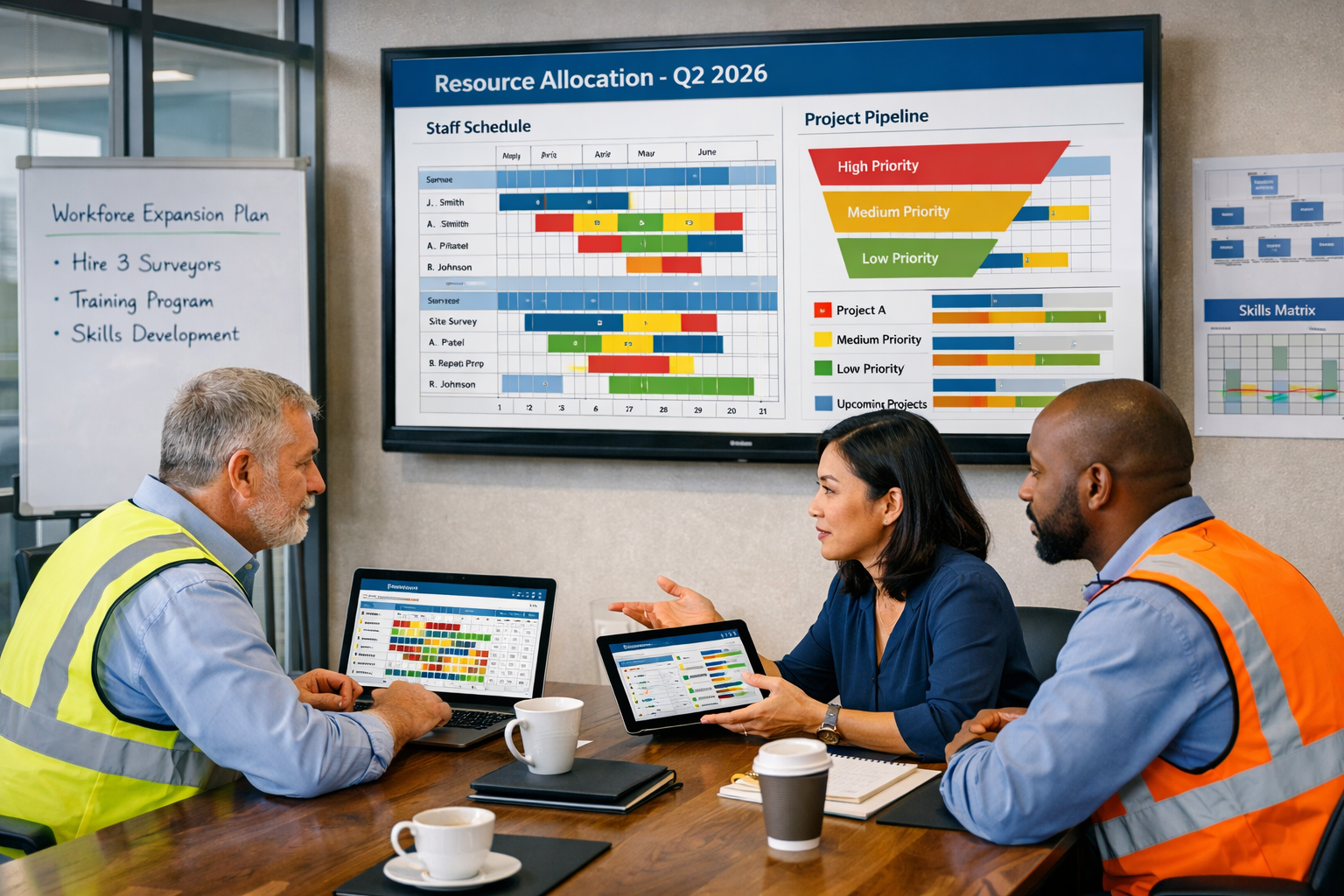
The engineering and construction industry faces potential shortages exceeding 2 million skilled craft professionals by 2028[3]. For surveying firms, this labor constraint represents the primary scaling bottleneck. Proactive recruitment and retention strategies separate firms that capture Q2 2026 demand from those that turn away business.
Immediate hiring priorities should focus on:
- Graduate surveyors ready for structured training programs
- Experienced chartered surveyors with specialized credentials
- Survey technicians proficient in modern equipment and software
- Administrative support to free technical staff for revenue-generating activities
Flexible staffing models provide capacity without permanent overhead. Options include:
✅ Associate surveyor networks for overflow work and geographic coverage
✅ Part-time specialists for niche services like dilapidations or RICS valuations
✅ Retired professionals returning for project-based engagements
✅ Cross-training existing staff to handle multiple survey types
Training and Development Acceleration
Scaling capacity requires more than hiring—it demands rapid skill development. Structured training programs compress the timeline from recruitment to productivity.
90-day onboarding framework:
| Week | Focus Area | Deliverables |
|---|---|---|
| 1-2 | Company systems, safety protocols | Platform proficiency |
| 3-6 | Supervised field work, report review | First assisted surveys |
| 7-10 | Independent surveys with review | Quality-approved reports |
| 11-13 | Specialized training, client interaction | Full productivity |
Mentorship pairing accelerates development while protecting quality. Senior surveyors supervise 2-3 junior staff, reviewing reports before client delivery and providing real-time field coaching. This model maintains standards during rapid expansion.
Technology training deserves dedicated investment. Modern surveying relies on laser scanning, drone photogrammetry, GPS equipment, and specialized software. Firms should allocate 10-15% of new hire time to equipment and platform training during the first quarter.
Geographic Coverage Optimization
Strategic location decisions multiply capacity without proportional cost increases. Firms serving multiple markets should analyze:
- Travel time from office to typical job sites
- Market density of active projects and prospects
- Competitor presence and capacity constraints
- Local partnerships with estate agents, solicitors, and developers
Establishing satellite coverage in high-demand areas like Islington, Putney, or Fulham reduces travel time and enables same-day service—a competitive differentiator when transaction timelines compress under 2026 reforms.
Technology Integration for Scaling Surveyor Operations for Q2 2026 Demand Surge

Digital Systems as Competitive Advantage
Contractors with deeply integrated digital systems are better positioned to protect margins, reclaim time, and scale with confidence in 2026[2]. For surveying practices, technology integration determines whether capacity expansion generates proportional profit growth.
Core technology stack components:
🔧 Customer Relationship Management (CRM) tracking inquiries, quotes, and conversions
🔧 Project Management Platform coordinating schedules, assignments, and deadlines
🔧 Mobile Field Applications enabling real-time data capture and report initiation
🔧 Automated Report Generation reducing writing time by 40-60%
🔧 Cloud Storage and Collaboration providing secure access across teams
🔧 Accounting Integration linking project completion to invoicing and payment tracking
The critical factor isn't adopting individual tools—it's achieving deep integration where data flows seamlessly between systems. A surveyor completing a building survey should trigger automatic report template population, client notification, invoice generation, and schedule updates without manual data re-entry.
Equipment Modernization ROI
The global land survey equipment market's growth reflects technology advancement that improves both speed and accuracy[1]. Strategic equipment investment pays for itself through productivity gains and service expansion.
High-ROI equipment investments:
- Laser scanning systems reducing measurement time by 50-70%
- Drone platforms for roof surveys and large site assessment
- Thermal imaging cameras for damp surveys and building diagnostics
- Mobile LiDAR for topographic and boundary surveys
- 360-degree cameras for virtual property documentation
Calculate equipment ROI by comparing:
Traditional method time × hourly rate × annual uses
versus
Equipment cost + training + maintenance
Most modern equipment achieves payback within 12-18 months while enabling service offerings competitors can't match.
Automation and Efficiency Multipliers
Strategic automation targets repetitive, low-value tasks that consume surveyor time without requiring professional judgment. Priority automation opportunities include:
✨ Appointment scheduling through client self-service portals
✨ Quote generation using standardized pricing matrices
✨ Report formatting with template-based systems
✨ Photo organization through AI-powered tagging and sorting
✨ Client communication via automated status updates
Each automation hour reclaimed equals additional billable capacity. A firm completing 500 surveys annually that saves 30 minutes per survey through automation gains 250 hours—equivalent to hiring a part-time surveyor without recruitment or training costs.
Operational Excellence in Reform-Driven Recovery
Margin Protection Strategies
Rising operational costs and persistent labor shortages threaten profitability even as revenue grows[3]. Scaling Surveyor Operations for Q2 2026 Demand Surge: Capacity Strategies in Reform-Driven Recovery requires explicit margin protection tactics.
Price optimization starts with understanding true delivery costs. Many surveying firms undercharge for rush services, specialized surveys, or distant locations. Implement:
- Tiered pricing based on turnaround time (standard, expedited, emergency)
- Geographic premiums for travel exceeding 30-45 minutes
- Complexity adjustments for non-standard construction or large properties
- Service bundling encouraging clients to combine surveys for efficiency
Cost discipline prevents margin erosion during expansion. Monitor:
- Utilization rates targeting 65-75% billable time for technical staff
- Subcontractor costs ensuring associate rates preserve margin
- Travel efficiency clustering appointments geographically
- Equipment utilization maximizing return on capital investments
Quality Assurance at Scale
Rapid growth risks quality degradation that damages reputation and triggers costly remediation. Systematic quality assurance protects brand value during expansion.
Three-tier quality framework:
- Self-review checklist completed by surveyor before submission
- Peer review for new staff or complex surveys
- Random sampling with senior surveyor reviewing 10-15% of completed reports
Digital systems enable efficient quality tracking. Flag reports requiring additional review based on:
- Surveyor experience level
- Property complexity indicators
- Client history or sensitivity
- Service type risk profile
Investing 5-7% of capacity in quality assurance prevents the 20-30% capacity loss from errors, revisions, and reputation damage.
Client Experience During High-Volume Periods
Demand surges test client service standards. Firms that maintain responsiveness and communication during busy periods build loyalty that extends beyond Q2 2026.
Communication protocols:
📞 Inquiry response within 4 business hours
📞 Quote delivery within 24 hours for standard surveys
📞 Appointment scheduling offering multiple options within 5-7 days
📞 Report delivery meeting committed timelines with proactive updates if delays occur
Expectation management prevents dissatisfaction. When capacity constraints extend timelines, offer:
- Transparent wait times rather than vague "we'll get back to you"
- Priority options with expedited pricing for urgent needs
- Alternative solutions like associate surveyors or partner firms
- Proactive updates if schedules shift
Clients accept reasonable delays when communicated professionally. They don't accept being ignored or surprised.
Strategic Partnerships and Market Positioning
Referral Network Development
Surveying demand concentrates at transaction points controlled by referral partners. Strategic relationship development multiplies lead flow without marketing expense.
High-value referral sources:
🤝 Estate agents recommending surveys to buyers
🤝 Mortgage brokers advising clients on survey selection
🤝 Solicitors coordinating transaction requirements
🤝 Property developers needing project-specific surveys
🤝 Commercial agents referring business clients
Effective partnership requires:
- Consistent quality building trust through reliable delivery
- Fast turnaround supporting partners' transaction timelines
- Clear communication keeping partners informed of progress
- Reciprocal referrals directing clients to trusted partners
- Educational content helping partners understand which survey clients need
Service Portfolio Optimization
Capacity constraints force prioritization. Not all survey types generate equal profit or strategic value. Analyze service mix by:
| Survey Type | Average Fee | Delivery Time | Margin % | Strategic Value |
|---|---|---|---|---|
| Level 2 Survey | £450-650 | 3-4 hours | 45-55% | High volume, referral driver |
| Level 3 Survey | £800-1,200 | 6-8 hours | 50-60% | Premium service, expertise showcase |
| RICS Valuation | £300-500 | 2-3 hours | 40-50% | Lender relationships |
| Dilapidations | £1,500-3,000 | 8-12 hours | 55-65% | Commercial niche, high margin |
During peak demand, prioritize services offering the best combination of margin, efficiency, and strategic positioning. Consider referring lower-margin, time-intensive work to associates while focusing internal capacity on premium services.
Competitive Positioning in Reform Environment
Homebuying reforms create differentiation opportunities for firms that adapt quickly[5]. Position your practice around:
Speed and availability ⚡ offering expedited services that support compressed transaction timelines
Digital delivery 📱 providing reports, photos, and documentation through secure client portals
Transparent pricing 💷 publishing clear fee schedules and turnaround commitments
Reform expertise 📋 educating clients and partners on new process requirements
Comprehensive service 🏠 bundling surveys, valuations, and specialist assessments
Firms that help clients navigate 2026 reforms capture market share from competitors still operating under pre-reform assumptions.
Financial Planning and Investment Decisions
Capital Allocation Priorities
Scaling requires investment across multiple categories. Strategic capital allocation maximizes return while managing cash flow during expansion.
Investment priority framework:
- Technology infrastructure (35-40% of growth capital) – highest ROI through efficiency gains
- Equipment acquisition (25-30%) – enables service expansion and productivity
- Staff recruitment and training (20-25%) – builds sustainable capacity
- Marketing and business development (10-15%) – fills pipeline to justify capacity
- Working capital reserve (10%) – buffers timing gaps between delivery and payment
Avoid the common mistake of hiring aggressively without supporting technology and equipment investments. Surveyors without proper tools and systems generate lower productivity and higher frustration.
Cash Flow Management During Growth
Revenue growth often precedes cash collection, creating working capital strain. Manage growth-phase cash flow through:
✅ Deposit requirements collecting 25-50% upfront for surveys
✅ Faster invoicing billing immediately upon report delivery
✅ Payment terms offering small discounts for immediate payment
✅ Credit management following up on overdue accounts within 7 days
✅ Line of credit establishing bank facility before needing it
Monitor days sales outstanding (DSO) targeting collection within 14-21 days for residential work and 30 days for commercial clients. Each week of delayed collection ties up capital needed for growth investment.
Scenario Planning and Flexibility
While Q2 2026 forecasts indicate strong demand, prudent operators plan for multiple scenarios. Develop capacity strategies for:
Base case (60% probability): Demand increases 25-35% over Q1 2026
Upside case (25% probability): Demand surges 50%+ driven by accelerated reforms
Downside case (15% probability): Economic headwinds dampen activity to 10-15% growth
Build flexibility through:
- Scalable associate networks expanding or contracting with demand
- Equipment leasing versus purchasing for specialized tools
- Temporary staff during peak periods
- Service portfolio adjustments emphasizing high-margin work if volumes disappoint
Firms that scale intelligently capture upside while protecting downside risk.
Implementation Roadmap
30-Day Quick Wins
Immediate actions generate capacity gains before Q2 2026 demand peaks:
Week 1-2:
- Audit current capacity utilization and identify bottlenecks
- Review pricing for all services and implement rush/distance premiums
- Establish quality assurance checklist and review protocols
- Survey staff about process inefficiencies and technology frustrations
Week 3-4:
- Implement appointment scheduling automation
- Standardize report templates for faster completion
- Launch recruitment campaign for immediate hiring needs
- Contact top 10 referral partners to discuss capacity and collaboration
90-Day Transformation
Month 1:
- Complete technology stack evaluation and select integrated platforms
- Hire priority positions with structured onboarding program
- Establish associate surveyor network for overflow capacity
- Implement tiered pricing and service bundling
Month 2:
- Roll out new technology systems with comprehensive staff training
- Acquire priority equipment with ROI exceeding 18 months
- Develop referral partner program with incentives and communication protocols
- Create client education content about 2026 reforms and survey selection
Month 3:
- Optimize geographic coverage with satellite locations or partnerships
- Refine service portfolio based on margin and efficiency analysis
- Establish financial dashboards tracking utilization, margin, and cash flow
- Conduct quality audit and refine assurance processes
Ongoing Optimization
Scaling Surveyor Operations for Q2 2026 Demand Surge: Capacity Strategies in Reform-Driven Recovery requires continuous improvement beyond initial implementation:
📊 Monthly metrics review tracking utilization, margin, quality, and client satisfaction
📊 Quarterly strategy sessions adjusting capacity plans based on actual demand
📊 Staff feedback loops identifying operational friction and improvement opportunities
📊 Technology assessment evaluating new tools and integration opportunities
📊 Competitive intelligence monitoring market positioning and pricing
Conclusion
The convergence of homebuying reforms, infrastructure investment, and commercial recovery creates exceptional opportunity for surveying practices in Q2 2026. Firms that scale strategically—building team capacity, integrating technology, protecting margins, and maintaining quality—will capture market share and establish competitive advantages extending beyond the immediate demand surge.
Success requires moving beyond simply being busy to being strategically profitable. The 47% of contractors prioritizing margin improvement recognize that operational scale without efficiency gains erodes rather than enhances business value[2]. For surveying firms, this means investing in the technology, training, and systems that multiply productivity while maintaining the quality standards that drive referrals and repeat business.
The labor shortage risk remains real—potential shortfalls exceeding 2 million skilled professionals by 2028 demand proactive recruitment and retention[3]. Firms that build associate networks, develop junior staff rapidly, and leverage technology to maximize existing team productivity will navigate constraints that paralyze competitors.
Immediate action steps:
- Assess current capacity and identify specific bottlenecks limiting growth
- Prioritize technology integration focusing on systems that eliminate manual data re-entry
- Launch recruitment initiatives targeting both permanent staff and flexible associate networks
- Implement margin protection through strategic pricing and cost discipline
- Strengthen referral partnerships positioning your firm as the reliable choice during high-demand periods
- Establish quality assurance protocols that scale without degrading standards
- Monitor financial metrics weekly during growth phase to identify issues early
The Q2 2026 demand surge represents a defining moment for surveying practices. Firms that execute strategic capacity expansion will emerge stronger, more profitable, and better positioned for sustained growth. Those that simply react to demand without operational discipline risk burning out staff, disappointing clients, and missing the recovery's full potential.
The playbook is clear. The opportunity is immediate. The time to scale is now.
References
[1] Global Land Survey Equipment Market Outlook 2026 2036 Infrastructure Boom Drives Precision Mapping Demand – https://world.einnews.com/pr_news/903145238/global-land-survey-equipment-market-outlook-2026-2036-infrastructure-boom-drives-precision-mapping-demand
[2] New Research Reveals Busy Is Not The Same As Profitable For Commercial Landscaping Contractors In 2026 – https://www.barchart.com/story/news/1176546/new-research-reveals-busy-is-not-the-same-as-profitable-for-commercial-landscaping-contractors-in-2026
[3] Engineering And Construction Industry Outlook – https://www.deloitte.com/us/en/insights/industry/engineering-and-construction/engineering-and-construction-industry-outlook.html
[4] Kpmg 2026 Tariff Survey – https://kpmg.com/us/en/media/news/kpmg-2026-tariff-survey.html
[5] Homebuying Process Reforms 2026 Impact On Early Building Surveys And Valuation Timing – https://nottinghillsurveyors.com/blog/homebuying-process-reforms-2026-impact-on-early-building-surveys-and-valuation-timing