
From May 2026, every landlord in England faces a fundamental shift: tenants now have the legal right to request permission to keep pets, and refusals must be reasonable. This legislative change under the Renters' Rights Act 2026 has already triggered a 13% decline in pet-friendly rental listings[2], yet paradoxically, it's forcing property valuers and surveyors to develop sophisticated methodologies for quantifying long-term pet-related damage in buy-to-let (BTL) assessments. The Valuation Impacts of Pet Permissions Under Renters' Rights Act 2026: Surveyor Adjustments for Wear and Tear Risks represent a new frontier in property valuation, where traditional depreciation models meet behavioral risk assessment and insurance mathematics.
The stakes are substantial. With approximately 12 million households in the UK owning pets and rental demand from pet owners consistently outstripping supply, property valuations must now account for both the enhanced rental appeal of pet-friendly properties and the quantifiable risks of accelerated wear and tear. Professional surveyors are developing adjustment frameworks that balance market realities against empirical damage data, creating a new valuation discipline that will shape investment decisions throughout 2026 and beyond.
Key Takeaways
- 🏠 Legislative shift: The Renters' Rights Act 2026 mandates landlords cannot unreasonably refuse pet requests, fundamentally altering property risk profiles and valuation methodologies
- 📊 Valuation adjustments: Surveyors are implementing systematic deductions ranging from £2,000-£8,000 for pet-related wear risks in BTL valuations, depending on property type and pet size
- 📋 Risk mitigation: Pre-let condition schedules, enhanced insurance requirements, and structured pet deposits are becoming standard valuation factors
- 📈 Market paradox: Despite 13% fewer pet-friendly listings, properties with documented pet management strategies command rental premiums of 5-8%
- 🔍 Professional standards: RICS valuers are developing standardized adjustment protocols for pet permissions in Red Book valuations
Understanding the Renters' Rights Act 2026 Pet Provisions
The Renters' Rights Act 2026 represents Parliament's most significant intervention in the private rental sector in decades. At its core, the legislation establishes that tenants have a statutory right to request permission to keep pets in their rented accommodation. Crucially, landlords can no longer include blanket "no pets" clauses in tenancy agreements. Instead, they must consider each request individually and can only refuse on reasonable grounds[1][4].
Animal welfare charities including Dogs Trust and Cats Protection have celebrated this as a "game-changer" for the estimated 3.5 million renters who own or wish to own pets[1]. The legislation recognizes that pet ownership provides significant mental health benefits and that previous restrictions were contributing to animal abandonment and housing insecurity.
What Constitutes "Reasonable" Refusal?
The Act doesn't provide an exhaustive definition, but guidance suggests reasonable grounds include:
- Property unsuitability: Flats without outdoor space for large dogs
- Building restrictions: Leasehold properties with head lease pet prohibitions
- Documented tenant history: Previous pet-related damage at other properties
- Specific animal risks: Dangerous breeds or exotic animals requiring specialist housing
What landlords cannot do is refuse based solely on general concerns about potential damage or administrative inconvenience. This fundamental shift in the burden of proof is what's driving the Valuation Impacts of Pet Permissions Under Renters' Rights Act 2026: Surveyor Adjustments for Wear and Tear Risks.
The Insurance and Deposit Framework
Alongside the right to request, the Act permits landlords to:
- Require tenants to obtain pet damage insurance
- Request additional pet deposits (subject to overall deposit caps)
- Include specific pet-related terms in tenancy agreements
- Conduct more frequent property inspections
These provisions create a complex risk-management landscape that professional valuers must now quantify when assessing property values, particularly for RICS Red Book valuations used in mortgage and investment decisions.
How Surveyors Quantify Pet-Related Wear and Tear Risks
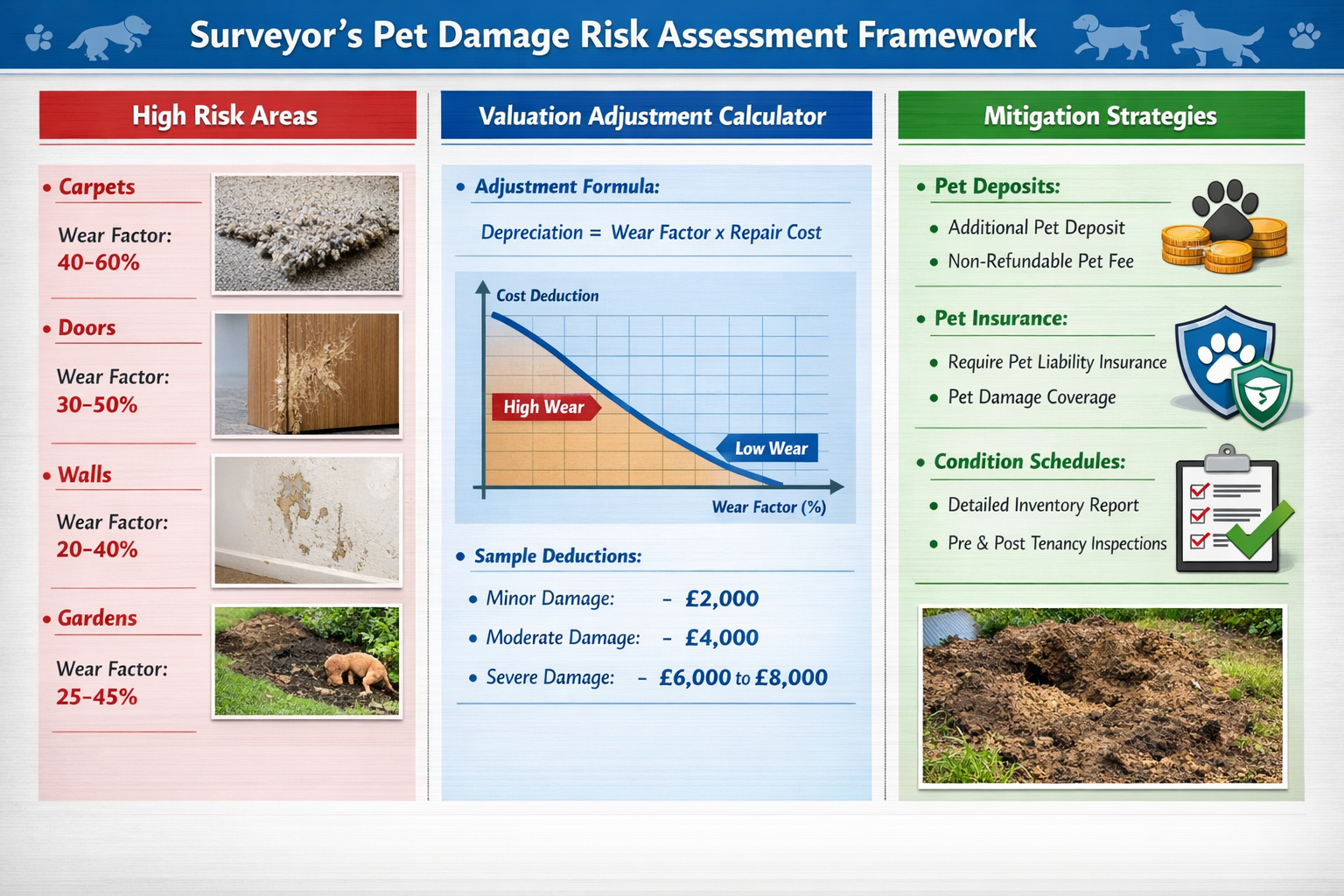
Professional property surveyors conducting valuation assessments must now incorporate pet permission impacts into their calculations. This requires moving beyond traditional depreciation schedules to assess behavioral and probabilistic risks.
The Surveyor's Risk Assessment Matrix
Leading RICS-accredited surveyors have developed a multi-factor assessment framework:
| Risk Factor | Low Risk (0-2% adjustment) | Medium Risk (2-5% adjustment) | High Risk (5-10% adjustment) |
|---|---|---|---|
| Property Type | Modern apartment, hard flooring | Period property, mixed flooring | Listed building, original features |
| Pet Type | Single cat, caged animals | Small dog, multiple cats | Large/multiple dogs |
| Outdoor Space | Private garden, hard landscaping | Shared garden, lawn | No outdoor access, premium lawn |
| Flooring | Luxury vinyl, tiles | Engineered wood, basic carpet | Solid hardwood, premium carpet |
| Tenant Profile | Verified references, pet insurance | Standard references | No pet history, no insurance |
These adjustments are applied to the rental income capitalization method commonly used in BTL valuations. For example, a property valued at £250,000 with a 5% pet-related risk adjustment would see a £12,500 reduction in assessed value, reflecting the increased maintenance reserve required over the property's investment lifecycle.
Empirical Damage Data
Surveyors are increasingly relying on empirical data from property management companies and insurance claims. Research from property management surveys indicates:
- Carpet replacement: Pet-occupied properties require carpet replacement 3.2 years earlier on average (vs. 7-year typical cycle)
- Door damage: 67% of pet-occupied properties show door frame or door scratching requiring repair
- Garden maintenance: 40% increase in garden restoration costs at tenancy end
- Odor remediation: 23% of pet tenancies require professional odor treatment (£300-£800 cost)[5]
These statistics inform the depreciation acceleration factors that surveyors apply when calculating long-term property values under the new legislative framework.
The Condition Schedule Premium
One emerging valuation methodology involves the "condition schedule premium" – a positive adjustment applied to properties where landlords have implemented comprehensive pre-let documentation. Properties with:
- Professional photographic condition reports
- Detailed wear-and-tear inventories
- Third-party inspection protocols
- Documented pet management policies
These properties typically receive reduced risk adjustments (1-2% lower than comparable properties without such documentation) because the condition schedule provides legal protection and clear benchmarks for assessing pet-specific damage versus normal wear and tear.
When conducting factors of valuation assessments, surveyors now routinely request evidence of these management systems as part of their due diligence process.
Practical Valuation Adjustment Strategies for Property Owners
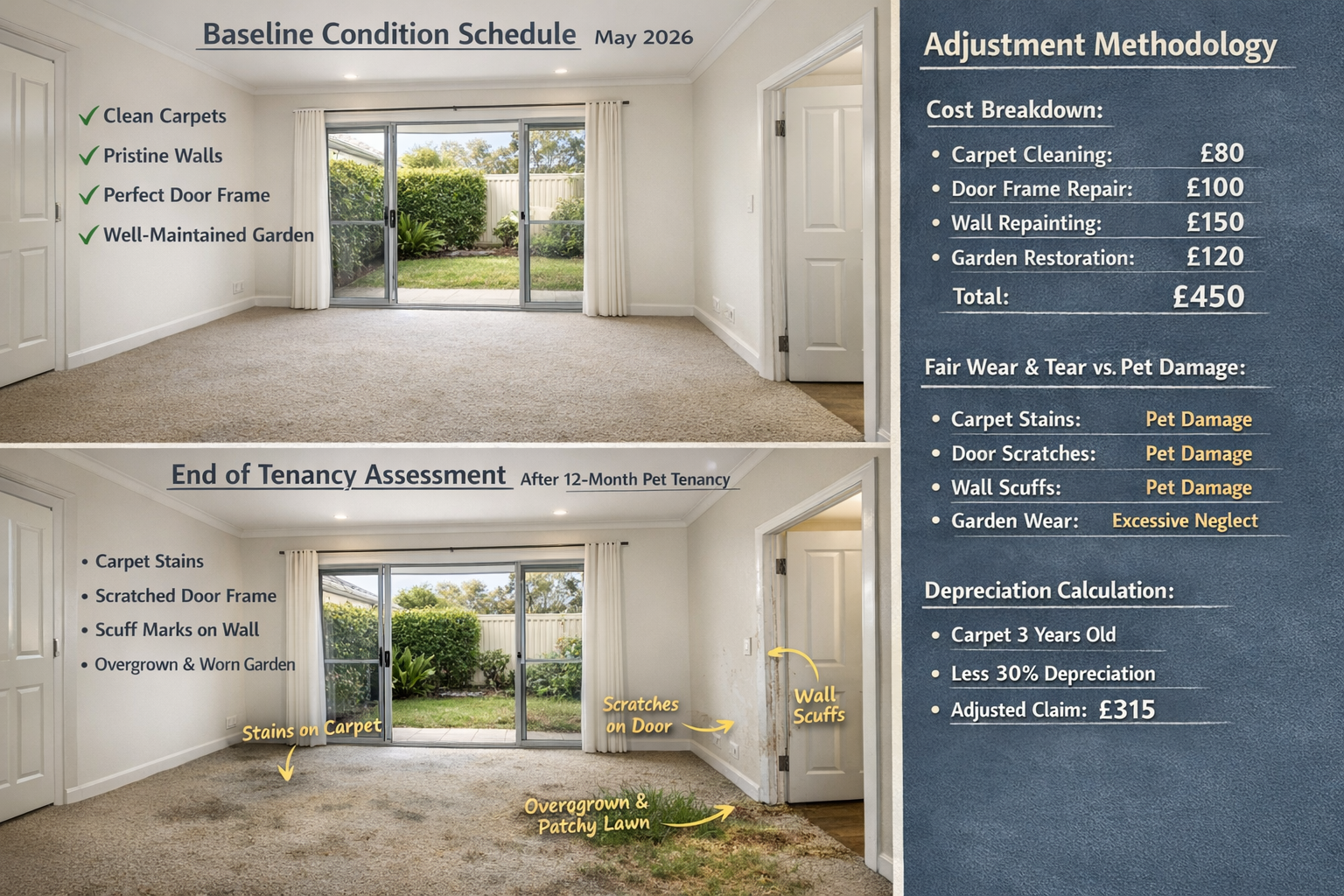
For landlords and property investors navigating the Valuation Impacts of Pet Permissions Under Renters' Rights Act 2026: Surveyor Adjustments for Wear and Tear Risks, several practical strategies can minimize valuation deductions while maintaining legal compliance.
Strategy 1: Implement Tiered Pet Permission Policies
Rather than blanket acceptance, develop a structured approach:
Bronze Tier (Minimal adjustment: 0-1%)
- Single cat or caged animal
- Tenant provides pet insurance certificate
- Standard deposit arrangement
- Bi-annual inspections
Silver Tier (Moderate adjustment: 2-3%)
- Small dog (under 15kg) or multiple cats
- Enhanced pet insurance (£5,000+ coverage)
- Additional pet deposit (within legal limits)
- Quarterly inspections
Gold Tier (Higher adjustment: 4-6%)
- Large dog or multiple dogs
- Comprehensive pet damage insurance
- Professional cleaning at tenancy end (pre-agreed)
- Professional garden restoration clause
This tiered approach allows surveyors to apply differentiated risk adjustments based on documented management protocols rather than applying uniform deductions across all pet-friendly properties.
Strategy 2: The Pre-Let Condition Schedule
Professional surveyors consistently emphasize that the single most effective valuation protection is a comprehensive condition schedule completed before pet occupation begins. Best practice includes:
✅ Professional photography: High-resolution images of all floors, doors, walls, and outdoor spaces
✅ Detailed descriptions: Written documentation of existing wear, material types, and condition grades
✅ Third-party verification: Independent surveyor or inventory specialist sign-off
✅ Tenant acknowledgment: Signed acceptance of baseline condition
✅ Digital archiving: Cloud-stored records with timestamps
Properties with documented condition schedules typically see 2-3% lower valuation adjustments compared to those without, as surveyors can more confidently assess the differential between pet-specific damage and pre-existing conditions.
Strategy 3: Insurance-Backed Valuation Models
Forward-thinking property investors are incorporating insurance products directly into their valuation strategies:
Landlord Pet Damage Insurance: Specialist policies covering pet-specific damage beyond standard landlord insurance. Annual premiums typically range from £150-£400 depending on property value and pet type.
Tenant Pet Insurance Requirements: Mandating tenants maintain pet liability insurance with minimum coverage thresholds (typically £2,000-£5,000 for property damage).
When these insurance arrangements are documented and verified, surveyors conducting freehold valuations or investment appraisals apply reduced risk premiums because the financial exposure is transferred to insurance providers.
Strategy 4: Material Specification Upgrades
Some landlords are proactively upgrading properties with pet-resistant materials, which surveyors recognize in valuation adjustments:
- Luxury vinyl tile (LVT) instead of carpet in main living areas
- Scratch-resistant door treatments or protective panels
- Washable paint finishes (satin or semi-gloss) in high-traffic areas
- Reinforced door frames or threshold guards
- Artificial grass or hardscaping in gardens
While these upgrades require upfront investment (typically £3,000-£8,000 for a two-bedroom property), they can eliminate or significantly reduce pet-related valuation adjustments while also commanding higher rental values. Surveyors typically recognize these improvements as "pet-proofing" that extends property lifecycle and reduces maintenance reserves.
Strategy 5: The Rental Premium Calculation
Perhaps counterintuitively, properties that embrace pet permissions with proper management systems often achieve rental premiums of 5-8% due to the significant unmet demand from pet-owning tenants[4]. Surveyors increasingly factor this premium into income capitalization valuations.
For example:
- Standard rental value: £1,200/month
- Pet-friendly premium: +£75/month (6.25%)
- Annual additional income: £900
- Capitalized value increase (at 5% yield): £18,000
This positive adjustment can partially or fully offset the wear-and-tear risk deductions, particularly when combined with robust management protocols. When obtaining a Red Book valuation, providing evidence of sustained rental premiums and reduced void periods strengthens the case for net positive valuation impacts.
Market Dynamics and Investment Implications
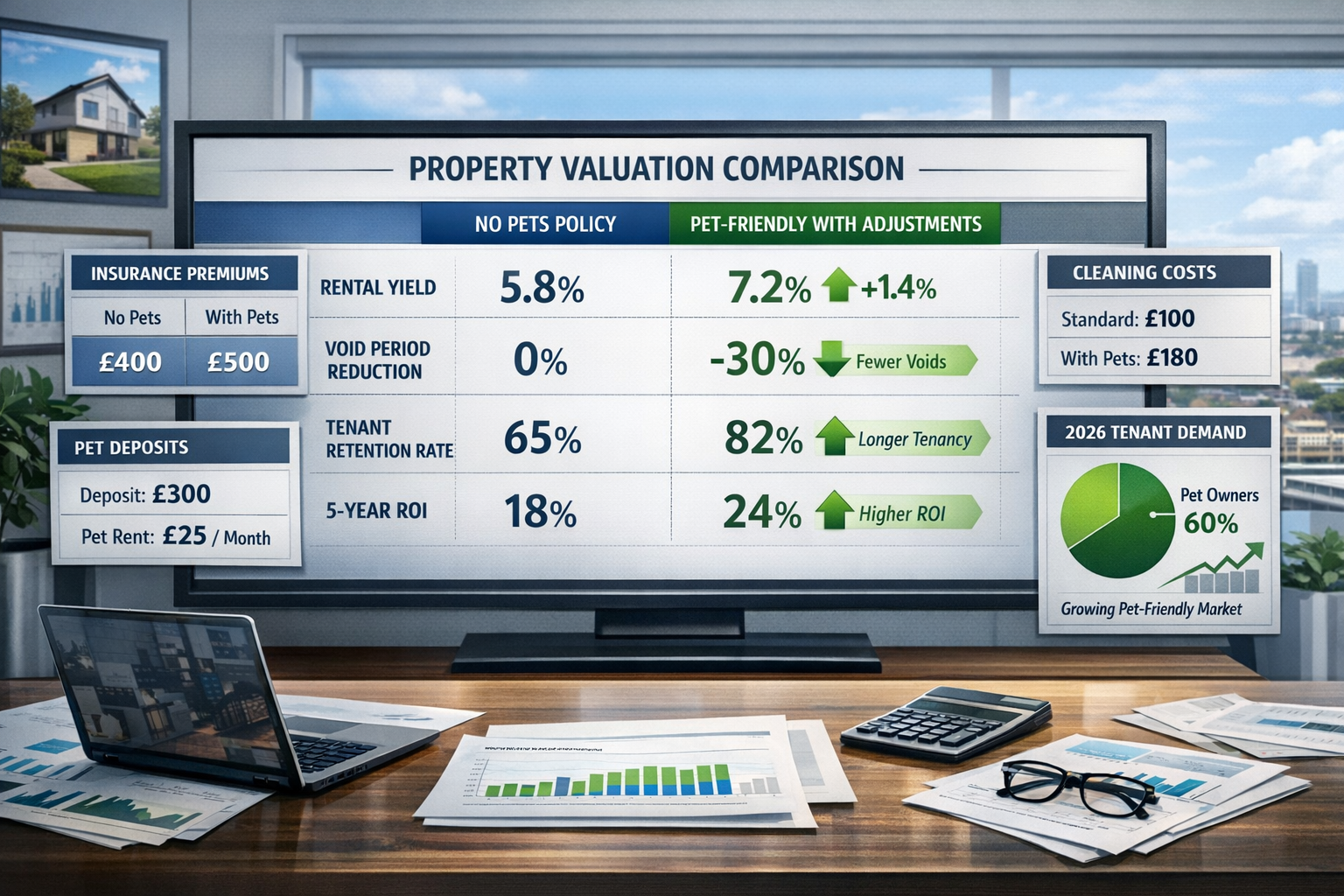
The broader market response to the Renters' Rights Act 2026 reveals complex dynamics that professional surveyors must consider when assessing property values.
The Supply Paradox
Despite the legislation's intention to increase pet-friendly housing, initial market data shows a 13% decline in pet-friendly rental listings[2]. This apparent paradox stems from several factors:
- Risk-averse landlord exodus: Some landlords are exiting the market entirely rather than adapting to new regulations
- Selective compliance: Landlords removing explicit "pet-friendly" marketing while handling requests case-by-case
- Premium positioning: Remaining pet-friendly properties commanding higher rents, reducing affordable supply
For surveyors, this supply constraint creates valuation complexity. Properties genuinely positioned as pet-friendly with proper management systems are becoming scarce assets in high-demand markets, potentially justifying premium valuations despite wear-and-tear risks.
Geographic Variation in Valuation Impacts
The Valuation Impacts of Pet Permissions Under Renters' Rights Act 2026: Surveyor Adjustments for Wear and Tear Risks vary significantly by location:
Urban Core Markets (London, Manchester, Birmingham)
- Higher baseline property values
- Greater tenant demand from pet owners
- Smaller properties with limited outdoor space
- Typical adjustment: 3-5% for pet permissions
Suburban Family Markets
- Properties with gardens and outdoor space
- Lower per-square-foot values
- Higher proportion of pet-owning households
- Typical adjustment: 1-3% for pet permissions
Rural and Semi-Rural Markets
- Larger properties with extensive grounds
- Pet ownership cultural norm
- Lower density, more pet-suitable housing
- Typical adjustment: 0-2% for pet permissions
Surveyors must calibrate their adjustments to local market conditions, tenant demographics, and comparable property analysis. A chartered surveyor in London will apply different methodologies than one assessing properties in rural areas.
The Institutional Investor Response
Large-scale institutional landlords and build-to-rent operators are adopting sophisticated approaches that influence valuation standards:
- Pet-specific property designs: Purpose-built rentals with pet washing stations, outdoor runs, and durable materials
- Centralized pet management: Dedicated pet coordinators and standardized policies across portfolios
- Data-driven risk modeling: Actuarial analysis of pet-related costs across thousands of tenancies
- Insurance partnerships: Bulk insurance arrangements reducing per-unit costs
These institutional approaches are establishing best-practice benchmarks that surveyors reference when assessing smaller portfolio or individual BTL properties. Properties that meet or exceed institutional standards receive more favorable valuation adjustments.
Long-Term Investment Modeling
For investors holding properties for 10+ year horizons, the valuation calculus shifts. Consider:
Traditional No-Pets Model (declining viability)
- Increasingly difficult to enforce under new legislation
- Shrinking tenant pool
- Higher void periods
- Potential legal challenges
Pet-Friendly with Management Model (emerging standard)
- Access to broader tenant market
- Reduced void periods (typically 30-40% shorter)
- Rental premium potential
- Higher maintenance reserves required
- Enhanced tenant retention
Surveyors conducting valuation assessments for long-term investors increasingly model the pet-friendly scenario as the baseline, with appropriate adjustments for management quality rather than treating pet permissions as an exceptional risk factor.
Professional Standards and RICS Guidance
The Royal Institution of Chartered Surveyors (RICS) is developing specific guidance for members conducting valuations under the new legislative framework. While formal technical standards are still evolving in 2026, several principles are emerging:
Red Book Compliance for Pet-Adjusted Valuations
When conducting RICS Red Book valuations, surveyors must:
- Explicitly state assumptions regarding pet permissions and management protocols
- Document adjustment methodologies with clear rationale for percentage deductions or premiums
- Reference comparable evidence from similar properties with documented pet tenancies
- Distinguish between market value (reflecting current legislative environment) and investment value (reflecting specific investor risk tolerance)
- Disclose uncertainty where empirical data is limited or market evidence is emerging
The principle of transparency is paramount. Valuation reports should clearly articulate how the Renters' Rights Act 2026 pet provisions have been factored into the assessment, allowing clients to understand the assumptions underlying the valuation figure.
Emerging Valuation Methodologies
RICS members are developing several specialized approaches:
The Lifecycle Cost Method: Calculates the present value of incremental maintenance and replacement costs attributable to pet occupation over a typical tenancy cycle (3-5 years), then applies this as a capital adjustment.
The Risk-Adjusted Yield Method: Modifies the capitalization rate applied to rental income based on pet-related risk factors, typically adding 0.25-0.75% to the yield rate for pet-friendly properties without robust management systems.
The Comparables Adjustment Method: Identifies recent sales of similar properties with documented pet tenancy histories and applies differential adjustments based on observed market pricing.
Professional surveyors typically employ multiple methodologies and reconcile the results to arrive at a final valuation opinion, documenting the reasoning in the valuation report.
Due Diligence Requirements
For surveyors assessing investment properties, due diligence now extends to:
- Reviewing existing tenancy agreements for pet clauses
- Examining maintenance records for pet-related repairs
- Analyzing void period data for pet-friendly vs. non-pet properties
- Assessing landlord insurance coverage for pet-related damage
- Evaluating condition schedule quality and documentation standards
This enhanced due diligence is particularly critical for portfolio acquisitions or commercial property valuations where multiple residential units are involved.
Practical Implementation Timeline for 2026
As the Renters' Rights Act 2026 provisions take full effect from May 2026, property owners and surveyors should follow this implementation timeline:
Q2 2026 (April-June): Immediate Compliance Phase
- Review all existing tenancy agreements for non-compliant pet clauses
- Develop pet permission request procedures
- Obtain baseline condition reports for all properties
- Update landlord insurance policies
Q3 2026 (July-September): System Development Phase
- Implement tiered pet permission frameworks
- Establish inspection protocols
- Create pet-specific tenancy addendums
- Train property managers on new procedures
Q4 2026 (October-December): Data Collection Phase
- Document all pet permission requests and outcomes
- Track pet-related maintenance costs
- Monitor void periods and rental premiums
- Compile evidence for valuation adjustments
2027 and Beyond: Optimization Phase
- Refine adjustment methodologies based on empirical data
- Adjust insurance coverage based on claims experience
- Optimize material specifications and property improvements
- Benchmark against market standards
Conclusion
The Valuation Impacts of Pet Permissions Under Renters' Rights Act 2026: Surveyor Adjustments for Wear and Tear Risks represent a fundamental evolution in property valuation methodology. Rather than viewing pet permissions as a simple negative adjustment, sophisticated surveyors and property investors are developing nuanced frameworks that balance genuine wear-and-tear risks against market demand realities and rental premium opportunities.
The evidence suggests that properties with robust pet management systems—including comprehensive condition schedules, appropriate insurance arrangements, tiered permission policies, and pet-resistant materials—can achieve net neutral or even positive valuation impacts compared to traditional no-pets properties. Conversely, properties that passively accept the new legislative requirements without strategic management systems face valuation deductions of 3-8% in surveyor assessments.
Actionable Next Steps
For property owners and investors:
- Commission a professional condition schedule for all rental properties before accepting pet tenants
- Consult with a qualified RICS surveyor to understand specific valuation impacts for your property type and location
- Review and upgrade insurance coverage to include pet-specific damage provisions
- Implement a documented pet permission policy with clear criteria and management protocols
- Consider strategic material upgrades to pet-resistant specifications in high-wear areas
- Track all pet-related costs and rental premiums to build empirical data for future valuations
For those seeking professional valuation services that properly account for the new legislative framework, engaging RICS-qualified surveyors with expertise in rental property assessment is essential. The valuation landscape has fundamentally changed, and professional guidance ensures accurate property assessments that reflect both risks and opportunities in the post-Renters' Rights Act 2026 market.
The landlords and investors who will thrive in this new environment are those who view pet permissions not as an unavoidable burden, but as a strategic opportunity to differentiate their properties, access underserved tenant demand, and implement management systems that protect long-term asset values while complying with evolving regulatory requirements.
References
[1] Animal Charities Hail Game Changer Renters Rights Act – https://www.vettimes.com/news/business/sustainability/animal-charities-hail-game-changer-renters-rights-act
[2] Watch – https://www.youtube.com/watch?v=rVat8TD4IBE
[4] Your Questions Answered Pet Provisions In The Renters Rights Bill – https://www.cluttons.com/insights/blog/your-questions-answered-pet-provisions-in-the-renters-rights-bill/
[5] 2025 Landlord And Property Manager Survey Results – https://cob.org/wp-content/uploads/2025-Landlord-and-Property-Manager-Survey-Results.pdf