
Buyer demand has plummeted to a net balance of -26% in February 2026—the sharpest monthly decline recorded this year—creating a perfect storm for property valuation disputes that demand expert witness intervention[1]. When market momentum collapses and comparable evidence becomes scarce or contradictory, the role of Expert Witness Valuations Amid February 2026 RICS Survey Caution: Adjusting for Geopolitical and Rate Uncertainty becomes critical for resolving mortgage disputes, contract disagreements, and tribunal proceedings.
The February 2026 RICS Residential Market Survey reveals a market fractured by regional divergence, weakened transaction volumes, and mounting macro-economic pressures. For chartered surveyors providing RICS valuation services, these conditions present unprecedented challenges in defending valuations under cross-examination. This article examines how expert witnesses must adapt their methodology, evidence presentation, and uncertainty disclosures to maintain credibility in 2026's volatile property market.
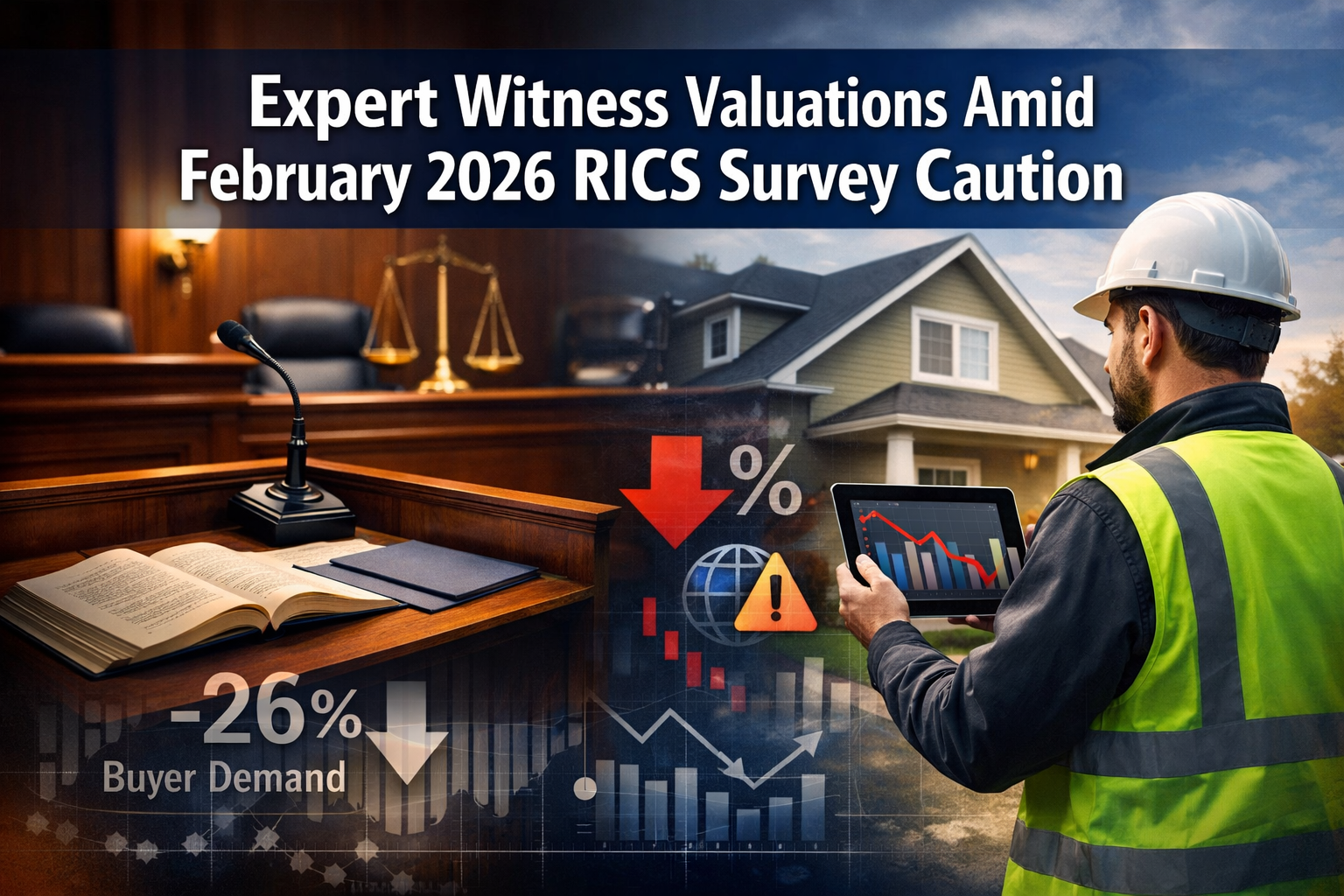
Key Takeaways
- 📉 Buyer demand fell to -26% net balance in February 2026, significantly reducing available comparable transaction evidence for expert witness valuations
- 🗺️ Severe regional divergence requires expert witnesses to carefully justify comparable selection, with London at -40% while Northern Ireland shows positive momentum
- ⚖️ Material uncertainty clauses are increasingly necessary under RICS standards when market conditions create unreliable or inconsistent comparable evidence
- 📊 Buyers are renegotiating based on survey findings, creating post-contract disputes that require expert witness involvement to resolve valuation disagreements
- 🎯 Robust evidence presentation and transparent methodology documentation are essential for expert witnesses defending valuations amid geopolitical and interest rate uncertainty
Understanding the February 2026 RICS Survey: Market Conditions Driving Valuation Disputes
The February 2026 RICS Residential Market Survey paints a sobering picture of market conditions that directly impact the work of expert witnesses in property valuation disputes. The data reveals multiple pressure points that create fertile ground for disagreements requiring tribunal intervention.
Sharp Decline in Buyer Demand and Transaction Volumes
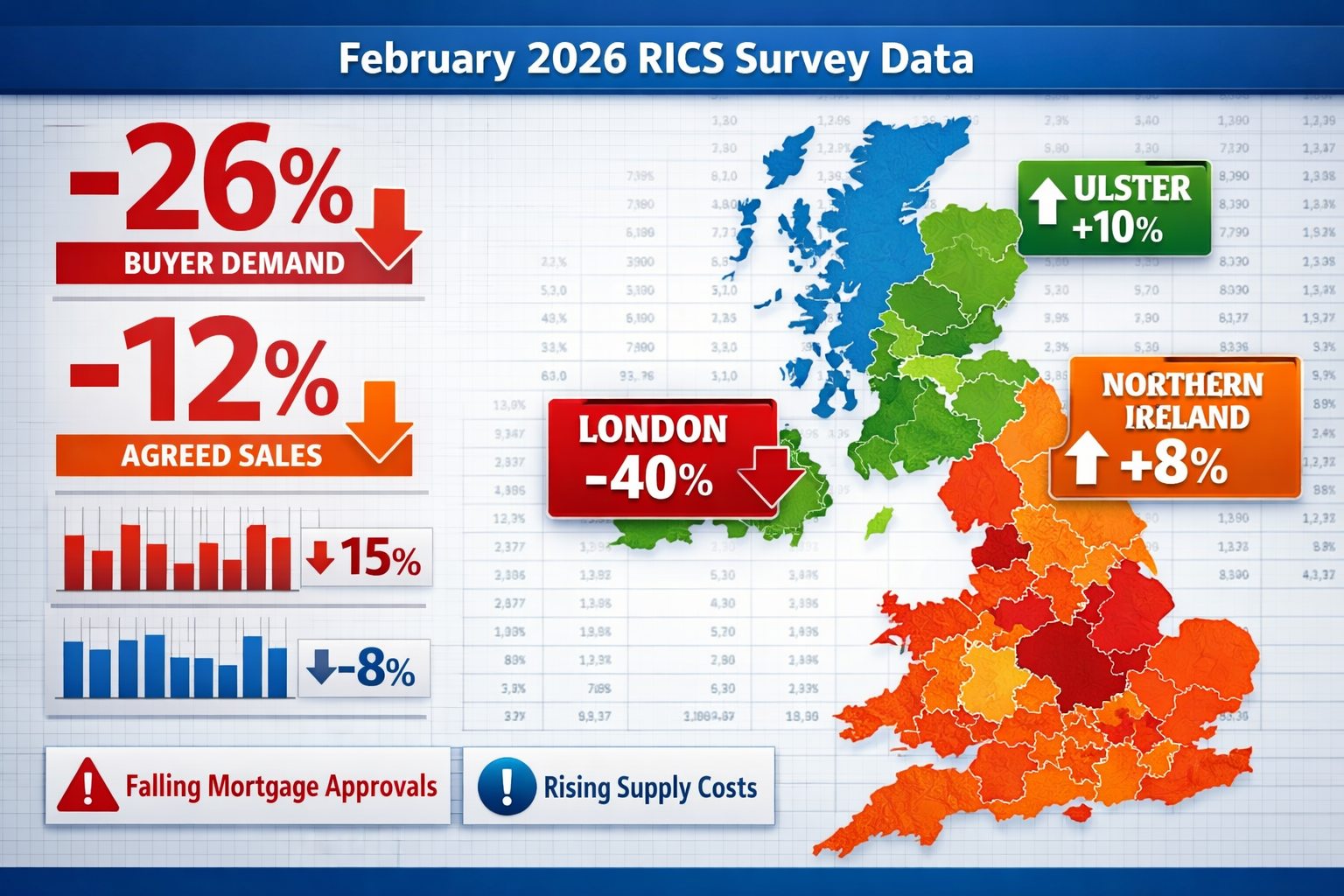
New buyer enquiries registered a net balance of -26% in February 2026, down from -15% the previous month[1]. This represents one of the steepest monthly declines in recent years and signals a fundamental shift in market momentum. For expert witnesses, this creates a critical challenge: fewer transactions mean fewer comparable sales to support valuation opinions.
Agreed sales remained subdued at -12%, while near-term sales expectations softened further to -2%[1]. This triple pressure—declining enquiries, weak agreed sales, and pessimistic forward expectations—reduces the pool of recent comparable transactions available for chartered surveyors conducting valuations.
Key implications for expert witness valuations:
- ⏰ Comparables become "stale" more quickly in rapidly changing markets
- 📍 Geographic search radius must often expand to find sufficient evidence
- 💰 Price adjustments for time and location become more subjective and contestable
- 🔍 Greater scrutiny required on comparable selection methodology
National Price Stagnation Masks Regional Extremes
While the headline national house price net balance registered -12% in February 2026[1], this aggregate figure conceals dramatic regional variations that complicate comparable evidence selection:
| Region | Net Balance | Market Condition |
|---|---|---|
| London | -40% | Severe downward pressure |
| South East | -24% | Significant weakness |
| East Anglia | -26% | Substantial decline |
| Northern Ireland | Positive | Firmer trends |
| Scotland | Positive | Relative strength |
| North West England | Positive | Outperforming national average |
This regional divergence creates particular challenges for expert witnesses defending valuations in dispute proceedings. A comparable property transaction in Manchester may have limited relevance to a London valuation, yet expert witnesses must often justify why certain comparables were selected while others were rejected.
Rental Market Data Scarcity Compounds Evidence Challenges
Landlord rental instructions posted a firmly negative net balance of -27% in February 2026[2], limiting available rental property data for expert witness valuations in dispute cases. This is particularly problematic for:
- Investment property valuations requiring income capitalization approaches
- Leasehold disputes involving rental value assessments
- Right to Buy valuations where rental evidence supports market value opinions
- Commercial property valuations with residential comparison elements
The scarcity of rental data forces expert witnesses to rely more heavily on historical evidence, requiring careful time adjustments and transparent disclosure of data limitations.
Expert Witness Valuations Amid February 2026 RICS Survey Caution: Evidence Presentation Strategies
When market conditions deteriorate and comparable evidence becomes scarce or contradictory, expert witnesses must adapt their evidence presentation to maintain credibility under cross-examination. The February 2026 market conditions demand heightened rigor in methodology documentation and transparent disclosure of uncertainty.
Robust Comparable Selection and Justification
In stable markets, comparable selection follows relatively straightforward criteria: proximity, property type, size, condition, and transaction date. However, Expert Witness Valuations Amid February 2026 RICS Survey Caution: Adjusting for Geopolitical and Rate Uncertainty require a more sophisticated approach.
Best practices for comparable selection in uncertain markets:
-
Expand the search radius systematically 🎯
- Document why local comparables are insufficient
- Justify each geographic expansion with market data
- Apply appropriate location adjustments with transparent methodology
-
Weight recent transactions more heavily 📅
- Prioritize transactions within 3 months in rapidly changing markets
- Apply time adjustments based on local price indices
- Disclose when time adjustments exceed 10% (indicating high uncertainty)
-
Include multiple valuation approaches 🔢
- Cross-check sales comparison with income capitalization where applicable
- Reference Red Book valuation standards for methodology selection
- Document why certain approaches were given greater weight
-
Prepare for aggressive cross-examination ⚖️
- Anticipate challenges to comparable selection
- Document why rejected comparables were inappropriate
- Maintain detailed working papers showing all considered evidence
Material Uncertainty Clauses: When and How to Apply Them
RICS Valuation – Global Standards specify scenarios requiring material uncertainty clauses in valuation reports when reliable comparable evidence is lacking or inconsistent[3]. The February 2026 market conditions create multiple scenarios where such clauses are appropriate:
Triggering conditions for material uncertainty declarations:
- ✅ Fewer than three comparable sales within 6 months and 1 mile radius
- ✅ Regional price indices showing volatility exceeding 5% monthly
- ✅ Significant geopolitical events creating forward-looking uncertainty
- ✅ Interest rate volatility affecting mortgage availability and buyer behavior
- ✅ Contradictory comparable evidence suggesting multiple defensible value conclusions
"Accurate real estate valuations become particularly challenging when macro conditions create inconsistent comparable evidence, requiring expert valuers to frame and justify uncertainty assumptions."[3]
Proper material uncertainty clause language should:
- Clearly state the specific factors creating uncertainty
- Quantify the potential value range where possible
- Reference market data supporting the uncertainty declaration
- Avoid appearing to hedge or evade professional responsibility
- Maintain compliance with RICS expert witness standards
Geopolitical and Interest Rate Adjustments
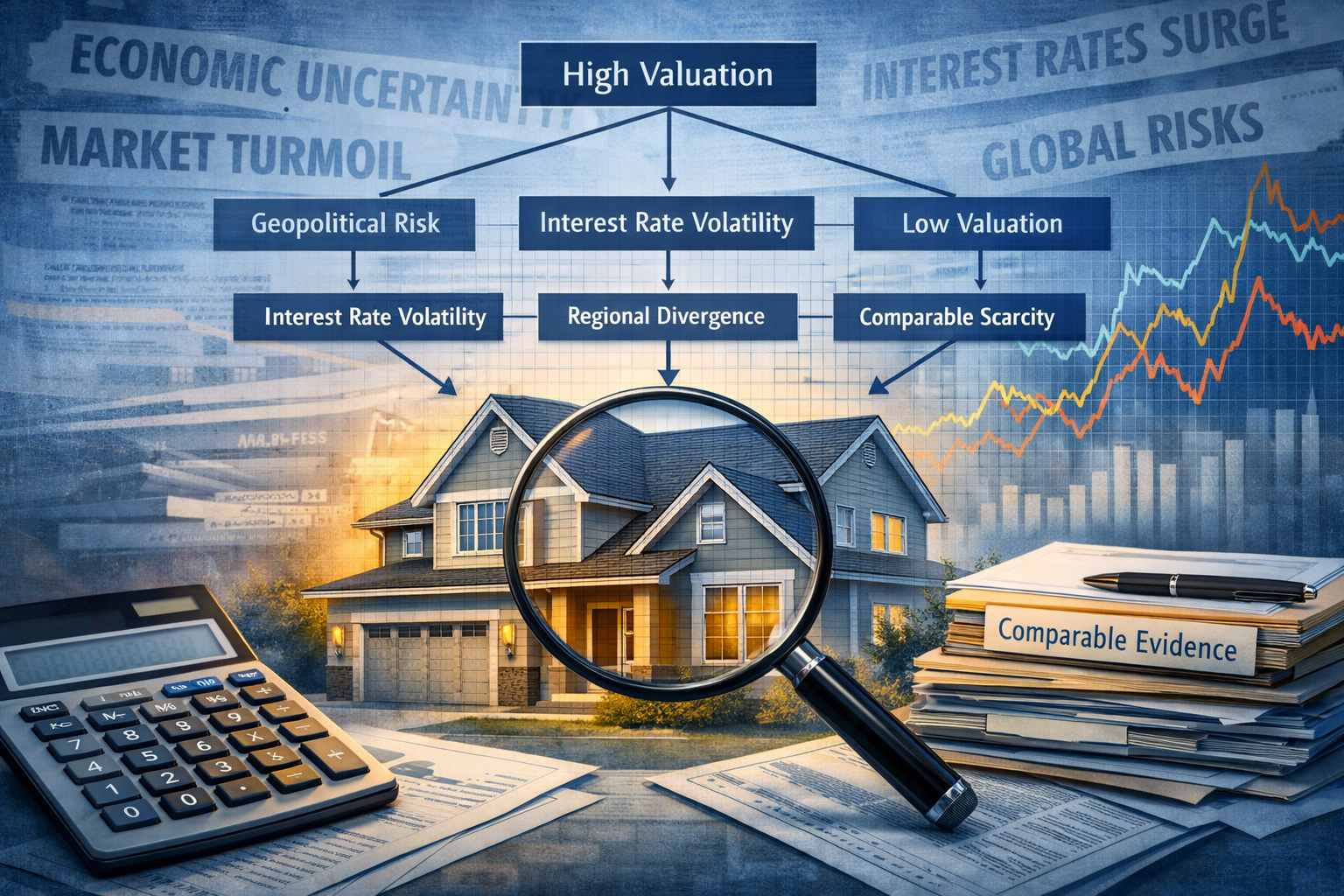
The February 2026 market reflects weakened confidence due to intensifying concerns over inflation, interest rates, and geopolitical instability[1]. Expert witnesses must address how these macro factors impact specific property valuations.
Framework for incorporating macro uncertainty:
Interest Rate Impact Analysis:
- Document base rate changes and mortgage rate trends
- Analyze how rate changes affect buyer affordability for subject property
- Reference mortgage approval data showing tightening lending standards
- Adjust comparable evidence for different financing conditions at transaction dates
Geopolitical Risk Assessment:
- Identify specific geopolitical events affecting market sentiment
- Distinguish between temporary sentiment shifts and fundamental value changes
- Reference investor confidence indices and market liquidity indicators
- Avoid speculation while acknowledging measurable market impacts
Regional Economic Factors:
- Analyze local employment trends and economic indicators
- Consider regional exposure to specific industries or economic sectors
- Reference migration patterns and demographic shifts
- Connect macro trends to specific property market outcomes
Case Studies: Defending Expert Witness Valuations in February 2026 Market Conditions
Real-world dispute scenarios illustrate how expert witnesses apply robust methodology to defend valuations amid the challenging conditions revealed in the February 2026 RICS survey.
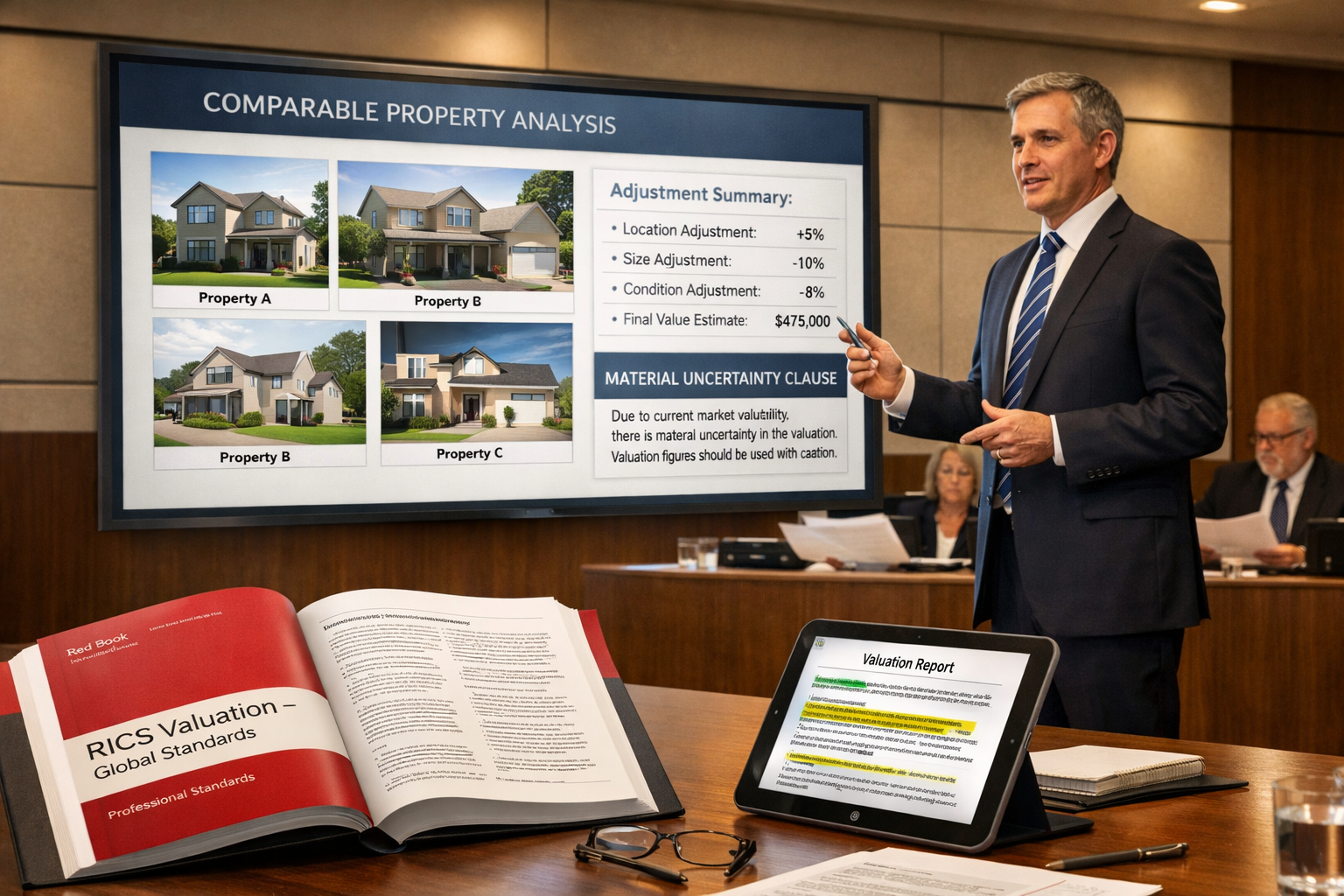
Case Study 1: London Property Dispute with Limited Comparables
Scenario: A mortgage lender disputes a borrower's valuation of a £1.2 million London property, claiming the valuation was inflated. The February 2026 RICS data shows London experiencing -40% net balance in buyer demand[1], creating significant comparable evidence challenges.
Expert Witness Approach:
The expert witness expanded the geographic search radius from 0.5 miles to 1.5 miles to identify sufficient comparables, documenting why closer transactions were insufficient. The witness applied location adjustments of 8-12% based on local price gradients, supported by Land Registry data.
Critically, the expert included a material uncertainty clause noting that the London market was experiencing "unprecedented volatility with buyer demand at historic lows, creating limited comparable evidence and increased valuation uncertainty of approximately ±7%."
Outcome: The tribunal accepted the valuation methodology, noting the expert's transparent disclosure of uncertainty and robust comparable selection justification. The material uncertainty clause protected the expert from allegations of negligence while acknowledging genuine market challenges.
Case Study 2: Regional Divergence in Multi-Property Portfolio Valuation
Scenario: A property investment fund required expert witness testimony for a portfolio valuation dispute spanning properties in London, Manchester, and Edinburgh. The February 2026 regional divergence created contradictory market signals.
Expert Witness Approach:
The witness prepared region-specific valuation reports acknowledging different market dynamics:
- London properties: Applied conservative adjustments reflecting -40% demand decline
- Manchester properties: Used more stable comparables reflecting North West's positive trends
- Edinburgh properties: Leveraged Scotland's relative market strength for more confident valuations
Each regional report included specific RICS building survey data and local market analysis, avoiding the trap of applying uniform national assumptions to regionally diverse properties.
Outcome: The expert's region-specific approach demonstrated sophisticated understanding of market nuances, strengthening credibility and resulting in acceptance of the portfolio valuation methodology.
Case Study 3: Post-Survey Renegotiation Dispute
Scenario: A buyer commissioned a Level 2 Homebuyer Survey that revealed previously unknown structural issues. The buyer sought a £45,000 price reduction, while the seller disputed the valuation impact of the defects.
Expert Witness Approach:
The expert witness obtained the original survey report and conducted an independent inspection. The witness prepared a detailed cost-to-cure analysis for each identified defect, distinguishing between:
- Immediate safety repairs (£12,000)
- Necessary maintenance within 12 months (£18,000)
- Desirable improvements not affecting value (£15,000)
The expert applied a value adjustment of £30,000 (immediate and necessary repairs only), supporting this with comparable evidence showing similar properties with and without equivalent defects.
Outcome: The tribunal accepted the expert's cost-to-cure methodology and awarded a £30,000 price adjustment, rejecting the buyer's claim for desirable improvements that didn't impact market value.
RICS Standards for Expert Witness Valuations: Compliance Requirements in 2026
Expert witnesses providing valuation evidence must comply with specific RICS standards that govern professional conduct, methodology, and evidence presentation. Understanding these requirements is essential for Expert Witness Valuations Amid February 2026 RICS Survey Caution: Adjusting for Geopolitical and Rate Uncertainty.
Core RICS Expert Witness Standards
RICS maintains established standards for surveyors providing expert evidence before tribunals, courts, and dispute resolution proceedings[5]. These standards emphasize:
Professional Independence 🎓
- Expert's duty is to the tribunal, not the instructing party
- Opinions must be unbiased and based solely on evidence
- Financial interests in case outcomes must be disclosed
- Conflicts of interest require immediate disclosure or withdrawal
Methodology Transparency 📋
- All valuation approaches must be clearly explained
- Assumptions must be explicitly stated and justified
- Limitations of available evidence must be disclosed
- Alternative methodologies considered should be documented
Evidence Quality Standards 🔍
- Comparable evidence must meet minimum relevance criteria
- Data sources must be verified and reliable
- Hearsay evidence must be clearly identified
- Working papers must support all conclusions
Report Format Requirements 📄
- Statement of truth and expert declaration
- Qualifications and experience summary
- Clear statement of instructions received
- Range of opinion where appropriate (not single-point certainty in uncertain markets)
Applying Red Book Standards to Expert Witness Work
While RICS Red Book valuations are typically prepared for specific purposes (mortgage, purchase, financial reporting), expert witness valuations often involve retrospective assessment of whether a previous valuation was reasonable.
Key Red Book principles applicable to expert witness work:
-
Basis of Value Clarity
- Market Value vs. Market Rent vs. Investment Value
- Clear definition of the valuation date (retrospective or current)
- Special assumptions explicitly stated
-
Inspection Standards
- Level of inspection must be appropriate to the dispute
- Limitations of inspection must be disclosed
- Reliance on third-party reports (e.g., structural surveys) must be stated
-
Uncertainty and Sensitivity
- Material uncertainty clauses when conditions warrant
- Sensitivity analysis showing value impact of key assumptions
- Range of values rather than false precision in volatile markets
-
Departure Provisions
- When Red Book compliance isn't possible, departures must be disclosed
- Justification for any methodology departures
- Impact of departures on valuation reliability
Documentation and Working Papers
The February 2026 market conditions demand exceptional documentation rigor. Expert witnesses should maintain:
Comparable Evidence Files 📁
- Detailed property descriptions with photographs
- Transaction dates, prices, and terms
- Adjustments applied with supporting calculations
- Reasons for rejecting alternative comparables
Market Analysis Documentation 📊
- RICS survey data and interpretation
- Local price indices and trend analysis
- Interest rate and mortgage availability data
- Geopolitical event timeline with market impact assessment
Methodology Working Papers 📝
- Alternative valuation approaches considered
- Calculations showing all adjustment factors
- Sensitivity analysis for key assumptions
- Peer review or quality control checks
Correspondence Records ✉️
- Instructions received from solicitors or parties
- Questions posed during preparation
- Clarifications provided before testimony
- Any limitations or constraints on scope
Practical Strategies for Expert Witnesses Navigating 2026's Uncertain Market
Beyond technical compliance with RICS standards, expert witnesses can employ practical strategies to strengthen their credibility and effectiveness in the challenging February 2026 market environment.
Strategy 1: Proactive Uncertainty Communication
Rather than viewing uncertainty as weakness, expert witnesses should embrace transparent uncertainty disclosure as a mark of professional integrity. In volatile markets, acknowledging limitations strengthens rather than undermines credibility.
Effective uncertainty communication techniques:
- Use value ranges rather than single-point estimates when evidence supports multiple conclusions
- Quantify uncertainty where possible (e.g., "±5-7% based on comparable evidence variability")
- Distinguish between data limitations and methodology limitations
- Reference RICS guidance on material uncertainty to demonstrate standards compliance
Strategy 2: Multi-Scenario Analysis
When geopolitical and interest rate uncertainty create multiple plausible future scenarios, expert witnesses can present scenario-based valuations that demonstrate analytical sophistication:
Base Case Scenario:
- Most likely market trajectory based on current evidence
- Central valuation estimate with standard assumptions
Downside Scenario:
- Assumes continued market deterioration consistent with February 2026 trends
- Conservative valuation reflecting increased risk factors
Upside Scenario:
- Assumes market stabilization or recovery
- Optimistic valuation reflecting improved conditions
This approach demonstrates that the expert has considered multiple possibilities rather than anchoring to a single outcome, particularly valuable when defending valuations months or years after the valuation date.
Strategy 3: Enhanced Comparable Adjustment Documentation
In markets with limited comparable evidence, the quality of adjustment justification becomes more important than the quantity of comparables. Expert witnesses should:
- Create detailed adjustment matrices showing each factor applied to each comparable
- Provide market data supporting adjustment percentages (not just professional judgment)
- Use paired sales analysis where possible to quantify specific adjustment factors
- Prepare visual presentations (charts, maps, photographs) to support adjustment rationale
Strategy 4: Continuous Market Monitoring and Data Collection
Expert witnesses should maintain ongoing market intelligence systems rather than conducting research only when instructed on specific cases:
- Subscribe to RICS survey data and analysis services
- Maintain databases of local comparable transactions
- Track interest rate changes and mortgage availability trends
- Monitor geopolitical events with potential property market impacts
- Network with local estate agents and chartered surveyors for market intelligence
This proactive approach enables expert witnesses to provide context-rich testimony demonstrating deep market knowledge rather than case-specific research that may appear selective.
Strategy 5: Cross-Examination Preparation
The adversarial nature of dispute proceedings means expert witnesses face aggressive cross-examination designed to undermine their credibility. Preparation strategies include:
Anticipate Common Challenges:
- "Why did you select these comparables and not others?"
- "How can you be certain of your value when the market is so uncertain?"
- "Isn't your valuation just your opinion rather than objective fact?"
- "Did the party paying your fee influence your conclusions?"
Prepare Robust Responses:
- Document comparable selection criteria applied systematically
- Acknowledge uncertainty while defending methodology rigor
- Distinguish between opinion on value (subjective) and methodology (objective)
- Demonstrate independence through transparent process documentation
Practice Testimony Delivery:
- Rehearse explanations of complex methodology in plain language
- Prepare visual aids that simplify technical concepts
- Maintain professional composure under hostile questioning
- Avoid defensive reactions that undermine credibility
The Role of Technology in Expert Witness Valuations
Modern expert witnesses increasingly leverage technology to enhance evidence quality and presentation effectiveness, particularly valuable in the challenging February 2026 market conditions.
Valuation Software and Comparable Databases
Specialized valuation software provides:
- Automated comparable searches with customizable criteria
- Statistical analysis tools for adjustment calculations
- Report generation with standardized formatting and compliance checks
- Audit trails documenting all methodology steps and decisions
These tools enhance consistency, reduce errors, and provide documentation that withstands cross-examination scrutiny.
Geographic Information Systems (GIS)
GIS technology enables expert witnesses to:
- Visualize comparable property locations relative to subject property
- Analyze location adjustment factors using distance and amenity mapping
- Present evidence through compelling visual maps and spatial analysis
- Quantify location value differentials with data-driven precision
Market Data Analytics Platforms
Subscription services providing real-time market data offer:
- Historical price indices for time adjustments
- Transaction volume trends supporting market condition analysis
- Rental yield data for investment property valuations
- Demographic and economic indicators for forward-looking assessments
Virtual Inspection Technology
When physical inspections are impractical or retrospective valuations require assessment of past property conditions:
- Historical street view imagery documents property appearance at specific dates
- Virtual tour technology enables remote property assessment
- Drone photography provides aerial perspectives for land and location analysis
- 3D modeling creates detailed property visualizations for tribunal presentations
Future Outlook: Expert Witness Valuations Beyond February 2026
While the February 2026 RICS survey reveals challenging current conditions, expert witnesses must also consider forward-looking trends that will shape valuation disputes in coming months and years.
Anticipated Market Developments
Interest Rate Trajectory:
Market expectations suggest continued volatility in interest rates throughout 2026, with potential for both increases (if inflation persists) and decreases (if economic growth weakens). Expert witnesses should monitor central bank communications and adjust forward-looking assumptions accordingly.
Geopolitical Uncertainty:
Global instability shows no signs of rapid resolution, suggesting that material uncertainty clauses will remain appropriate for many valuations throughout 2026 and potentially into 2027.
Regional Divergence Persistence:
The dramatic regional variations evident in February 2026 data likely reflect structural economic differences rather than temporary fluctuations, requiring expert witnesses to maintain region-specific market knowledge.
Technology Adoption:
Increased use of property technology for inspections and valuations will create new disputes around methodology appropriateness and evidence reliability.
Emerging Dispute Types
Expert witnesses should prepare for evolving dispute categories:
Climate and Sustainability Disputes:
As environmental regulations tighten and buyer preferences shift toward sustainable properties, disputes over green valuations and energy efficiency adjustments will increase.
Remote Valuation Challenges:
Increased use of desktop and automated valuations will generate disputes when these methodologies produce materially different results from traditional inspection-based approaches.
Shared Ownership Complexity:
Growing shared ownership schemes create unique valuation challenges requiring specialized expertise.
Leasehold Reform Impacts:
Ongoing leasehold reform legislation will create transitional disputes requiring expert witnesses to value properties under changing regulatory frameworks.
Conclusion
Expert Witness Valuations Amid February 2026 RICS Survey Caution: Adjusting for Geopolitical and Rate Uncertainty represents one of the most challenging environments for property valuation professionals in recent years. The February 2026 RICS survey reveals a market characterized by plummeting buyer demand (-26% net balance), severe regional divergence (London at -40% versus positive trends in Northern Ireland and Scotland), and weakened transaction volumes that limit comparable evidence availability[1][2].
For expert witnesses navigating these conditions, success requires:
✅ Robust comparable selection methodology with transparent justification for each property included or excluded from analysis
✅ Appropriate use of material uncertainty clauses when market conditions create genuine valuation ambiguity, protecting professional integrity while acknowledging limitations
✅ Region-specific market analysis recognizing that national aggregate data masks dramatic local variations requiring tailored approaches
✅ Enhanced documentation standards maintaining detailed working papers that withstand aggressive cross-examination
✅ Compliance with RICS expert witness standards ensuring professional independence, methodology transparency, and evidence quality
✅ Proactive uncertainty communication framing limitations as marks of professional integrity rather than weakness
The geopolitical instability and interest rate volatility that characterize early 2026 create both challenges and opportunities for expert witnesses. Those who adapt their methodology, enhance their evidence presentation, and maintain rigorous professional standards will strengthen their credibility and effectiveness in dispute resolution proceedings.
Actionable Next Steps
For chartered surveyors providing expert witness services:
- Review your comparable evidence databases to ensure sufficient recent transactions for current instructions
- Update valuation report templates to include appropriate material uncertainty clause options
- Enhance documentation procedures to capture detailed comparable selection justification
- Invest in continuing professional development focused on expert witness standards and testimony skills
- Consider obtaining specialist RICS valuation services training for complex dispute scenarios
For property professionals engaging expert witnesses:
- Instruct experts early in dispute processes to allow thorough evidence gathering
- Provide comprehensive documentation including all relevant surveys, reports, and transaction records
- Clarify the specific valuation questions requiring expert opinion
- Understand that uncertainty disclosures strengthen rather than weaken expert credibility
- Budget for robust evidence preparation recognizing that challenging markets require enhanced analysis
The February 2026 market conditions demand excellence in expert witness valuation work. By embracing transparent methodology, rigorous evidence standards, and appropriate uncertainty disclosure, expert witnesses can navigate this challenging environment while maintaining professional integrity and delivering credible, defensible opinions that serve the interests of justice.
References
[1] Uk Residential Survey February 2026 – https://www.rics.org/news-insights/uk-residential-survey-february-2026
[2] Uk Residential Market Survey February 2026 – https://www.rics.org/content/dam/ricsglobal/documents/market-surveys/uk-residential-market-survey/UK-Residential-Market-Survey_February-2026.pdf
[3] Real Estate Valuation Extreme Conditions – https://ww3.rics.org/uk/en/journals/property-journal/real-estate-valuation-extreme-conditions.html
[4] Expert Witness Valuations In 2026s Stabilizing Market Rics Standards For Mortgage Disputes And Property Disagreements – https://nottinghillsurveyors.com/blog/expert-witness-valuations-in-2026s-stabilizing-market-rics-standards-for-mortgage-disputes-and-property-disagreements
[5] Surveyors Acting As Expert Witnesses – https://www.rics.org/profession-standards/rics-standards-and-guidance/sector-standards/dispute-resolution-standards/surveyors-acting-as-expert-witnesses