An estate agent's market appraisal carries no legal weight in financial remedy proceedings. Family courts and solicitors preparing Form E financial disclosure require something far more specific: a formal chartered surveyor valuation for divorce that meets the evidential standards set by the RICS Red Book and, where the report is used in contested proceedings, the Civil Procedure Rules. Understanding what evidence that report must address, and why an informal estimate falls short, can save months of dispute and thousands of pounds in legal costs.
Key Takeaways
- A Red Book-compliant RICS valuation is the accepted standard for matrimonial property valuations; estate-agent appraisals are not equivalent.
- The report must state the basis of value (Market Value), the valuation date, and the full scope of assets inspected.
- Comparable market evidence, adjusted for material differences, must be set out within the report itself.
- Where proceedings are contested, the surveyor must comply with CPR Part 35 and may be appointed as a Single Joint Expert.
- Leasehold properties, shared ownership, and properties with structural issues require additional evidential layers beyond standard bricks-and-mortar value.
Why an Estate-Agent Estimate Is Not Enough
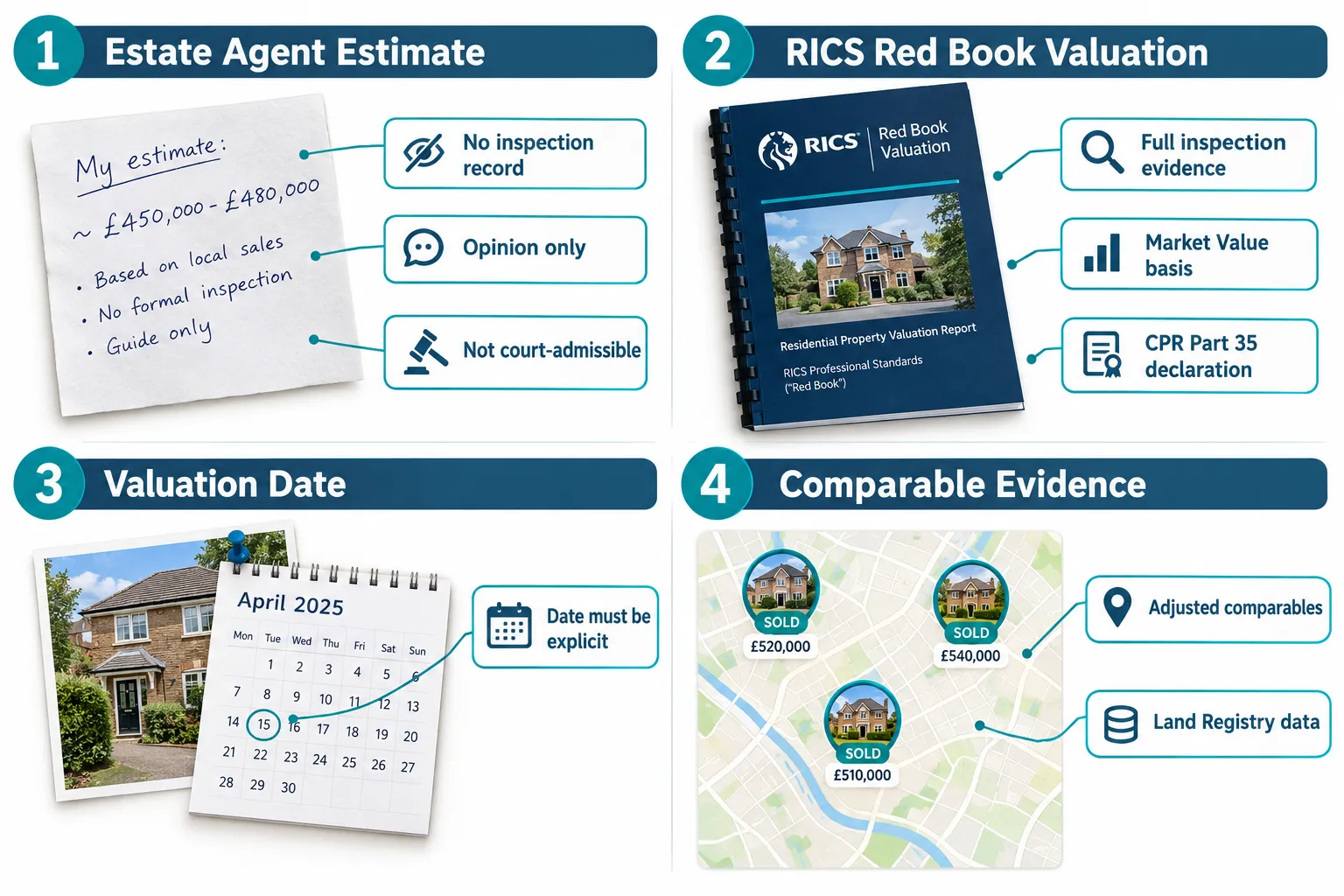
Most separating couples receive a free market appraisal from a local agent. That document is a sales tool. It reflects what the agent believes the property might achieve if marketed today, and it is produced without a formal inspection methodology, without reference to a defined basis of value, and without any professional obligation to the court or to either party.
A chartered surveyor valuation for divorce: what evidence the report must address is an entirely different exercise. The RICS Valuation, Global Standards (the Red Book) sets out mandatory requirements for any valuation that will be used in legal proceedings [1]. The surveyor must inspect the property, record its condition, identify the assets being valued, state the basis of value explicitly, and support the figure with comparable market evidence. Every assumption or limitation that affects the opinion of value must be disclosed.
The distinction matters practically. A solicitor preparing a client's Form E, the financial statement filed in financial remedy proceedings, must include a property valuation. If the figure is challenged, a court will give little weight to an agent's letter. A Red Book report from a RICS-registered valuer carries professional accountability and can be tested under cross-examination [2].
The Core Evidential Requirements: What the Report Must Contain
Basis of Value and Valuation Date
The report must state, unambiguously, that the basis of value is Market Value as defined in the Red Book: the estimated amount for which the property would exchange on the valuation date between a willing buyer and a willing seller in an arm's-length transaction [1]. No other basis is appropriate for matrimonial proceedings unless the court directs otherwise.
The valuation date is equally important. In divorce cases, the relevant date is usually the date of the inspection or the date of the final hearing, depending on the stage of proceedings. The report must make this explicit. A figure produced in one market condition cannot simply be relied upon six months later, courts expect the valuation to reflect the position at the date it purports to address [3].
Where proceedings are protracted, a refreshed valuation may be required. RICS guidance suggests that a residential valuation becomes unreliable after three to six months in a moving market. Solicitors should flag this to clients early.
Full Inspection and Property Description
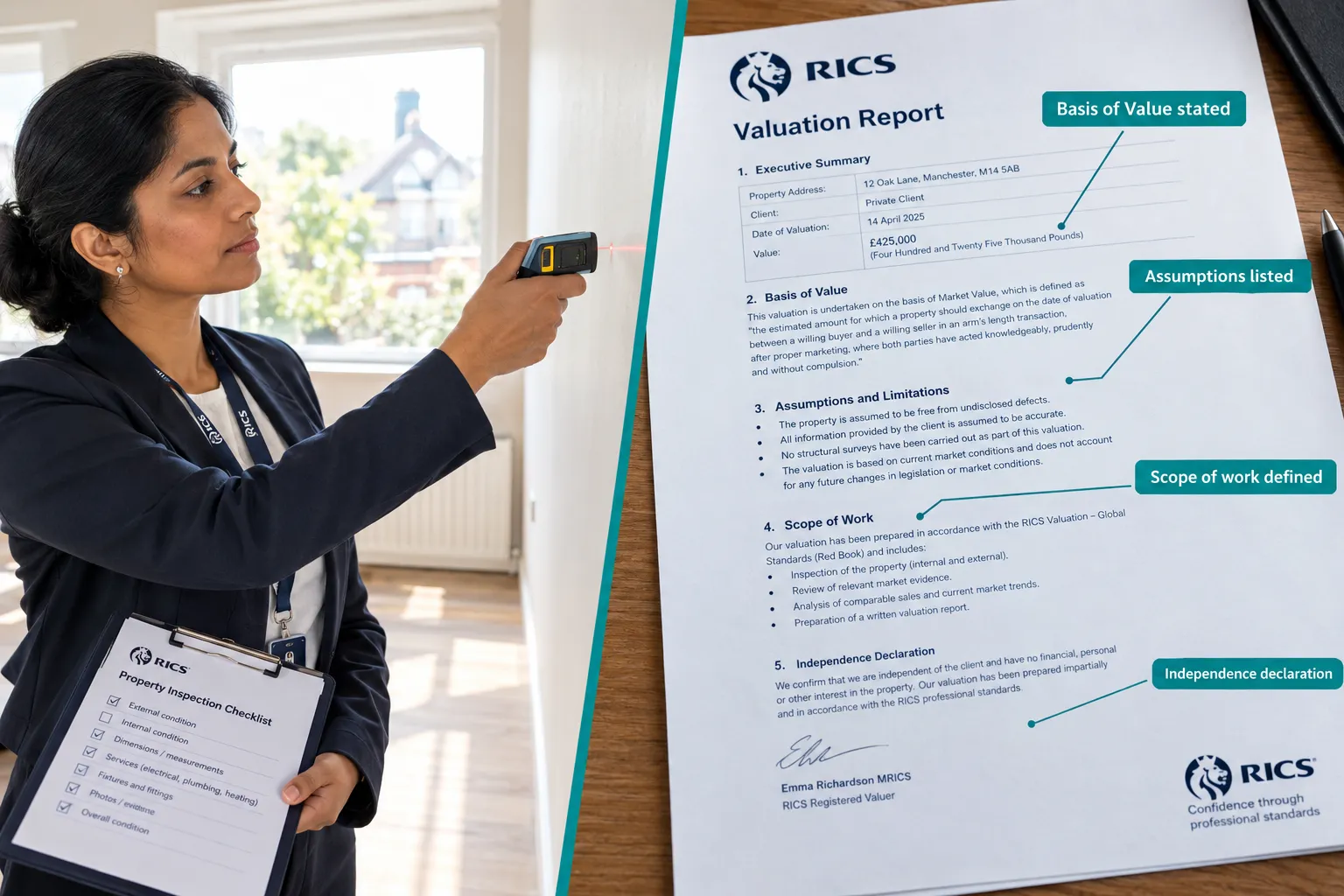
A desktop or drive-by assessment is not sufficient for matrimonial purposes. The surveyor must physically inspect the property and record:
- The address, tenure (freehold or leasehold), and legal description
- The accommodation and floor areas
- The construction type and general condition
- Any material defects that affect value
- Fixtures, fittings, or chattels included or excluded from the valuation
This evidential record serves two purposes. First, it demonstrates that the opinion of value is grounded in fact rather than assumption. Second, it protects both parties: if one spouse has allowed the property to deteriorate, or has made improvements, the inspection record captures that position at the valuation date [4].
For properties with structural issues, the surveyor may need to cross-refer to a building survey or specialist report. Guidance on structural defects found in building surveys is relevant here, since unresolved defects can reduce Market Value and must be reflected in the valuation figure.
Comparable Market Evidence
The valuation must not rest on the surveyor's general experience alone. The report must set out the comparable transactions relied upon, typically three to five sales of similar properties in the locality, drawn from Land Registry data or recognised market databases [3]. Each comparable should be:
- Identified by address and sale date
- Described briefly (size, type, condition)
- Adjusted for material differences from the subject property
Adjustments must be explained. A comparable that sold for £480,000 but had a loft conversion the subject property lacks requires a downward adjustment, and that adjustment must be reasoned, not arbitrary. This analytical transparency is what separates a Red Book report from an agent's opinion.
For a fuller explanation of how comparable evidence and other factors feed into a formal valuation, see the factors of valuation overview.
Scope of Work, Assumptions, and Limitations
Every Red Book report must include a terms of engagement section that records:
- Who instructed the valuer and in what capacity
- The purpose of the valuation (matrimonial/financial remedy proceedings)
- What assets are included and excluded
- Any special assumptions made (for example, that planning permission exists, or that a lease extension has been granted)
- Any limitations on the inspection (for instance, areas not accessed)
Undisclosed assumptions are a common ground for challenge. If the surveyor assumed vacant possession but one party is in occupation under a court order, that assumption must be stated and its effect on value addressed [4].
Independence, Neutrality, and the Single Joint Expert
The Conflict-of-Interest Test
A surveyor who has previously acted for one party, as a buying agent, letting agent, or adviser, may be conflicted. The Red Book requires the valuer to disclose any actual or potential conflict of interest before accepting the instruction [1]. In matrimonial proceedings, this is not a formality. A report produced by a surveyor with a prior relationship to one party is vulnerable to challenge and may be excluded.
Both parties should agree on the choice of valuer at the outset. Where they cannot agree, the court may direct a Single Joint Expert (SJE), a single RICS valuer appointed to act for both parties and report to the court [6].
CPR Part 35 and the Expert's Declaration
Where the valuation report will be used in contested financial remedy proceedings, the surveyor must comply with Civil Procedure Rules Part 35. This requires the report to include a declaration that:
- The surveyor understands their overriding duty to the court, not to the instructing party
- The report contains the surveyor's own independent opinion
- The surveyor has set out all facts and assumptions material to the opinion
- The surveyor will notify the parties if their opinion changes
This declaration is not optional in contested cases. A report that lacks it may be inadmissible [6]. RICS professional guidance on surveyors acting as expert witnesses sets out the precise wording and obligations [10].
For a broader explanation of what expert witness status means in property disputes, the expert witness services for UK property disputes guide covers the procedural framework in detail.
Leasehold, Shared Ownership, and Complex Assets
Standard residential valuations become more involved when the property is leasehold, shared ownership, or subject to a trust or occupancy restriction.
Leasehold Properties
For leasehold flats, the report must address:
- The unexpired lease term at the valuation date
- Ground rent and service charge levels
- Any onerous lease terms that affect saleability
- The marriage value calculation if the lease is below 80 years
A short lease can reduce Market Value by tens of thousands of pounds. The report must quantify that effect, not simply note it. See the valuation costs page for an indication of how complexity affects fees.
Shared Ownership
Where one or both parties hold a shared ownership interest, the valuation must identify the share percentage held, the full open-market value of the whole property, and the value of the share. The interaction between the lease terms and the housing association's right of first refusal must be addressed. More detail on this specific valuation type is available on the valuation of shared ownership page.
Properties With Tenants or Occupiers
If the property is tenanted, the report must consider whether Market Value is assessed on a vacant-possession basis or subject to the tenancy. These two figures can differ materially. The instruction must specify which basis is required, and the report must address both if there is any ambiguity about the likely position at the time of sale.
Currency of Evidence and When a Refreshed Valuation Is Needed
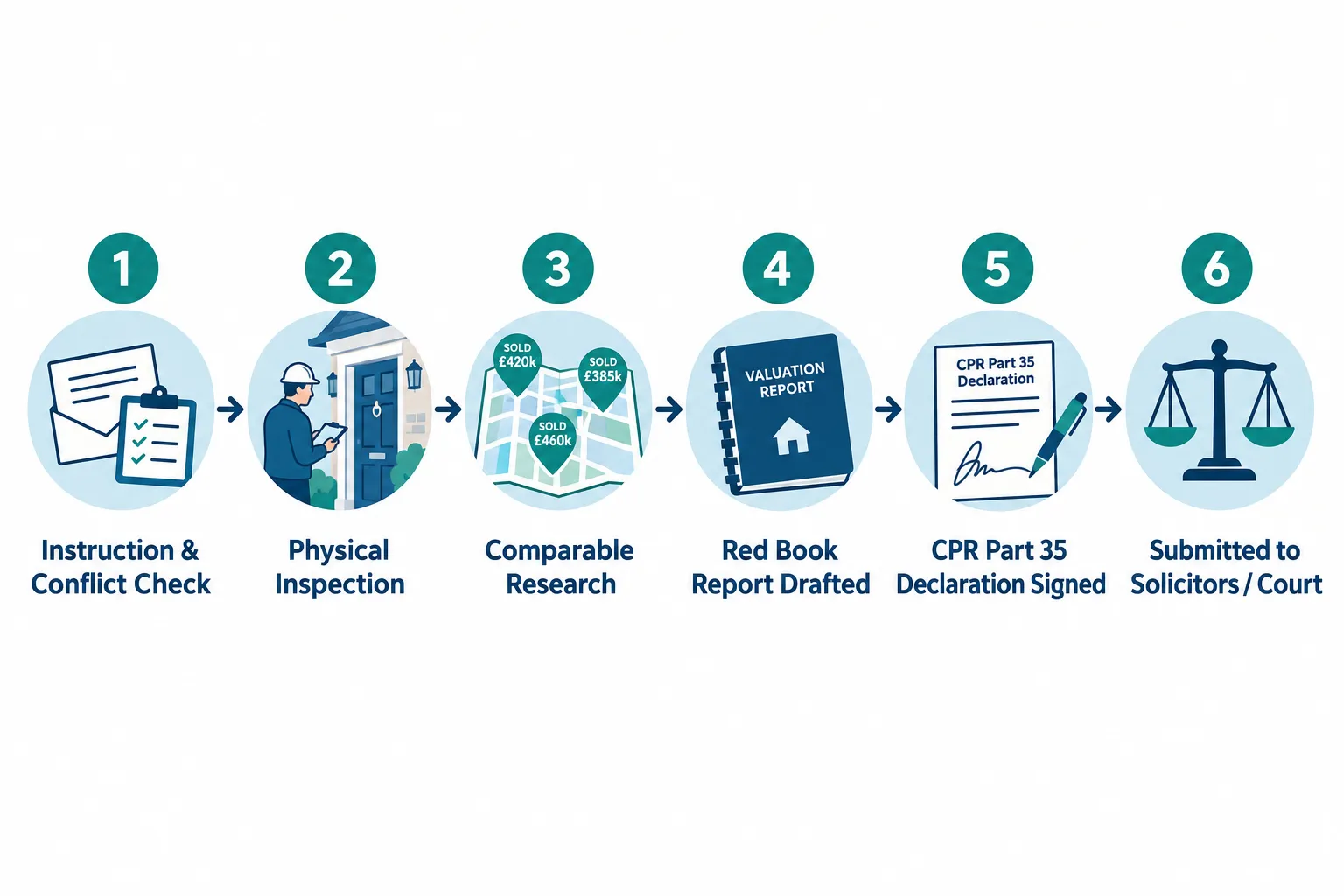
A valuation produced at the start of proceedings may be 12 or 18 months old by the time a final hearing takes place. Courts expect valuations to reflect current market conditions. The following table summarises the general guidance on validity windows:
| Market Condition | Typical Validity Window | Action Required |
|---|---|---|
| Stable market | Up to 6 months | Desktop review may suffice |
| Rising or falling market | 3 months or less | Full re-inspection recommended |
| Post-significant event (flood, fire, structural work) | Immediately superseded | New inspection required |
Solicitors should build review triggers into their case management. If the final hearing is relisted, the valuation date should be checked before the report is filed [3].
Costs and Proportionality
RICS matrimonial valuations for a standard residential property typically start from around £600, though fees rise with property complexity, size, and location [7]. Where both parties agree on value, a single joint instruction keeps costs proportionate. Where there is genuine dispute, each party may instruct their own valuer, but the court will often direct a joint expert to avoid duplication.
The valuation dispute expert witness service is relevant where the parties' valuations diverge significantly and a third expert is needed to resolve the gap.
The Interaction With Financial Disclosure
The property valuation does not sit in isolation. It forms part of the Form E financial disclosure that each party must file. Courts expect "full and frank" disclosure, and a valuation that has been commissioned from a surveyor known to favour one party's position, or that rests on undisclosed assumptions, can be treated as a breach of that duty.
Where a party believes the valuation produced by the other side is incorrect, there are formal mechanisms to challenge it. The article on how to challenge a building survey valuation in the UK sets out the procedural steps, including the use of a counter-report and the without-prejudice discussion between experts that courts now routinely direct.
Frequently Asked Questions
Does the valuation have to be a Red Book report, or will any RICS surveyor's letter do?
For matrimonial proceedings, the valuation must comply with the RICS Valuation, Global Standards (Red Book). A brief letter or email from a surveyor does not meet that standard and will not be accepted as reliable evidence by a court [1].
Can the parties use the same surveyor?
Yes. A Single Joint Expert appointed by both parties is the most cost-efficient approach and is encouraged by the courts. The surveyor must confirm in writing that they have no conflict of interest with either party [6].
What if the parties cannot agree on a valuer?
Either party can apply to the court for directions. The court may select a valuer from a panel or direct the parties to agree one within a set timeframe.
How long does a matrimonial valuation take?
Most residential valuations are completed within five to ten working days of the inspection. Complex or high-value properties may take longer.
Does the report cover contents and chattels?
No. A property valuation covers the land and buildings. Chattels are valued separately, usually by a specialist, and are listed on Form E independently.
What happens if the property has been improved or damaged since separation?
The surveyor must value the property as inspected on the valuation date. Material changes since separation, extensions, damage, or neglect, will be reflected in the figure. The report should note any evidence of recent works.
Is a Red Book valuation the same as a mortgage valuation?
No. A mortgage valuation is produced for the lender and is not disclosed to the borrower in full. A matrimonial Red Book valuation is produced for the parties and the court, with full transparency of methodology and comparable evidence [5].
Conclusion
A chartered surveyor valuation for divorce is not a bureaucratic formality. It is a piece of evidence that must withstand scrutiny from solicitors, opposing experts, and potentially a judge. The report must address the basis of value, the valuation date, the physical condition of the property, the comparable market evidence relied upon, and the full scope of assets and assumptions. Where proceedings are contested, it must also carry a CPR Part 35 declaration confirming the surveyor's independence and overriding duty to the court.
Practical next steps:
- Instruct a RICS-registered valuer with specific experience in matrimonial valuations, confirm Red Book compliance before signing terms.
- Agree with the other party, through solicitors, whether a Single Joint Expert is appropriate; this reduces cost and the risk of a contested battle of experts.
- Check the valuation date against the expected hearing date and commission a refreshed report if the gap exceeds three to six months.
- For leasehold, shared ownership, or tenanted properties, brief the surveyor fully on the tenure details before inspection.
- Ensure the report is filed as part of Form E financial disclosure and that any assumptions are flagged to your solicitor before submission.
References
[1] Valuation Standards – rics.org
[2] Matrimonial Valuations – Matrimonial valuations
[3] Property Valuation For Divorce Rics Guide 2026 – winfieldssurveyors.co.uk
[4] Divorce Valuation Uk Property Asset Guide – connaughtlaw.com
[5] Types Of Property Valuations – johndwood.co.uk
[6] Surveyors Acting As Expert Witnesses – rics.org
[7] Matrimonial Property Valuation Rics Red Book Reports For Divorce Settlements – winfieldssurveyors.co.uk
[10] Surveyors acting as expert witnesses (Feb 2023 amendment) – rics.org