Fewer than one in ten chartered surveyors who accept expert witness instructions in property disputes have read the Civil Procedure Rules in full, yet a single procedural misstep can result in evidence being excluded, costs sanctions, or regulatory referral. For any RICS member navigating the full lifecycle of expert witness work, from the first telephone enquiry through to cross-examination in court, understanding the precise obligations that govern this role is not optional. This guide to Expert Witness Services for UK Property Disputes: A Chartered Surveyor's Complete Practice Guide sets out those obligations clearly, drawing on the RICS 5th edition standard, CPR requirements, and current best practice across valuation, defects, and party wall matters.
Key Takeaways
- The RICS 5th edition "Surveyors acting as expert witnesses" takes effect on 30 November 2026 and introduces a mandatory global professional standard alongside non-mandatory additional guidance for England and Wales.
- An expert witness's overriding duty runs to the tribunal, not to the instructing party, this principle governs every stage of the engagement.
- AI-generated content within expert evidence must be clearly identified, supervised, and disclosed under the new standard.
- RICS has issued specific warnings about high-volume housing disrepair work, including the risks of pre-populated templates and undisclosed conflicts of interest.
- The 4th edition (amended February 2023) remains operative until 30 November 2026; surveyors must comply with it now while preparing for the transition.
The Regulatory Framework Governing Expert Witness Work in 2026
The foundation of all expert witness practice for RICS members is the professional standard "Surveyors acting as expert witnesses." The current operative version is the 4th edition, amended in February 2023, and it remains binding until the 5th edition takes effect on 30 November 2026 [8][9].
The 5th edition represents the first substantive update since 2014 and introduces a deliberately two-part structure [1][2]:
Part 1, Mandatory Professional Standard: Applies globally to all RICS members giving expert evidence before any tribunal. It sets non-negotiable requirements around independence, impartiality, competence, and, notably, the use of artificial intelligence.
Part 2, Additional Guidance for England and Wales: Non-mandatory but highly practical, covering instructions, fees, conflicts of interest, report format, and the distinction between the expert witness and advocate roles [3].
"Expert evidence must be independent, unbiased, and limited to the surveyor's field of competence.", RICS 5th Edition Professional Standard [2]
The scope of the new standard is explicitly global, making it a unified benchmark for surveyors giving evidence in civil proceedings worldwide, while the accompanying guidance provides jurisdiction-specific detail for property disputes in England and Wales [1][5].
What the Mandatory Standard Requires
Three core obligations underpin the mandatory standard:
| Obligation | What it means in practice |
|---|---|
| Independence and impartiality | Members must only accept instructions where they can act without bias toward either party |
| Competence | Members must have appropriate experience, expertise, and resources to complete the assignment |
| AI transparency | Any AI-generated content must be identified, supervised, and disclosed within the evidence [2] |
The AI requirement is a notable new element. The standard is explicit: work produced using AI must be carried out under the member's direction, and the expert remains personally responsible for every opinion expressed [2][14]. This matters practically, a surveyor who uses AI drafting tools for report sections cannot delegate professional accountability to the software.
From Instruction to Report: The Full Lifecycle of an Expert Witness Engagement
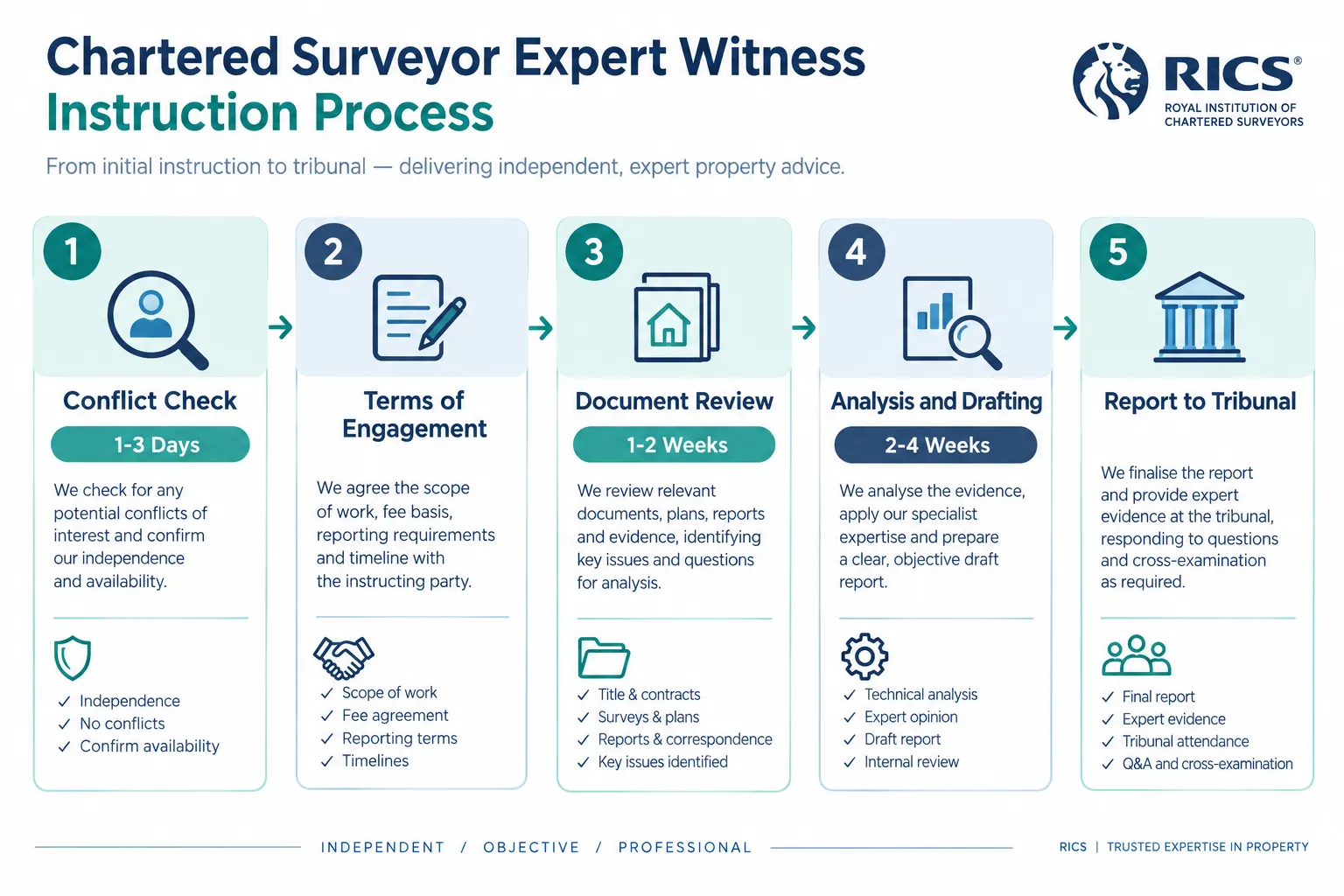
Understanding the complete lifecycle of expert witness services for UK property disputes is essential for both managing client expectations and meeting regulatory obligations. The process moves through several distinct stages, each with its own compliance requirements.
Stage 1: Conflict Checks and Terms of Engagement (1-3 Working Days)
Before accepting any instruction, a surveyor must conduct a thorough conflict-of-interest check. RICS has been particularly clear about this in the context of high-volume work. Its 2025 practice alert on housing disrepair cases warned explicitly against allowing conflicts to arise through repeated instructions from the same claimant solicitors or claims management companies [5][6].
Terms of engagement must be confirmed in writing. The RICS client guide for expert witnesses requires surveyors to advise prospective clients in writing that the relevant professional standard and tribunal rules will apply to the engagement [11]. This written notice manages expectations from the outset: the expert's duty runs to the court, not to the party paying the fee.
Key elements of a compliant engagement letter include:
- Confirmation of the expert's overriding duty to the tribunal
- Reference to the applicable RICS standard and CPR rules
- Scope of the instruction and the expert's specific field of competence
- Fee arrangements, including provisions for attendance at hearings
- Confirmation that the expert can act impartially
Stage 2: Document Review and Site Inspection (1-2 Weeks)
Once instructed, the expert reviews all relevant documents, title plans, leases, schedules of condition, previous reports, correspondence, and undertakes any necessary site inspection. The duration of this stage varies considerably depending on the complexity of the dispute and the volume of documents provided.
A critical discipline at this stage is maintaining independence. RICS has warned against surveyors who allow their analysis to be shaped by the instructing party's preferred outcome, particularly in housing disrepair cases where claimant-generated templates are sometimes provided to experts [5][6][7].
Stage 3: Analysis and Drafting (2-4 Weeks)
This is the most substantive phase. The expert forms and records their independent opinion, identifies the range of reasonable opinion where appropriate, and drafts the report. The report must be addressed to the tribunal, not to the instructing party, a requirement reinforced by both the RICS standard and CPR Practice Direction 35 [3][6].
A compliant expert witness report for UK property disputes must include:
- The expert's qualifications and relevant experience
- A list of materials relied upon
- Facts, assumptions, and any instructions received
- The expert's analysis and reasoning
- A range of opinion where the evidence supports more than one defensible conclusion
- Clear conclusions
- A statement of truth confirming the expert's understanding of their duty to the court [12]
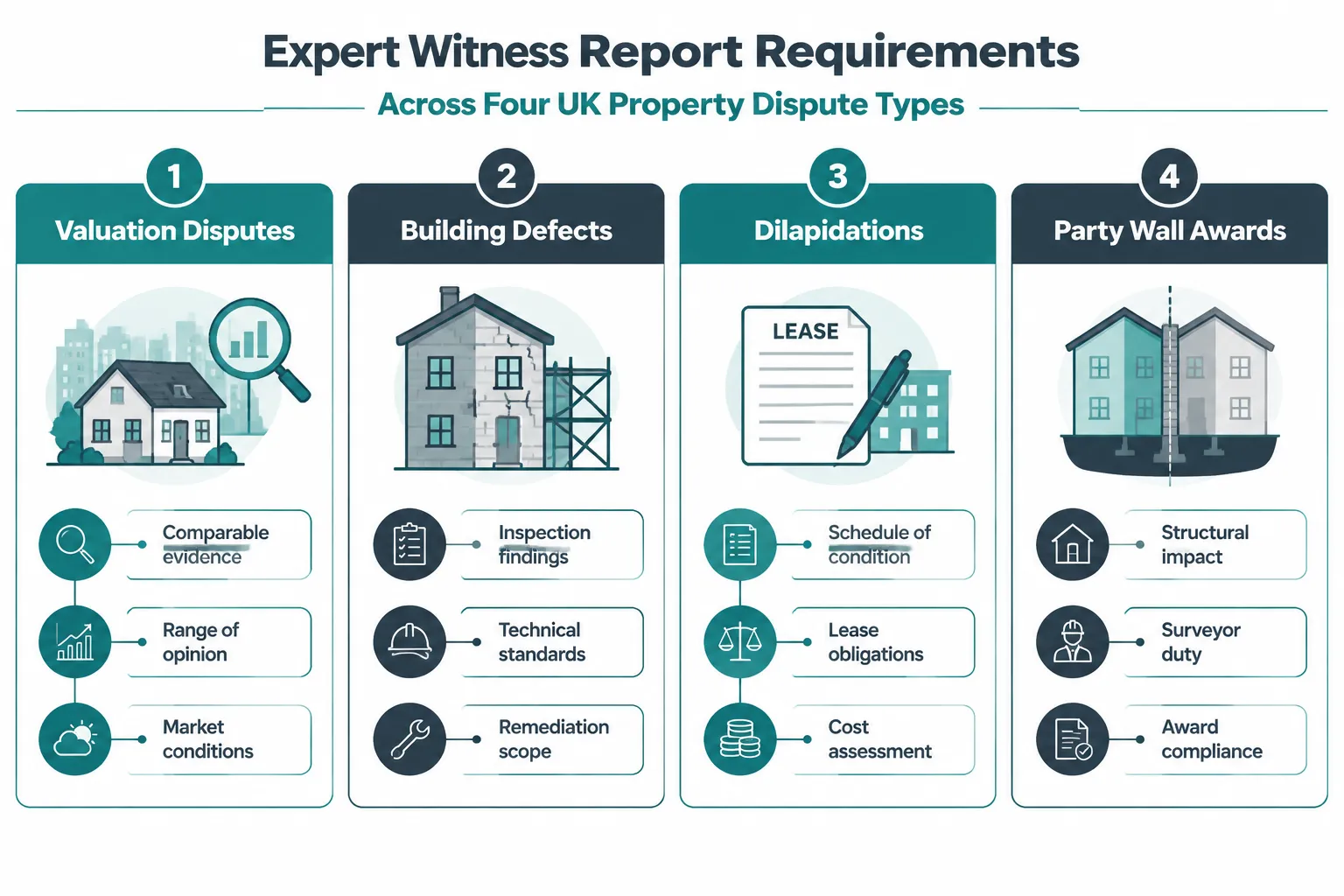
Specific Property Dispute Types: Valuation, Defects, and Party Wall Matters
The practical application of expert witness obligations varies across the main categories of UK property dispute. Chartered surveyors acting as expert witnesses must understand how the general framework applies to each context.

Valuation Disputes
In valuation disputes, whether arising from compulsory purchase, lease renewals, or contested probate valuations, the expert's core task is to provide an independent opinion of value supported by comparable evidence. The report must explain the methodology applied, identify the comparables relied upon, and set out a range of opinion where the market evidence supports differing conclusions.
A common failing in valuation expert evidence is overstating certainty. Where comparables are limited or market conditions were volatile at the relevant date, the expert must acknowledge the evidential constraints rather than present a single figure as incontrovertible [2][6].
Building Defects and Housing Disrepair
Defects cases, including housing disrepair claims, have attracted the most regulatory attention in recent years. RICS issued a formal practice alert in 2025 highlighting the risks of high-volume work, specifically [5][6]:
- Using pre-populated templates that do not reflect the surveyor's own independent inspection
- Overstating qualifications or relevant experience
- Failing to identify conflicts of interest arising from repeated instructions from the same source
- Producing reports that are effectively advocacy documents rather than independent expert evidence
The SRA has also flagged concerns about high-volume claims processes more broadly, reinforcing that the regulatory spotlight on this area extends beyond RICS alone [7].
For defects cases, the expert's report must be grounded in a physical inspection carried out personally by the expert (or under their direct supervision), with findings recorded contemporaneously. The scope of any remediation assessment must be limited to the expert's actual field of competence.
Dilapidations
Dilapidations disputes at lease end require the expert to address the schedule of dilapidations, the tenant's repairing obligations under the lease, and the appropriate measure of damages. The expert must distinguish clearly between their role as an independent expert and any prior involvement as an adviser to one of the parties, a distinction the RICS additional guidance addresses directly [3].
Party Wall Disputes
Party wall matters occupy a slightly different position because the Party Wall etc. Act 1996 creates a statutory framework with its own surveyor roles. Where a party wall dispute reaches court, however, a chartered surveyor may be required to act as a CPR-compliant expert witness rather than as a party wall surveyor. The two roles carry different duties and must not be conflated [10].
The RICS 5th Edition Standard: Key Changes and Transition Planning
Surveyors who currently deliver expert witness services for UK property disputes must plan their transition to the 5th edition ahead of its 30 November 2026 effective date [1][9].
What Is Changing
The most significant substantive changes in the 5th edition are:
Global scope: The mandatory standard now applies to RICS members giving expert evidence in any jurisdiction, not only England and Wales [1][13].
AI obligations: The explicit requirement to identify, supervise, and disclose AI-generated content is entirely new and reflects the rapid adoption of AI drafting tools across the profession [2][14].
Reinforced independence requirements: The language around independence and impartiality has been strengthened, with clearer guidance on the circumstances in which a surveyor should decline or withdraw from an instruction [2].
Separation of mandatory and guidance elements: The two-part structure makes it easier for surveyors to identify which obligations are absolute and which represent best-practice guidance, though the additional guidance for England and Wales should be treated as highly persuasive in practice [3][5].
Transition Steps for Chartered Surveyors
Firms and individual practitioners should take the following steps before 30 November 2026:
- Audit current practice against the 4th edition to identify any gaps
- Review AI tool usage in report preparation and establish disclosure protocols
- Update engagement letters to reflect the new standard's language on independence and competence
- Train fee earners on the distinction between expert and advocate roles
- Review conflict-check procedures, particularly for high-volume instruction sources
- Read the additional guidance for England and Wales in full [3]
Joint Statements and Without-Prejudice Meetings
Expert witness work rarely ends with the delivery of the written report. In most civil proceedings, the court will direct experts on the same issue to meet, identify areas of agreement, and produce a joint statement. This document, sometimes called a Scott Schedule in construction and dilapidations cases, is then used by the court to narrow the issues for trial.
The joint statement process requires the expert to engage genuinely with the opposing expert's reasoning. Attempts to use the meeting as a negotiating exercise, or to resile from positions taken in the report without good reason, undermine the expert's credibility and may attract judicial criticism [6][12].
Cross-Examination
Cross-examination is the final test of an expert witness's evidence. The key disciplines are consistency with the written report, clarity of reasoning, and the willingness to make concessions where the opposing evidence genuinely warrants them. An expert who defends every position regardless of the evidence will lose credibility with the tribunal; an expert who abandons positions under pressure without good reason will be equally ineffective [6].
Conclusion
Expert witness services for UK property disputes sit at the intersection of professional regulation, procedural law, and technical expertise. The complete practice guide for chartered surveyors in 2026 must account for the transition to the RICS 5th edition standard, the overriding duty to the tribunal at every stage of the engagement, and the specific risks that arise in high-volume and template-driven instruction environments.
Actionable next steps for chartered surveyors:
- Download and read the RICS 5th edition professional standard and additional guidance now, ahead of the 30 November 2026 effective date [1][2][3]
- Audit all current expert witness engagement letters and report templates against the mandatory requirements
- Establish a written AI disclosure protocol if AI tools are used in any part of the report preparation process
- Review conflict-of-interest procedures for any instructions received from repeat sources
- Ensure that every report produced is addressed to the tribunal, includes a statement of truth, and reflects the expert's own independent opinion, not the instructing party's preferred narrative
The consequences of non-compliance, excluded evidence, costs sanctions, and RICS disciplinary proceedings, are significant. The reward for getting it right is a practice built on credibility, which is ultimately the only currency an expert witness possesses.
References
[1] Surveyors Acting As Expert Witnesses – rics.org
[2] Surveyors Acting As Expert Witnesses 5th Edition Tribunal Combined – rics.org
[3] Additional Guidance For Surveyors Acting As Expert Witnesses 5th Edition 280826 – rics.org
[5] New Expert Witness Guidance For Rics Members – nmrk.com
[6] Expert Witness Duties Responsibilities – ww3.rics.org
[7] Sra Update 139 High Volume Claims Changes – sra.org.uk
[8] Surveyors acting as expert witnesses Feb2023amend – rics.org
[9] Rics Standards – isurv.com
[10] expertwitnesssurveyor – expertwitnesssurveyor.com
[12] expertwitnesssurveyor – expertwitnesssurveyor.com