The UK data centre market is experiencing unprecedented growth in 2026, driven by the explosive demand for artificial intelligence infrastructure. As investors prioritize data centre projects in their real estate portfolios, the need for rigorous Building Surveys for UK Data Centre Expansions: RICS Standards Amid the 2026 AI Infrastructure Surge has never been more critical. These specialized surveys ensure structural integrity, cooling system capacity, and power infrastructure can support the intensive requirements of AI workloads.
With RICS launching landmark global standards for responsible AI use in surveying practice—effective 9 March 2026—surveyors face a dual challenge: conducting comprehensive building assessments while complying with new regulatory frameworks that govern how AI tools support their work.[2][3]
This convergence of rapid infrastructure expansion and evolving professional standards creates both opportunities and complexities for chartered surveyors working on data centre projects across the United Kingdom.
Key Takeaways
- 🏗️ Specialized building surveys for data centre expansions must assess structural loading capacity, cooling infrastructure, and power systems beyond standard commercial property inspections
- 📋 RICS AI standards taking effect 9 March 2026 require documented risk registers, audit trails, and due diligence for every AI tool used in surveying practice[2][3]
- ⚡ AI-driven demand is transforming data centre requirements, with floor loading, thermal management, and electrical capacity emerging as critical survey focus areas
- ✅ Compliance frameworks now mandate governance protocols, transparency requirements, and ethical oversight for AI integration in building survey workflows[2]
- 🎯 Early adoption of RICS standards positions surveying firms competitively with clients seeking responsible AI use and stronger regulatory compliance[2]
Understanding the 2026 Data Centre Infrastructure Boom
Why Data Centres Top Investment Priorities
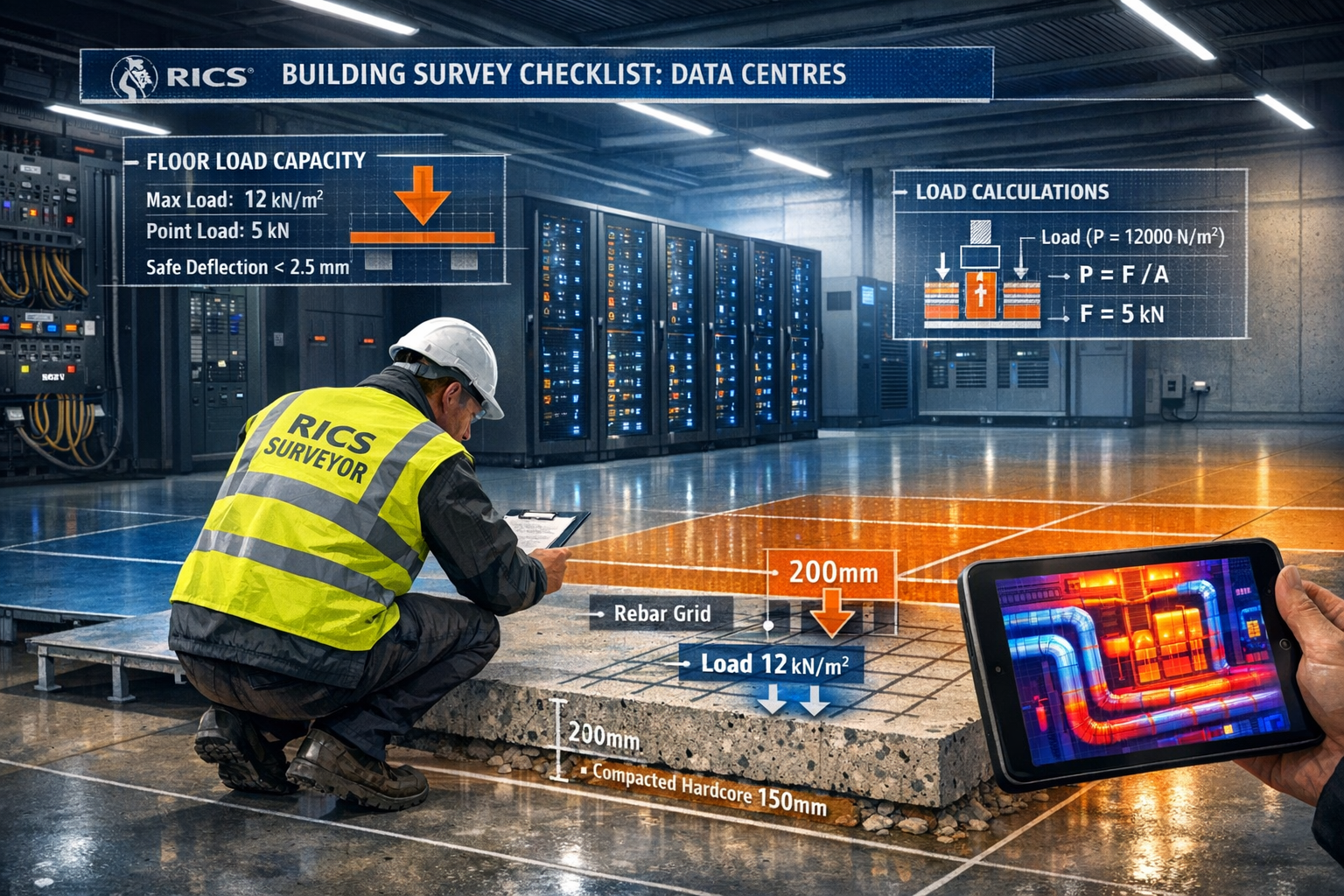
The artificial intelligence revolution has fundamentally altered data centre requirements. Traditional server facilities designed for cloud storage and web hosting cannot support the computational intensity of large language models, machine learning training, and real-time AI inference workloads.
Key drivers of 2026 expansion:
- GPU-intensive computing: AI training requires specialized graphics processing units generating significantly more heat than conventional servers
- Power density increases: Modern AI racks consume 30-50 kW compared to 5-10 kW for traditional server racks
- Cooling system demands: Liquid cooling and advanced HVAC systems necessary for thermal management
- Geographic expansion: UK regions outside London attracting investment due to power availability and land costs
- Regulatory compliance: Data sovereignty requirements keeping UK data processing within national borders
This infrastructure surge demands specialized commercial building surveys that go far beyond standard property assessments. Surveyors must evaluate whether existing structures can accommodate the physical, electrical, and thermal demands of AI infrastructure.
The Scale of UK Data Centre Growth
Investment in UK data centres reached record levels in 2026, with major technology companies announcing expansions across Manchester, Birmingham, Edinburgh, and Bristol. These facilities represent billions in capital deployment, making thorough building surveys essential risk management tools.
The expansion timeline creates urgency: developers need rapid assessments to secure financing, obtain planning permissions, and begin construction. However, rushing survey processes risks overlooking critical structural deficiencies that could derail projects or create catastrophic failures after commissioning.
RICS Building Survey Standards for Data Centre Expansions
Comprehensive Assessment Requirements
Building surveys for data centre expansions require specialized expertise beyond residential or standard commercial property inspections. The Royal Institution of Chartered Surveyors provides frameworks that ensure systematic evaluation of all critical building systems.
Essential survey components for data centre projects:
| Survey Element | Assessment Focus | Critical Considerations |
|---|---|---|
| Structural Integrity | Floor loading capacity, foundation strength | AI server racks require 1,500-2,000 kg/m² loading vs. 500-750 kg/m² for offices |
| Electrical Infrastructure | Power distribution, redundancy systems | Minimum N+1 redundancy, capacity for 2-5 MW per facility |
| Cooling Systems | HVAC capacity, liquid cooling readiness | Precision cooling maintaining 18-27°C with humidity control |
| Building Envelope | Thermal performance, weatherproofing | Preventing external temperature fluctuations affecting operations |
| Access & Logistics | Loading bay capacity, equipment access routes | Accommodating large transformer and generator deliveries |
| Fire Suppression | Detection systems, suppression infrastructure | Specialized systems protecting equipment without water damage |
Professional RICS building surveys provide the comprehensive documentation investors and developers require before committing capital to expansion projects.
Structural Loading Analysis
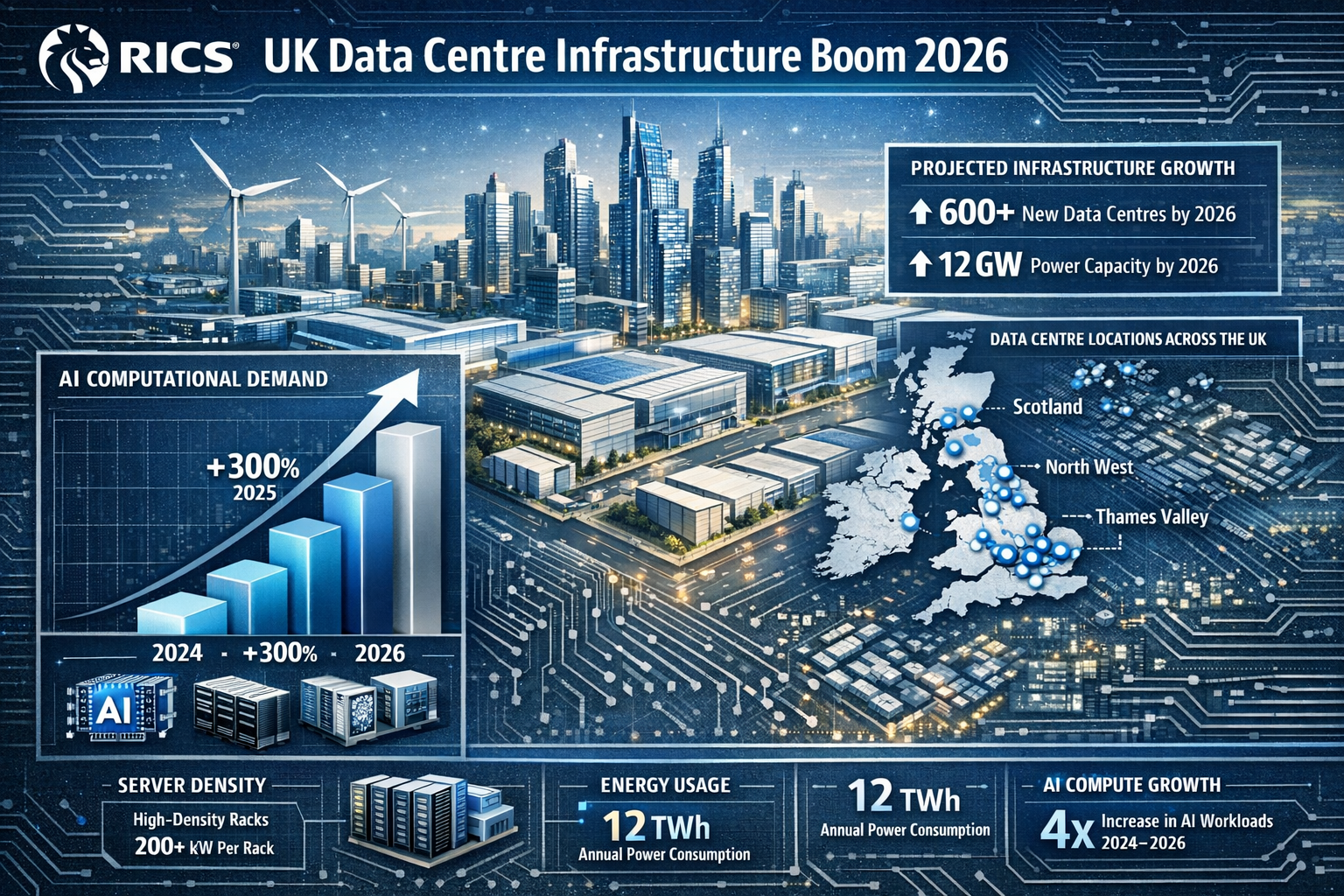
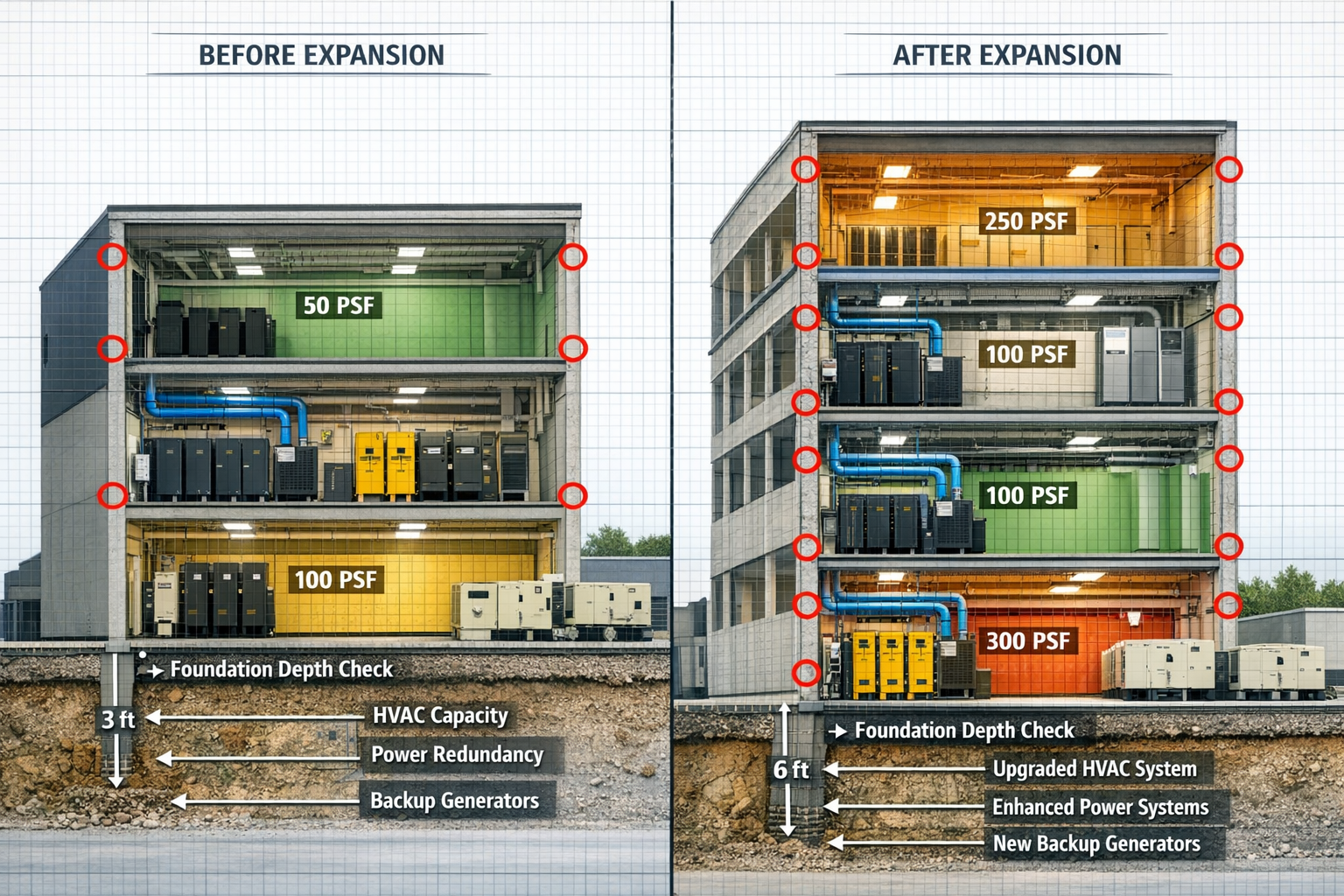
The most critical aspect of data centre building surveys involves assessing whether existing floor slabs can support concentrated server rack loads. Unlike distributed office loads, data centre equipment creates point loads that can exceed structural design specifications.
Surveyors must evaluate:
- Concrete slab thickness and reinforcement: Minimum 150-200mm reinforced concrete for raised floor systems
- Column spacing and load paths: Ensuring structural grid accommodates rack layouts
- Foundation capacity: Verifying soil bearing capacity supports total building loads
- Vibration sensitivity: Assessing whether structural movement could affect sensitive equipment
Specialized structural surveys often accompany building surveys for data centre projects, providing detailed engineering analysis of load-bearing capacity and required reinforcements.
Power and Cooling Infrastructure Assessment
Electrical capacity represents the primary constraint for most data centre expansions. Building surveys must assess not only current electrical service but also the feasibility of upgrades to support AI workloads.
Critical electrical survey elements:
- Service entrance capacity: Evaluating transformer size and utility company upgrade timelines
- Distribution infrastructure: Assessing busway, panel boards, and circuit capacity
- Backup power systems: Space and structural support for generators and UPS systems
- Power density per rack: Determining maximum supportable kW per cabinet
Cooling infrastructure assessment complements electrical evaluation, as power consumption directly correlates with heat generation requiring removal. Surveyors examine existing HVAC systems, available space for cooling equipment expansion, and water supply for evaporative cooling systems.
RICS AI Standards: Compliance Requirements for Building Surveys in 2026
The Landmark Global Standard for Responsible AI Use
On 9 March 2026, RICS implemented the first global professional standard governing responsible artificial intelligence use in surveying practice.[3] This mandatory framework applies to all RICS members and regulated firms worldwide, fundamentally changing how surveyors integrate AI tools into building assessment workflows.
The standards emerged from recognition that AI technologies—from automated defect detection to predictive maintenance algorithms—offer significant benefits but also introduce risks around data quality, bias, and professional accountability.[2]
The four main regulatory pillars:
- 📊 Governance and Risk Management: Documented frameworks for AI tool selection, deployment, and oversight
- 🔍 Transparency: Clear audit trails showing data sources and AI-assisted decision points
- ⚖️ Ethical Development: Ensuring AI tools align with professional standards and client interests
- 👤 Professional Oversight: Maintaining surveyor responsibility for AI-generated outputs
These requirements directly impact how surveyors conduct and document building assessments for data centre expansions, particularly when using AI-powered tools for thermal imaging analysis, structural defect detection, or predictive capacity modeling.
Risk Register and Due Diligence Mandates
The RICS standards require firms to maintain comprehensive risk registers for every AI tool deployed in surveying practice.[2] This documentation must include:
- Data source transparency: Identifying training datasets and their limitations
- Known algorithmic biases: Documenting scenarios where AI tools may produce unreliable outputs
- Validation protocols: Establishing how AI-generated findings are verified by qualified surveyors
- Management strategies: Defining mitigation approaches for identified risks
For data centre building surveys, this might involve documenting how AI-assisted thermal imaging tools analyze cooling system performance, including validation procedures ensuring automated defect detection doesn't miss critical issues requiring professional judgment.
Due diligence requirements before AI tool implementation:
✅ Vendor assessment and capability verification
✅ Data privacy and security evaluation
✅ Integration testing with existing survey workflows
✅ Staff training on appropriate AI tool use
✅ Client disclosure protocols for AI-assisted work
✅ Professional indemnity insurance coverage confirmation
These protocols ensure that AI enhances rather than compromises the quality and reliability of building surveys supporting major infrastructure investments.
Audit Trail Documentation Standards
Transparency represents a cornerstone of the new RICS AI standards. Surveyors must maintain clear audit trails showing how AI tools contributed to survey findings and recommendations.[2]
For data centre expansion projects, this documentation might include:
- Thermal imaging analysis: Recording which defects were AI-detected versus surveyor-identified
- Structural capacity modeling: Documenting AI-generated load calculations with professional verification
- Predictive maintenance assessments: Showing AI algorithms used and surveyor interpretation
- Report generation: Identifying AI-assisted content versus professional analysis
This transparency builds client confidence while protecting surveyors from liability issues if AI tools produce erroneous outputs. The standards emphasize that professional responsibility remains with the chartered surveyor regardless of AI tool involvement.
Building Surveys for UK Data Centre Expansions: RICS-Compliant Survey Protocols
Pre-Survey Planning and Scope Definition
Successful data centre building surveys begin with comprehensive scope definition that aligns client objectives with RICS standards. This planning phase establishes survey boundaries, identifies specialized assessments required, and determines appropriate AI tool deployment within compliance frameworks.
Essential pre-survey activities:
- Client briefing sessions: Understanding expansion timeline, capacity targets, and budget constraints
- Document review: Analyzing existing building plans, structural calculations, and as-built drawings
- Site reconnaissance: Preliminary visits identifying access constraints and safety considerations
- Specialist coordination: Engaging structural engineers, M&E consultants, and environmental specialists
- AI tool selection: Choosing compliant technologies with documented risk registers
The planning phase also establishes reporting formats that satisfy both client requirements and RICS documentation standards, including transparency around AI-assisted analysis.
On-Site Inspection Protocols
Data centre building surveys demand systematic inspection methodologies covering all critical building systems. Chartered surveyors follow structured protocols ensuring no critical elements are overlooked.
Comprehensive inspection checklist:
🔲 Foundation and Substructure
- Ground conditions and bearing capacity
- Foundation type and condition
- Basement waterproofing and drainage
- Subsidence indicators or settlement patterns
🔲 Structural Frame
- Column and beam condition assessment
- Floor slab thickness and reinforcement verification
- Load-bearing wall integrity
- Expansion joint condition
🔲 Building Envelope
- Roof condition and weatherproofing
- External wall thermal performance
- Window and door sealing
- Water ingress evidence
🔲 Mechanical Systems
- HVAC capacity and condition
- Ductwork and air distribution
- Cooling tower infrastructure
- Ventilation rates and air quality
🔲 Electrical Infrastructure
- Service entrance and transformer capacity
- Distribution panel condition
- Cable routing and capacity
- Emergency power systems
🔲 Fire Protection
- Detection system coverage
- Suppression system type and condition
- Fire-rated compartmentation
- Emergency egress routes
Modern survey tools including thermal imaging cameras, moisture meters, and structural analysis equipment support these inspections. When AI-powered tools assist with defect detection or analysis, surveyors document their use according to RICS transparency standards.[2]
Specialized Testing and Analysis
Beyond visual inspection, data centre building surveys often require specialized testing to verify structural capacity and system performance.
Common testing protocols:
- Concrete core sampling: Verifying slab thickness and compressive strength
- Electrical load testing: Confirming distribution system capacity under simulated loads
- Thermal imaging surveys: Identifying insulation deficiencies and thermal bridging
- Air tightness testing: Measuring building envelope performance for cooling efficiency
- Vibration analysis: Assessing whether structural movement affects sensitive equipment
These technical assessments provide quantitative data supporting surveyor recommendations about expansion feasibility and required upgrades. Results integrate into comprehensive survey reports documenting all findings with appropriate professional interpretation.
RICS Standards for Building Surveys: Reporting and Recommendations
Comprehensive Report Structure
RICS standards establish clear frameworks for building survey reports that serve both professional documentation requirements and client decision-making needs. For data centre expansions, reports must communicate complex technical findings in accessible formats while maintaining professional rigor.
Essential report components:
- Executive Summary: High-level findings, critical issues, and cost implications
- Property Description: Location, construction type, age, and current use
- Survey Methodology: Inspection scope, testing conducted, and AI tools deployed
- Structural Assessment: Foundation, frame, and loading capacity analysis
- Building Systems Evaluation: Mechanical, electrical, and fire protection systems
- Defect Identification: Categorized by urgency and remediation requirements
- Expansion Feasibility Analysis: Capacity for proposed data centre upgrades
- Cost Estimates: Remediation and upgrade investment requirements
- Recommendations: Prioritized action items with implementation timelines
- Appendices: Technical data, test results, and photographic evidence
Reports must clearly distinguish between surveyor observations, AI-assisted analysis, and professional recommendations, maintaining transparency required by 2026 RICS standards.[2]
Risk Categorization and Prioritization
Effective building survey reports categorize identified issues by severity and urgency, helping clients prioritize remediation investments.
Standard risk classification:
| Category | Definition | Examples | Action Timeline |
|---|---|---|---|
| Critical | Immediate safety risks or structural failure potential | Inadequate floor loading capacity, electrical fire hazards | Immediate action required |
| Significant | Issues affecting expansion feasibility | Insufficient cooling capacity, limited power service | Address before expansion |
| Moderate | Defects requiring attention but not expansion-blocking | Minor water ingress, aging HVAC components | Plan within 12-24 months |
| Minor | Cosmetic or maintenance items | Decorative finishes, minor weathering | Routine maintenance schedule |
This categorization helps developers and investors understand which issues require immediate capital allocation versus those manageable through phased approaches.
Compliance with RICS Valuation Standards
Building surveys for data centre expansions often accompany RICS valuations supporting financing arrangements. Survey findings directly impact property valuations by identifying capital expenditure requirements and operational risks.
Surveyors must coordinate with valuation professionals to ensure building condition assessments inform accurate market valuations. This collaboration proves particularly important for data centre projects where specialized infrastructure significantly affects property value beyond standard commercial real estate metrics.
Navigating Party Wall and Boundary Considerations
Party Wall Agreements for Data Centre Expansions
Many data centre expansion projects involve work affecting party walls or boundaries with adjacent properties. The Party Wall Act 1996 establishes legal frameworks governing these situations, requiring specialized surveys and agreements.[6]
Common party wall scenarios in data centre projects:
- Structural reinforcement: Strengthening shared walls for increased loading
- Foundation underpinning: Excavating near party walls for equipment installation
- Service penetrations: Running electrical or cooling infrastructure through party structures
- Vibration impact: Heavy equipment affecting adjacent properties
Party wall surveys document pre-construction conditions, establish agreed-upon work scopes, and provide frameworks for resolving disputes. These specialized assessments complement building surveys by addressing legal and neighbor relations aspects of expansion projects.
Boundary Surveys and Access Rights
Data centre expansions frequently require confirming property boundaries, access rights for service connections, and easements for utility infrastructure. Building surveyors coordinate with land surveyors to verify legal boundaries and identify any encroachments or access constraints.
Critical boundary considerations:
- Utility easements: Rights to run power lines or fiber optic cables across adjacent properties
- Access routes: Ensuring construction and maintenance vehicle access
- Setback compliance: Verifying building expansions meet planning authority requirements
- Rights of light: Confirming expansions don't infringe on neighboring properties
These legal and spatial considerations often determine expansion feasibility as significantly as structural or mechanical factors, making comprehensive assessment essential during initial survey phases.
Cost Implications and Investment Planning
Survey Costs for Data Centre Projects
Building survey costs for data centre expansions vary based on facility size, complexity, and specialized testing requirements. Understanding fee structures helps developers budget appropriately for due diligence phases.
Typical cost factors:
- Property size: Larger facilities require more inspection time and reporting
- Structural complexity: Multi-story buildings or complex geometries increase assessment difficulty
- Testing requirements: Specialized testing (core sampling, load testing) adds significant costs
- Timeline urgency: Expedited surveys command premium fees
- Specialist involvement: Structural engineers and M&E consultants increase total costs
For context on professional fees, review general survey pricing frameworks, though data centre projects typically exceed standard commercial survey costs due to specialized requirements.
Return on Investment for Comprehensive Surveys
While thorough building surveys represent significant upfront costs, they deliver substantial ROI by identifying issues before major capital commitments.
Value delivered through professional surveys:
💰 Risk mitigation: Avoiding catastrophic structural failures or system inadequacies
💰 Accurate budgeting: Identifying all upgrade costs before financing commitments
💰 Timeline optimization: Preventing construction delays from unforeseen issues
💰 Negotiation leverage: Using survey findings to adjust purchase prices or lease terms
💰 Insurance benefits: Demonstrating due diligence for favorable coverage terms
💰 Regulatory compliance: Ensuring planning authority and building control approval
The cost of discovering inadequate floor loading capacity or electrical service after purchasing a property far exceeds investment in comprehensive pre-acquisition surveys. For data centre projects involving tens of millions in capital deployment, survey costs represent a fraction of one percent of total investment while protecting against multimillion-pound risks.
Future-Proofing Data Centre Infrastructure
Designing for Scalability and Adaptability
Building surveys for data centre expansions should assess not only current requirements but also future scalability potential. AI technology evolves rapidly, and infrastructure installed in 2026 must accommodate unknown future demands.
Future-proofing considerations:
- Modular expansion capacity: Space for additional server halls or equipment rooms
- Power infrastructure headroom: Electrical service sized for 150-200% of initial requirements
- Cooling system scalability: HVAC infrastructure supporting capacity increases
- Floor loading margins: Structural capacity exceeding immediate needs
- Technology flexibility: Avoiding infrastructure locked to specific equipment generations
Surveyors provide valuable guidance on which future-proofing investments deliver genuine value versus over-engineering that ties up capital unnecessarily.
Sustainability and Energy Efficiency
Environmental considerations increasingly influence data centre design and expansion decisions. Building surveys assess opportunities for energy efficiency improvements that reduce operational costs while meeting sustainability commitments.
Sustainability assessment areas:
🌱 Renewable energy integration: Roof capacity for solar panels, space for battery storage
🌱 Waste heat recovery: Opportunities to capture and reuse server-generated heat
🌱 Water efficiency: Cooling system water consumption and recycling potential
🌱 Building envelope performance: Thermal efficiency reducing cooling loads
🌱 Embodied carbon: Assessing whether renovation produces lower carbon footprint than new construction
These sustainability assessments align with corporate environmental commitments while identifying operational cost reduction opportunities that improve long-term investment returns.
Selecting the Right Surveying Partner
Qualifications and Expertise Requirements
Data centre building surveys demand specialized expertise beyond general commercial property assessment. Selecting appropriately qualified surveyors proves critical for project success.
Essential surveyor qualifications:
✓ RICS membership: Ensuring compliance with professional standards and ethical frameworks
✓ Data centre experience: Demonstrated track record with similar infrastructure projects
✓ Technical specialization: Understanding of high-density computing requirements
✓ AI standards compliance: Implementation of March 2026 RICS AI frameworks[2][3]
✓ Professional indemnity insurance: Adequate coverage for project scale
✓ Multidisciplinary coordination: Ability to manage structural, M&E, and environmental specialists
RICS-registered valuers bring professional credibility and accountability essential for major infrastructure investments.
Questions to Ask Prospective Surveyors
Before engaging surveying firms for data centre expansion projects, developers and investors should conduct thorough due diligence on professional capabilities.
Critical questions for surveyor selection:
- How many data centre building surveys have you completed in the past 24 months?
- What AI tools do you use in survey practice, and how do you comply with RICS AI standards?
- Can you provide case studies of similar expansion projects?
- What specialized testing capabilities do you offer or coordinate?
- How do you structure reporting to support financing and planning applications?
- What is your typical timeline from instruction to report delivery?
- How do you handle issues discovered during surveys that affect project feasibility?
- What professional indemnity insurance limits do you maintain?
These questions help identify surveyors with genuine data centre expertise rather than generalists attempting to expand into specialized markets without appropriate experience.
Conclusion
Building Surveys for UK Data Centre Expansions: RICS Standards Amid the 2026 AI Infrastructure Surge represent a critical convergence of specialized technical assessment and evolving professional regulatory frameworks. As artificial intelligence drives unprecedented demand for computing infrastructure, the role of chartered surveyors in evaluating structural capacity, power systems, and cooling infrastructure has never been more vital.
The implementation of RICS global AI standards on 9 March 2026 adds a new dimension to surveying practice, requiring documented governance, transparency, and ethical oversight for AI tools supporting building assessments.[2][3] Surveyors who embrace these standards position themselves as trusted advisors capable of delivering both technical excellence and regulatory compliance.
For developers and investors pursuing data centre expansion opportunities in the UK market, comprehensive building surveys provide essential risk management and investment protection. The specialized requirements of AI infrastructure—from extreme floor loading to intensive cooling demands—make thorough professional assessment non-negotiable for project success.
Actionable Next Steps
For property developers and investors:
- Engage RICS-qualified surveyors with demonstrated data centre expertise early in acquisition or expansion planning
- Ensure survey scope addresses structural, mechanical, electrical, and future scalability considerations
- Request transparency about AI tool use and RICS compliance in survey workflows
- Budget appropriately for comprehensive assessments including specialized testing
- Use survey findings to inform financing negotiations and construction planning
For surveying professionals:
- Implement RICS AI standards with documented risk registers and audit trails before the 9 March 2026 deadline
- Develop specialized expertise in data centre infrastructure requirements
- Build multidisciplinary teams capable of comprehensive technical assessments
- Invest in AI-powered survey tools that enhance rather than replace professional judgment
- Position your practice as a trusted advisor for clients navigating the 2026 infrastructure surge
The intersection of AI-driven infrastructure demand and professional standards evolution creates both challenges and opportunities. Surveyors who master this specialized domain while maintaining rigorous compliance with RICS frameworks will lead the profession through this transformative period in UK real estate development.
References
[1] Rics Launches Global Construction Standards Consultation – https://www.rics.org/news-insights/rics-launches-global-construction-standards-consultation
[2] Rics Ai Standards For Surveyors – https://goreport.com/rics-ai-standards-for-surveyors/
[3] Rics Launches Landmark Global Standard On Responsible Use Of Ai In Surveying – https://www.rics.org/news-insights/rics-launches-landmark-global-standard-on-responsible-use-of-ai-in-surveying
[4] Uk Influence And Advocacy Update January 2026 – https://www.rics.org/news-insights/uk-influence-and-advocacy-update-january-2026
[5] Home Survey Standards – https://www.rics.org/profession-standards/rics-standards-and-guidance/sector-standards/building-surveying-standards/home-surveys/home-survey-standards
[6] Party Wall Surveys For Data Centre Expansions Navigating Agreements In The 2026 Investment Surge – https://nottinghillsurveyors.com/blog/party-wall-surveys-for-data-centre-expansions-navigating-agreements-in-the-2026-investment-surge