Nearly every UK building surveyor listed on major platforms carries a rating above 4.5 out of 5. When almost everyone scores near the top, star ratings alone tell you almost nothing. The real challenge of navigating UK building surveyor reviews and ratings is not finding a highly rated firm, it is learning to separate genuine quality signals from marketing noise before committing to a survey that could shape a six-figure property decision.
This guide explains how to read Trustpilot, Google, comparison-site directories, and curated testimonial pages with a critical eye, so that online feedback becomes a reliable tool rather than a source of false confidence.
Key Takeaways
- RICS accreditation is the non-negotiable first filter; reviews should only be compared between RICS-regulated firms
- High star ratings are near-universal among listed surveyors, volume, recency, and qualitative themes matter far more than the score itself
- Firm-hosted testimonial pages are marketing material; always cross-check against independent platforms such as Trustpilot or verified aggregators
- How a firm responds to negative reviews is one of the strongest indicators of service quality
- Consistent positive signals across multiple independent platforms is the most reliable safeguard against choosing the wrong firm
Why RICS Status Must Come Before Any Review Comparison
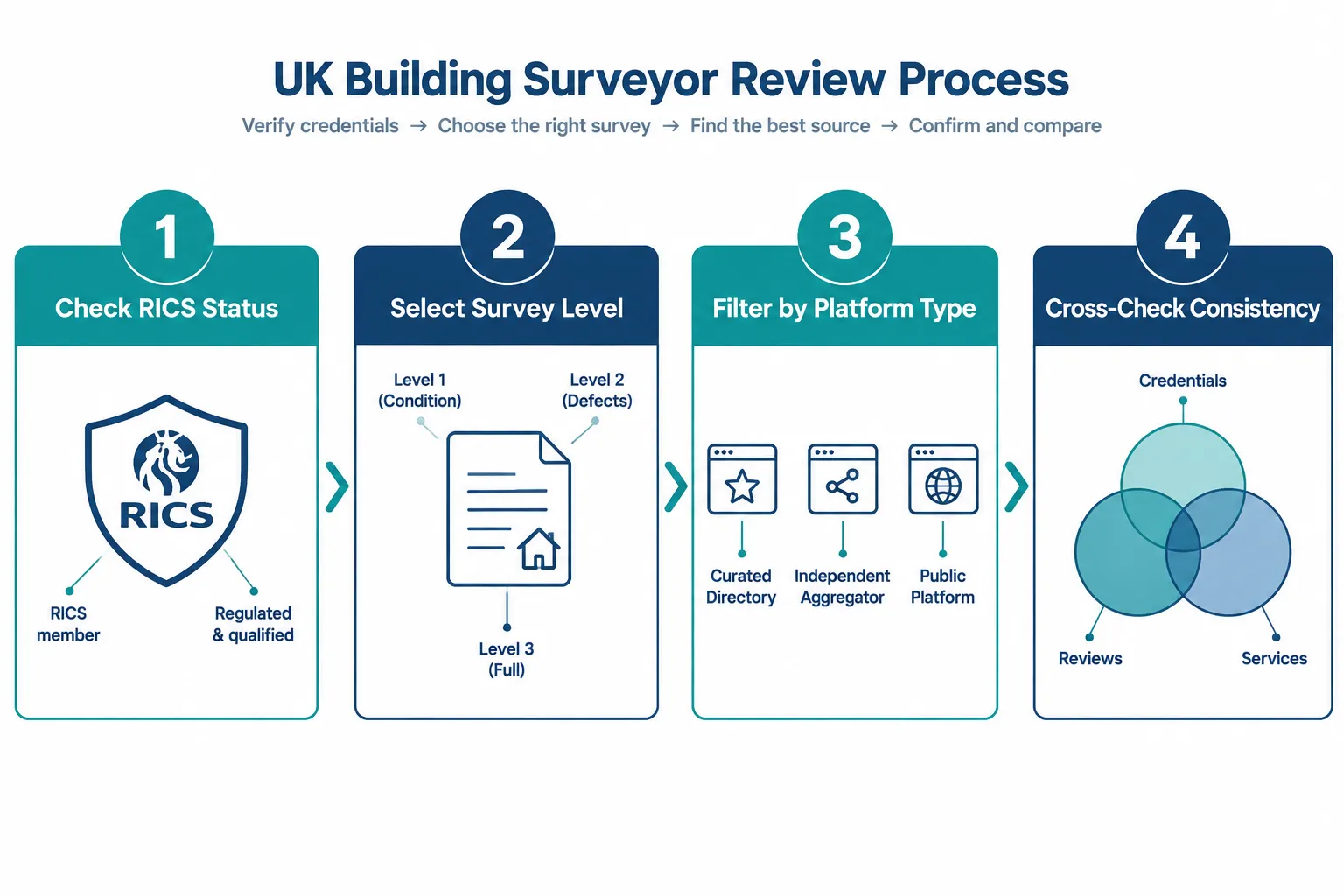
The Royal Institution of Chartered Surveyors (RICS) is the primary authority for judging surveyor competence in the UK. Its official guidance sets out three standard survey levels, the RICS Home Survey Level 1, Level 2, and Level 3, and makes clear that these surveys can only be carried out by RICS-qualified surveyors [15]. This single fact should restructure how any buyer approaches online research.
The logical sequence is: first, decide which survey level the property requires; second, confirm that any firm under consideration is RICS-regulated for that level; only then compare reviews between qualifying firms. Skipping the accreditation check and going straight to star ratings risks selecting a polished-looking, well-reviewed firm that is simply not qualified to carry out the survey type the property demands.
Directories such as Reallymoving's RICS Surveyor Reviews section enforce this filter automatically. Because the directory only lists RICS-regulated partners, every firm shown already meets the baseline qualification standard [5]. Browsing a curated, regulated directory before moving to open platforms like Trustpilot reduces the risk that an attractive rating belongs to an unregulated operator.
Practical step: Before opening any review page, confirm RICS membership directly on the RICS website using the firm's name or registration number. Treat any firm that cannot be verified there as disqualified, regardless of its online rating.
Understanding the Landscape of UK Building Surveyor Review Platforms
Not all review sources carry the same weight. Understanding the structure of each platform type is essential for using UK building surveyor reviews and ratings effectively.
Curated Regulated Directories
Platforms such as Reallymoving's surveyor directory list only RICS-regulated firms, with average ratings typically clustering between 4.8 and 5.0 out of 5 based on dozens to over 100 customer reviews per firm [5]. The controlled entry criteria make these directories a safer starting point than open platforms, but the narrow rating range also means differentiation must come from reading qualitative comments rather than comparing scores.
Independent Verified Aggregators
Services such as LocalBuildingSurveyor.co.uk collect reviews through Reviews.co.uk from verified users of their matching service [12]. The "verified user" label adds authenticity because it confirms the reviewer actually used the service, reducing the likelihood of fabricated or incentivised feedback. These aggregators are particularly useful for cross-checking claims made on a firm's own website.
Open Public Platforms
Trustpilot and Google Reviews allow any customer to post feedback, making them the most transparent but also the most variable sources. Firms such as Morguard Building Surveyors have accumulated 294 total Trustpilot reviews, with 68 posted in the most recent 12-month period, with reviewers consistently describing thorough reports and strong communication [6]. UK Building Survey and Snagging Ltd holds an "Excellent" Trustpilot score of 4.8/5 from 36 reviews [3], while Viking Surveyors carries strong ratings from 142 reviews [9]. The sheer volume and spread over time on these profiles is more reassuring than a handful of older five-star reviews.
Firm-Hosted Testimonial Pages
Henderson Surveyors promotes "130+ Five Star Google Reviews" through client stories on its own site, Andrew James Property Surveyors features recommendation-filled testimonials [10], and M Survey hosts comments praising quick turnaround and good value [1]. These pages are useful for understanding the tone and experience clients describe, but they are curated by the firm itself. Treat them as marketing material and verify the claims independently.
How to Read Reviews Without Being Misled: Signals That Actually Matter
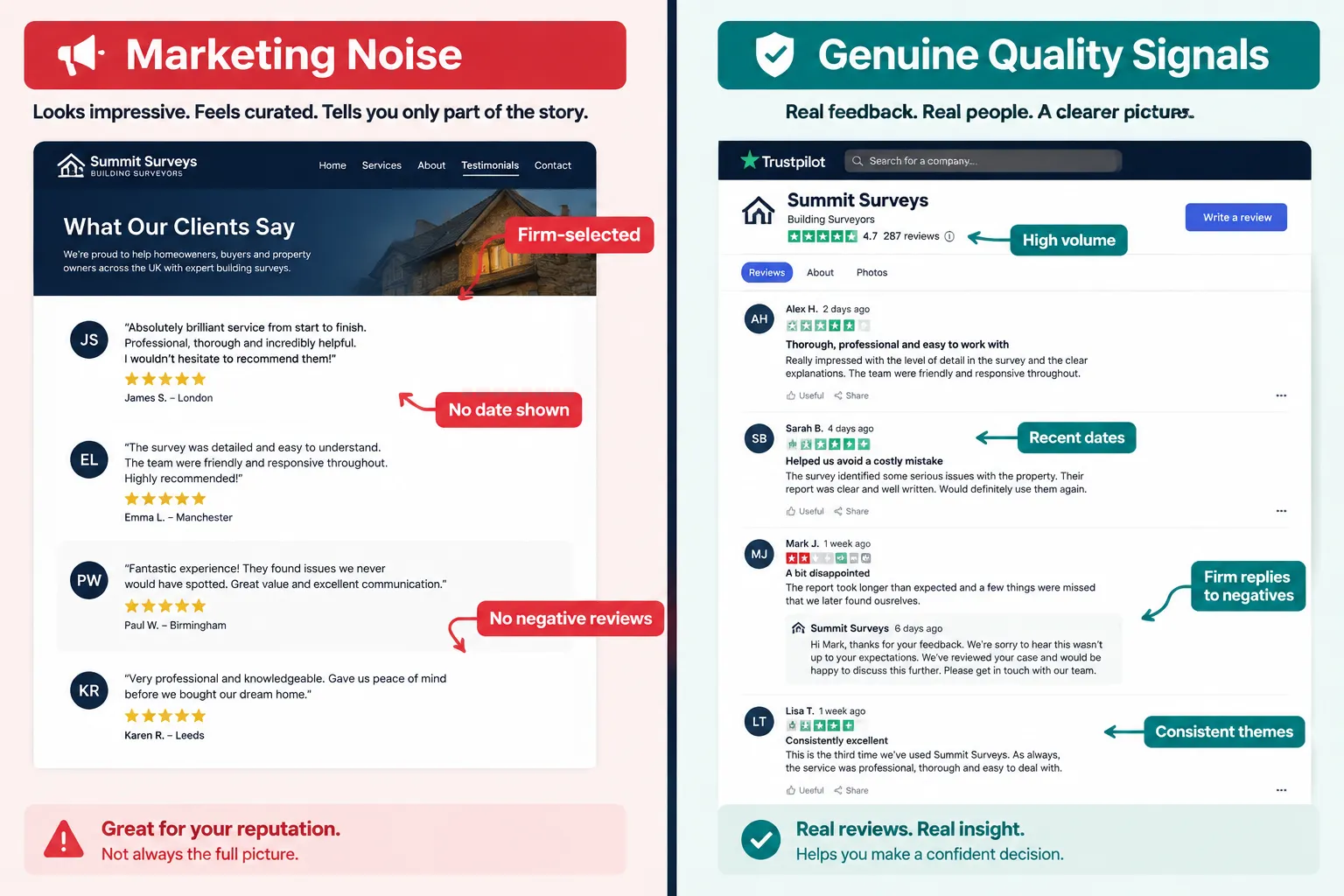
Given that rating inflation is widespread, most listed UK surveyors cluster near the top of any scale, the following signals provide genuine differentiation when evaluating UK building surveyor reviews and ratings.
Review Volume and Recency
A firm with 36 reviews and a 4.8/5 score is not directly comparable to one with 294 reviews and a 4.7/5 score. The higher volume is statistically more reliable. More importantly, recency matters: 68 reviews posted in the last 12 months, as seen on Morguard's Trustpilot profile [6], indicates a firm that is actively serving clients and maintaining standards in the current market. A cluster of older five-star reviews with no recent activity could mask a decline in service quality.
What to check:
- Total review count (higher is more reliable)
- Reviews posted in the last 6-12 months (indicates current performance)
- Whether the review pace is consistent or shows sudden spikes (spikes can indicate review campaigns)
Qualitative Themes Across Reviews
The most valuable information in any review is the specific language clients use. Across platforms, clients of firms such as M Survey, Morguard, and Durie Heritage repeatedly mention fast booking, quick report turnaround, clear explanations, and willingness to answer follow-up queries [1][6]. When these themes appear independently across dozens of reviews on different platforms, they represent a reliable picture of operational strengths.
Conversely, watch for recurring complaints about slow communication, vague reports, or difficulty reaching surveyors after the survey is complete. A single negative review may reflect an unusual circumstance; three or more reviews describing the same problem represent a pattern.
How the Firm Responds to Negative Reviews
Home Surveying's Trustpilot profile carries a "Great" rating of 4/5 from 114 reviews, and the firm has replied to 50% of negative reviews [14]. This engagement is a meaningful quality signal. A firm that explains issues, acknowledges shortcomings, and offers remedies demonstrates accountability. A firm that ignores critical feedback, or responds defensively, reveals how it handles problems in practice.
Checklist for evaluating responses to negative reviews:
| Signal | What it suggests |
|---|---|
| Firm replies promptly and professionally | Strong client care culture |
| Firm acknowledges the issue and offers a remedy | Accountable and solution-focused |
| Firm ignores negative reviews entirely | Low engagement, potential service risk |
| Firm responds defensively or disputes every complaint | Poor complaints handling |
Specialism Match
Durie Heritage's Trustpilot profile, focused on building surveyors for historic and listed properties, shows consistent praise specifically for deep heritage expertise, thorough inspections, and clear guidance on resolving issues with older buildings [13]. This clustering of comments around a specific property type is a critical signal. A firm with excellent reviews for modern new-build snagging surveys is not necessarily the right choice for a Grade II listed farmhouse.
When reading reviews, look for explicit mentions of the property type, period homes, new builds, flats, commercial conversions, and match those references to the property being purchased or inspected.
Comparison Lists and Editorial Rankings: Useful Starting Points, Not Final Verdicts
A February 2026 guide on Teddington Town ranked six UK building survey companies with scores between 8.9/10 and 10/10, offering a comparative editorial assessment of quality and value [7]. CompareMyMove's guide highlights firms including Camsure Homes, Your Surveyors Ltd, Dunford Penrose Surveyors, and Countrywide Home Surveys, each with five-star ratings and typically 20-50 five-star reviews [8].
These lists serve a legitimate purpose: they provide a shortlist of firms that have passed some editorial scrutiny, saving research time. However, they should be treated as starting points rather than definitive endorsements. Editorial rankings may reflect commercial relationships, affiliate arrangements, or criteria that do not match individual buyer priorities. Measured Survey Pro, for example, carries a 4.5/5 Trustpilot rating from 13 reviews [4], a credible score but from a sample size that warrants caution before a high-value commission.
How to use comparison lists responsibly:
- Use the list to generate a shortlist of 3-5 candidate firms
- Verify each firm's RICS status independently
- Search each firm on Trustpilot, Google, and any relevant directory
- Read qualitative comments, not just scores
- Check recency and volume of reviews
- Assess how the firm responds to negative feedback
Cross-Platform Consistency: The Most Reliable Safeguard
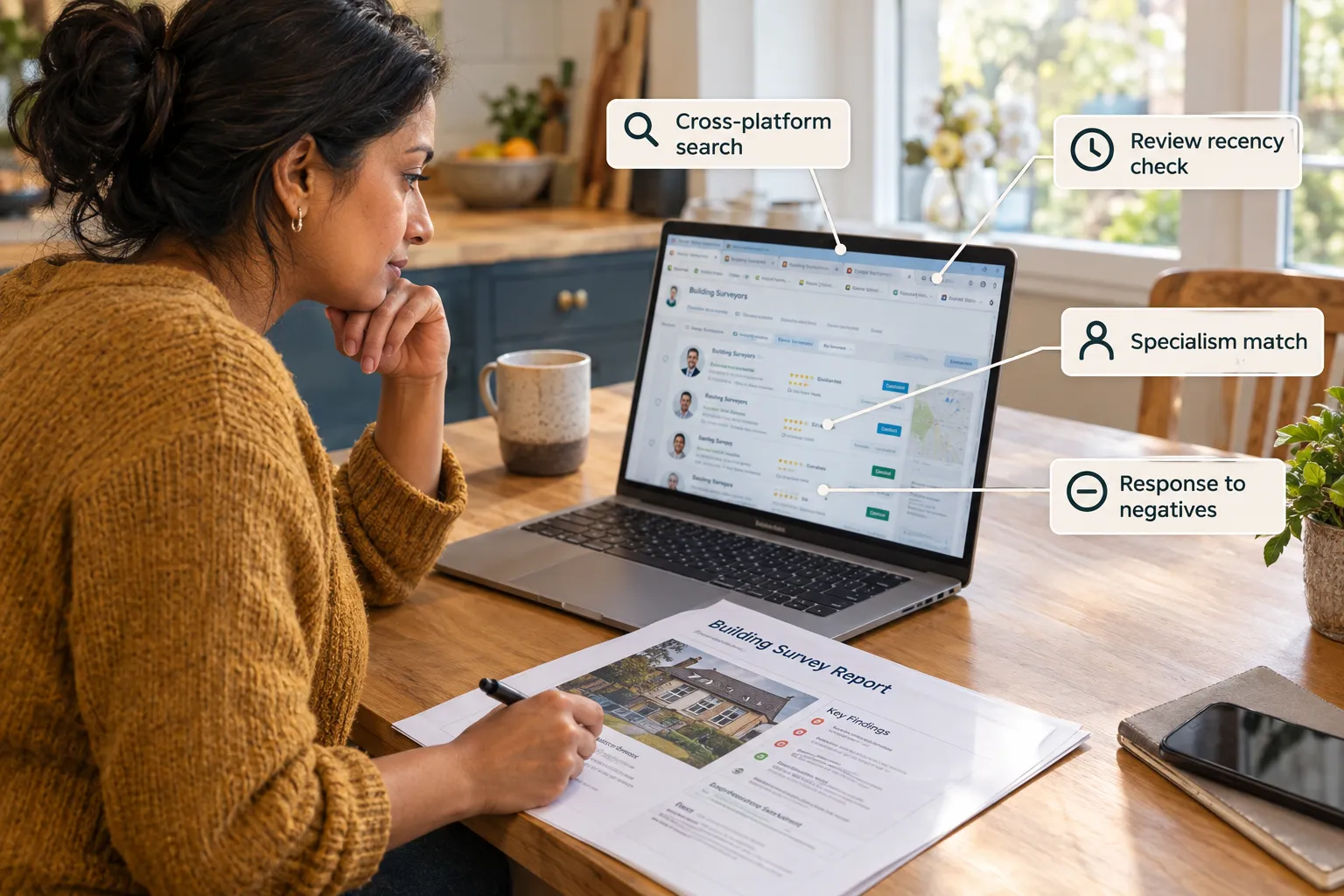
The most practical protection against choosing the wrong firm when using UK building surveyor reviews and ratings is cross-platform consistency. Many reputable surveyors now appear simultaneously on RICS-regulated directories such as Reallymoving [5], independent verified aggregators such as LocalBuildingSurveyor [12], and open public platforms including Trustpilot [3][6].
When a firm's ratings, review volumes, and qualitative themes are consistently strong across these structurally different sources, the probability that the positive image results from selective or manipulated reviews drops significantly. Each platform type has different incentive structures and different verification mechanisms. Gaming all of them simultaneously is far harder than curating a single testimonials page.
"Cross-platform consistency is not a guarantee of quality, but it is the closest thing to one that online research can offer."
Conversely, a firm that scores well only on its own website testimonials but has minimal or mixed reviews on Trustpilot and no presence on regulated directories should prompt caution. The absence of independent verification is itself a signal.
A Practical Cross-Platform Research Routine
Follow these steps for each firm on a shortlist:
- RICS register check, confirm current regulated status on the RICS website
- Regulated directory search, look up the firm on Reallymoving or a comparable RICS-partner directory [5]
- Trustpilot search, check total reviews, 12-month volume, star distribution, and firm responses [3][6][9]
- Google Reviews check, note whether scores align with Trustpilot findings
- Aggregator check, search LocalBuildingSurveyor or a similar verified-review aggregator [12]
- Firm website review, read testimonials as context, not as evidence [1][10]
- Pattern analysis, identify recurring themes (positive and negative) across all sources
If steps 2 through 5 all point in the same direction, confidence in the assessment is substantially higher than if only one source was consulted.
What Review Themes Tell You About Day-to-Day Service
Beyond accreditation and platform credibility, the specific themes that recur across reviews for well-regarded firms reveal what clients actually value, and what causes dissatisfaction when it is absent.
Across firms such as M Survey, Morguard, and Durie Heritage, the most frequently praised attributes are [1][6][13]:
- Speed of booking and survey completion, critical when a property transaction has a tight timeline
- Comprehensiveness of the written report, clients want findings explained clearly, not buried in technical language
- Accessibility after the survey, willingness to answer follow-up questions by phone or email
- Clear prioritisation of issues, distinguishing urgent structural problems from minor maintenance points
These themes are not incidental. They map directly onto the most common sources of dissatisfaction: a surveyor who is cheap but slow, produces a generic report, and becomes unreachable after the survey is complete. Reading reviews with these categories in mind transforms a scroll through star ratings into a structured evaluation of operational fit.
Conclusion
Navigating UK building surveyor reviews and ratings effectively requires a structured approach rather than a quick scan of star scores. In 2026, the information environment is rich but noisy: nearly every listed firm scores well, curated testimonial pages are standard marketing practice, and rating inflation is widespread across open platforms.
The safeguard is method. Start with RICS accreditation as a non-negotiable filter. Use regulated directories as a controlled first layer of research. Move to independent platforms, Trustpilot in particular, and evaluate volume, recency, qualitative themes, and how the firm handles complaints. Cross-reference findings across structurally different platforms, because consistency across sources is the strongest available signal of genuine quality. Finally, match review themes to the specific property type and survey level required, not just to a generic notion of "good service."
Actionable next steps:
- Determine the correct RICS survey level for the property before researching any firm
- Verify RICS membership for every shortlisted firm directly on the RICS website
- Run each shortlisted firm through at least three independent review sources
- Read 10-15 reviews per firm in full, focusing on report quality, communication, and post-survey support
- Check how the firm responds to its lowest-rated reviews before making a final decision
Firms that maintain transparent, verified review profiles across multiple platforms and actively engage with both positive and negative feedback are increasingly well-positioned to earn client trust. Those relying solely on static, self-curated testimonial pages face a growing credibility gap with buyers who know how to look beyond the headline score.
References
[1] Reviews – msurvey.uk
[2] Testimonials – hbsurv.co.uk
[3] Uksnagging – trustpilot.com
[4] Measuredsurvey365.co – uk.trustpilot.com
[5] Directory – reallymoving.com
[6] Morguard.co – uk.trustpilot.com
[7] 6 Best Building Survey Companies In The Uk 2026 Guide – teddingtontown.co.uk
[8] Best Surveyors – comparemymove.com
[9] Www.vikingsurveyors.co – trustpilot.com
[10] Testimonials – andrewjamessurveyors.co.uk