Every year, thousands of homeowners in England and Wales receive a party wall notice through their letterbox and have no idea what to do next. The Party Wall etc. Act 1996 exists precisely to protect people in that position. Understanding the Party Wall Act for Neighbours in England & Wales: Your Rights When You're the Adjoining Owner is not just useful, it can mean the difference between a smooth building project next door and serious, uncompensated damage to your home. This guide explains what the law gives you, what you can demand, and what to do when things go wrong.
Key Takeaways
- As an adjoining owner, you have the legal right to receive formal written notice before any covered works begin next door, with minimum notice periods of one or two months depending on the type of work.
- If you do not consent to a party wall notice within 14 days, a dispute is automatically deemed to have arisen, giving you the right to appoint your own surveyor at the building owner's expense.
- The building owner must not cause you unnecessary inconvenience and must compensate you for any loss or damage caused by works carried out under the Act.
- You can serve a counter-notice setting out your own requirements, including the timing and method of works.
- If no valid notice was ever served, you have the right to seek a court injunction to stop the works.
What the Party Wall Act Actually Does for You as a Neighbour
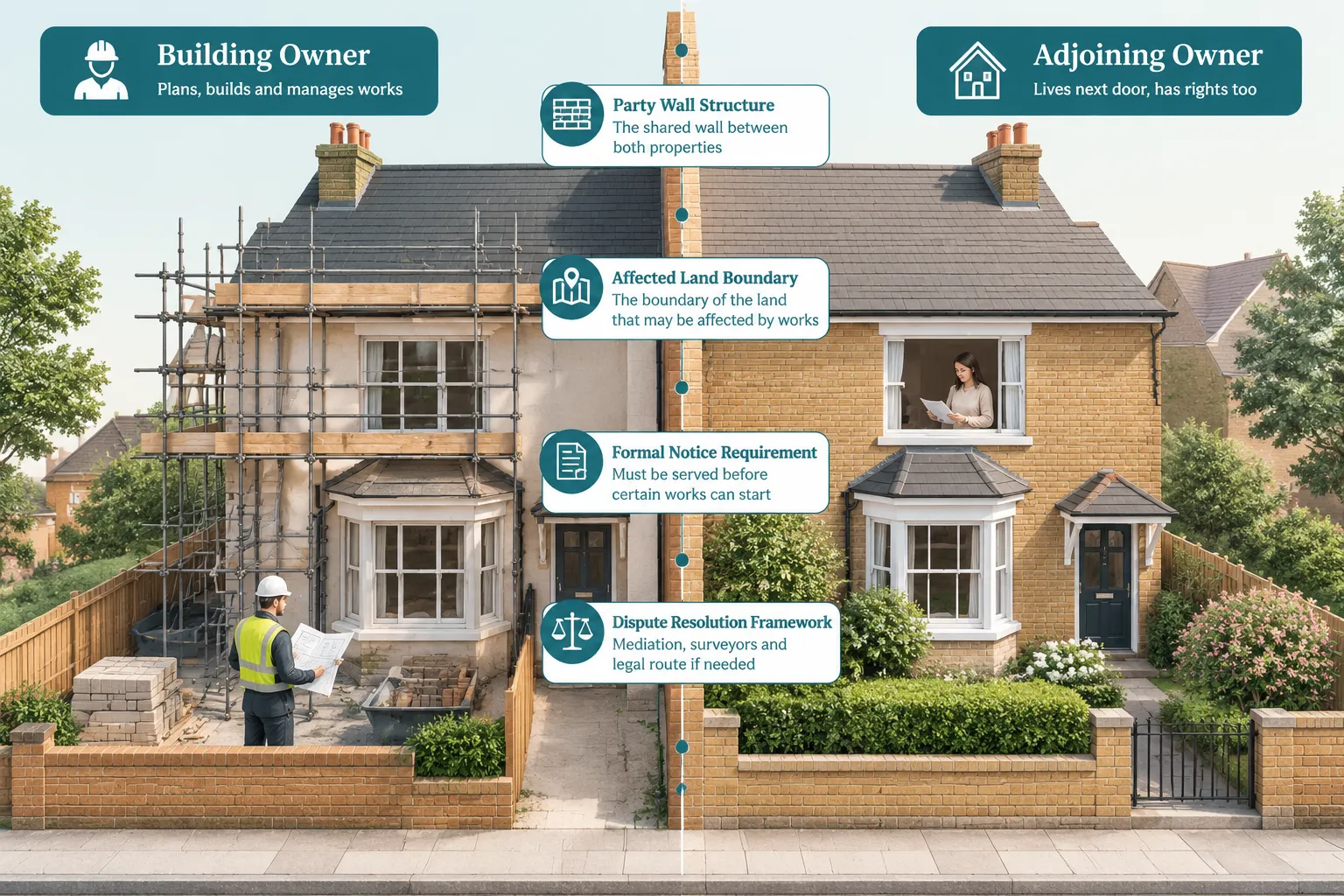
The Party Wall etc. Act 1996 is not just a set of rules for builders and developers. Its core purpose is to provide a framework that prevents and resolves disputes between building owners and adjoining owners, the legal term for neighbours whose land or buildings are directly affected by the proposed works [1][4]. The Act covers three main categories of work:
- Works to an existing party wall or party structure (such as cutting into, raising, or demolishing a shared wall)
- New party walls or party fence walls built at or astride the boundary
- Excavation near neighbouring buildings, typically within three or six metres depending on depth [3]
As of 2026, the Act has not been substantively amended since it came into force. The legislation carries no known outstanding effects, meaning the rights described in this article are exactly as Parliament enacted them in 1996 [2][3]. What has changed is the quality of guidance available: the official government explanatory booklet has been updated and simplified, with the most recent version designed to answer the questions neighbours most commonly ask [1][4][5].
Who counts as an "adjoining owner"? The Act defines this broadly. You qualify if you own or occupy land, buildings, storeys, or rooms that adjoin those of the building owner. For excavation works under section 6, the definition extends to anyone whose property falls within the specified distances from the proposed excavation [3]. If you are a tenant rather than a freeholder, you may also have rights under the Act as an "adjoining occupier." Both owners and occupiers are entitled to protection [1].
Your Core Rights Under the Party Wall Act for Neighbours in England & Wales
The Right to Receive Proper Notice
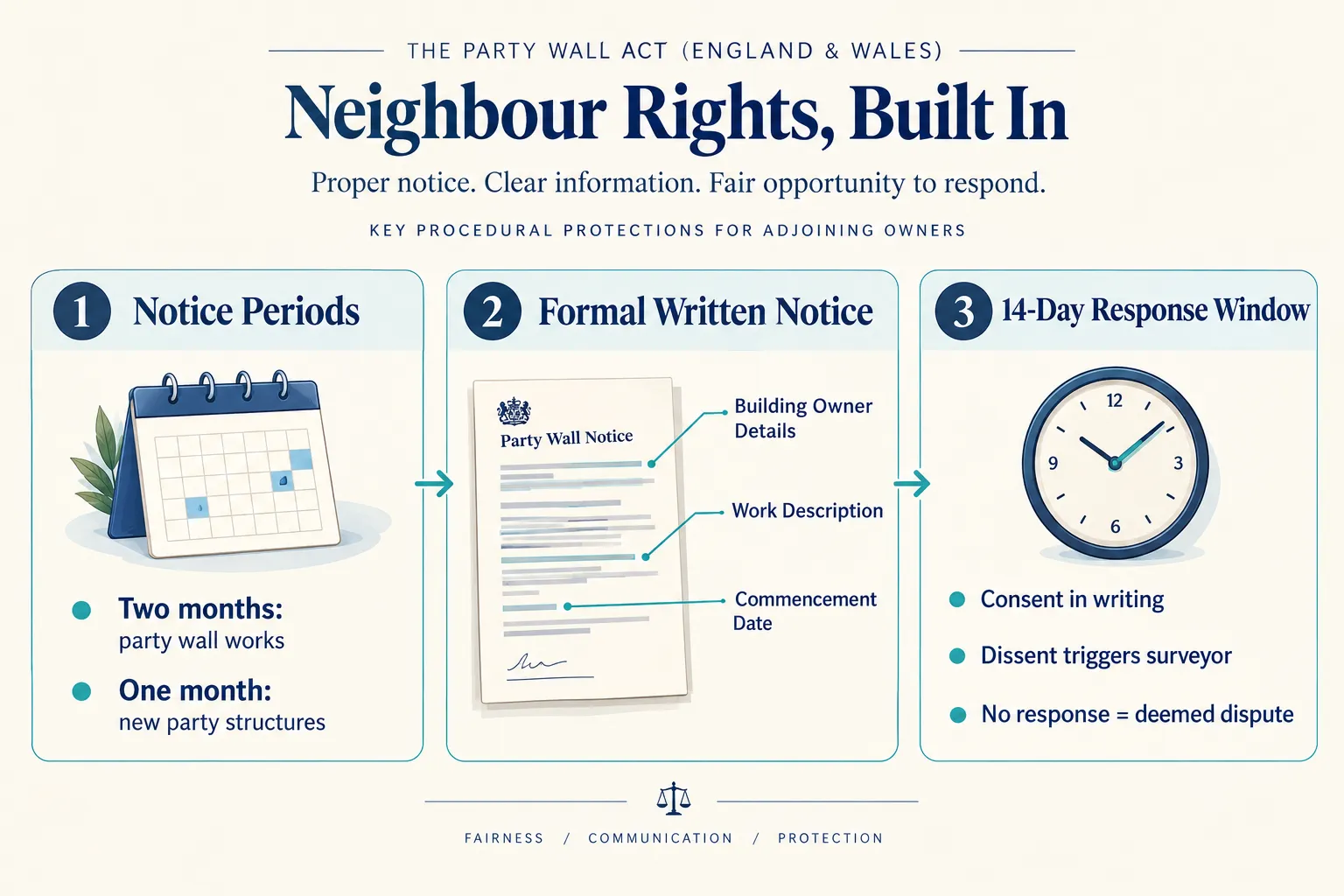
Before any work covered by the Act begins, the building owner must serve you with formal written notice. The minimum notice periods are:
| Type of Work | Minimum Notice Required |
|---|---|
| Works to an existing party wall or structure | Two months |
| New party wall, party fence wall, or line of junction works | One month |
| Excavation near neighbouring buildings (section 6) | One month |
These are not courtesy notices. They are a legal requirement [1][4]. The notice must describe the proposed works clearly enough for you to understand what is planned and to make an informed decision about whether to consent or dissent.
The Right to Consent, Dissent, or Serve a Counter-Notice
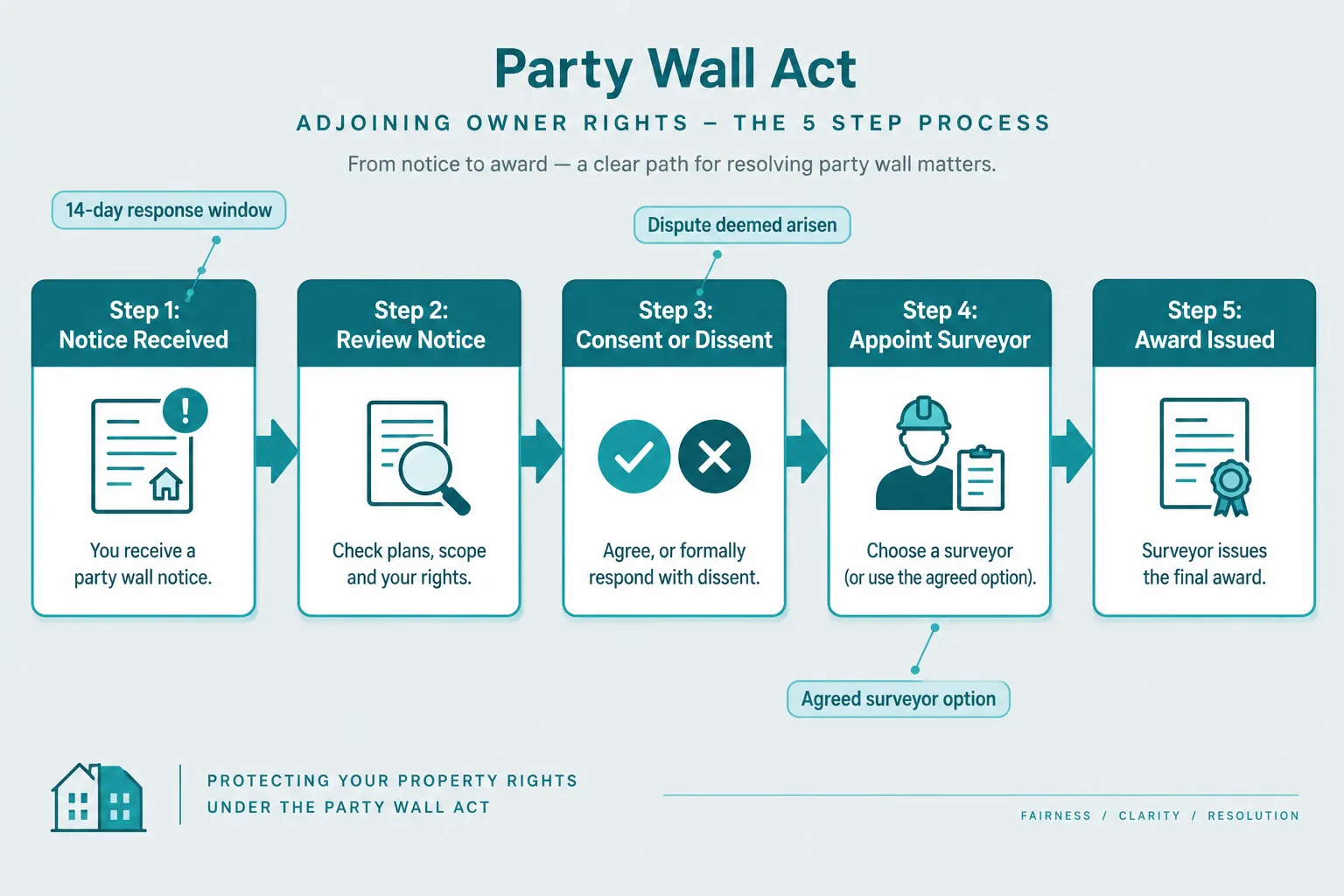
Once you receive a valid notice, you have three options:
- Consent in writing, the works may proceed without a formal award, though you retain all rights to compensation if damage occurs.
- Dissent and agree a single surveyor, you and the building owner jointly appoint one "agreed surveyor" to draw up an award regulating the works.
- Dissent and appoint your own surveyor, you appoint a separate surveyor, who then acts alongside the building owner's surveyor. The two surveyors together (or a third surveyor if they cannot agree) issue an award [1][4].
If you do not respond within 14 days of receiving the notice, a dispute is automatically deemed to have arisen [3][1]. This triggers the surveyor appointment process. You do not lose your rights by failing to respond, the mechanism simply moves to the next stage.
You may also serve a counter-notice setting out your own requirements. For example, you can require that works be carried out in a particular way, at particular times, or with specific protective measures in place [1][3]. This is a powerful tool that is often overlooked by neighbours who do not know it exists.
The Right to a Surveyor, and Who Pays
One of the most important protections in the Act is that the cost of the party wall process is generally borne by the building owner, not by you [1]. This includes the reasonable fees of your appointed surveyor in most circumstances. The surveyor you appoint acts independently and in accordance with the Act, they do not simply act as your advocate, but they do ensure that your interests are properly considered and that the award contains adequate protections.
The surveyor or surveyors will produce a party wall award (sometimes called a determination). This legally binding document will typically cover:
- The nature and scope of the permitted works
- The hours during which works may be carried out
- Access arrangements
- A schedule of condition of your property before works begin
- Provisions for compensation if damage occurs [1][4]
Key Protections: Section 7, Special Foundations, and Compensation
Section 7: The "No Unnecessary Inconvenience" Rule
Section 7 of the Act is one of the most practically significant protections for neighbours. It states that the building owner must not exercise rights under the Act "in such a manner or at such time as to cause unnecessary inconvenience" to any adjoining owner or occupier [10][3].
This provision has real teeth. It means that:
- Works cannot be carried out at unreasonable hours without your agreement
- The building owner must take steps to minimise disruption to your daily life
- Temporary hoardings, shoring, or other protective structures must be provided at the building owner's expense [10][1]
Section 7 also contains an explicit compensation obligation. The building owner must compensate you for any loss or damage arising from works carried out under the Act [10]. This includes physical damage to your property, but can also extend to other quantifiable losses. If damage occurs, you do not need to prove negligence, the obligation to compensate arises from the Act itself.
Special Foundations: Your Right to Refuse
Section 7(4) provides a specific protection that many adjoining owners are unaware of. The Act does not authorise the building owner to place "special foundations" on your land without your prior written consent [10][3]. Special foundations are reinforced concrete foundations containing steel rods or other metal reinforcement. Without your written agreement, the building owner simply cannot install them beneath your land, regardless of what the award might otherwise permit. This is a firm veto right.
Section 11: Cost Sharing and Fair Contributions
Section 11 governs how costs are shared when works benefit both parties or when the building owner uses a wall that belongs to the adjoining owner. Where a building owner encloses on or makes use of a wall owned by you, they may be required to make a financial contribution towards the cost of that wall, taking into account its age and condition [3]. This provision ensures that you are not left out of pocket when your existing property is used or relied upon during the building owner's project [7].
Excavation Near Your Property: Section 6 Rights
Section 6 of the Act applies when a building owner plans to excavate within three metres of your building (where the excavation will go deeper than your foundations) or within six metres (where the excavation will meet a line drawn downward at 45 degrees from the bottom of your foundations) [9][3].
In these situations, you have the right to require the building owner to:
- Underpin your foundations or otherwise strengthen and safeguard them
- Carry out any such protective works at their own expense, not yours [9][1]
This obligation applies "so far as may be necessary for the safety and stability" of your building [9]. The building owner cannot simply proceed with deep excavation and hope for the best. If your foundations are at risk, the Act requires them to act, and to pay for it.
What to Do If You Never Received a Valid Notice
This is one of the most common problems neighbours face. A building owner may start work without serving any notice, or may serve a defective notice that does not meet the Act's requirements. What are your options?
First, establish whether the works are covered by the Act. Not all building work requires a party wall notice. Works that are clearly internal, entirely within the building owner's own land, and do not affect the party wall or involve excavation near your property may not trigger the Act at all. If in doubt, consult a party wall surveyor.
If the works are covered and no valid notice was served, the government's own guidance makes clear that you may seek to stop the work through a court injunction or other legal redress [1]. An injunction is a court order requiring the building owner to stop works until the proper procedure has been followed. Courts in England and Wales have granted injunctions in these circumstances, and the threat of one is often enough to bring a building owner back to the table.
Practical steps to take:
- Document everything, photograph the works, note dates and times, keep copies of any correspondence
- Write to the building owner formally, stating that no valid notice has been received and that the works must stop
- Consult a party wall surveyor immediately, many offer initial advice at low or no cost
- If the building owner refuses to comply, seek legal advice about applying for an injunction
- If damage has already occurred, obtain independent evidence of its extent and cause before it is disturbed
"A building owner who proceeds without serving proper notice loses the protection of the Act and exposes themselves to injunction proceedings and uncapped common law liability for any damage caused."
It is worth noting that even where works have already been completed without proper notice, you may still have a claim for compensation for any damage caused. The absence of an award does not extinguish your rights, it simply means the building owner has not followed the correct process.
Access Rights and Your Property
Section 8 of the Act gives the building owner and their workers a right of access to your property to carry out works permitted under the Act, but only after giving you at least 14 days' notice (or one month's notice for excavation works) [3]. This access right is not unlimited. It is confined to what is reasonably necessary to carry out the permitted works, and the building owner remains liable for any damage caused during that access.
You are entitled to have a representative present during access if you wish. You do not have to allow access at times that are unreasonable or outside the hours specified in the award.
Conclusion: Protecting Your Position as an Adjoining Owner
The Party Wall Act for Neighbours in England & Wales: Your Rights When You're the Adjoining Owner provides a robust set of legal protections that apply from the moment a building owner plans work near your home. The key actions to take are clear:
- When you receive a notice, read it carefully, note the date, and decide promptly whether to consent or dissent. Do not ignore it.
- If you dissent, appoint a surveyor without delay. You are generally entitled to have your reasonable surveyor's fees paid by the building owner.
- Serve a counter-notice if you have specific requirements about how or when the works should be carried out.
- If no notice was served, document the situation immediately and seek professional advice about an injunction.
- If damage occurs, gather evidence promptly and pursue compensation through the award process or, where necessary, through the courts.
The Act has remained unchanged since 1996 and continues to provide a clear, workable framework [2][3]. The official government guidance, updated through 2026, is freely available and written in plain English [1][4][5]. Consulting a qualified party wall surveyor early, even before you respond to a notice, is the single most effective step any adjoining owner can take to protect their property and their rights.
References
[1] The Party Wall Etc Act 1996 Explanatory Booklet – gov.uk
[2] Contents – legislation.gov.uk
[3] legislation.gov.uk – legislation.gov.uk
[4] Preventing And Resolving Disputes In Relation To Party Walls – gov.uk
[5] The Party Wall Etc Act 1996 Revised Explanatory Booklet – gov.uk
[7] What Rights Does A Building Owner Have Over A Type B Party Wall Owned By The Adjoined Owner – tayross.com
[9] Section 6 – legislation.gov.uk
[10] Section 7 – legislation.gov.uk