Fewer than a handful of valuation surveyors worldwide hold formal RICS Expert Witness Accreditation under the Expert Witness Accreditation Service, and in the entire Americas, one firm claims to be the only holder of that credential. That statistic alone signals how selective, and how valuable, the pathway truly is.
For RICS members considering expert witness work in 2026, understanding the full landscape of RICS Expert Witness Accreditation for Surveyors, the routes available, the precise requirements at each level, and the mistakes that derail applications, is essential before accepting a first court instruction.
Key Takeaways
- RICS operates two distinct formal statuses: Registered Expert Witness (entry level) and Accredited Expert Witness (President's Panel), each with specific, non-negotiable criteria.
- The Expert Witness Certificate is the standard training gateway to both statuses, though an exemption route exists for experienced practitioners.
- All candidates, whether exempt from the course or not, must have all five Expert Witness Certificate competencies formally assessed.
- The RICS global standard "Surveyors acting as Expert Witnesses" (5th edition, 2026) is mandatory for all registered and accredited expert witnesses.
- Common pitfalls include failing to produce a recent expert witness report, choosing unsuitable referees, and submitting reports that show weak knowledge of procedural rules.
Understanding the RICS Expert Witness Accreditation Framework
The RICS Dispute Resolution Service (DRS) administers the Expert Witness Accreditation Service (EWAS), which exists to confirm that expert witnesses are appropriately experienced, trained, and subject to rigorous quality control [1]. EWAS is the primary RICS mechanism for recognising expert witnesses internationally and remains the governing framework as of 2026 [1][5].
Alongside EWAS, the Expert Witness Registration Scheme (EWRS) operates as a voluntary register specifically for RICS members acting as expert witnesses before UK tribunals [2]. The two schemes are complementary: EWRS governs regulatory compliance and professional conduct, while EWAS governs training, competency assessment, and formal accreditation status [1][2].
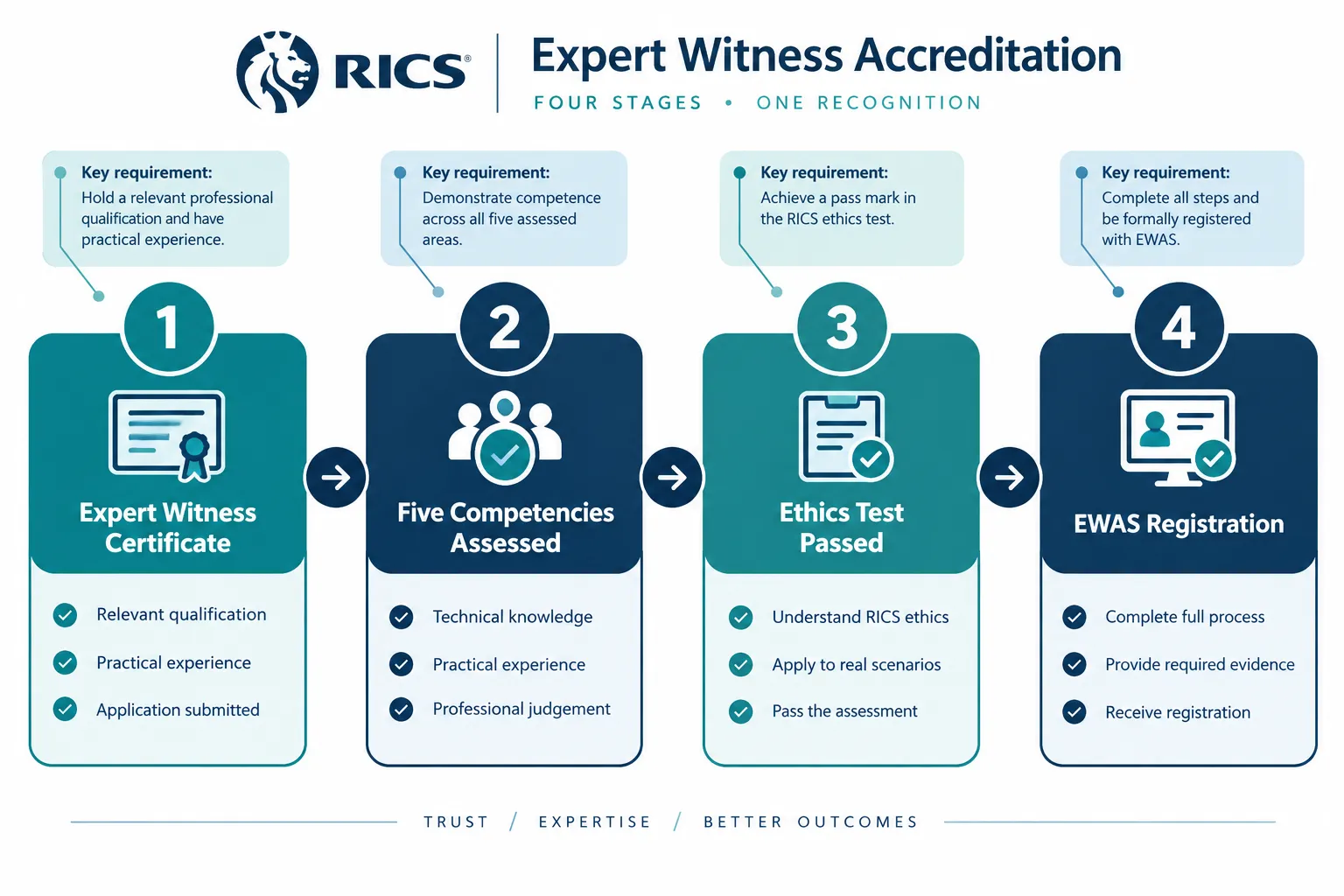
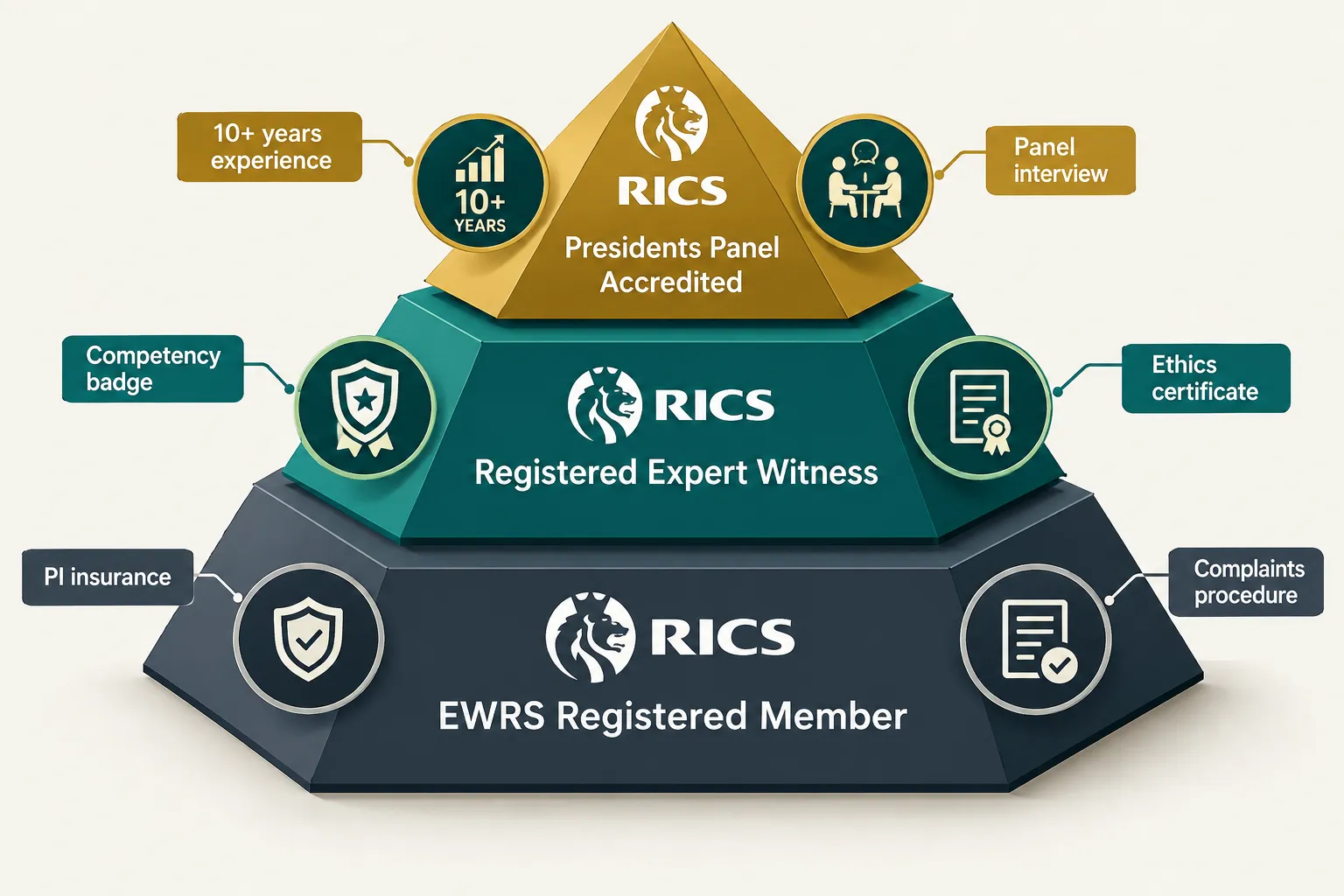
Together, these schemes create a structured ladder with three broad positions a surveyor can occupy:
| Status | Scheme | Key Requirement |
|---|---|---|
| EWRS Registered Member | EWRS | Chartered RICS membership, PI insurance, complaints procedure |
| RICS Registered Expert Witness | EWAS | Certificate or exemption, five competencies assessed, ethics test |
| RICS Accredited Expert Witness | EWAS (President's Panel) | All of the above plus 10 years' experience and panel interview |
The governing professional standard underpinning all three positions is "Surveyors acting as Expert Witnesses" (5th edition), updated in 2026 and mandatory for all RICS members undertaking expert witness work [9]. Familiarity with this standard is not optional, both EWRS rules and EWAS inclusion criteria require that all expert witness work be carried out in accordance with it [2][8][9].
Routes to RICS Expert Witness Accreditation for Surveyors: Routes, Requirements and Common Pitfalls
The Expert Witness Certificate: The Primary Training Route
The standard pathway begins with the RICS Expert Witness Certificate, which RICS positions as the formal gateway to both Registered and Accredited Expert Witness status via EWAS [4][5]. The Certificate is delivered through structured, competency-based training covering practical report-writing, courtroom skills, and procedural obligations under the Civil Procedure Rules [4][7].
As of September 2026, updated programmes are available in the UK and a dedicated online certificate runs for the MENA region, reflecting RICS's international reach [4][6][7]. The programmes explicitly state that once participants gain sufficient expert witness experience after completing the Certificate, they can apply for RICS Accredited Expert Witness status through a panel interview [4][5][6].
The Certificate is not simply a training course, it is the assessed competency benchmark that determines eligibility for formal RICS recognition.
The Exemption Route
Experienced practitioners who can demonstrate equivalent knowledge and skills may apply under the Expert Witness Certificate Exemption Policy (updated June 2026) to seek exemption from attending the certificate course itself [10]. However, the policy is unambiguous: all candidates, whether exempt or not, must still have all five competencies of the Certificate successfully assessed [10][13].
This creates a dual route, training or exemption, but with a single, non-negotiable competency benchmark. A surveyor with 20 years of expert witness experience cannot bypass the formal assessment process simply on the basis of tenure.
Becoming a RICS Registered Expert Witness
For inclusion on the List of RICS Registered Expert Witnesses, candidates must satisfy the following criteria [10]:
- Successfully complete the Expert Witness Certificate or obtain a formal exemption
- Have all five Expert Witness Certificate competencies formally assessed and passed
- Pass the online ethics test: "DRS Professional Ethics"
- Submit a completed EWAS Skills Form for Registered Expert Witnesses
- Provide evidence of ethics test completion
This represents the minimum technical and ethical baseline for registration [10]. The Registered status is the appropriate first goal for surveyors who are building their expert witness practice and do not yet meet the experience threshold for the President's Panel.
Becoming an RICS Accredited Expert Witness (President's Panel)
The RICS President's Panel of Accredited Expert Witnesses carries the highest level of formal recognition under EWAS. The criteria (updated January 2026) are considerably more demanding [8]:
- Successful completion and assessment of all five Expert Witness Certificate competencies
- A minimum of 10 years' experience in the primary profession
- At least one expert witness report produced in the last five years
- Full compliance with CPD requirements of the principal professional bodies over the last three calendar years
- Successful completion of the online ethics test
- A panel assessment interview
- Payment of a panel assessment fee: £450 + VAT for RICS members or £495 + VAT for non-members [8]
The panel interview is a genuine assessment, not a formality. Candidates are expected to demonstrate command of procedural rules, RICS standards, and the practical realities of giving expert evidence in court or tribunal settings.
EWRS Membership: Regulatory Obligations Running Alongside Accreditation
Accreditation under EWAS addresses professional recognition. Compliance under the Expert Witness Registration Scheme (EWRS) addresses regulatory standing [2]. For surveyors practising in the UK, both matter.
EWRS eligibility requires being a Chartered Member of RICS with appropriate qualifications and experience, and conducting all expert witness work in accordance with the 5th-edition practice statement [2]. Registered surveyors under EWRS must also satisfy one of two conditions:
- Carry out all expert witness work through an RICS-regulated firm, or
- Operate a compliant complaints-handling procedure with an approved redress mechanism
In addition, all EWRS registrants must maintain adequate professional indemnity (PI) insurance [2]. Annual scheme fees apply unless the surveyor is covered through a regulated firm.
RICS retains the power to refuse applications or re-applications for up to 12 months where a member has previously been refused, administratively de-registered, or removed following disciplinary action [2]. This underscores that EWRS registration is not a permanent entitlement, it is contingent on sustained compliance.
Common Pitfalls in RICS Expert Witness Accreditation for Surveyors: Routes, Requirements and Common Pitfalls
Understanding the requirements is one thing. Avoiding the specific failure points that derail applications is another. EWAS criteria and EWRS guidance reveal a consistent pattern of mistakes [8][12].
Pitfall 1: No Recent Expert Witness Report
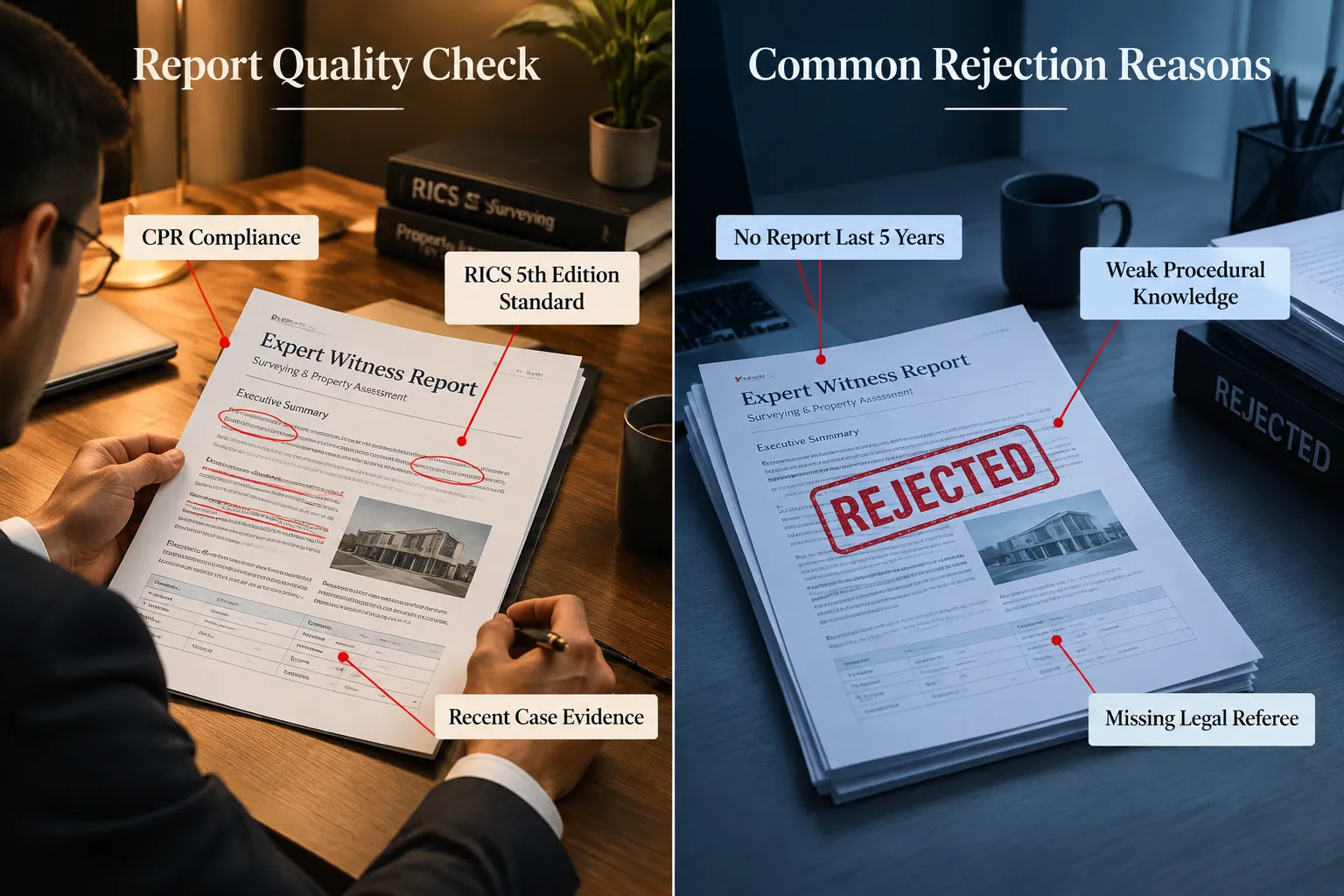
Both the Accredited Expert Witness criteria and EWRS guidance require candidates to produce at least one expert witness report from the last five years [8]. Surveyors who have expert witness experience from earlier in their careers but have not undertaken recent instructions face an immediate barrier. The solution is straightforward but requires planning: build and maintain an active expert witness practice before applying, not after.
Pitfall 2: Unsuitable Referees
Applications for the President's Panel require referees who can speak to the quality of the candidate's expert evidence. At least one referee must be a legal professional who is familiar with the surveyor's evidence in practice [8][12]. Referees who are colleagues or fellow surveyors with no direct knowledge of the candidate's courtroom or tribunal performance will not satisfy this requirement.
Pitfall 3: Reports That Fail Procedural Standards
This is perhaps the most substantive pitfall. Expert witness reports submitted as evidence of competence must demonstrate satisfactory knowledge of:
- The Civil Procedure Rules (CPR) and relevant Practice Directions
- Applicable case law governing expert evidence
- Mandatory RICS standards, including the 5th-edition practice statement [8][12][9]
Reports that are technically sound on surveying matters but weak on procedural compliance will be assessed as inadequate. Candidates should review their existing reports critically against these standards before submission.
Pitfall 4: CPD and Ethics Gaps
For Accredited Expert Witness status, CPD compliance across the last three calendar years is a hard requirement [8]. Gaps in CPD records, even partial gaps, can delay or block applications. Similarly, failure to maintain ethics compliance or to complete the DRS Professional Ethics online test will prevent registration at either level [10].
Pitfall 5: Misunderstanding the Exemption Route
Some experienced surveyors assume that the exemption from attending the Expert Witness Certificate course means they can bypass the competency assessment entirely. This is incorrect. The exemption covers course attendance only, the five competency assessments remain mandatory for every candidate without exception [10]. Applying for exemption without arranging competency assessment creates unnecessary delays.
Pitfall 6: Inadequate Firm or Regulatory Arrangements
Surveyors who operate outside an RICS-regulated firm must independently establish a compliant complaints-handling procedure with an approved redress mechanism and maintain adequate PI insurance before applying under EWRS [2]. Candidates who overlook these regulatory arrangements, focusing solely on the training and competency side, may find their EWRS application stalled even after achieving EWAS recognition.
A Staged Approach: Planning the Route in 2026
RICS materials implicitly endorse a staged progression for surveyors planning their expert witness career in 2026 [4][8][9][10]. The following sequence reflects best practice:
Step 1, Undertake the Expert Witness Certificate (or apply for exemption)
Complete the structured training programme or, if eligible, apply for exemption while arranging formal competency assessment across all five areas [4][10].
Step 2, Build a compliant expert witness track record
Produce expert witness reports that are fully aligned with the 5th-edition RICS standard and demonstrate command of the CPR and relevant Practice Directions [9][8].
Step 3, Maintain CPD and ethics compliance
Keep CPD records current across all principal professional bodies and complete the DRS Professional Ethics test [8][10].
Step 4, Apply for RICS Registered Expert Witness status
Submit the EWAS Skills Form, competency evidence, and ethics test completion to secure inclusion on the Registered list [10].
Step 5, Accumulate experience and apply for the President's Panel
Once the 10-year experience threshold is met and a recent, high-quality expert report is available, apply for Accredited Expert Witness status with appropriate legal referee support and prepare for the panel interview [8].
Step 6, Ensure EWRS compliance runs in parallel
Confirm that all expert witness work is conducted through an RICS-regulated firm or that independent regulatory arrangements (complaints procedure, PI insurance) are in place [2].
The scarcity of formally accredited valuation expert witnesses, with only a handful of RICS Valuation Expert Witness EWAS certifications reportedly in existence worldwide, suggests that surveyors who complete this pathway gain a meaningful competitive advantage, particularly in international markets where RICS accreditation carries significant weight.
Conclusion
RICS Expert Witness Accreditation for Surveyors represents a structured, demanding, and genuinely valuable professional credential. The pathway is clear, Expert Witness Certificate or exemption, competency assessment, ethics compliance, and then either Registered or Accredited status depending on experience, but the requirements at each stage are precise and unforgiving of gaps.
Actionable next steps for surveyors in 2026:
- Review the current RICS Expert Witness Certificate programmes (UK or MENA online) and register for the next available cohort, or assess eligibility for the exemption route [4][6].
- Audit existing expert witness reports against the 5th-edition "Surveyors acting as Expert Witnesses" standard and the CPR requirements before submitting them as competency evidence [9].
- Confirm that all firm-level regulatory arrangements, PI insurance, complaints procedure, RICS regulation, are in place before initiating an EWRS or EWAS application [2].
- Identify a suitable legal referee now, before applying, to avoid delays at the critical application stage [8].
- Set a CPD compliance review for the last three calendar years and address any gaps before targeting the President's Panel [8].
The credential is rare. The process is achievable. The competitive advantage for those who complete it is substantial.
References
[1] Expert Witness Accreditation Service – rics.org
[2] Rules For Registration Of Schemes Appendix D OCO Expert Witness Registration Scheme – rics.org
[3] EWAS Criteria For Inclusion RICS Accredited Expert Witness 2021 – rics.org
[4] Expert Witness Certificate – rics.org
[5] Expert Witness Training Courses – rics.org
[6] Online Expert Witness Certificate MENA – rics.org
[7] Expert Witness Certificate UK Programme – rics.org
[8] EWAS Criteria For Inclusion RICS Accredited Expert Witness – rics.org
[9] Surveyors Acting As Expert Witnesses – rics.org
[10] EWAS Criteria For Inclusion RICS Registered Expert Witness – rics.org