Four in five commercial buildings across major UK cities risk becoming unlettable without urgent improvements to their energy credentials, a statistic that has transformed sustainability ratings from a compliance footnote into a core driver of asset value [9]. For valuers, investors and asset managers working across offices, retail and industrial property, understanding how EPC bands and BREEAM certifications translate into rental income, yield movements and capital values is no longer optional. It is fundamental to accurate appraisal.
This article examines the evidence base behind sustainability ratings and commercial property value: how EPC and BREEAM influence UK valuations across asset classes, what the 2026 policy environment means for pricing, and what practical steps owners can take to protect and enhance value.
Key Takeaways
- The median UK commercial EPC is currently rated C (score 67), meaning most stock sits close to, or below, proposed future minimum thresholds [8].
- From April 2026, business rates assessments are explicitly linked to EPC ratings, creating a direct financial mechanism connecting energy performance to occupancy costs [6].
- London office evidence shows measurable rental and capital value uplifts for EPC A and B properties compared with lower-rated equivalents [7].
- BREEAM-certified logistics assets command yield premiums over non-certified stock, with offices showing rent premiums in more recent studies [5].
- Decarbonisation costs are material but modest relative to the value shifts that non-compliance can trigger, making proactive investment the rational choice [1] [2].
The Policy Landscape Driving Sustainability Ratings and Commercial Property Value
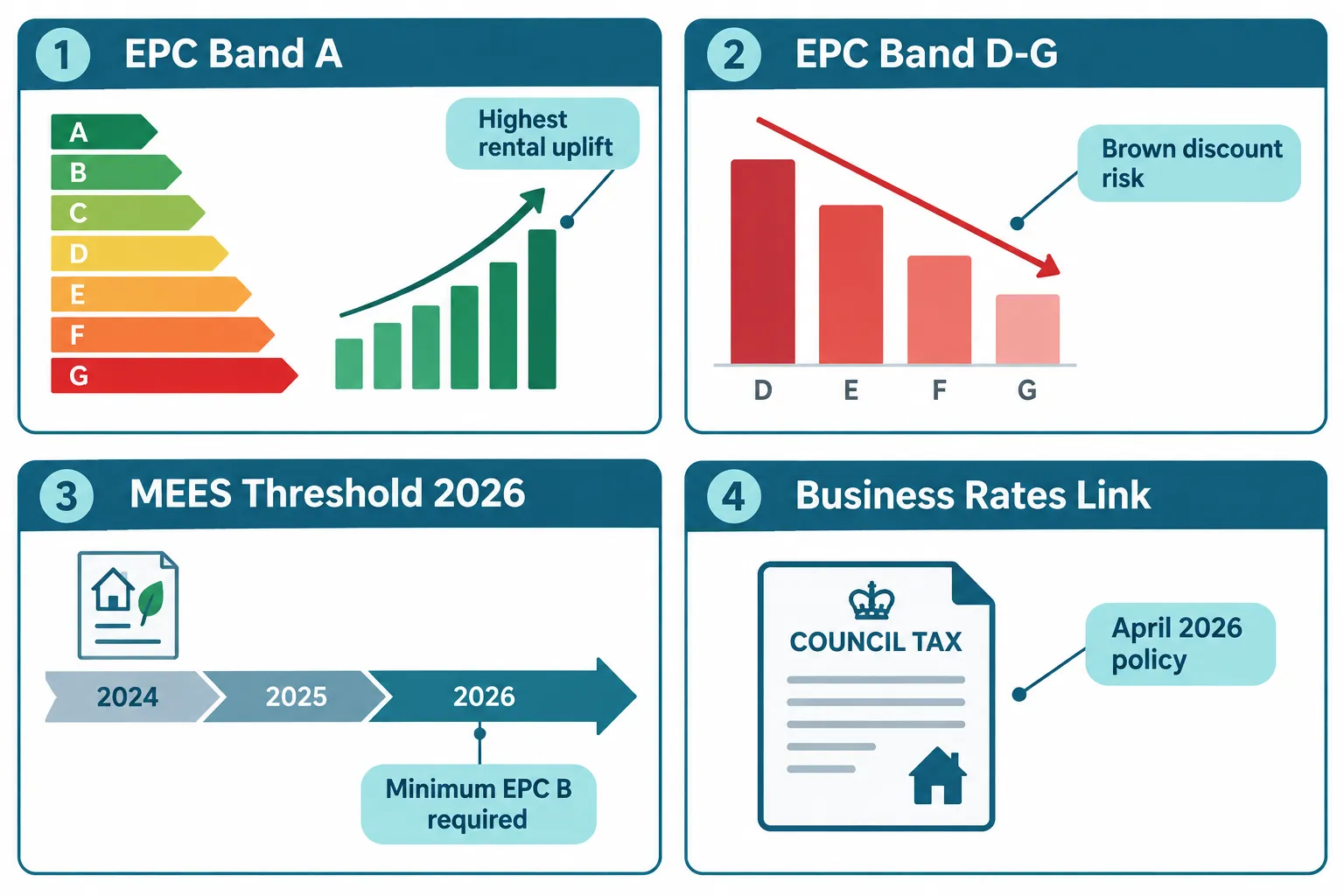
The Minimum Energy Efficiency Standards (MEES) framework has been the primary regulatory engine reshaping how sustainability ratings affect commercial property value in the UK. Initially requiring a minimum EPC E rating for new commercial lettings, the trajectory of policy has consistently moved toward tighter thresholds. The current direction of travel points firmly toward an EPC B minimum for commercial leases, with the government's consultation process confirming this ambition [10].
What the 2026 MEES update means in practice:
- Landlords of sub-standard properties face restrictions on granting new leases and renewing existing ones.
- Exemptions remain available but are time-limited and require formal registration.
- The enforcement burden is shifting toward local authorities, increasing the practical risk of non-compliance becoming visible in due diligence.
Baker McKenzie's 2026 analysis of the MEES update for commercial lettings confirms that the regulatory direction is unambiguous: properties that cannot demonstrate compliance with evolving EPC thresholds will face material restrictions on their lettability [10]. For valuers, this creates a binary risk, assets that cannot be let cannot generate income, and an asset that cannot generate income cannot sustain its capital value.
The Business Rates and EPC Link from April 2026
Perhaps the most significant structural shift of 2026 is the explicit connection between EPC ratings and business rates assessments. Knight Frank's research confirms that from April 2026, business rates are now a new area of value adjustment directly tied to energy performance [6]. This is a departure from the historic position where energy ratings influenced value only through market perception and regulatory risk.
The mechanism works as follows: properties with weaker EPC ratings may attract higher effective occupancy costs through the business rates system, making them less attractive to occupiers on a total cost-of-occupation basis. This directly suppresses the rental bids that well-informed tenants will make for sub-standard space, feeding through into both passing rent and estimated rental value (ERV) assessments.
"Decarbonisation is no longer just a compliance issue, it is a direct input into the valuation model."
This shift matters because it moves sustainability from a qualitative risk factor to a quantifiable line in the occupier's cost appraisal. Valuers can no longer treat EPC ratings as a soft overlay; they must model the business rates differential as a hard number.
How EPC Bands Translate Into Rental and Capital Values
The academic and market evidence on EPC band impacts has evolved considerably over the past decade. Early research, including work published through the University of Reading, suggested that energy labelling had limited direct pricing effect in UK commercial markets [5]. That finding reflected a period when MEES thresholds were distant, occupier awareness was low and green credentials were largely voluntary signals.
The picture in 2026 is materially different. Analysis of London office transactions shows a clear pattern: EPC A and B properties command measurable rental uplifts and capital value premiums over C, D and E-rated equivalents [7]. The premium is not uniform, it varies by submarket, lease length and occupier type, but the directional evidence is consistent.

Key findings from London office market evidence:
- EPC A and B offices achieve higher rents per square foot than equivalent D and E-rated stock in the same submarkets.
- The capital value differential widens when the analysis accounts for yield movement, better-rated assets attract more institutional demand, compressing yields.
- The "brown discount", the valuation penalty applied to sub-standard stock, is becoming more pronounced as the EPC B minimum approaches.
The Scale of the Brown Discount Problem
The current rating profile of UK commercial stock makes the brown discount a systemic issue rather than an edge case. The median UK commercial EPC sits at C with a score of 67 [8]. Given that the proposed minimum standard is EPC B, a significant majority of urban commercial stock is below the threshold that future regulation will require.
Real Estate UK's research puts the exposure in stark terms: four in five commercial buildings across major cities are at risk of becoming unlettable without significant improvement works [9]. For a portfolio investor, this is not a tail risk, it is the central scenario for a large proportion of existing holdings.
The valuation implications are direct:
| EPC Band | Current MEES Status | Risk to Lettability | Likely Valuation Impact |
|---|---|---|---|
| A | Fully compliant | None | Green premium applies |
| B | Compliant (proposed minimum) | None | Neutral to slight premium |
| C | Currently lettable | Medium-term risk | Emerging discount |
| D-E | Currently lettable (E minimum) | High risk | Material brown discount |
| F-G | Non-compliant now | Immediate | Severe discount or void |
Valuers applying the RICS Red Book framework must now engage with this table explicitly. An asset's position within it determines not just its current income security but its reversionary potential and exit yield assumptions.
BREEAM Ratings and Their Measurable Effect on Yields and Rents
While EPC ratings operate primarily through a regulatory compliance mechanism, BREEAM certifications work through a different channel: market preference. BREEAM, the Building Research Establishment Environmental Assessment Method, provides a holistic measure of a building's sustainability credentials, covering energy, water, materials, ecology and management.
The valuation evidence for BREEAM is strongest in two asset classes: offices and logistics.
Offices: Studies examining environmental certificate impacts on London office prices find that BREEAM-certified buildings achieve rent premiums over non-certified equivalents [7]. The premium reflects occupier willingness to pay for buildings that support their own ESG reporting obligations, attract talent and reduce operational costs. As corporate net-zero commitments deepen, this occupier preference is becoming more durable.
Logistics and industrial: BREEAM-certified logistics assets demonstrate measurable yield premiums, meaning investors accept a lower initial return in exchange for the perceived lower risk and stronger covenant quality associated with certified stock [5]. In a sector where rental growth has been strong and institutional demand intense, the yield differential between BREEAM Excellent and uncertified warehouses has become a standard input in investment appraisals.
Why Historic Academic Views Have Been Superseded
The University of Reading's earlier research, which found limited direct pricing effects from energy labelling [5], was produced in a different market context. At that time:
- MEES thresholds were not yet in force.
- Institutional ESG mandates were nascent.
- Occupier awareness of total energy costs was lower.
- The business rates link did not exist.
Each of those conditions has now changed. The academic baseline is useful for understanding the trajectory of the market, but practitioners should not rely on it as a guide to current pricing dynamics. The weight of transactional evidence from 2020 onwards consistently shows that sustainability ratings influence both rents and yields in measurable ways.
The Cost of Compliance Relative to Value Shifts
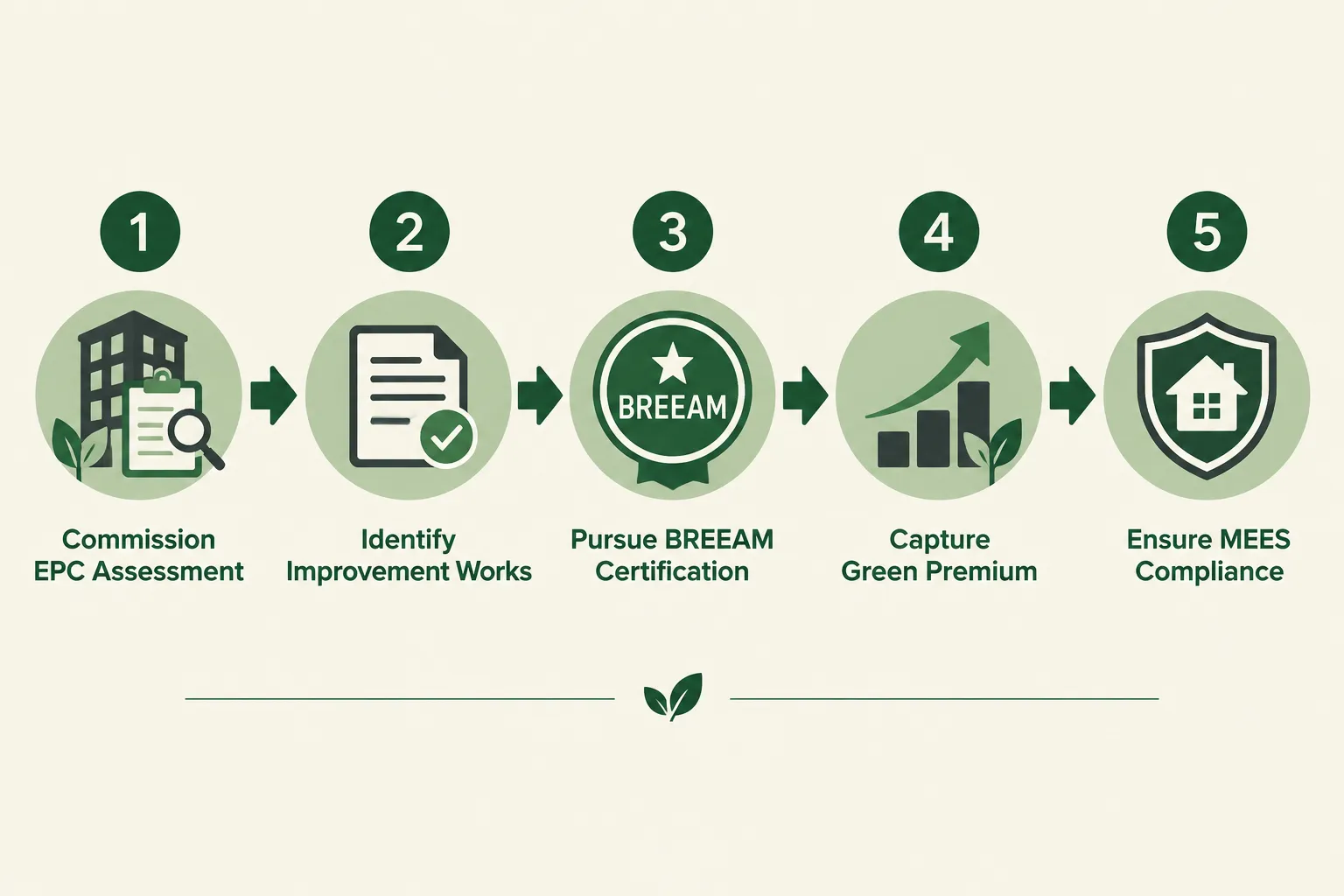
A common objection to proactive EPC improvement is cost. Commercial EPC assessments themselves are relatively modest, assessment fees for standard commercial properties typically range from a few hundred pounds for smaller units to several thousand for large or complex buildings [1] [2]. The assessment cost is not the barrier; the capital expenditure required to move a building up the EPC scale is the real question.
Typical improvement pathways and their cost-benefit profile:
Low-cost, high-impact measures:
- LED lighting upgrades
- Building management system (BMS) optimisation
- Insulation improvements to roofs and facades
- Smart metering and energy monitoring
Medium-cost measures:
- HVAC system replacement or upgrade
- Double or triple glazing installation
- Renewable energy integration (rooftop solar PV)
High-cost, transformative measures:
- Full fabric retrofit
- Heat pump installation
- Structural envelope improvements
The critical framing for investors is that compliance costs, while material, are modest relative to the value shifts that non-compliance triggers. A building that loses lettability loses all income. A building that drops from EPC C to a brown-discounted D or E rating in the market's perception may see yield decompression of 25 to 75 basis points, which on a commercial asset worth several million pounds represents a capital value reduction far exceeding any reasonable retrofit budget [6].
Data Infrastructure Supporting Valuation Decisions
One underappreciated development is the maturation of EPC data infrastructure. Large, publicly accessible EPC databases now underpin both valuation analysis and portfolio risk screening [8]. Valuers can benchmark a subject property against the distribution of ratings in its submarket, identify the gap to minimum compliance thresholds and model the cost-to-compliance as a specific line item in their appraisal.
This data availability means that sustainability risk is increasingly visible in the due diligence process. Buyers and lenders routinely screen portfolios for EPC exposure before committing capital. A concentration of sub-B rated assets in a portfolio is now a negotiating point in acquisition pricing, and a trigger for lender covenant conditions in some financing structures.
Forward-Looking Expectations: Deepening the Green Premium and Brown Discount
The direction of travel for sustainability ratings and commercial property value is clearly toward greater differentiation. Several reinforcing factors will deepen the green premium and brown discount over the coming years.
Regulatory tightening: The proposed EPC B minimum for commercial lettings, combined with the April 2026 business rates link, creates a dual mechanism, regulatory restriction on the supply side and cost disadvantage on the occupier side, that will make sub-B stock progressively harder to let and to value [6] [10].
Institutional capital flows: Pension funds, sovereign wealth funds and listed REITs operating under TCFD and SFDR frameworks are required to report and manage climate-related financial risks. This creates structural demand for certified, high-rated assets and structural pressure to divest or discount lower-rated stock.
Occupier ESG commitments: Corporate tenants with net-zero targets need buildings that support, rather than undermine, their emissions reporting. An EPC F office generates Scope 1 and 2 emissions that appear directly on a tenant's carbon account. The willingness of quality occupiers to pay a rent premium for certified space, or to accept a rent discount for sub-standard space, is a market force that will intensify.
Lending conditions: Green finance products, including green loans and sustainability-linked bonds, offer preferential pricing for assets meeting defined sustainability criteria. The cost of capital differential between green-certified and brown-discounted assets will feed through into capitalisation rates and, ultimately, into market values.
"The forward-looking valuer must treat EPC B compliance not as a ceiling but as the new floor, the minimum condition for maintaining institutional-grade asset status."
Conclusion
The relationship between sustainability ratings and commercial property value has moved from theoretical to transactional. EPC bands now directly influence rental bids, lettability and business rates costs. BREEAM certifications command measurable yield premiums in logistics and rent premiums in offices. The proposed EPC B minimum and the April 2026 business rates link have made decarbonisation a direct input into the valuation model, not a qualitative overlay.
Actionable next steps for valuers and investors:
-
Audit the portfolio now. Screen all holdings against current and proposed MEES thresholds using the publicly available EPC database. Identify assets at risk of brown discount or lettability restriction.
-
Model compliance costs explicitly. Commission EPC assessments for any asset where the rating is unknown or out of date [1] [2]. Build cost-to-compliance estimates into acquisition pricing and hold/sell analysis.
-
Pursue BREEAM certification for new developments and major refurbishments. The yield and rent premium evidence justifies the additional assessment and design costs, particularly in offices and logistics.
-
Engage valuers who understand the business rates link. From April 2026, the energy-performance-to-business-rates mechanism must be reflected in ERV and net income calculations [6].
-
Factor forward-looking regulation into exit assumptions. Discount rates and exit yields for sub-B assets should reflect the realistic cost of compliance that a future buyer will price in.
The commercial property market is repricing sustainability risk in real time. Assets that lead on EPC and BREEAM credentials will attract institutional capital, quality occupiers and green finance on favourable terms. Those that lag will face a compounding brown discount that becomes harder and more expensive to reverse with each passing year.
References
[1] Commercial Energy Performance Certificate Cost – propertytaxpartners.co.uk
[2] Commercial Epc Cost – commercialepcassessors.co.uk
[3] commercialepcassessors.co.uk – commercialepcassessors.co.uk
[4] Uk Commercial Real Estate Business Rates And Epcs A New Area Of Value Activity 7484955406205796352 96zd – linkedin.com
[5] centaur.reading.ac.uk – centaur.reading.ac.uk
[6] Business Rates And Epcs A New Area Of Value Adjustment – knightfrank.co.uk
[7] The Impact Of Environmental Certificates On Office Prices In London – academia.edu
[8] Commercial Epc Statistics – easyepc.org
[9] 4 In 5 Commercial Buildings Across Major Cities At Risk Of Becoming Unlettable Without Urgent Government Clarity On Epc Regulations – realestateuk.org
[10] United Kingdom Mees Update For Commercial Lettings – bakermckenzie.com