London's 12-month price expectation score among RICS-surveyed professionals collapsed from +56% to just +7% between mid-2025 and February 2026 — while North West respondents held firmly in positive territory. That single data point captures the most consequential shift in UK property surveying practice right now. Regional Valuation Divergence in Spring 2026: Building Survey Strategies When London Prices Stagnate and Northern Markets Recover is not a theoretical concept — it is a live operational challenge that is reshaping how chartered surveyors select comparables, brief clients, and justify valuations across every property type.
Key Takeaways 📌
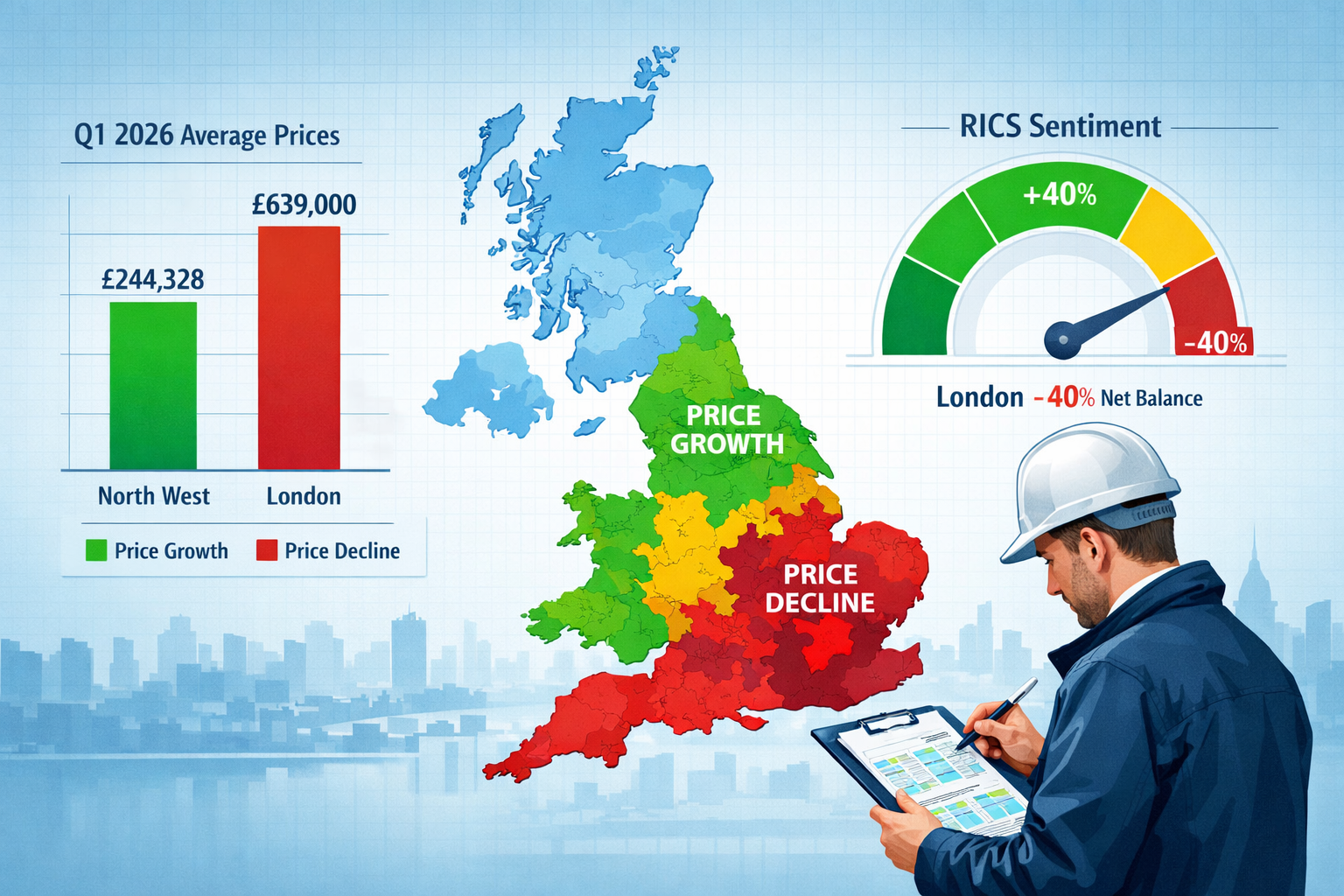
- London's average sold price fell from ~£846,000 (April 2025) to ~£639,000 (January 2026) — a dramatic correction requiring surveyors to abandon stale comparables [1]
- North West prices grew +2.1% year-on-year to £244,328, while North East recorded +1.2% growth — demanding different valuation benchmarks from southern regions [3]
- RICS net balance for London price expectations hit -40%, versus a far milder -24% in the South East — confirming the capital as the epicentre of softening [5]
- Outer London boroughs (Bromley +6.0%, Havering +5.2%) outperformed inner London, meaning even within Greater London, blanket assumptions are dangerous [2]
- Surveyors must apply region-specific comparable analysis, adjusting for property type, local transaction volumes, and buyer profile — not national averages
Understanding the Data Behind Regional Valuation Divergence in Spring 2026
The London Correction in Numbers
The scale of London's price movement in 2026 demands attention. England's average sold price reached £341,273 in Q1 2026, representing a 5.16% decline year-on-year, while asking prices remained stubbornly stable at around £371,042 — creating a widening gap between vendor expectations and achieved transactions [1].
London sits at the sharp end of this correction. Average sold prices dropped from approximately £846,000 in April 2025 to around £639,000 by January 2026 [1]. For surveyors, this creates an immediate practical problem: comparables from 12 months ago are materially misleading.
💬 "The gap between asking prices and achieved prices is not a negotiation margin — it is a structural signal that valuers must read carefully."
Price per square foot data reinforces this picture. London achieved prices ranged between £716 and £818 per square foot over the past 12 months, with a median settlement of £756/sqft [1]. That range alone — over £100/sqft — illustrates why postcode-level precision matters more than ever when conducting a RICS Red Book valuation.
Northern Resilience: A Structural Shift, Not a Blip
The North West achieved +2.1% annual price growth to £244,328, while the North East recorded +1.2% growth with typical prices at £181,198 [3]. These are not headline-grabbing numbers, but in the context of a national market declining 5.16% year-on-year, positive growth is a significant divergence.
The sub-£250,000 segment is particularly active. England recorded 7,659 transactions in this price band during Q1 2026, concentrated in northern English regions, the Midlands, and Wales, where salary-to-house-price ratios remain more accessible [1]. First-time buyers are driving activity in these markets — a buyer profile that responds differently to survey findings than the investment-led purchasers common in prime London.
| Region | Q1 2026 Avg Price | Annual Change |
|---|---|---|
| London | ~£639,000 | -1.2% (broader region) |
| South East | Data softening | >-1% annual |
| North West | £244,328 | +2.1% |
| North East | £181,198 | +1.2% |
| Wales | £223,472 | -3.15% |
| England Overall | £341,273 | -5.16% |
Sources: [1][3]
Within-London Divergence: Outer Boroughs vs Prime Central
Even within Greater London, applying a single benchmark is a professional risk. Outer boroughs showed genuine strength: Bromley achieved +6.0%, Havering +5.2%, and Waltham Forest +4.0% year-on-year [2]. Meanwhile, ultra-prime central districts like SW1X commanded prices above £13 million for prime properties, while outer London postcodes transacted at £220,000–£300,000 [1].
Premium central and west London districts (SW10, NW8, W8) averaged above £1.9 million but with thin transaction volumes — making comparable selection extremely sensitive to timing and property specification [1].
Surveyors operating across North London or East London need to treat each borough as its own micro-market rather than defaulting to a Greater London average.
How Surveyors Must Adapt: Practical Building Survey Strategies for Regional Valuation Divergence in Spring 2026

1. Rebuild Your Comparable Selection Window 🔍
In a stable market, surveyors typically draw comparables from a 12-month window. In the current environment, that window must shrink to 3–6 months maximum in London and southern markets — and be supplemented with trend analysis showing the direction of travel.
In northern markets where prices are growing, a slightly longer window may be acceptable, but surveyors should weight recent transactions more heavily to capture upward momentum.
Practical steps:
- Flag the date of each comparable explicitly in reports
- Note whether the comparable pre- or post-dates the Q4 2025 correction in London
- Apply percentage adjustments where comparable timing creates material differences
- Cross-reference achieved prices against asking prices to gauge local negotiation dynamics
Understanding the difference between a lender's automated assessment and a professional survey is critical — many clients confuse the two. A clear explanation of what a mortgage valuation covers versus a full survey helps set expectations before the instruction begins.
2. Differentiate by Property Type — Not Just Location 🏘️
Property type performance diverged sharply in Q1 2026. Detached homes averaged £463,537, semi-detached £317,963, terraced £267,506, and flats £256,786 nationally [1]. But these national averages mask enormous regional variation.
Flats led transaction volumes with 6,574 sales in Q1 2026, followed by terraced houses (6,179), semi-detached (5,534), and detached (4,731) [1]. In London, the flat market faces specific headwinds — service charge inflation, cladding remediation costs, and leasehold reform uncertainty all affect achievable prices independently of the broader market.
A commercial building survey or residential survey in a northern city for a terraced property requires an entirely different comparable framework from a London flat — even if the headline price is similar.
Surveyor checklist by property type:
- ✅ Flats: Check lease length, service charge history, EWS1 status, building safety fund eligibility
- ✅ Terraced/Semi-detached: Focus on structural condition, extension compliance, drainage
- ✅ Detached: Boundary disputes, outbuilding condition, planning history
- ✅ Commercial: Yield analysis, tenant covenant strength, dilapidations exposure
3. Recalibrate Client Expectations by Region 📊
RICS respondents in London reported a net balance of -40% for price expectations — meaning far more professionals expect prices to fall than rise [5]. In the South East, that figure was -24% [5]. These are not minor sentiment shifts; they represent a fundamental change in market psychology that clients need to understand before exchange.
In northern markets, the conversation is different. Buyers in the North West and North East are entering markets with genuine momentum. Surveyors should be prepared to explain why a survey finding that might justify a price reduction in London may carry less negotiating weight in a competitive northern market with limited stock.
💬 "Applying a national benchmark to a regional market is like using a national weather forecast to plan a local outdoor event — technically related, practically useless."
4. Address the Asking Price vs Achieved Price Gap 💷
England's asking prices averaged £371,042 in March 2026 against achieved prices of £341,273 — a gap of nearly £30,000 [1]. This gap is not uniform. In London, the divergence is wider; in competitive northern markets, properties are sometimes achieving closer to asking price.
Surveyors should:
- Present clients with both asking price data and achieved price data for comparables
- Explain that a survey-informed renegotiation is more credible when backed by regional achieved price trends
- Avoid conflating Rightmove asking price data with Land Registry achieved prices in reports
For clients considering a freehold valuation or assessing factors of valuation for tax or estate purposes, the achieved-vs-asking gap has direct implications for the defensibility of the figure.
5. Structural Surveys: Prioritise Differently by Market Condition 🔧
In a softening London market, buyers have more leverage — meaning survey findings carry more weight in negotiations. A structural survey that identifies significant defects gives a London buyer a credible basis for renegotiation that the current market supports.
In recovering northern markets, the same defects may not achieve the same price reduction — competing buyers may be willing to absorb costs that a London buyer would not. Surveyors should frame findings in terms of remediation cost ranges rather than implied price reductions, allowing clients to make informed decisions within their local market context.
Additional specialist surveys worth recommending in either market:
- Subsidence surveys for older stock in both regions
- Damp surveys for Victorian and Edwardian terraces common in northern cities
- Roof surveys for properties where aerial inspection is limited
Prime Central London: The International Buyer Exception

Prime Central London operates by different rules. Asking prices in PCL increased only 0.8% in April 2026 versus a typical monthly increase of 1.2% — a slowdown, but not a collapse [4]. The reason: international demand.
USD-denominated and Middle Eastern buyers are benefiting from pound weakness linked to geopolitical uncertainty, creating effective "currency discounts" on already-softened sterling prices [4]. This means surveyors working in prime central postcodes face a dual challenge: domestic buyers are cautious and price-sensitive, while international buyers may be less focused on survey findings and more on currency-adjusted value.
Implications for surveyors in PCL:
- Valuations must account for the thin transaction volumes that make comparables unreliable
- International buyer profiles may require valuation for capital gains tax or probate valuation considerations
- Survey reports should be written with clarity sufficient for non-UK-based clients unfamiliar with British building conventions
Regional Valuation Divergence in Spring 2026: A Framework for Surveying Firms
Operational Recommendations for Practice Leaders
Surveying firms operating across multiple regions need to formalise their approach to the current divergence. Ad hoc adjustments by individual surveyors create inconsistency and professional risk.
Recommended firm-level actions:
- Create region-specific comparable databases updated monthly, separating London, South East, Midlands, and Northern markets
- Develop regional market briefing notes for client-facing staff — a one-page summary of current conditions by region
- Review fee structures — northern market surveys at £180,000–£244,000 price points may require different scope than London surveys at £600,000+
- Train surveyors on regional buyer profiles — first-time buyers in the North need different communication than investor clients in prime London
- Standardise the language around market conditions in reports — avoid ambiguous phrases like "the current market" without specifying which market
When National Data Misleads
The England average of £341,273 is arithmetically real but operationally misleading for almost every individual instruction. A surveyor in Manchester using the national average as a benchmark is understating local market strength. A surveyor in Kensington using it is overstating achievable prices.
The RICS February 2026 survey data makes this explicit: sentiment, transaction volumes, and price expectations vary so significantly by region that national data should serve only as context, never as a primary benchmark [5].
Conclusion: Actionable Next Steps for Spring 2026
Regional Valuation Divergence in Spring 2026 is the defining operational challenge for UK chartered surveyors right now. The data is unambiguous: London and the South are softening, northern markets are holding or growing, and within every region there are further micro-market variations that demand precision.
Here is what to do immediately:
- 🗂️ Audit your comparable database — remove or flag any London comparables older than six months
- 📍 Treat each borough and postcode as a distinct market — Bromley and Kensington are not interchangeable
- 📋 Update client briefing templates to reflect regional conditions rather than national averages
- 🔍 Commission specialist surveys — subsidence, structural, and damp assessments are more negotiation-relevant in a buyer's market
- 📞 Speak to a regional specialist — if operating outside your primary market, local expertise is not optional
The surveyors who adapt their methodology to reflect genuine regional divergence will deliver more defensible valuations, better client outcomes, and stronger professional reputations. Those who apply national benchmarks to local markets risk both accuracy and credibility.
The market has split. Surveying practice must split with it.
References
[1] UK House Prices Regional Divergence 2026 – https://www.realyse.com/blogs/uk-house-prices-regional-divergence-2026
[2] Regional Property Market Update Spring 2026 London – https://www.morganandassociates.co.uk/regional-property-market-update-spring-2026-london/
[3] Property Market Update By Country And Region – https://thenegotiator.co.uk/columns/kate-faulkner/property-market-update-by-country-and-region/
[4] Geopolitics Vs The Spring Bounce The Resilience Of The London Market In 2026 – https://www.capitalhomesint.com/news/geopolitics-vs-the-spring-bounce-the-resilience-of-the-london-market-in-2026
[5] UK Residential Market Survey February 2026 – https://www.rics.org/content/dam/ricsglobal/documents/market-surveys/uk-residential-market-survey/UK-Residential-Market-Survey_February-2026.pdf