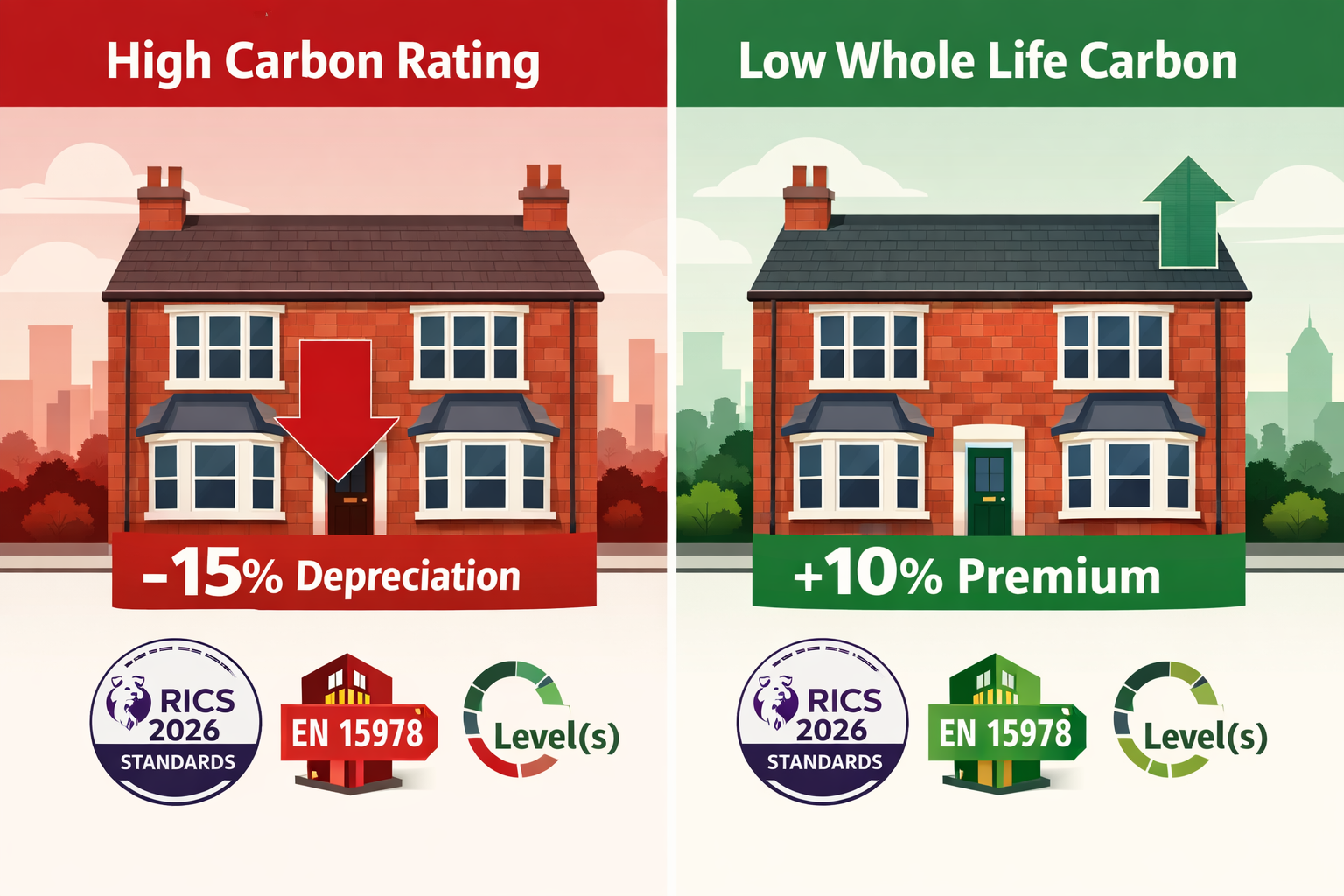
By 2030, properties with poor whole-life carbon profiles could face valuation discounts of up to 20% in institutional-grade markets — yet fewer than one-third of UK surveyors currently apply a structured carbon adjustment methodology in their Red Book valuations. That gap is closing fast, and the post-RICS 2026 standards landscape is forcing the profession to act.
Valuation Adjustments for Whole Life Carbon Ratings: Surveyor Strategies Post-RICS 2026 Standards sits at the intersection of sustainability science, property law, and market economics. With the RICS WLCA 2nd Edition now in full force and the newly launched CLEAR initiative reshaping global carbon reporting norms, surveyors who fail to embed carbon data into their valuation frameworks risk producing assessments that are both professionally non-compliant and commercially misleading. [1][2]
This article sets out a practical, evidence-based framework for chartered surveyors navigating the post-2026 standards environment — covering methodology alignment, adjustment quantification, and client communication strategies.
Key Takeaways 📌
- The RICS WLCA 2nd Edition (effective July 1, 2024) mandates whole-life carbon assessment compliance for all RICS members globally — this obligation carries through 2026 and beyond.
- The CLEAR initiative, launched April 2026, aligns — not replaces — existing standards (EN 15978, Level(s), RICS WLCA), enabling cross-methodology comparison.
- PAS 2080:2023 provides the infrastructure carbon management framework that underpins how embodied and operational carbon data feeds into valuation models.
- Surveyors must apply quantified, defensible adjustments to reflect carbon ratings, using comparable evidence and benchmarking tools.
- Properties with verified low whole-life carbon ratings are increasingly attracting measurable market premiums, particularly in commercial and institutional sectors.
Understanding the Post-RICS 2026 Standards Framework
The RICS WLCA 2nd Edition: What Changed and Why It Matters
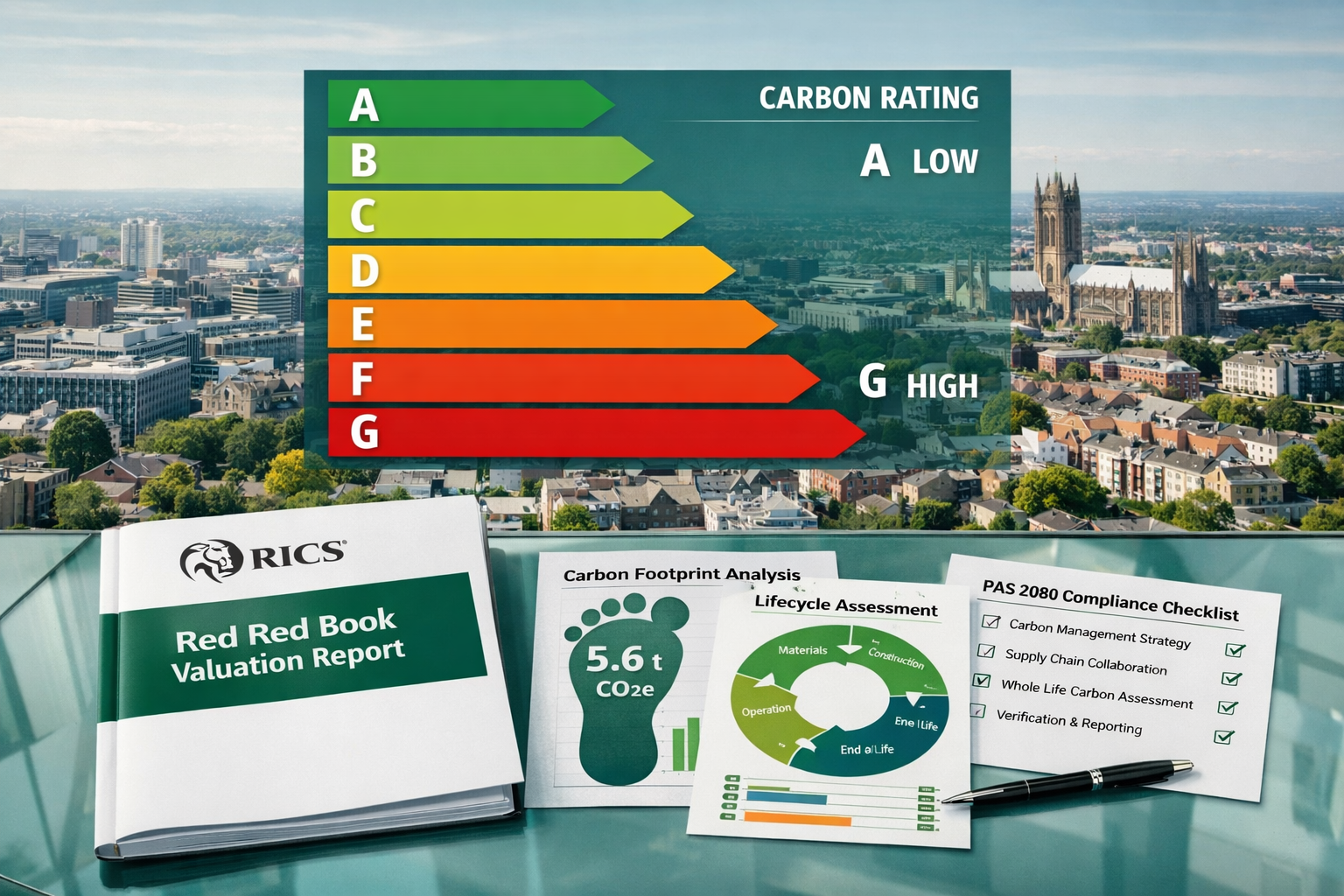
The RICS Whole Life Carbon Assessment (WLCA) professional standard, 2nd edition, became mandatory for all RICS members conducting carbon assessments from 1 July 2024 [2]. Its requirements extend through 2026 and set the baseline against which all valuation-related carbon data must be interpreted.
Key obligations under the 2nd edition include:
- Assessing both embodied carbon (modules A1–A5, B1–B5, C1–C4) and operational carbon (modules B6–B7) across the full asset lifecycle
- Aligning with EN 15978 as the primary calculation methodology
- Documenting data quality, assumptions, and uncertainty ranges within assessment reports [4]
- Distinguishing between biogenic carbon, sequestered carbon, and fossil fuel-derived emissions
💡 "The 2nd edition isn't just a technical update — it's a professional liability shift. Surveyors who ignore whole-life carbon data in their valuations are now operating outside RICS standards."
For surveyors producing RICS Red Book valuations, this creates a direct obligation: carbon performance data must be considered as a material factor where it is available and where it affects market value.
The CLEAR Initiative: A Game-Changer for Cross-Methodology Consistency
On 20–22 April 2026, RICS and global partners launched the Coalition for Life Cycle Emissions Alignment and Reporting (CLEAR) at the Sustainable Buildings and Construction Summit in Lausanne, Switzerland [1]. This three-year initiative addresses one of the most persistent problems in carbon-adjusted valuations: methodological inconsistency.
CLEAR's core deliverables include:
| CLEAR Deliverable | Relevance to Surveyors |
|---|---|
| Globally aligned WLC measurement framework | Enables like-for-like comparable evidence |
| Cross-methodology comparison tools | Bridges EN 15978, Level(s), and RICS WLCA outputs |
| Region-specific guidance | Accounts for UK planning and building regulation context |
| Digital reporting platform | Centralises benchmark data for valuation use |
Critically, CLEAR aligns rather than replaces existing standards [3]. Surveyors do not need to abandon EN 15978 or RICS WLCA workflows. Instead, CLEAR provides the interpretive layer that allows carbon data from different methodologies to be compared — a prerequisite for robust comparable evidence in valuation.
PAS 2080:2023 and Its Role in Valuation Resilience
PAS 2080:2023 — the BSI standard for managing infrastructure carbon — provides the management system framework that sits beneath the RICS WLCA technical standard. Its 2023 revision expanded scope to include buildings alongside infrastructure, making it directly relevant to property valuation contexts [6].
For surveyors, PAS 2080:2023 matters because:
- It defines carbon management roles and responsibilities across the asset lifecycle
- It requires organisations to set carbon reduction targets aligned with science-based pathways
- It establishes verification and assurance requirements that affect the credibility of carbon data presented in valuation reports
When a client presents a whole-life carbon assessment as part of a RICS building survey or valuation instruction, surveyors should check whether the underlying data has been produced within a PAS 2080:2023-compliant management system. Unverified carbon claims carry significant valuation risk.
Valuation Adjustments for Whole Life Carbon Ratings: Surveyor Strategies Post-RICS 2026 Standards in Practice
Quantifying Carbon Adjustments: The Evidence Challenge
The most technically demanding aspect of valuation adjustments for whole life carbon ratings is the absence of a standardised adjustment table. Unlike EPC ratings — where market evidence of the "green premium" is now reasonably well-documented — whole-life carbon ratings are newer to market discourse and comparables are still thin in many sectors.
Surveyors should approach quantification through three evidence tiers:
Tier 1 — Direct Market Evidence
- Comparable sales or lettings where WLC ratings are disclosed
- Investor pricing differentials in institutional transactions (particularly commercial and BTR sectors)
- Auction results where carbon credentials are marketed
Tier 2 — Proxy Evidence
- EPC band differentials as a partial proxy (operational carbon only)
- Retrofit cost analysis: the cost to achieve a lower carbon rating, capitalised as a negative adjustment
- Stranded asset risk modelling for high-carbon properties
Tier 3 — Expert Judgement
- Sector-specific benchmarks from RICS, UKGBC, and LETI guidance
- Regulatory trajectory analysis (future carbon pricing, mandatory disclosure timelines)
- Lender appetite data (green mortgage availability and pricing differentials)
A comprehensive RICS home survey that incorporates whole-life carbon data should clearly state which evidence tier underpins any adjustment applied, along with the degree of uncertainty.
Practical Adjustment Ranges: What the Evidence Suggests
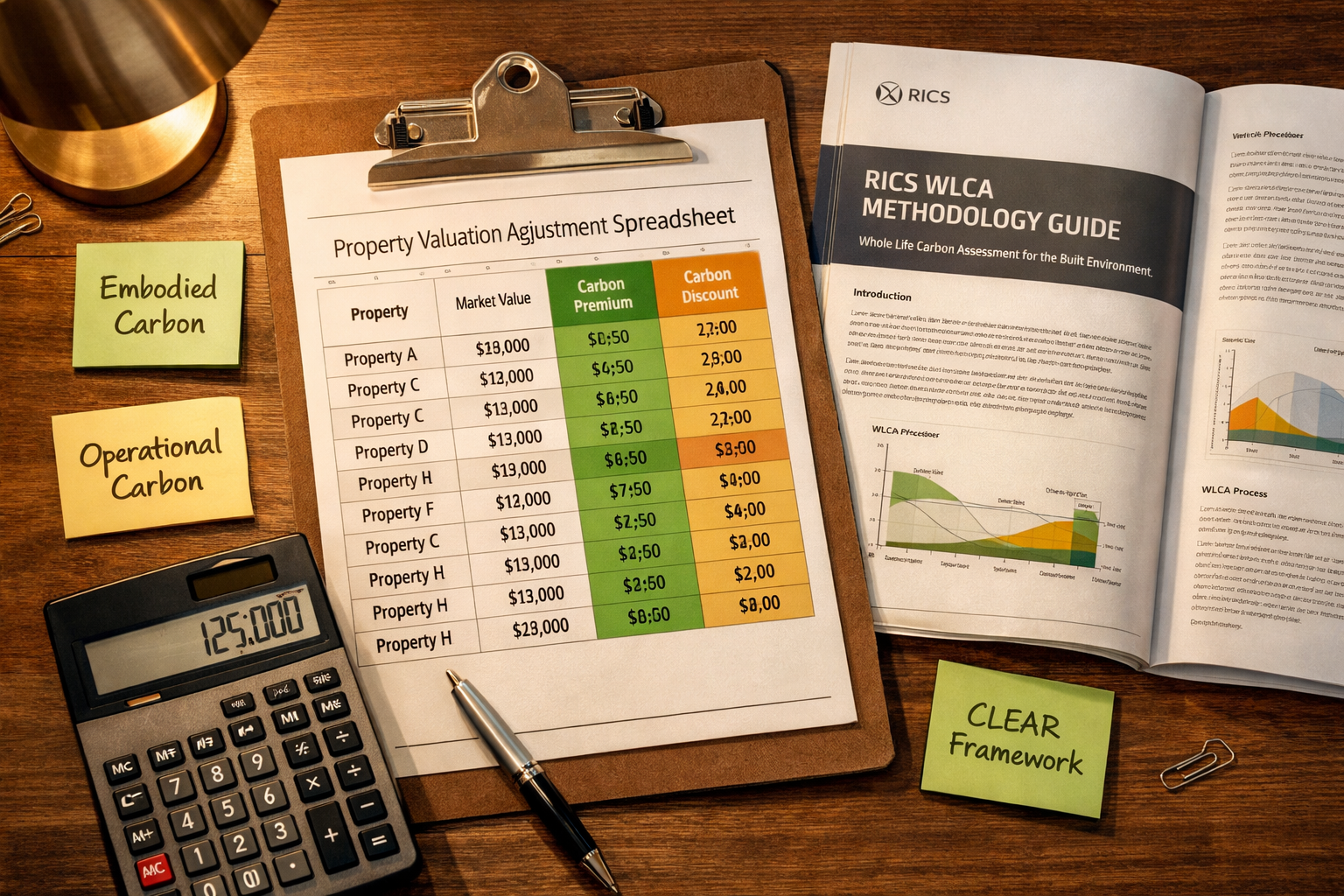
While no universal table exists, emerging market evidence and professional guidance point to the following indicative adjustment ranges for 2026 market conditions:
| Carbon Rating Category | Adjustment Direction | Indicative Range | Confidence Level |
|---|---|---|---|
| Verified Net Zero / Very Low WLC | Premium | +3% to +8% | Moderate (commercial) |
| Good Practice Low Carbon | Slight Premium | +1% to +3% | Low-Moderate |
| Business as Usual / Average | Neutral | 0% | N/A |
| Above Average Carbon / Poor EPC | Discount | -2% to -7% | Moderate |
| High Carbon / Stranded Asset Risk | Significant Discount | -8% to -20% | Moderate-High (institutional) |
⚠️ Important caveat: These ranges are indicative only and must be tested against local market evidence. Adjustments in residential markets remain smaller and less consistent than in commercial markets. Surveyors must not apply these figures mechanically without comparable support.
For capital gains tax valuations or probate valuations, where the valuation date may be historical, surveyors should apply the carbon adjustment evidence that was available at the relevant date — not current market sentiment.
Surveyor Strategies: A Step-by-Step Methodology
Embedding carbon adjustments into valuation practice requires a structured workflow. The following six-step approach reflects RICS WLCA 2nd Edition obligations and CLEAR framework principles:
Step 1: Data Collection and Verification 🔍
- Request the full WLCA report (or equivalent) from the client or vendor
- Verify methodology alignment with EN 15978 / RICS WLCA
- Check PAS 2080:2023 compliance status of the producing organisation
- Identify data quality rating (DQR) scores within the assessment
Step 2: Scope Boundary Review
- Confirm which lifecycle modules are covered (A1–A5, B1–B7, C1–C4, D)
- Note any excluded modules and their potential materiality
- Check whether biogenic carbon is included or excluded [5]
Step 3: Benchmark Comparison
- Compare the subject property's WLC intensity (kgCO₂e/m²) against sector benchmarks
- Use RICS WLCA benchmark data, LETI Carbon Targets, and RIBA 2030 Climate Challenge figures
- Identify the property's position relative to current and future regulatory thresholds
Step 4: Adjustment Quantification
- Select the appropriate evidence tier (Tier 1 preferred)
- Apply adjustments to the base valuation with full transparency
- Document the adjustment rationale, evidence base, and uncertainty range
Step 5: Sensitivity Analysis
- Model the valuation under different carbon pricing scenarios
- Assess the impact of anticipated regulatory changes (e.g., mandatory WLC disclosure in planning)
- Present a range of values where uncertainty is high
Step 6: Report Disclosure
- Disclose all carbon-related adjustments explicitly in the valuation report
- State the limitations of available data
- Recommend further specialist assessment where WLC data is absent or unverified
This methodology applies whether the surveyor is conducting a standard RICS valuation, a specific defect survey, or a dilapidations assessment where carbon performance affects reinstatement cost and asset value.
Valuation Adjustments for Whole Life Carbon Ratings: Surveyor Strategies Post-RICS 2026 Standards — Client Communication and Risk Management
Communicating Carbon Adjustments to Clients
One of the most underestimated challenges in post-RICS 2026 practice is client education. Many property owners, investors, and lenders are unfamiliar with whole-life carbon concepts and may resist adjustments — particularly downward ones — that they do not understand.
Effective client communication strategies include:
- Plain language summaries of the WLC assessment findings, translated into financial impact terms
- Scenario modelling showing how carbon performance affects long-term asset value under different regulatory trajectories
- Comparison with EPC as a familiar reference point, while clearly explaining the broader scope of WLC ratings
- Reference to lender requirements: major UK lenders are increasingly requiring WLC data for commercial lending decisions, making carbon performance a direct financing risk
💡 "Clients who understand that a poor carbon rating affects their refinancing options — not just their ESG credentials — engage very differently with the adjustment conversation."
When advising clients considering right-to-buy valuations or shared ownership transactions, surveyors should note that social housing stock often carries significant embodied and operational carbon liabilities — and that retrofit obligations under net-zero pathways may affect future market value.
Managing Professional Liability in Carbon-Adjusted Valuations
The integration of carbon data into valuations introduces new professional indemnity considerations. Surveyors should be aware of the following risk areas:
Risk 1: Reliance on Unverified Carbon Data
- Always request third-party verification of WLC assessments where material adjustments are applied
- Document the data quality limitations in the report
Risk 2: Failure to Adjust Where Evidence Exists
- Post-RICS 2026 standards, omitting a carbon adjustment where market evidence supports one may constitute a valuation error
- Maintain a documented evidence file for all adjustments (and non-adjustments)
Risk 3: Over-Adjustment in Thin Markets
- In residential markets where WLC comparable evidence is scarce, apply conservative adjustments with explicit uncertainty ranges
- Avoid extrapolating commercial market premiums to residential contexts without evidence
Risk 4: Methodological Inconsistency
- With CLEAR now providing cross-methodology alignment tools, surveyors should use these to ensure that carbon data from different assessment methodologies is interpreted consistently [3]
The Role of Building Surveys in Carbon Data Gathering
A RICS Level 3 building survey provides the physical inspection data that underpins carbon assessment inputs — particularly for existing buildings where as-built records are incomplete. Surveyors conducting building surveys should now routinely:
- Record construction material types and quantities (for embodied carbon estimation)
- Note building services systems and their age (for operational carbon modelling)
- Identify retrofit barriers that would affect the cost and feasibility of carbon reduction
- Flag missing or unreliable data that limits the accuracy of any WLC assessment
This integration of building survey data with carbon assessment methodology is a defining feature of professional practice under the post-RICS 2026 standards regime.
Conclusion: Actionable Next Steps for Surveyors in 2026
The convergence of the RICS WLCA 2nd Edition, PAS 2080:2023, and the CLEAR initiative has created a new professional standard for carbon-adjusted valuations. Surveyors who treat whole-life carbon ratings as a peripheral ESG consideration — rather than a material valuation factor — are increasingly out of step with both regulatory requirements and market reality.
Actionable next steps for chartered surveyors in 2026:
- ✅ Audit your current valuation templates — ensure they include a carbon data section and adjustment disclosure field
- ✅ Complete RICS WLCA 2nd Edition CPD — mandatory compliance requires demonstrable competence
- ✅ Subscribe to the CLEAR digital platform (launching through 2026–2028) to access cross-methodology benchmark data [1]
- ✅ Build a carbon comparables database — start recording WLC data from every instruction where it is available
- ✅ Update your PI insurance review — discuss carbon-adjusted valuation risks with your insurer
- ✅ Engage clients proactively — introduce carbon performance as a standard agenda item in valuation briefings
- ✅ Collaborate with energy assessors and carbon consultants — whole-life carbon is a multidisciplinary field; surveyors need specialist partners
The profession that masters valuation adjustments for whole life carbon ratings in 2026 will be best positioned to serve clients, manage liability, and lead the built environment's transition to net zero. The standards are set. The tools are emerging. The time to act is now.
References
[1] Rics And Global Partners Launch Clear – https://www.rics.org/news-insights/rics-and-global-partners-launch-clear
[2] Whole Life Carbon Assessments In 2026 Valuations Rics 2nd Edition Standards For Surveyors – https://nottinghillsurveyors.com/blog/whole-life-carbon-assessments-in-2026-valuations-rics-2nd-edition-standards-for-surveyors
[3] Rics Launches Clear To Align Whole Life Carbon Reporting Across Construction – https://oneclicklca.com/en/resources/articles/rics-launches-clear-to-align-whole-life-carbon-reporting-across-construction
[4] Whole Life Carbon Assessment – https://www.rics.org/profession-standards/rics-standards-and-guidance/sector-standards/construction-standards/whole-life-carbon-assessment
[5] Wlca Delivering The Future Of Carbon Assessment In The Built Environment – https://www.rics.org/news-insights/wlca-delivering-the-future-of-carbon-assessment-in-the-built-environment
[6] Whole Life Carbon Assessment In Building Surveys Rics Pas 2080 2nd Edition And Valuation Resilience In 2026 – https://nottinghillsurveyors.com/blog/whole-life-carbon-assessment-in-building-surveys-rics-pas-2080-2nd-edition-and-valuation-resilience-in-2026