Roughly 4.6 million households in England's private rented sector (PRS) live in properties where at least one Category 1 hazard has been identified under the Housing Health and Safety Rating System (HHSRS) — yet enforcement action has historically been slow, inconsistent, and difficult to trigger. That changes in 2026. With Awaab's Law expanding in May 2026 to cover excess cold, structural collapse, fire, and electrical hazards across the PRS, the role of the building surveyor has shifted from advisory to legally consequential.
Building Survey Defect Identification Under Awaab's Law 2026: Excess Cold, Structural Collapse, and Fire Hazards in Private Rental Stock is no longer just a technical exercise — it is a compliance obligation with enforceable timelines, landlord liability, and direct implications for tenant safety. Surveyors conducting Level 3 inspections must now document hazards with a precision and urgency that the sector has never previously demanded.
Key Takeaways 🔑
- Awaab's Law Phase 2 expands in 2026 to cover excess cold, structural collapse, fire, electrical hazards, excess heat, and falls in the private rented sector.
- Strict response timelines apply: emergency hazards require action within 24 hours; significant hazards must be investigated within 10 working days and remediation commenced within 5 working days of investigation completion.
- Surveyor reports must now explicitly identify and grade hazard severity, accounting for tenant vulnerability (age, health conditions, disability).
- Structural collapse and fire hazards carry the same investigation and remediation timelines as other significant hazards under the new framework.
- Phase 3 (2027) will extend coverage to all remaining 29 HHSRS hazards, making early compliance preparation essential for landlords and surveyors alike.
What Awaab's Law Phase 2 Actually Means for the PRS in 2026
Awaab's Law was originally introduced following the tragic death of two-year-old Awaab Ishak in 2020, caused by prolonged exposure to severe mould in a social housing property. Phase 1 focused on damp and mould. Phase 2, arriving in 2026, dramatically widens the scope [1].
The new hazard categories being added include:
| Hazard Category | Risk Level | Typical Trigger |
|---|---|---|
| Excess Cold | Significant/Emergency | Indoor temps below 16°C |
| Excess Heat | Significant | Prolonged overheating |
| Structural Collapse | Significant/Emergency | Visible movement, cracking |
| Fire | Significant/Emergency | Faulty wiring, blocked egress |
| Electrical Hazards | Significant | Exposed conductors, overloaded circuits |
| Falls (stairs, surfaces) | Significant | Defective steps, loose balustrades |
| Domestic/Personal Hygiene | Significant | Inadequate sanitation |
"These hazards present a significant risk of harm and must be treated with the same urgency as damp and mould under the new statutory framework." [1]
Phase 2 does not specify an exact date beyond "later in 2026," but surveyors and landlords operating in the PRS should treat preparation as immediately necessary [2][3]. Phase 3, projected for 2027, will bring all remaining 29 HHSRS hazards into scope, excluding only overcrowding [3].
For landlords and surveyors unfamiliar with HHSRS scoring methodology, a professional chartered surveyor inspection provides the structured hazard assessment framework now required under the law.
Identifying Excess Cold Defects: What Surveyors Must Document
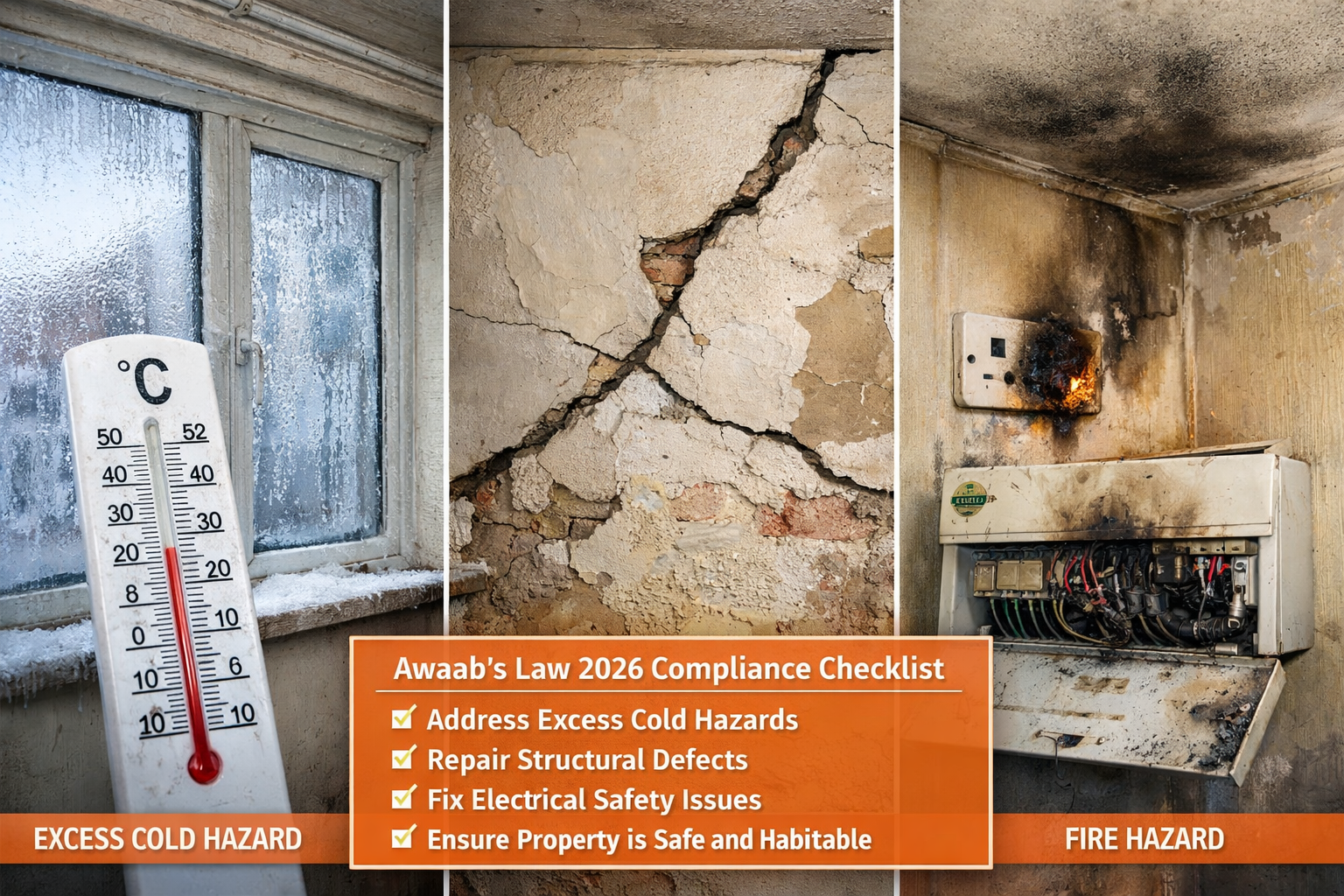
Excess cold is one of the most prevalent yet under-documented hazards in older PRS stock. Properties built before 1980 frequently lack adequate insulation, double glazing, or effective heating systems — creating indoor temperatures that fall below the 16°C threshold considered safe for general occupancy, and below 18°C for households with elderly or vulnerable residents [2].
Key Defects to Identify During Level 3 Inspections
Thermal performance failures:
- Single-glazed windows with no secondary glazing
- Uninsulated solid walls (cavity wall insulation absent or failed)
- Inadequate loft insulation (below 270mm recommended depth)
- Cold bridges at junctions between walls, floors, and roofs
Heating system deficiencies:
- Boilers over 15 years old with poor efficiency ratings
- Absence of thermostatic radiator valves
- Rooms with no fixed heating provision
- Blocked or disconnected flues
Surveyor documentation requirements under Awaab's Law 2026:
Surveyors must go beyond simply noting "inadequate heating." Reports must now [2]:
- ✅ Record measured or estimated internal temperatures
- ✅ Identify specific construction defects causing heat loss
- ✅ Note tenant vulnerability factors (age, health conditions)
- ✅ Assign an HHSRS hazard score or equivalent severity rating
- ✅ State whether the hazard meets the threshold for emergency or significant classification
Critical point: Excess cold poses a statistically greater risk to elderly tenants and those with cardiovascular or respiratory conditions. Surveyors must factor in tenant demographics when assessing hazard significance — a cold property that might be tolerable for a healthy 30-year-old may constitute an emergency for an 80-year-old with heart disease [2].
A damp survey often runs alongside excess cold assessments, since cold surfaces promote condensation and mould growth — two hazards that frequently co-exist in poorly insulated PRS stock.
Structural Collapse Hazards: Timelines, Triggers, and Surveyor Liability
Structural collapse is arguably the most technically demanding hazard category being introduced under Phase 2. Unlike excess cold — which can often be assessed through visual inspection and temperature measurement — structural defects require detailed investigation, professional judgement, and, frequently, specialist input.
What Constitutes a Structural Collapse Hazard?
Under HHSRS, structural collapse risk arises from defects that compromise the load-bearing capacity or stability of any part of the building. In PRS stock, the most common triggers include:
- Subsidence and heave: Ground movement causing differential settlement, typically visible as diagonal cracking at window and door corners
- Lintel failure: Corroded or undersized lintels above openings causing sagging brickwork
- Roof structure deterioration: Rotten or broken rafters, ridge board failure, or spread of roof timbers
- Retaining wall instability: Leaning or cracked garden walls adjacent to habitable areas
- Floor joist decay: Wet rot in suspended timber floors, particularly in ground floor rooms
Response Timelines Under Awaab's Law 2026
For structural collapse hazards classified as significant, the statutory framework requires [1]:
- 📋 Investigation commenced: within 10 working days of the landlord becoming aware
- 🔧 Remediation commenced: within 5 working days of investigation completion
- 🚨 Emergency structural hazards: action within 24 hours
This places enormous pressure on surveyors to produce reports that clearly distinguish between hazard severity levels. A vague notation of "some cracking observed — monitor" is no longer sufficient if the cracking pattern suggests active structural movement.
A structural survey conducted by a qualified RICS chartered surveyor provides the level of detail now required — identifying crack classifications (using BRE Digest 251 categories), monitoring recommendations, and clear remediation pathways.
For properties where subsidence is suspected, a dedicated subsidence survey may be necessary to establish whether movement is historic and stable, or active and progressing.
Surveyor Liability Considerations
Building Survey Defect Identification Under Awaab's Law 2026: Excess Cold, Structural Collapse, and Fire Hazards in Private Rental Stock creates a new liability landscape. If a surveyor fails to identify a structural hazard that subsequently causes injury or death, the question of professional negligence becomes significantly more complex under the new statutory framework [5].
Surveyors should:
- Use crack monitoring gauges during inspection where movement is suspected
- Recommend specialist structural engineer input where load-bearing elements are affected
- Clearly state in reports where further investigation is required before a definitive hazard assessment can be made
- Retain photographic evidence with date-stamps and measurement references
For complex cases, an expert witness report may be required where structural defect disputes proceed to tribunal or court.
Fire Hazards and Electrical Risk: The New Compliance Frontier
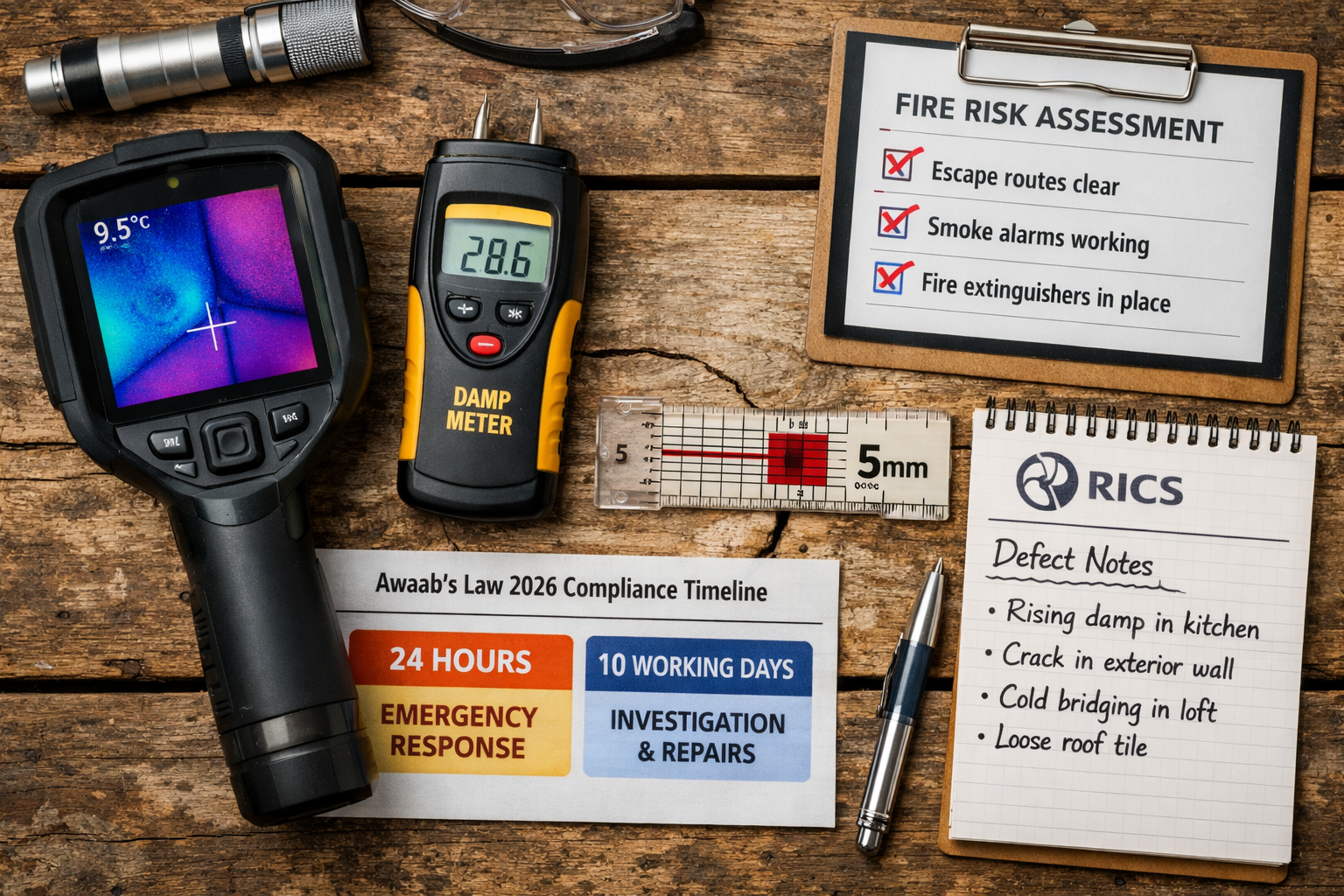
Fire hazards in the PRS encompass a broad range of defects — from faulty consumer units and inadequate smoke detection to blocked means of escape and combustible cladding. Under Awaab's Law Phase 2, these hazards carry the same investigation and remediation timelines as structural collapse: 10 working days to investigate, 5 working days to begin remediation [1][5].
Fire Hazard Defects: Surveyor Checklist
Means of escape:
- Windows in habitable rooms openable for escape
- Internal fire doors present and correctly specified (FD30 minimum)
- Staircase enclosure maintained (no open-plan conversion without fire engineering)
- External escape routes unobstructed
Detection and suppression:
- Interlinked smoke alarms on every floor
- Heat detector in kitchen
- Carbon monoxide detectors where solid fuel or gas appliances present
- Sprinkler systems in HMOs (where required by local authority)
Electrical installation defects (fire risk):
- Consumer unit: metal-clad (post-2016 standard) or legacy plastic unit
- Residual current devices (RCDs) present and tested
- Evidence of overloading: scorching at sockets, melted cable insulation
- Electrical Installation Condition Report (EICR) in date (5-year cycle for PRS)
Surveyors cannot conduct full electrical testing — that requires a qualified electrician. However, visual identification of obvious electrical defects during a building survey is now an expected part of the inspection scope under Awaab's Law 2026 [5].
Roof Condition and Fire Spread Risk
An often-overlooked fire hazard in converted Victorian and Edwardian terraces is the absence of compartmentation in the roof void. Where loft conversions have been carried out without proper fire separation, a fire in one unit can spread rapidly through the roof space to adjacent properties.
A roof survey should be included in any Level 3 inspection of converted PRS stock, specifically examining:
- Presence and condition of fire barriers in shared roof voids
- Condition of felt, battens, and tiles that could accelerate fire spread
- Access hatches and their fire resistance specification
Practical Protocols for Level 3 Inspections Under the New Framework
Building Survey Defect Identification Under Awaab's Law 2026: Excess Cold, Structural Collapse, and Fire Hazards in Private Rental Stock demands a more structured approach to the Level 3 inspection process than many surveyors have previously applied.
Pre-Inspection Preparation
Before attending site, surveyors should:
- Review any existing EICR, gas safety certificate, or previous survey reports
- Confirm tenant occupancy details (age, disability, health conditions where disclosed)
- Check local authority housing enforcement records where publicly available
- Identify property age and construction type to anticipate likely hazard categories
On-Site Documentation Standards
| Documentation Element | Minimum Standard |
|---|---|
| Photographs | Date-stamped, geo-tagged, minimum 12MP |
| Thermal imaging | Recommended for excess cold and damp assessment |
| Crack measurement | BRE Digest 251 classification recorded |
| Temperature readings | Spot measurements in each habitable room |
| Hazard severity rating | HHSRS score or equivalent grading |
| Tenant vulnerability note | Recorded where relevant to hazard significance |
Report Structure Requirements
Under Awaab's Law, a compliant building survey report for PRS properties should include [2][4]:
- Executive summary — hazards identified, severity classification, recommended response timeline
- Hazard-by-hazard analysis — each defect linked to HHSRS category
- Tenant vulnerability assessment — where information is available
- Remediation priority matrix — emergency / significant / routine
- Specialist referral recommendations — structural engineer, electrician, gas engineer
- Photographic appendix — evidential standard documentation
For landlords and surveyors wanting to understand the full scope of a professional inspection, the RICS specific defect survey provides a targeted assessment framework particularly suited to identifying individual hazard categories under the new law.
Landlord Obligations and Enforcement Consequences
Awaab's Law creates statutory obligations — not guidance. Landlords who fail to meet investigation and remediation timelines face:
- Rent repayment orders — tenants can reclaim up to 12 months' rent
- Civil penalties — local authorities can issue fines without court proceedings
- Prohibition orders — properties can be closed to occupation
- Criminal prosecution — in cases of serious or repeated non-compliance
The enforcement burden falls on local housing authorities, but the evidential basis for enforcement action increasingly relies on professional survey reports. A well-documented RICS home survey or Level 3 building survey provides the factual foundation that enforcement teams need to act — and that landlords need to demonstrate compliance.
The surveyor's report is now, in practical terms, a compliance document as much as a technical one.
Landlords managing larger portfolios should consider commissioning schedule of condition reports at the start of each tenancy, creating a baseline record that protects both parties and demonstrates proactive compliance with Awaab's Law obligations.
Conclusion: Actionable Next Steps for Surveyors and Landlords
The expansion of Awaab's Law in 2026 represents the most significant shift in private rented sector compliance obligations in a generation. For surveyors, it demands upgraded inspection protocols, more precise hazard documentation, and a clearer understanding of statutory response timelines. For landlords, it creates enforceable duties that cannot be deferred or dismissed.
Immediate actions to take:
-
Surveyors: Update Level 3 inspection checklists to explicitly cover excess cold, structural collapse, fire, and electrical hazard categories with HHSRS-aligned severity ratings.
-
Landlords: Commission proactive building surveys on all PRS properties before Phase 2 takes full effect — identifying and remediating hazards before enforcement timelines begin to run.
-
Both parties: Establish clear communication protocols so that landlords are formally notified of hazards in writing, triggering the statutory clock accurately and transparently.
-
Portfolio managers: Implement a hazard tracking system that records investigation start dates, remediation commencement, and completion — creating an auditable compliance trail.
-
All stakeholders: Begin preparing for Phase 3 (2027), when all remaining HHSRS hazards enter scope — making comprehensive baseline surveys an urgent priority.
The properties most at risk are those built before 1970, in areas of high PRS concentration, and occupied by vulnerable tenants. These are precisely the properties where proactive, expert-led building survey defect identification under Awaab's Law 2026 can make the difference between a safe home and a preventable tragedy.
References
[1] Awaabs Law Policy Web Version 10 – https://www.southernhousing.org.uk/media/cxvlllnp/awaabs-law-policy-web-version-10.pdf
[2] Awaabs Law Is Here The Surveyors Guide For Compliance – https://www.surventrix.com/blog/awaabs-law-is-here-the-surveyors-guide-for-compliance
[3] Awaabs Law Guide – https://wordnerds.ai/awaabs-law-guide
[4] Awaabs Law And Surveyors What Your Reports Must Include In 2026 – https://goreport.com/awaabs-law-and-surveyors-what-your-reports-must-include-in-2026/
[5] Electrical Hazards And Fire Risk Assessment In Building Surveys Awaabs Law 2026 Extensions And Surveyor Liability – https://nottinghillsurveyors.com/blog/electrical-hazards-and-fire-risk-assessment-in-building-surveys-awaabs-law-2026-extensions-and-surveyor-liability