Approximately one in five UK property transactions that collapse after survey do so because buyers and their advisors fail to distinguish between defects that require a price chip and defects that require a phone call to a solicitor. That distinction is not a matter of opinion, it is built directly into the RICS Home Survey Standard, which uses a formal three-tier condition rating system to separate routine maintenance from urgent, potentially dangerous problems. Understanding red flags in a UK building survey report: issues that demand immediate action, not just renegotiation, is the difference between a savvy purchase and a catastrophic one.
Key Takeaways
- Condition Rating 3 (red) in any RICS Level 1, 2, or 3 survey signals an urgent defect requiring immediate specialist investigation, not simply a bargaining chip.
- Structural movement, active dry rot, major roof defects, non-compliant electrical installations, and asbestos are the defects most likely to justify pausing or abandoning a transaction.
- Some red flags carry health-and-safety or legal consequences that no price reduction can adequately offset.
- Unpermitted structural alterations and post-Grenfell cladding issues can void insurance and create ongoing legal liability for a new owner.
- The correct sequence after a serious defect is identified is: pause exchange, instruct a specialist, obtain remediation costs, then decide, not the reverse.
How the RICS Condition Rating System Defines Urgency
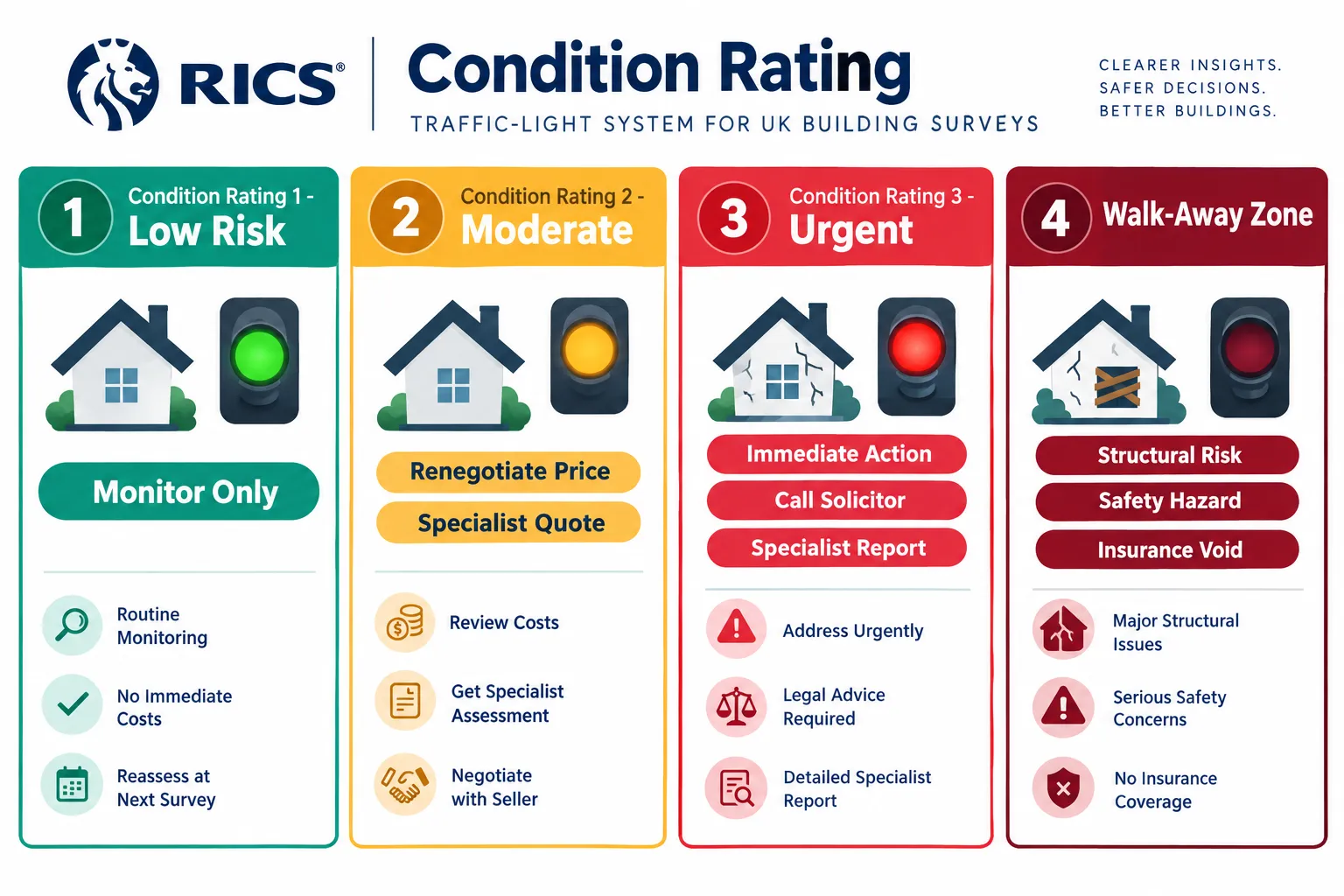
Before examining specific defects, it is essential to understand the framework surveyors use to communicate risk. RICS Home Surveys at Level 1, Level 2, and Level 3 all use a traffic-light condition rating system [2][7][8]:
| Rating | Colour | Meaning |
|---|---|---|
| Condition Rating 1 | Green | No repair currently needed; normal maintenance applies |
| Condition Rating 2 | Amber | Defects that need attention but are not urgent or serious |
| Condition Rating 3 | Red | Serious and/or urgent defects requiring immediate investigation or repair |
A Condition Rating 3 is not a negotiating tool. According to RICS standards, it identifies defects that are either a risk to the safety of the building's occupants or that could cause significant deterioration if left unaddressed [3][8]. Surveyors operating under the RICS Home Survey Standard are required to make this distinction explicit and to recommend clear next steps for any serious defect [6].
"A Condition Rating 3 does not mean 'ask for money off.' It means stop, investigate, and understand the full extent of the problem before any exchange of contracts."
The traffic-light system is explained clearly in RICS guidance and in practice notes used by surveyors across England, Wales, Scotland, and Northern Ireland [5][6]. When a buyer's solicitor or estate agent frames a Condition Rating 3 item purely as a renegotiation point, they are misrepresenting the standard.
The Defect Hierarchy: From 'Call Your Solicitor Today' to 'Monitor Over Time'
Not all Condition Rating 3 defects carry the same weight. Within the category of serious defects, there is a meaningful spectrum from those that may justify immediate withdrawal from a purchase to those that require specialist investigation before any decision is made. The following hierarchy is grounded in the types of defects RICS surveyors are trained to flag as urgent [1][3][6].
Tier 1: Defects That May Justify Walking Away
Structural movement and active subsidence
Progressive cracking, diagonal fractures at window and door openings, and visible displacement of walls or floors are the most serious structural signals a survey can report. Where a surveyor identifies active structural movement, meaning movement that is ongoing rather than historic, the implications extend far beyond repair costs. Subsidence can affect foundations, party walls, and neighbouring properties. Insurance for a property with a history of active subsidence is significantly more expensive and, in some cases, unavailable through standard markets [9][10].
The critical distinction here is between historic, stable movement (which may be manageable) and active, progressive movement (which demands a full structural engineer's report before exchange). No price reduction compensates for purchasing a property with an unresolved structural problem.
Dry rot (Serpula lacrymans)
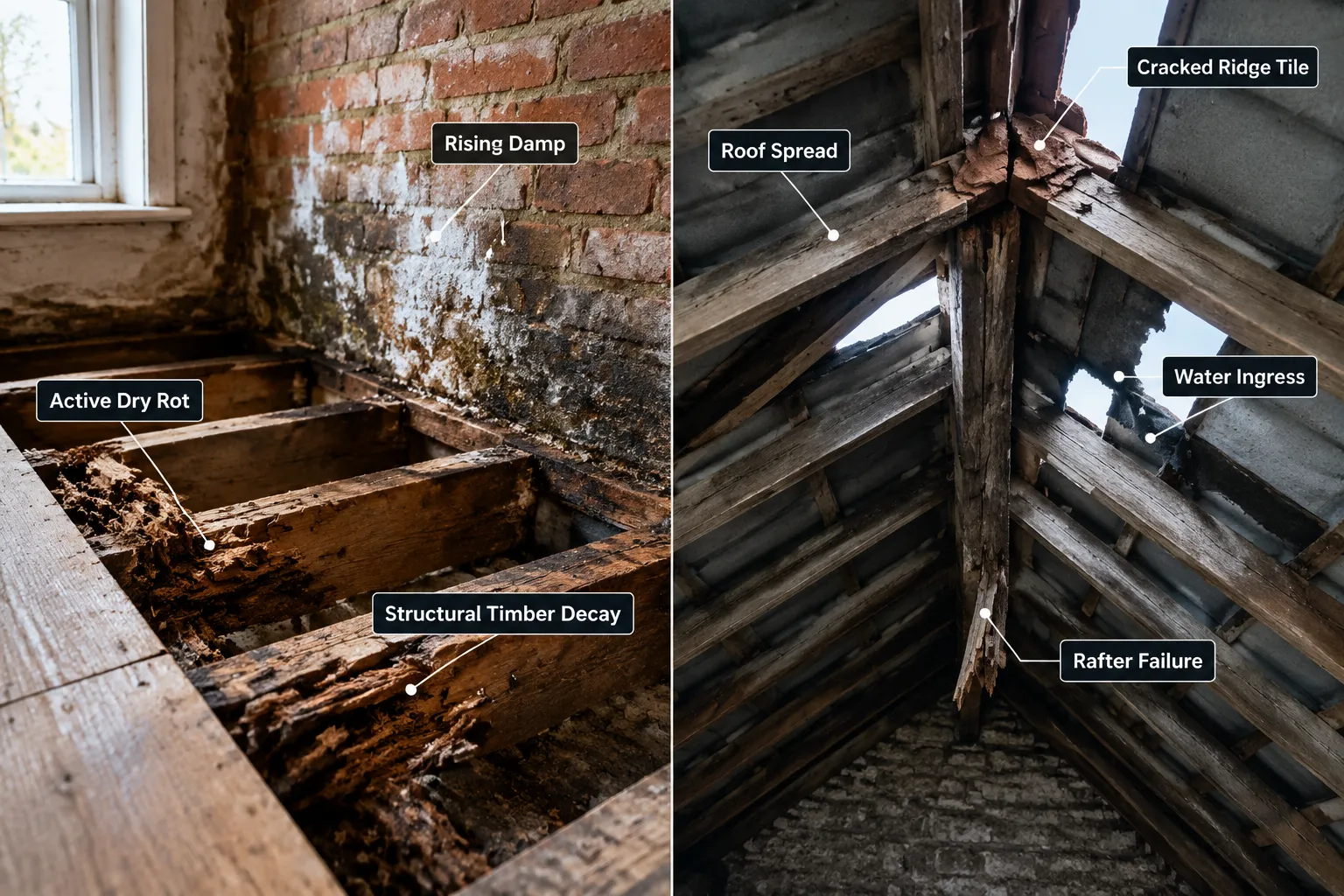
Dry rot is not simply a damp problem. It is a fungal organism that can travel through masonry, spread through an entire building, and destroy structural timbers with remarkable speed. Unlike wet rot, which is localised to areas of persistent moisture, dry rot can advance into dry areas once established [10]. Remediation is invasive, expensive, and must be carried out by a specialist, not a general builder. A survey report identifying active dry rot fruiting bodies or mycelium warrants immediate specialist investigation, not a modest price reduction.
Dangerous electrical installations
An electrical installation that is described in a survey as "dangerous," "non-compliant," or requiring immediate attention is a life-safety issue. Outdated wiring (particularly pre-1960s rubber-insulated wiring or aluminium wiring), missing RCD protection, and overloaded consumer units are associated with electrical fires. The cost of rewiring a property varies enormously by size and condition, but the safety risk is non-negotiable. An EICR (Electrical Installation Condition Report) from a qualified electrician should be obtained before exchange, not as an afterthought after completion [10].
Asbestos-containing materials (ACMs) in poor condition
Properties built or substantially refurbished before 2000 may contain asbestos in insulation boards, floor tiles, artex ceilings, pipe lagging, and roof sheets. When ACMs are in good condition and undisturbed, risk is lower. When a survey identifies damaged, friable, or disturbed asbestos, the situation demands an asbestos survey by a licensed specialist before any further work is planned or any exchange takes place [10]. The legal and health implications of disturbing asbestos without proper management are severe.
Tier 2: Defects Requiring Specialist Reports Before Exchange
Major roof defects and roof spread
A roof that is described as having widespread slipped or missing slates, failed felt, or, most critically, evidence of roof spread (where the roof structure pushes outward on the supporting walls) is a Condition Rating 3 issue that requires a specialist roofer or structural engineer's assessment [10]. Roof spread, in particular, can cause progressive wall failure and is not a defect that can be priced off the purchase cost without a full understanding of its extent.
Widespread or long-term damp
Rising damp, penetrating damp, and condensation are common in UK housing stock, but a survey that identifies widespread, long-term damp, particularly where it has affected structural timbers, plasterwork, or internal finishes across multiple areas, is flagging a habitability and structural risk, not a cosmetic issue. The source of the damp must be identified and costed by a specialist before exchange [5][9].
Unpermitted structural alterations
Structural alterations carried out without building regulations approval, removed load-bearing walls, altered roof structures, added openings, are a serious legal and structural risk. Without a completion certificate or retrospective building regulations consent, a buyer inherits both the structural uncertainty and the legal liability [9][10]. Indemnity insurance is sometimes offered as a solution, but it does not address the underlying structural risk if the work was carried out incorrectly.
Non-compliant loft conversions
A loft conversion without building regulations approval is particularly dangerous because it may lack adequate fire escape routes, structural support, or thermal insulation. Post-Grenfell, fire safety compliance in residential properties has received far greater regulatory scrutiny, and a non-compliant conversion can affect a buyer's ability to obtain a mortgage, insure the property, or sell it in the future [6][9].
Tier 3: Serious but Manageable with Proper Specialist Advice
Cladding and fire-stopping deficiencies
In the wake of the Grenfell Tower fire, cladding systems and fire-stopping details have become front-line concerns in surveys of flats and multi-occupancy buildings. Where a survey identifies potentially non-compliant cladding or inadequate fire compartmentation, the issue is not simply a repair cost, it is a potential barrier to mortgage lending, insurance, and resale [6]. EWS1 forms and specialist fire safety assessments are required before any purchase proceeds.
Significant chimney and flue defects
Defective chimneys and flues are a carbon monoxide and fire risk. Where a survey identifies structural instability in a chimney stack or a compromised flue, specialist inspection by a HETAS-registered engineer or structural specialist is required before the property is occupied.
What Distinguishes a Red Flag from a Renegotiation Point
The most common mistake buyers make is treating every negative item in a survey as an opportunity to reduce the purchase price. This conflates two entirely different categories of problem.
Renegotiation points are typically Condition Rating 2 items: a worn boiler approaching end of life, isolated areas of repointing needed, a dated kitchen that requires updating, or minor roof repairs to a small number of slates. These are real costs, and it is entirely reasonable to seek a price adjustment or ask the seller to carry out repairs. They do not, however, represent safety risks or structural unknowns.
Red flags demanding immediate action are Condition Rating 3 items where:
- The full extent of the problem is unknown without specialist investigation
- There is an immediate risk to the health or safety of occupants
- The defect may affect the legal validity of the transaction (e.g., unpermitted works)
- The defect may affect the buyer's ability to insure or mortgage the property
- Remediation costs cannot be estimated without specialist input
The RICS Home Survey Standard explicitly requires surveyors to communicate when a defect falls into this category and to recommend appropriate next steps [3][8]. A Level 3 Building Survey (formerly the Full Structural Survey) provides the most comprehensive assessment and is the appropriate product for older, larger, or non-standard properties [1][3].
"The purpose of a Condition Rating 3 is not to give buyers a number to subtract from the asking price. It is to tell them that they do not yet have enough information to make a safe decision."
Prince Surveyors' practice guidance reinforces this point: Level 2 and Level 3 reports under the RICS Home Survey Standard are required to clearly articulate risk levels and direct buyers toward appropriate specialist advice for serious defects [6].
The Correct Process After Identifying Red Flags in a UK Building Survey Report
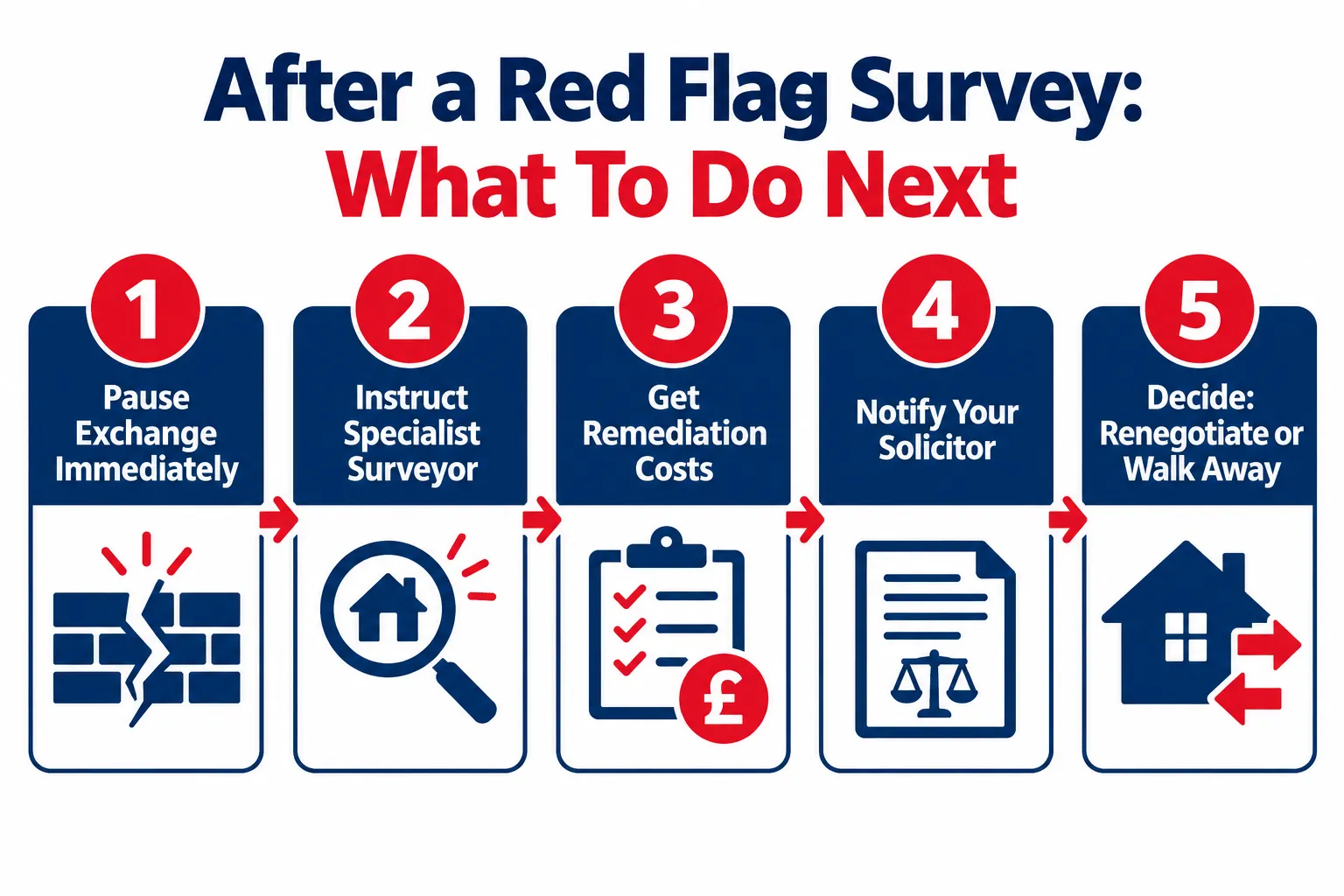
When a survey report contains Condition Rating 3 items, particularly those in Tier 1 or Tier 2 of the hierarchy above, the correct sequence of actions is as follows:
Step 1: Pause the transaction
Contact the solicitor immediately and make clear that exchange of contracts should not proceed until the defects are fully investigated. This is not an overreaction; it is the standard professional advice for serious defects [9].
Step 2: Instruct the right specialist
Depending on the defect, the appropriate specialist may be a structural engineer, a timber and damp specialist, a roofing contractor, an asbestos surveyor, a fire safety engineer, or an electrical contractor. The surveyor's report should indicate which type of specialist is required [6][8].
Step 3: Obtain remediation costs and a scope of works
A specialist's report should provide not just a diagnosis but a costed scope of works. Without this, any price renegotiation is based on guesswork.
Step 4: Reassess the transaction
Armed with a specialist report and remediation costs, the buyer can make an informed decision: renegotiate the purchase price, require the seller to carry out works before completion, or withdraw from the transaction entirely.
Step 5: Ensure legal protections are in place
Where defects relate to unpermitted works, the solicitor should advise on indemnity insurance, retrospective consent applications, or other legal remedies. These are not substitutes for structural safety but may be appropriate for legal compliance issues [9].
A Note on Survey Level and Red Flag Detection
The level of survey commissioned directly affects how many red flags are likely to be identified. A RICS Level 1 Home Condition Survey provides a basic traffic-light overview and is appropriate only for new-build or conventionally constructed modern properties [2]. A RICS Level 2 Home Survey provides more detail but does not include structural calculations or investigation of concealed areas [7]. A RICS Level 3 Building Survey is the most thorough option and is strongly recommended for:
- Properties built before 1930
- Properties that have been significantly altered or extended
- Properties in poor or unknown condition
- Non-standard construction (timber frame, thatched roof, listed buildings)
Buyers who commission a Level 1 or Level 2 survey on a property that warrants a Level 3 may receive a report that flags concerns without fully investigating them. In such cases, the survey may note that further investigation is required, and that recommendation should be treated with the same urgency as a Condition Rating 3 [1][3].
Conclusion
Identifying red flags in a UK building survey report: issues that demand immediate action, not just renegotiation, requires buyers to understand both the formal RICS condition rating framework and the practical hierarchy of defect severity. Not every Condition Rating 3 item is a reason to walk away, but every one of them is a reason to pause, investigate, and take professional advice before proceeding.
The actionable steps are clear:
- Read every Condition Rating 3 item in the survey report carefully and identify which tier of severity it falls into.
- Contact the solicitor before exchange if any Tier 1 or Tier 2 defects are present.
- Commission the appropriate specialist, structural engineer, asbestos surveyor, electrical contractor, before making any financial decision.
- Use the specialist's costed report as the basis for any renegotiation, not the survey report alone.
- Do not allow estate agents or sellers to reframe a safety or structural issue as a simple price adjustment.
A building survey is not a valuation exercise. It is a risk assessment. Treating it as such, and acting on its most serious findings with appropriate urgency, is the foundation of a safe and informed property purchase in 2026.
References
[1] Rics structural survey practice – https://www.bathnes.gov.uk/sites/default/files/2020-02/RICS%20structural%20survey%20practice_0.pdf
[2] Rhs Level One Final – https://www.rics.org/content/dam/ricsglobal/documents/standards/rhs_level_one_final.pdf
[3] Description Of The Rics Home Survey Level 3 – https://www.rics.org/content/dam/ricsglobal/documents/standards/description_of_the_rics_home_survey_level_3.pdf
[4] Client Survey 2026 Contractors – https://constructionmanagement.co.uk/client-survey-2026-contractors/
[5] How To Read A Survey Report Traffic Lights A South London Buyers Guide 2026 – https://southsurveyors.co.uk/2026/05/19/how-to-read-a-survey-report-traffic-lights-a-south-london-buyers-guide-2026/
[6] Rics Home Survey Standard In Practice What Level 2 And Level 3 Reports Should Say About Risk – https://princesurveyors.co.uk/blog/rics-home-survey-standard-in-practice-what-level-2-and-level-3-reports-should-say-about-risk/
[7] Rhs Level Two – https://www.rics.org/content/dam/ricsglobal/documents/standards/rhs_level_two.pdf
[8] Rhs Level Three – https://www.rics.org/content/dam/ricsglobal/documents/standards/rhs_level_three.pdf
[9] Retrospective Building Surveys And Valuations After Buying What To Do If You Discover Serious Defects – https://princesurveyors.co.uk/blog/retrospective-building-surveys-and-valuations-after-buying-what-to-do-if-you-discover-serious-defects/
[10] Building Survey Red Flags What Should And Shouldnt Scare You – https://delamerenicolet.co.uk/building-survey-red-flags-what-should-and-shouldnt-scare-you/