Nearly one in three UK homebuyers who skip a professional building survey later discover defects that cost more to repair than the survey itself would have cost. That single statistic makes the search for the best building surveyors in the UK one of the most financially consequential decisions in any property transaction, yet most buyers still choose on price alone.
This guide takes a different approach. Rather than listing firms by city, it gives buyers a repeatable national framework for evaluating any surveyor against the criteria that actually predict quality: RICS status, professional indemnity insurance, relevant local experience, turnaround times, and transparent fee structures. Whether the property is a Victorian terrace in Manchester or a modern flat in Bristol, the same evaluation criteria apply.
Key Takeaways
- RICS accreditation and regulated body membership are the non-negotiable baseline for any surveyor shortlist in 2026.
- Survey fees vary significantly by level (Level 1 to Level 3), property value, and location, comparing headline prices without matching survey scope leads to poor decisions.
- Professional indemnity (PI) insurance, verified client reviews, and realistic turnaround times are equally important quality signals alongside qualifications.
- Industry recognition and awards offer a practical shortlisting tool when local knowledge is hard to verify independently.
- Online comparison platforms now provide transparent fee benchmarking, but buyers must still interrogate what each quote actually includes.
Why Qualifications Are the First Filter When Comparing UK Building Surveyors
The term "building surveyor" is not legally protected in the UK. Anyone can, in principle, advertise surveying services without formal training. This makes professional accreditation the single most important filter when searching for the best building surveyors in the UK.
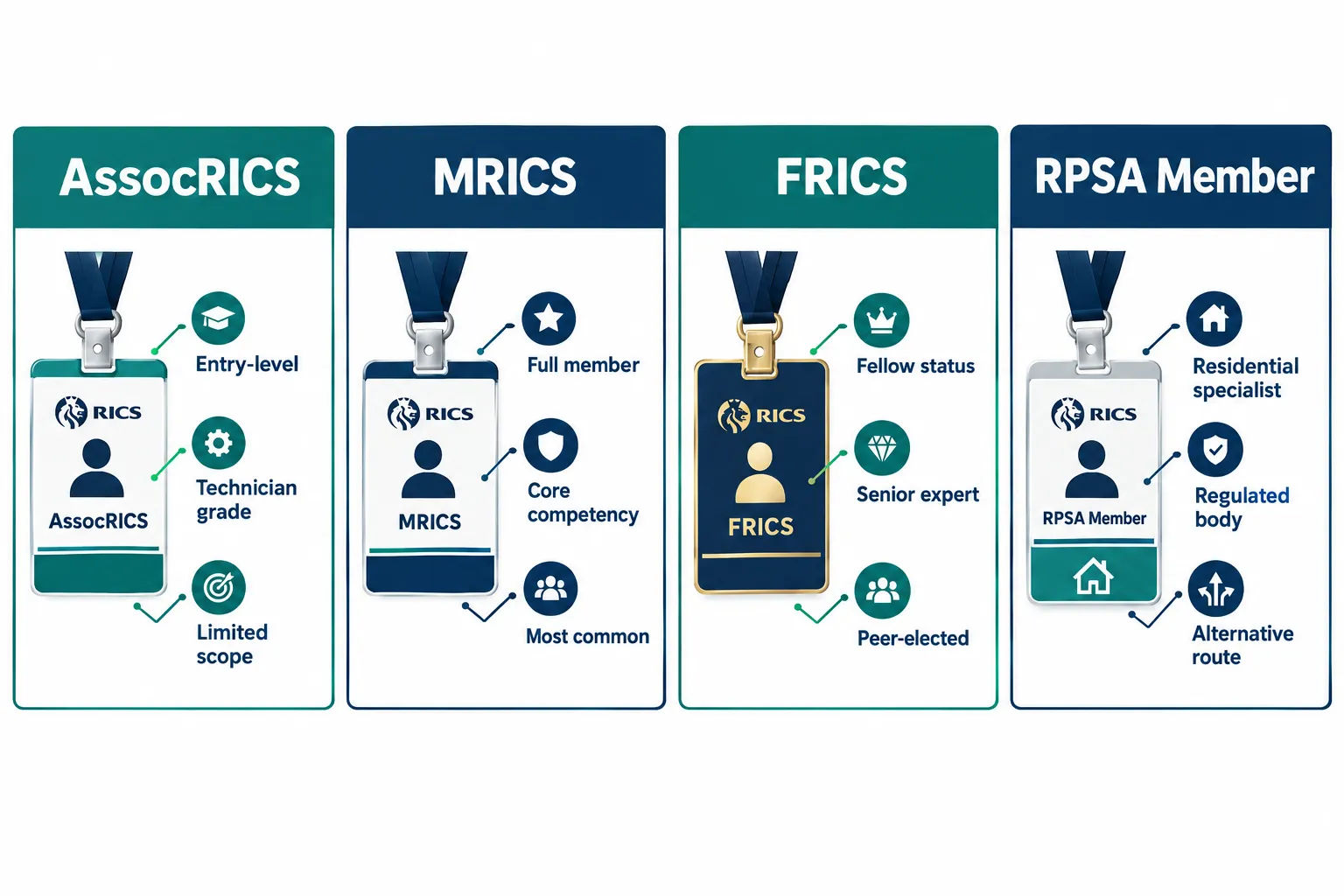
RICS (Royal Institution of Chartered Surveyors) remains the dominant regulatory body. RICS-regulated firms must follow defined practice standards, carry adequate professional indemnity insurance, and adhere to a formal complaints procedure. Within RICS membership, three designations are most relevant to residential buyers:
- AssocRICS, Associate member; suitable for straightforward surveys but with a narrower scope of practice.
- MRICS, Full Chartered Surveyor; the standard designation for most residential building surveys.
- FRICS, Fellow of RICS; a peer-elected senior grade indicating significant expertise and professional standing.
The Residential Property Surveyors Association (RPSA) offers an alternative regulated route. RPSA members are residential specialists who follow their own regulated reporting standards and are subject to independent oversight [5]. For buyers who want a surveyor focused exclusively on residential property, RPSA membership is a credible alternative to RICS.
"Accreditation is not a guarantee of quality in every case, but the absence of it is a reliable warning sign."
What to check before shortlisting any surveyor:
- Confirm RICS or RPSA membership directly on the respective body's online register, do not rely solely on a firm's own website claims.
- Ask whether the surveyor personally holds the designation or whether only the firm does.
- Verify that professional indemnity (PI) insurance is current and covers the property type and value being surveyed.
- Check whether the firm is subject to a formal complaints and redress scheme.
RICS guidance published in 2026 continues to emphasise that regulated practice and clear reporting standards are the foundation of consumer protection in the surveying sector [1]. Buyers who skip this verification step and choose on price alone take on a risk that is entirely avoidable.
The Role of Specialist Experience Alongside Formal Qualifications
Formal qualifications establish a baseline. Local and property-type experience determines whether a surveyor can add genuine value beyond a standard checklist.
A chartered surveyor who has spent a decade inspecting Victorian terraces in a specific region will identify period-specific defects, lime mortar failure, original sash window decay, historic damp patterns, that a generalist surveyor might miss or misclassify. Similarly, a surveyor experienced with modern timber-frame construction will approach a 2000s-built property very differently from one whose practice is concentrated on pre-war stock.
Questions to ask about local and specialist experience:
- How many surveys has the surveyor completed on properties of this type and age in this area?
- Can the firm provide anonymised examples of defects identified in comparable local properties?
- Does the surveyor have experience with specific issues common to the area (e.g., subsidence risk zones, flood plain proximity, mining legacy areas)?
Industry awards and recognition from bodies such as RICS, the RPSA, or regional property associations offer a practical shortlisting signal. Award-winning firms have typically been assessed against peer benchmarks, which provides an independent quality indicator that goes beyond self-reported credentials.
How to Compare Fees Intelligently: Survey Levels, Property Values and What "Competitive" Really Means
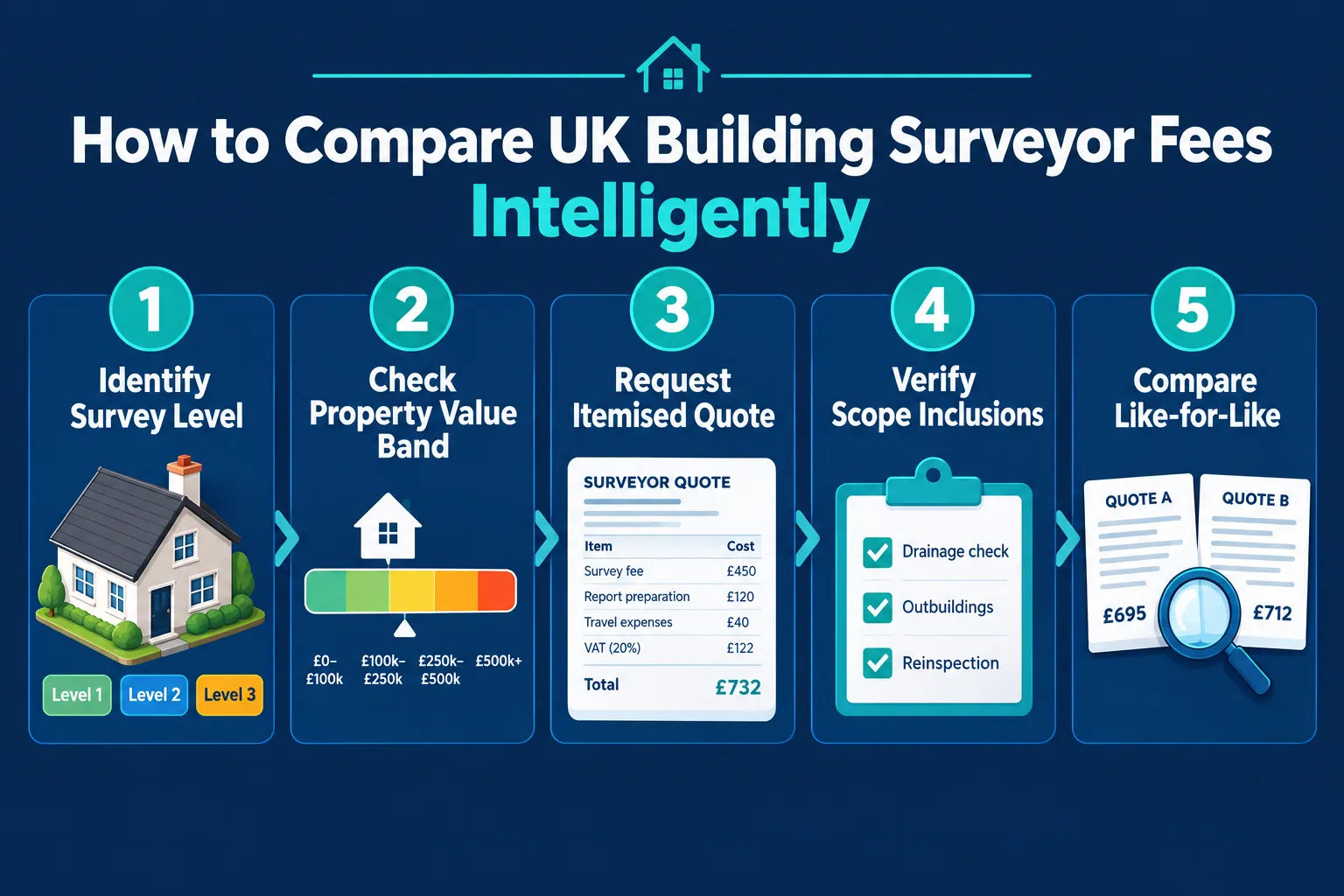
Fee comparison is where most buyers make their first mistake. The best building surveyors in the UK do not necessarily charge the highest fees, but the cheapest quote is rarely the safest choice either. Evidence from 2025-2026 shows survey prices rising across all levels, meaning that quotes significantly below market benchmarks deserve careful scrutiny rather than automatic acceptance [2] [7].
Understanding the Three Survey Levels
RICS defines three standard survey levels for residential properties. Matching the correct level to the property is the starting point for any meaningful fee comparison.
Level 1, RICS Home Survey (Condition Report)
A basic traffic-light condition report with no advice on repairs or maintenance. Suitable only for new-build or near-new properties in demonstrably good condition.
- Typical 2026 fee range: approximately £300,£500 [4] [8]
- Not recommended for older, extended, or non-standard construction properties
Level 2, RICS Home Survey (HomeBuyer Report)
The most commonly purchased survey. Includes condition ratings, advice on significant defects, and a market valuation (if requested). Suitable for conventional properties built after approximately 1900 that appear to be in reasonable condition.
- Typical 2026 fee range: approximately £400,£1,000+ depending on property value and location [2] [6] [9]
- Fee rises sharply for higher-value properties and in London and the South East
Level 3, RICS Building Survey (Full Structural Survey)
The most comprehensive option. Covers construction, condition, defects, and detailed repair recommendations. Essential for older properties, unusual construction types, extended properties, or any property where significant defects are suspected.
- Typical 2026 fee range: approximately £600,£1,500+ [4] [7] [10]
- Higher cost is justified by the depth of reporting and the potential to negotiate significant price reductions or identify deal-breaking defects
How Property Value and Location Affect What "Fair" Looks Like
Location and property value are the two variables that most influence whether a quote is competitive or inflated. A Level 2 survey on a £200,000 property in the North West might cost £450,£550, while the same survey level on a £700,000 property in Greater London could reasonably reach £900,£1,100 [3] [8].
Online comparison and pricing hub platforms now play a significant role in making this benchmarking accessible. Sites that aggregate surveyor quotes allow buyers to see regional price distributions rather than relying on a single firm's word that their fee is "standard" [6] [2].
- Survey level (Level 1, 2, or 3)
- Whether a market valuation is included or charged separately
- Property type and construction covered by the fee
- Whether outbuildings, garages, or annexes are included
- Drainage inspection or specialist sub-reports (usually extra)
- Reinspection fee if access is denied on the day
- Estimated turnaround time from inspection to report delivery
Why "Cheap" Quotes Deserve Scrutiny in 2026
Survey fees have risen in 2025-2026 alongside broader property market cost inflation [1] [10]. A quote that sits well below the current national range for the relevant survey level and property value should prompt two questions: what has been excluded from the scope, and is the surveyor cutting corners on inspection time?
A Level 3 Building Survey on a Victorian semi-detached property typically requires three to four hours on-site. A surveyor quoting a fee that implies a 90-minute visit is almost certainly not delivering a Level 3 inspection, regardless of what the paperwork says.
What a "Best-in-Class" Surveyor Actually Delivers: Practical Standards for 2026
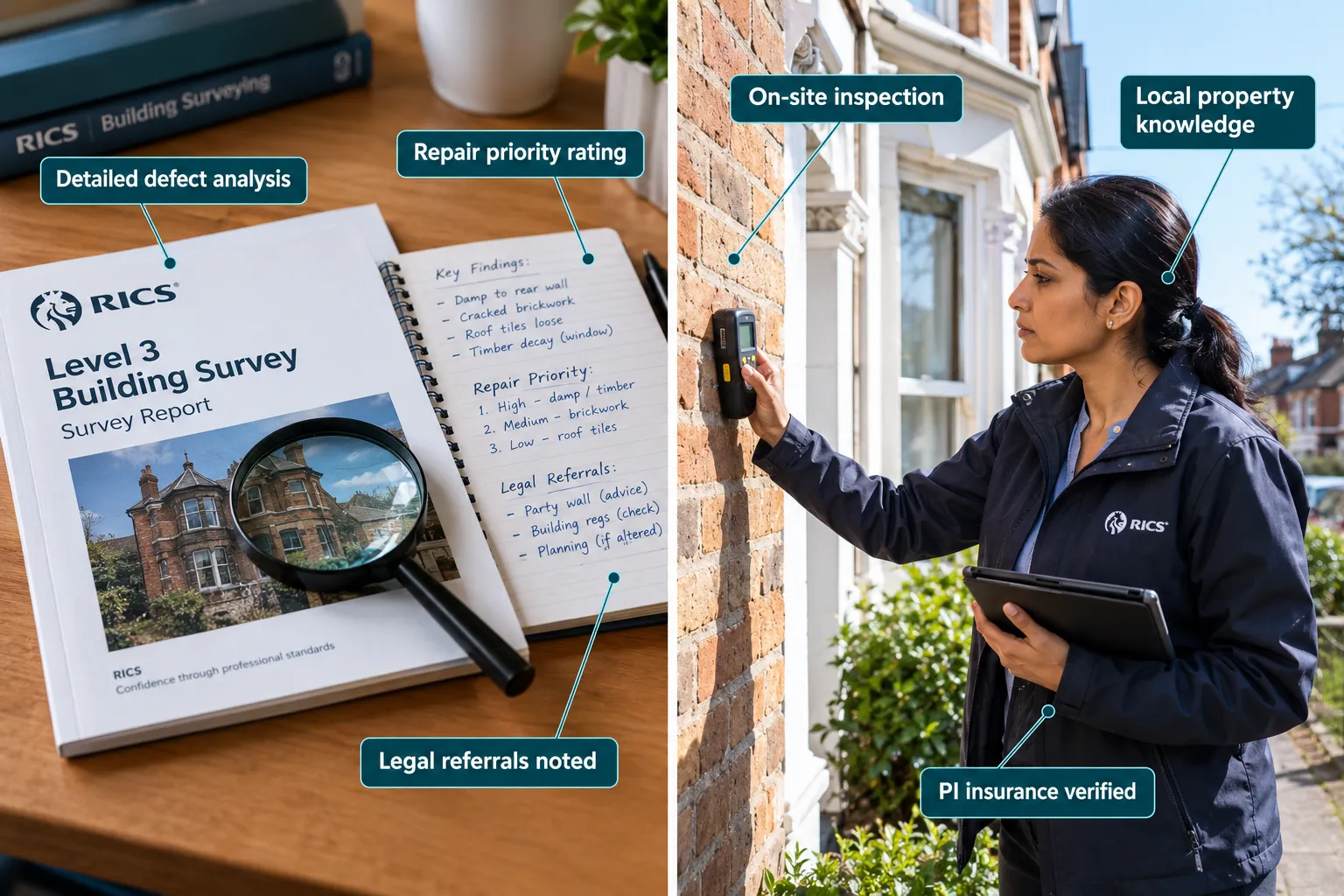
Identifying the best building surveyors in the UK requires looking beyond credentials and fees to what the surveyor actually delivers in practice. The following standards, drawn from 2026 consumer guidance and industry best practice, form a practical evaluation framework.
Report Quality and Clarity
A high-quality survey report should be:
- Specific to the property, not a generic template with property address inserted. Every section should reference actual observations from the inspection.
- Actionable, defects should be categorised by urgency and accompanied by clear repair recommendations or referrals to specialists.
- Written in plain English, technical terms should be explained. A report that requires a second professional to interpret is not serving the buyer.
- Delivered within the agreed timeframe, typically five to ten working days for a Level 2, up to fifteen for a comprehensive Level 3 [9].
RICS reporting standards require that Level 2 and Level 3 reports include condition ratings (1-3) for each element inspected, with clear guidance on what each rating means for the buyer's decision-making [3].
Turnaround Times and Responsiveness
Turnaround time matters in competitive property markets where buyers are working to mortgage offer deadlines. Before instructing a surveyor, confirm:
- The earliest available inspection date
- The guaranteed report delivery timeframe from inspection
- Whether the surveyor is personally contactable after report delivery to discuss findings
A surveyor who delivers a report and then becomes unreachable has not completed the service. The ability to ask follow-up questions, particularly about defects that may affect the purchase price negotiation, is a practical quality marker that buyers often overlook until it is too late.
Professional Indemnity Insurance: The Non-Negotiable Safety Net
PI insurance protects the buyer if a surveyor misses a significant defect that a competent professional should have identified. Without adequate PI cover, a negligence claim against a surveyor may be unenforceable in practice.
Minimum PI insurance checks:
- Confirm the policy is current and covers the property value
- Verify the level of cover (minimum £1 million is standard; higher-value properties require higher limits)
- Check whether the firm's PI cover extends to all surveyors employed, not just partners
Client Reviews: How to Read Them Critically
Online reviews are a useful signal but require careful interpretation. When evaluating reviews for a surveying firm:
- Prioritise reviews that describe specific outcomes (defects identified, price renegotiations achieved, post-report support) over generic praise.
- Look for patterns across multiple reviews rather than relying on individual testimonials.
- Check whether negative reviews relate to report quality and communication or merely to price, the former is a genuine quality signal, the latter is not.
- Verify reviews on independent platforms (Google, Trustpilot, Checkatrade) rather than relying solely on testimonials hosted on the firm's own website.
A 2026 Checklist for Comparing UK Building Surveyors
The following criteria bring together the key evaluation dimensions discussed throughout this guide:
| Criterion | What to Verify |
|---|---|
| RICS or RPSA membership | Check directly on the regulatory body's register |
| Surveyor's personal designation | MRICS, FRICS, or RPSA equivalent |
| PI insurance | Current, adequate for property value |
| Survey level match | Level 1, 2, or 3 appropriate to property |
| Fee scope | All inclusions and exclusions itemised |
| Local experience | Years active in area, property types covered |
| Turnaround time | Confirmed in writing before instruction |
| Post-report access | Named surveyor contactable for follow-up |
| Independent reviews | Verified on third-party platforms |
| Complaints procedure | Formal RICS or RPSA redress route in place |
Conclusion
Finding the best building surveyors in the UK is not a matter of searching for the most recognisable brand or the lowest quote. It is a structured evaluation process that begins with regulated accreditation, moves through intelligent fee comparison matched to survey level and property type, and concludes with a practical assessment of what the surveyor will actually deliver.
Actionable next steps for buyers in 2026:
- Verify every shortlisted surveyor's RICS or RPSA membership directly on the regulatory body's online register before requesting a quote.
- Match the survey level to the property, do not accept a Level 1 or Level 2 for an older, extended, or non-standard property where a Level 3 is warranted.
- Request itemised quotes from at least three surveyors, specifying the same property details and survey scope, then compare inclusions rather than headline prices.
- Use online comparison platforms to benchmark quotes against current 2026 regional fee ranges for the relevant survey level and property value.
- Confirm PI insurance cover, turnaround times, and post-report access in writing before instructing.
- Check independent reviews specifically for evidence of defect identification, communication quality, and post-report support.
A survey is not a cost to minimise, it is due diligence on what is likely the largest financial transaction of a buyer's life. Applying these criteria consistently will identify surveyors who deliver genuine professional value, regardless of where in the UK the property is located.
References
[1] Spring 2026 Hot Topics For Uk Building Surveyors Rics Insights On Market Shifts And Valuation Challenges – https://princesurveyors.co.uk/blog/spring-2026-hot-topics-for-uk-building-surveyors-rics-insights-on-market-shifts-and-valuation-challenges/
[2] House Survey Cost – https://www.surveyorlocal.co.uk/compare-surveys/house-survey-cost
[3] What Sort Of Survey Should I Have – https://hoa.org.uk/advice/guides-for-homeowners/i-am-buying/what-sort-of-survey-should-i-have/
[4] How Much Does A House Survey Cost – https://www.cjbloor.co.uk/advice/rics-home-survey/how-much-does-a-house-survey-cost/
[5] rpsa.org.uk – https://www.ricsfirms.com/industry-news/article/5441/
[6] Pricing Guide – https://surveysnearme.co.uk/pricing-guide/
[7] Cost – https://www.moneysavingadvisors.co.uk/surveys/cost
[8] Property Survey Cost Calculator Uk 2026 – https://ukcalculator.com/property-survey-cost-calculator-uk-2026.html
[9] How Much Does A Home Survey Cost – https://www.mickleson.co.uk/resources/how-much-does-a-home-survey-cost/
[10] Property Survey Cost Uk 2026 – https://www.propertypassport.uk/guides/property-survey-cost-uk-2026