As of May 2026, approximately 4.6 million privately rented homes in England fall under the expanded scope of Awaab's Law — a shift that fundamentally changes how landlords, surveyors, and contractors must approach retrofit works on terraced, semi-detached, and other attached properties [4]. For party wall surveyors, this creates an urgent and largely uncharted obligation: integrating hazard compliance timelines into notices, schedules of condition, and party wall awards before a single drill touches a shared wall.
This guide examines how Party Wall Surveys for Private Rented Sector Retrofit Works: Navigating Awaab's Law 2026 Hazard Extensions and Tenant Rights intersects with the Party Wall etc. Act 1996, the Renters' Rights Act 2025, and the Housing Health and Safety Rating System (HHSRS). Whether a landlord is upgrading insulation, replacing heating systems, or addressing structural damp, the legal landscape in 2026 demands a coordinated, documented, and time-sensitive approach.
Key Takeaways 📋
- Awaab's Law now applies to private landlords from May 2026, with 14-day investigation and 7-day repair timelines for damp and mould hazards.
- Emergency hazards require a 24-hour response, including broken boilers in winter and significant electrical faults.
- Party wall surveyors must embed Awaab's Law compliance into notices, schedules of condition, and awards when retrofit works affect shared walls.
- Non-compliance penalties are severe, ranging from compensation claims worth 25–60% of rent to fines exceeding £10,000 for health-related injuries.
- Phase 3 (October 2027) extends HHSRS hazard categories to include fire, electrical, structural, and hygiene risks — making early protocol development essential.
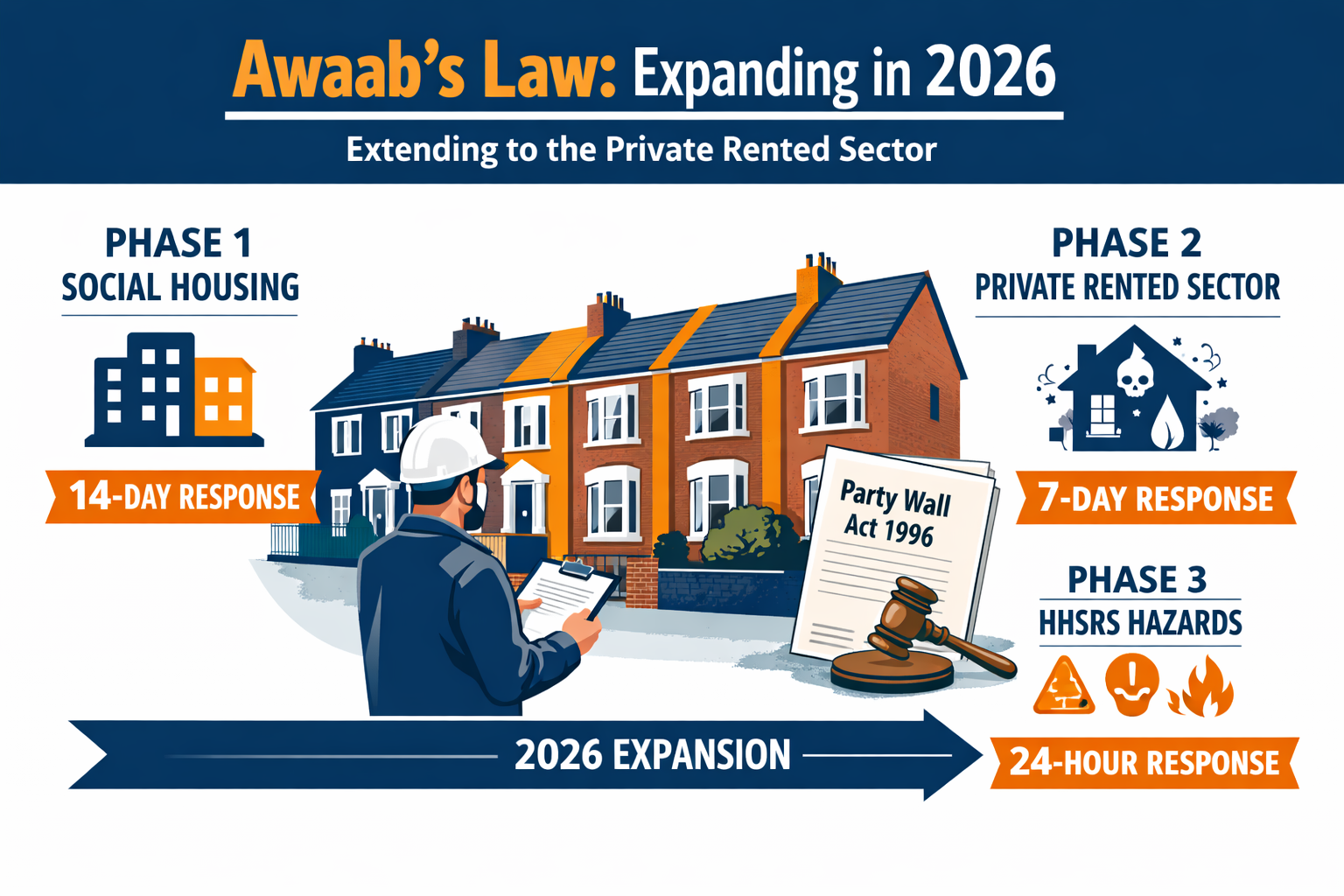
Understanding Awaab's Law 2026: What the PRS Extension Actually Means
Awaab's Law was originally introduced through the Social Housing (Regulation) Act 2023, following the tragic death of two-year-old Awaab Ishak from prolonged mould exposure in a social housing property. The law mandated strict repair timelines for registered social landlords. The 2026 extension brings those same obligations to private landlords across England [4].
The Three-Phase Rollout
| Phase | Sector | Hazard Scope | Key Deadline |
|---|---|---|---|
| Phase 1 | Social Housing | Damp & Mould | Already in force |
| Phase 2 (May 2026) | Private Rented Sector | Damp & Mould | Investigation: 14 days; Repairs: 7 days |
| Phase 3 (Oct 2027) | Private Rented Sector | All HHSRS Hazards (excl. overcrowding) | Full HHSRS scope [1] |
Under Phase 2, private landlords must:
- Investigate damp and mould reports within 14 days of notification [4]
- Begin repairs within 7 days of identifying a serious hazard [4]
- Provide written documentation of investigation findings within 3 working days of completing inspections [1]
- Respond to emergency hazards — gas leaks, boiler failures in winter, major electrical faults — within 24 hours [2]
💬 "The 2026 extension is not a minor administrative update. It is a structural recalibration of landlord liability that touches every aspect of property management — including how retrofit works are planned and executed on shared walls."
Phase 3, arriving in October 2027, extends the law to all significant HHSRS hazards — covering electrical safety, fire risk, structural integrity, and hygiene concerns [1]. This makes it critical for party wall surveyors to begin developing compliant protocols now, not after enforcement begins.
Enforcement and Penalties
Local authorities gain strengthened enforcement powers from 2026 onwards [3]. Non-compliance can result in:
- 🔴 Enforcement orders requiring immediate remediation
- 💰 Compensation claims equivalent to 25–60% of rent paid during the hazard period
- ⚖️ Damages of £1,000–£10,000+ for health-related injuries linked to unaddressed hazards
- 🏠 Loss of rental income if properties are deemed uninhabitable
- 📋 Payment of tenants' legal costs [7]
How Party Wall Surveys for Private Rented Sector Retrofit Works Must Adapt to Awaab's Law 2026 Hazard Extensions and Tenant Rights
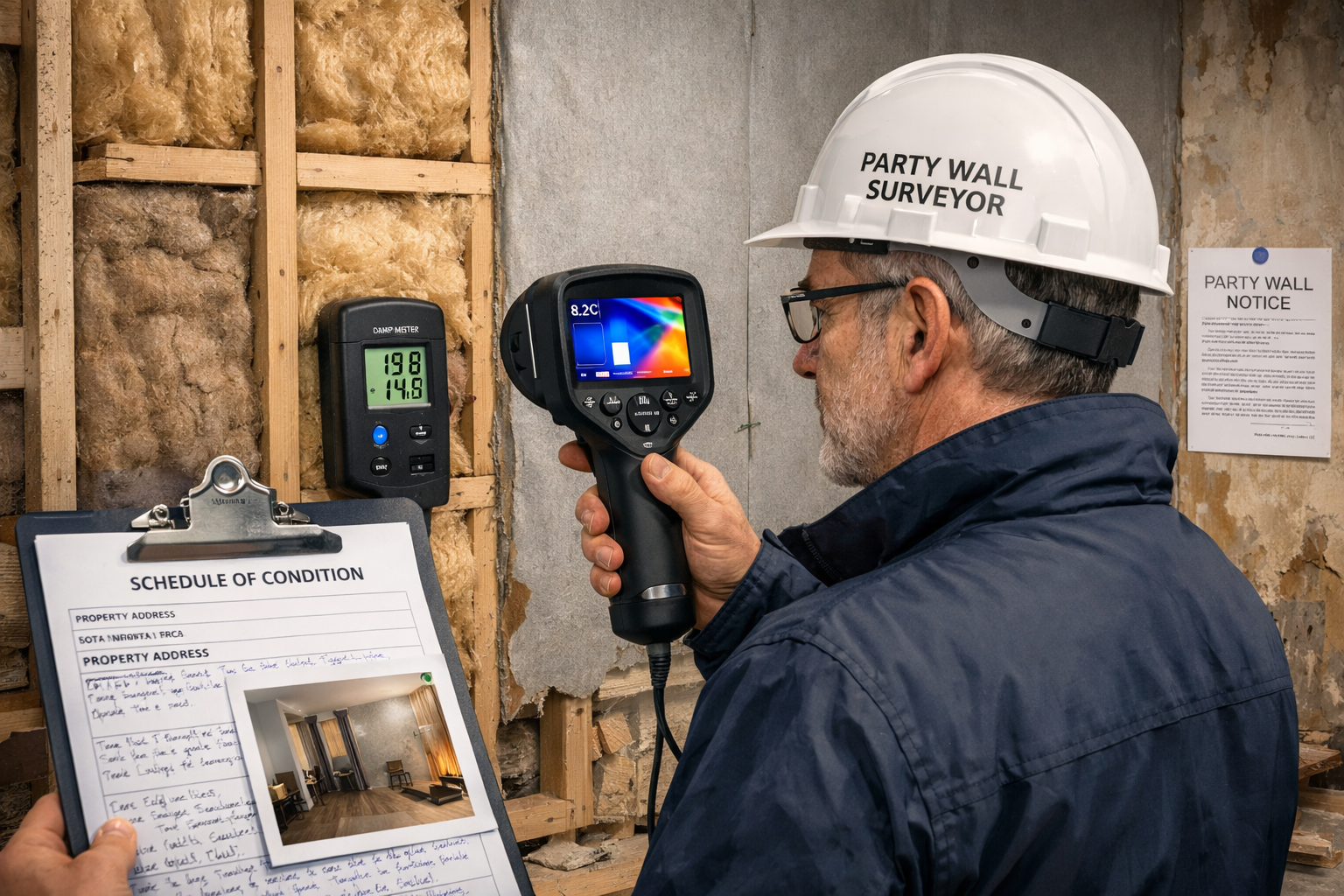
The intersection of Awaab's Law and the Party Wall etc. Act 1996 creates a genuinely novel compliance challenge. Retrofit works — particularly cavity wall insulation, solid wall insulation, heating upgrades, and damp-proofing — frequently involve or adjoin party walls and party structures. When these works are triggered by a legal hazard obligation under Awaab's Law, the usual timelines for party wall procedures come under significant pressure [9].
Why Retrofit Works Trigger Party Wall Obligations
Many of the most common Awaab's Law-relevant retrofit interventions directly engage the Party Wall etc. Act 1996:
- External wall insulation (EWI) on a semi-detached or terraced property may affect the party wall line
- Cavity wall insulation injected through shared walls requires a party wall insulation notice under Section 2 of the Act
- Damp-proofing works involving excavation near a shared boundary may trigger the 3-metre rule under Section 6
- Structural interventions — such as installing new lintels or beams to address excess cold — require formal notification to adjoining owners
When a landlord is legally obligated to begin repairs within 7 days under Awaab's Law but the standard party wall notice period is 1–2 months, the tension is immediate and significant.
Integrating Compliance Timelines: A Practical Framework
Party wall surveyors working in the private rented sector in 2026 should adopt the following integrated approach:
Step 1 — Early Hazard Identification
Commission a schedule of condition report before any retrofit works begin. This documents the pre-works state of both the subject property and the adjoining owner's property, providing essential protection if disputes arise.
Step 2 — Simultaneous Notice Service
Where an Awaab's Law hazard has been identified, serve the party wall notice at the same time as notifying the tenant of the investigation outcome. Do not wait for the notice period to expire before beginning non-invasive investigative works.
Step 3 — Emergency Protocol Activation
For 24-hour emergency hazards (gas, heating failure, electrical), surveyors should advise landlords to proceed with emergency works under common law rights and document the emergency justification thoroughly. Retrospective party wall agreements can be pursued where works were genuinely urgent.
Step 4 — Award Drafting with Hazard Clauses
The party wall award should explicitly reference the Awaab's Law obligation driving the works, the HHSRS hazard category involved, and the agreed methodology for minimising disruption to both the tenant and the adjoining owner.
Step 5 — Post-Works Documentation
Provide written evidence of completed repairs, linking back to the original hazard notification. This satisfies both the Awaab's Law documentation requirement (within 3 working days) [1] and the party wall surveyor's duty to record the condition of adjoining structures post-works.
The Schedule of Condition: A Critical Document
A schedule of condition report is arguably the most important document in any PRS retrofit project touching a party wall. It serves three simultaneous purposes in 2026:
- Protects the adjoining owner from spurious damage claims
- Protects the landlord by demonstrating proactive compliance with hazard identification duties
- Protects the tenant by creating a timestamped record of pre-existing conditions versus new hazards
RICS-Compliant Checklists: Balancing Landlord Obligations, Tenant Protections, and Adjoining Owner Safeguards
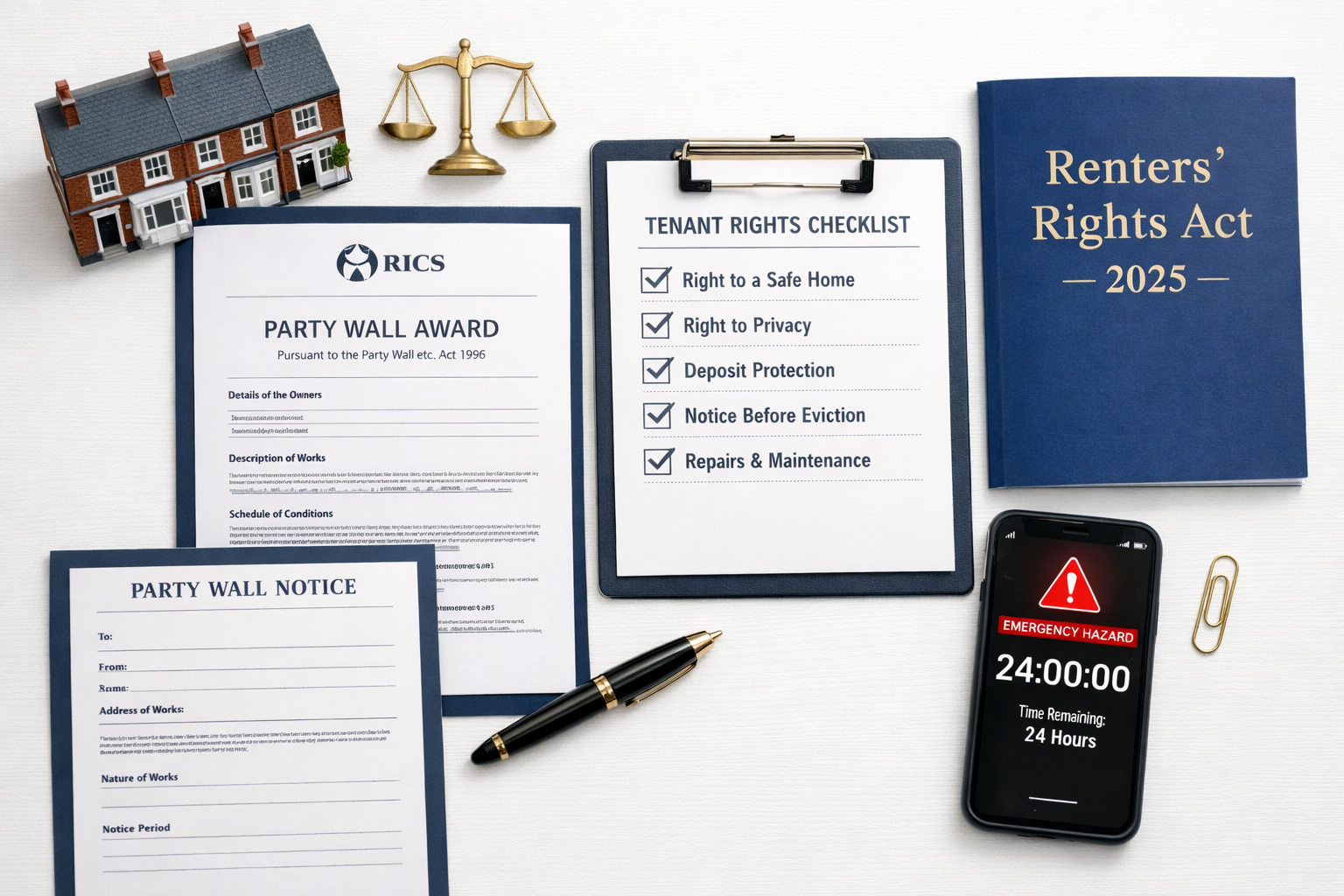
Navigating Party Wall Surveys for Private Rented Sector Retrofit Works: Navigating Awaab's Law 2026 Hazard Extensions and Tenant Rights requires surveyors to hold multiple legal frameworks in mind simultaneously. The following checklists provide a structured approach.
✅ Pre-Works Party Wall Checklist for PRS Retrofit (Awaab's Law Compliant)
Legal & Notification
- Identify all party walls, party structures, and boundary lines affected by proposed retrofit works
- Confirm whether works fall under Section 1 (new wall), Section 2 (works to existing party wall), or Section 6 (excavation notice) of the Party Wall etc. Act 1996
- Serve formal party wall notice to all adjoining owners with minimum statutory notice period
- Document the HHSRS hazard category driving the works (for Awaab's Law compliance)
- Confirm whether the hazard triggers a 24-hour, 7-day, or 14-day response obligation [2]
Survey & Documentation
- Commission schedule of condition for adjoining property before works begin
- Conduct structural survey of party wall to identify pre-existing defects
- Photograph and record all areas within 3 metres of proposed works
- Check for asbestos in walls, ceilings, or floors before any invasive works
Tenant Rights (Renters' Rights Act 2025)
- Provide tenant with written notice of planned works and expected duration
- Confirm works will not render the property uninhabitable without alternative accommodation arrangements
- Ensure works do not create new HHSRS hazards (e.g., dust, noise, cold ingress during insulation removal)
- Provide tenant with copy of Awaab's Law investigation findings within 3 working days [1]
✅ Party Wall Award Clauses for Awaab's Law Retrofit Works
When drafting a party wall award for PRS retrofit works in 2026, include:
- Hazard Recital Clause — Explicitly state the HHSRS hazard category and the statutory obligation under Awaab's Law driving the works
- Emergency Works Protocol — Define the threshold for emergency works that may proceed without prior consent, with retrospective notification obligations
- Tenant Access Clause — Confirm the surveyor's right to access the property during works for monitoring purposes, consistent with tenant rights under the Renters' Rights Act 2025
- Completion Certification — Require the building contractor to provide a completion certificate confirming the hazard has been remediated, to be shared with the local authority if requested [3]
- Reinstatement Obligations — Specify the standard to which any disturbed party wall or structure must be reinstated
Understanding the Adjoining Owner's Position
Adjoining owners — whether owner-occupiers or landlords themselves — retain full rights under the Party Wall etc. Act 1996 regardless of Awaab's Law obligations. A landlord's statutory duty to their tenant does not override an adjoining owner's right to:
- Appoint their own surveyor
- Dispute the proposed method of works
- Claim compensation for damage caused
If an adjoining owner carries out works without a party wall agreement or if no party wall notice has been served, the situation becomes legally complex — particularly when Awaab's Law timelines are already running. Early engagement with a chartered surveyor experienced in both party wall and PRS compliance is essential.
Cost Implications and Practical Considerations for Landlords in 2026
Understanding the cost of party wall surveys is important for landlords planning retrofit works under Awaab's Law. Costs typically include:
- Party wall surveyor fees: £700–£2,500+ depending on complexity and whether an agreed or appointed surveyor is used
- Schedule of condition: £300–£800 for a standard mid-terrace
- Structural surveys for party walls with suspected defects: £500–£1,500
- Emergency works premium: 20–40% above standard contractor rates for 24-hour response works
These costs must be weighed against the penalties for non-compliance with Awaab's Law, which can reach £10,000+ in health-related damages alone [7], plus potential rent refunds of 25–60% of all rent paid during the hazard period.
Key Risk Areas for PRS Landlords Undertaking Retrofit
| Risk | Awaab's Law Exposure | Party Wall Exposure |
|---|---|---|
| Cavity wall insulation causing damp | High — new hazard created | Medium — works to party wall |
| Heating system replacement | High — excess cold hazard | Low — internal works only |
| External wall insulation | Medium — may address damp | High — affects party wall line |
| Damp-proof course installation | High — directly addresses hazard | Medium — excavation may trigger Section 6 |
| Roof works affecting shared chimney | Medium | High — party structure involved |
Conclusion: Actionable Next Steps for Surveyors and Landlords
The expansion of Awaab's Law to the private rented sector in 2026 is not simply a landlord compliance issue — it is a party wall practice issue. Surveyors who fail to integrate hazard response timelines into their notice and award procedures risk leaving landlord clients exposed to enforcement action, and tenant clients without the protections the law now guarantees.
Immediate Actions for Party Wall Surveyors 🔑
- Update standard notice templates to include HHSRS hazard recitals and Awaab's Law compliance references
- Develop an emergency works protocol for 24-hour hazard situations that documents the legal justification for proceeding without prior consent
- Build multi-disciplinary relationships with asbestos surveyors, structural engineers, and HVAC specialists who understand Awaab's Law timelines
- Advise landlord clients proactively — do not wait for a hazard report to arrive before discussing party wall obligations
- Commission schedules of condition early — before any retrofit works are planned, not after a hazard is identified
Immediate Actions for Private Landlords 🏠
- Audit all properties for HHSRS hazards before the May 2026 deadline
- Identify all party walls in your portfolio and understand which retrofit works will require formal notification
- Instruct a chartered surveyor experienced in both PRS compliance and party wall procedures
- Document everything — investigation dates, findings, repair commencement, and completion
- Engage tenants transparently — written communication is now a legal requirement, not best practice
The legal landscape for private landlords and party wall surveyors has fundamentally shifted. Those who treat Party Wall Surveys for Private Rented Sector Retrofit Works: Navigating Awaab's Law 2026 Hazard Extensions and Tenant Rights as a single integrated discipline — rather than two separate compliance exercises — will be best placed to protect their clients, their tenants, and their professional reputations in 2026 and beyond.
References
[1] Awaab's Law Is Coming To Private Landlords Is Your Property Ready – https://www.eborpropertyco.co.uk/post/awaab-s-law-is-coming-to-private-landlords-is-your-property-ready
[2] Awaabs Law Private Rented Sector Extension – https://awaabs-law.com/awaabs-law-private-rented-sector-extension
[3] Awaabs Law Private Landlords 2026 – https://www.idealresponse.co.uk/blog/awaabs-law-private-landlords-2026/
[4] Awaabs Law What Private Landlords Need To Know Before 2026 – https://objectivehealth.co.uk/news/awaabs-law-what-private-landlords-need-to-know-before-2026
[5] Awaabs Law Technical Compliance Hvac Ventilation – https://www.arm-environments.com/resources/awaabs-law-technical-compliance-hvac-ventilation
[6] Awaabs Law For Housing Providers – https://www.buildtestsolutions.com/news/awaabs-law-for-housing-providers
[7] Awaabs Law Comes Into Force What Does It Mean For Construction – https://www.trowers.com/insights/2025/november/awaabs-law-comes-into-force-what-does-it-mean-for-construction
[8] Awaabs Law – https://www.rpclegal.com/thinking/construction/awaabs-law/
[9] Awaabs Law Extensions To Prs In 2026 Party Wall And Building Survey Protocols For New Hazard Categories – https://nottinghillsurveyors.com/blog/awaabs-law-extensions-to-prs-in-2026-party-wall-and-building-survey-protocols-for-new-hazard-categories