
Nearly 40% of first-time buyers entering the spring 2026 market are targeting properties built between 1965 and 1980 — drawn by comparatively lower asking prices and increased availability. Yet a significant proportion of this stock consists of concrete frame construction carrying defect profiles that a standard mortgage valuation will never uncover. Understanding building survey defect patterns in 1970s concrete frame properties: structural assessment protocols for spring 2026 buyer surge is no longer a niche specialism — it is essential knowledge for every buyer, surveyor, and lender active in this market right now.
Key Takeaways 📋
- Concrete rot and reinforcement corrosion are the most dangerous — and most frequently missed — defects in 1970s concrete frame stock.
- Precast reinforced concrete (PRC) homes classified under the Housing Defects Act 1984 carry mortgage restrictions unless a valid PRC Certificate exists.
- A Level 3 Building Survey (formerly Full Structural Survey) is the minimum appropriate survey type for any 1970s concrete frame property.
- Cold bridges, cavity wall failures, and aluminium window corrosion compound structural risks and affect insurability as well as value.
- Spring 2026's buyer surge means survey backlogs are growing — early instruction of a RICS chartered building surveyor is strongly advised.
Why 1970s Concrete Frame Properties Dominate the Spring 2026 Market
The spring 2026 first-time buyer rebound is being driven by improved mortgage affordability following successive Bank of England base rate adjustments and the extended Help to Buy successor scheme. This has pushed a wave of new purchasers toward the most affordable urban housing stock available — and that stock is disproportionately composed of system-built and concrete frame properties erected during the late 1960s and 1970s construction boom.
Local authorities and private developers of that era favoured industrialised building systems to meet urgent housing targets. The result was a generation of concrete frame flats, maisonettes, and low-rise blocks that are now between 45 and 55 years old. Many have received minimal structural maintenance. Some have been cosmetically refurbished, masking underlying defects from casual inspection.
💡 Pull Quote: "A fresh coat of paint on a 1970s concrete frame building is not a structural assessment — it is a liability waiting to be discovered."
For buyers, the risk is compounded by a widespread misunderstanding about survey types. Many assume a mortgage lender's valuation provides adequate protection. It does not. As explained in our guide on whether a mortgage valuation is the same as a survey, a valuation is carried out solely for the lender's security purposes and will not identify the structural defects discussed below.
Core Defect Patterns: What Building Surveys Must Identify
Understanding building survey defect patterns in 1970s concrete frame properties requires surveyors to work through a structured hierarchy of risk. The defects below are listed in order of structural severity.
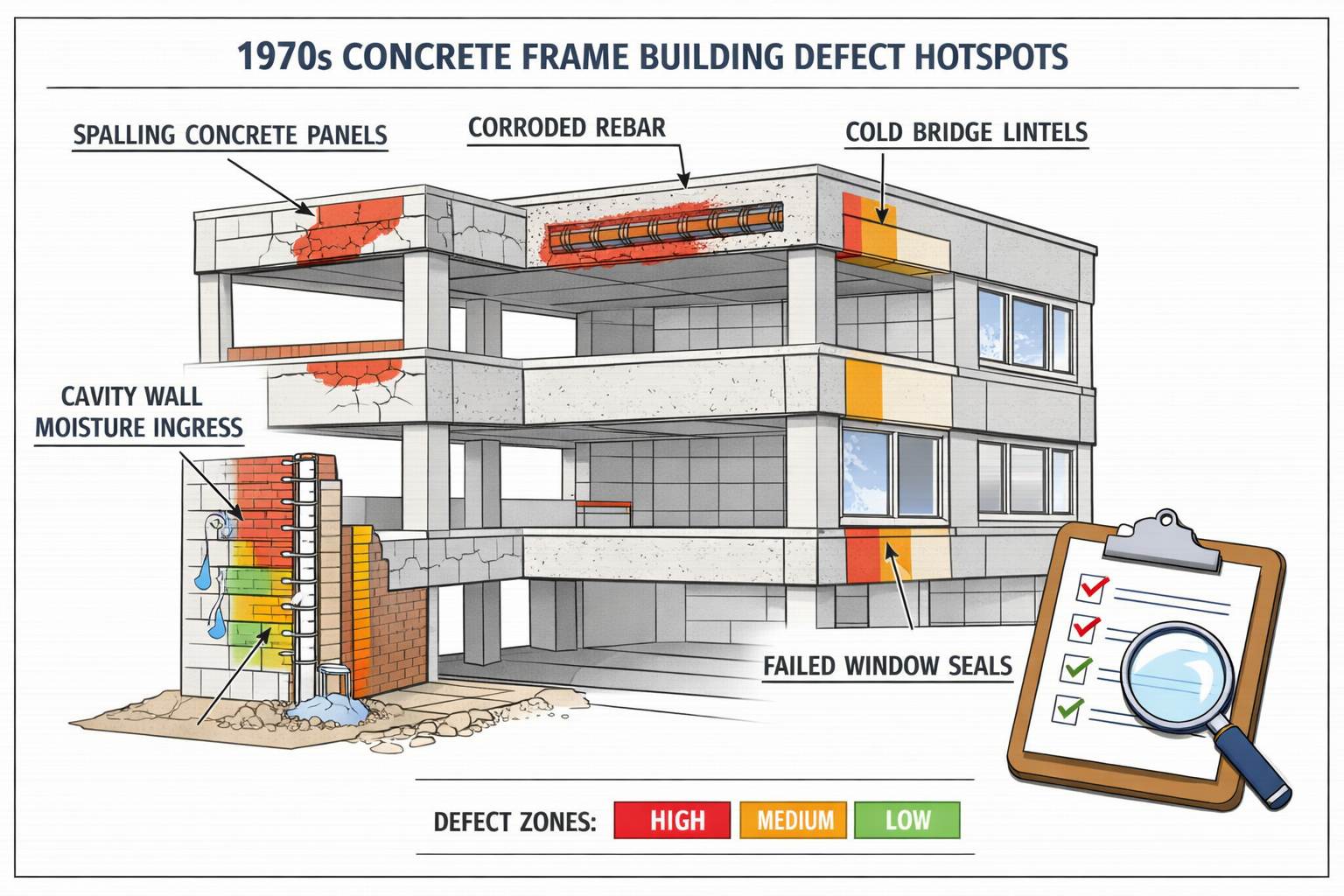
1. Concrete Rot and Reinforcement Corrosion 🔴
Concrete rot — technically known as reinforcement corrosion or rebar corrosion — remains the single most dangerous defect class in this building era [3]. It occurs when oxygen or chloride ions penetrate the concrete cover and reach the embedded steel reinforcement. Once the steel begins to oxidise, it expands in volume, generating internal pressure that fractures the surrounding concrete from within.
The visible symptoms include:
- Rust staining (brown or orange streaks running from joints or cracks)
- Spalling — chunks of concrete detaching from the surface
- Delamination — thin surface layers separating from the substrate
- Cracking aligned with reinforcement bars beneath
Particularly vulnerable systems include Kwaaitaal floors (built 1965–1983) and Manta floors (1965–1981), which are especially susceptible to rapid concrete rot when crawl spaces are damp or poorly ventilated, and can deteriorate to the point of floor failure [3]. Surveyors must probe all accessible concrete elements with a hammer (the "ringing" test) and use a carbonation depth indicator where permitted.
2. Precast Reinforced Concrete (PRC) System Classification 🔴
Several 1970s housing types — including Airey, Cornish Unit, Reema, Wates, and Orlit constructions — were formally classified as defective under the Housing Defects Act 1984 [4]. This classification was not cosmetic. It reflected genuine structural inadequacy in the precast panel systems used.
The practical consequences for 2026 buyers are severe:
| Issue | Impact |
|---|---|
| Unrepaired PRC home | Mortgage almost universally refused by mainstream lenders [4] |
| No PRC Certificate | Property effectively unmortgageable |
| Retrospective certificate | Some lenders may accept with higher deposit [4] |
| Certified remediated PRC | Standard mortgage products available |
Any buyer considering a property that may fall within a PRC designation must instruct a structural survey before exchange. The surveyor must confirm whether a valid PRC Certificate exists and whether the remediation work meets current standards.
3. Cold Bridge Defects at Concrete Lintels ⚠️
Concrete lintels installed in 1970s properties frequently lack insulation continuity. Where surrounding masonry or panel walls have been insulated — either at original construction or through subsequent retrofit — the concrete lintel itself acts as a thermal bridge, conducting cold from outside to the inner surface [3].
The consequences compound over time:
- Condensation forms on the cold inner face
- Mould growth follows, affecting air quality and finishes
- Moisture accelerates rust-induced cracking in the lintel itself
- Load-bearing capacity of the lintel can be compromised [3]
Surveyors should use a thermal imaging camera during cold weather surveys to identify cold bridge locations invisible to the naked eye. All lintels over window and door openings in concrete frame properties warrant close inspection.
4. Cavity Wall Ventilation Failure ⚠️
Many 1970s concrete frame and system-built properties incorporated cavity walls that have since had ventilation openings sealed — either deliberately during insulation upgrades or inadvertently during maintenance works [3]. A poorly ventilated cavity becomes a moisture trap.
The downstream effects include:
- Rising damp and lateral moisture penetration
- Timber decay in floor joists and window frames adjacent to damp cavities
- Internal condensation and persistent mould
- Degradation of any cavity wall insulation installed retrospectively
A subsidence survey may also be warranted where prolonged moisture ingress has affected ground conditions around shallow foundations — a not uncommon finding in 1970s low-rise concrete frame blocks.
5. Aluminium Window Frame Corrosion and Seal Failure ⚠️
Aluminium window frames fitted during the 1970s and 1980s are now well beyond their design life. They are particularly prone to oxidation corrosion, seal failure, and glazing bead deterioration [1]. In concrete frame buildings, failed window seals also create direct water ingress pathways into the structural frame itself — accelerating the reinforcement corrosion cycle described above.
Surveyors should check:
- Condition of rubber glazing profiles (brittleness, cracking, shrinkage)
- Evidence of water staining on inner reveals
- Functionality of opening mechanisms
- Presence of condensation between double-glazed units (indicating seal failure)
Level 3 Structural Assessment Protocols for Spring 2026 Surveys
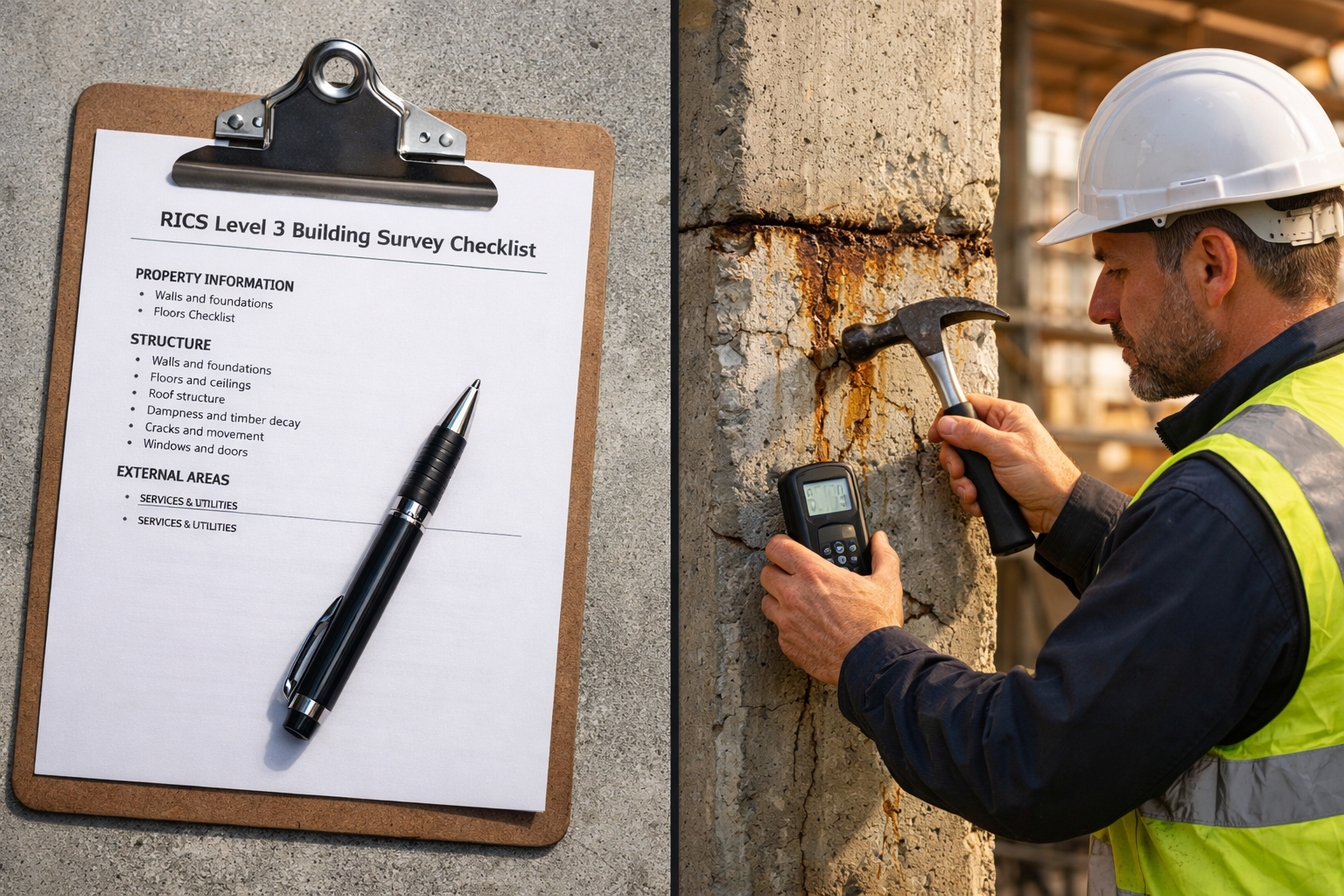
Given the defect profile above, the appropriate survey product for any 1970s concrete frame property is unambiguously a Level 3 Building Survey — the most comprehensive inspection available for residential property. A Level 2 HomeBuyer Report is insufficient for this construction type [5]. You can review the RICS HomeBuyer Survey Level 2 to understand its limitations before deciding on the right product.
For commercial concrete frame stock from the same era, a commercial building survey with structural engineering input is the appropriate route.
Pre-Inspection Protocol Checklist ✅
Before attending site, the surveyor should obtain and review:
- Planning history — any structural alterations, extensions, or change of use
- Building Regulations completion certificates for any post-construction works
- PRC Certificate (if applicable) — verify authenticity and scope
- VvE or management company documents (for flats) — maintenance records, reserve fund status
- Asbestos survey reports — mandatory review for this construction era
- EWS1 form (for flats in multi-storey blocks) — cladding fire safety status
On-Site Inspection Protocol Checklist ✅
Structural Frame:
- Hammer test all accessible concrete columns, beams, and soffits
- Document all spalling, rust staining, and cracking with photographs
- Measure crack widths (>0.3mm warrants specialist referral)
- Inspect basement and undercroft areas for water ingress and concrete deterioration
- Check expansion joints for sealant failure and debris accumulation
Envelope and Fabric:
- Inspect all lintels with thermal imaging where possible
- Check cavity wall ties for corrosion (use borescope where accessible)
- Inspect roof structure — flat roofs common in this era, check membrane condition via roof survey
- Test all window frames for corrosion, seal integrity, and water ingress evidence
- Check external drainage falls and gutter condition
Internal Fabric:
- Use moisture meter on all ground floor elements and walls adjacent to cavities
- Inspect all floor surfaces for deflection or springiness (indicating joist or slab deterioration)
- Check ceiling finishes for staining, cracking, or delamination
- Inspect service penetrations through concrete elements for cracking
When to Instruct a Structural Engineer
A Level 3 survey will frequently identify defects requiring specialist structural engineering input beyond the surveyor's remit. Referral is mandatory when:
- Crack widths exceed 0.3mm in structural concrete elements
- Spalling exposes reinforcement steel
- Floor deflection exceeds span/360 under normal loading
- Any suspicion of PRC construction without a valid certificate
- Evidence of differential settlement or foundation movement
The structural engineering team can provide load calculations, carbonation testing, and half-cell potential surveys to quantify reinforcement corrosion risk.
Navigating the Spring 2026 Buyer Surge: Practical Guidance

The surge in buyer activity during spring 2026 is creating real pressure on surveying capacity. Instruction lead times for Level 3 surveys in urban areas with high concentrations of 1970s stock — including Greater Manchester, West London, and parts of Essex and Hertfordshire — are extending. Buyers who delay survey instruction risk losing properties to faster-moving purchasers who are (incorrectly) relying on lender valuations alone.
Practical Steps for 2026 Buyers
- Identify construction type early — ask the estate agent or seller for any available building records before making an offer.
- Instruct a Level 3 survey immediately upon offer acceptance — do not wait for mortgage approval.
- Request specialist reports as a condition of exchange, not after — structural engineering, asbestos, and drainage surveys should be instructed in parallel.
- Review the PRC register — check whether the property type appears on the Housing Defects Act schedule.
- Factor remediation costs into offer price — concrete repair, window replacement, and cavity wall remediation are all significant costs. Survey pricing guidance can help budget for the full due diligence process.
- Do not rely on cosmetic condition — freshly decorated 1970s concrete frame properties may conceal years of deferred structural maintenance.
💡 Pull Quote: "In a competitive spring market, the buyers who commission thorough structural assessments are the ones who avoid five-figure repair bills after completion."
Regional Considerations
Buyers active in specific regions should note that chartered surveying expertise with 1970s concrete frame experience is available locally. For buyers in the South East and London, chartered surveyors in Essex and chartered surveyors in Hertfordshire offer Level 3 survey services with specific experience in this construction era.
Understanding the Full Defect Hierarchy: A Summary Table
The table below consolidates the building survey defect patterns in 1970s concrete frame properties into a risk-rated reference for surveyors and buyers managing the spring 2026 assessment surge.
| Defect Type | Risk Level | Survey Method | Action Required |
|---|---|---|---|
| Reinforcement corrosion / concrete rot | 🔴 Critical | Hammer test, carbonation indicator, half-cell survey | Structural engineer referral |
| PRC classification (unrepaired) | 🔴 Critical | Document review, visual inspection | PRC Certificate verification |
| Cold bridge / lintel cracking | 🟠 High | Thermal imaging, visual inspection | Monitor or repair |
| Cavity wall ventilation failure | 🟠 High | Moisture meter, borescope | Remediation required |
| Aluminium window seal failure | 🟡 Medium | Visual, water test | Replacement programme |
| Flat roof membrane deterioration | 🟡 Medium | Visual, roof survey | Condition-dependent |
| Asbestos-containing materials | 🔴 Critical | Asbestos survey (specialist) | Management plan required |
Conclusion: Actionable Next Steps for Buyers and Surveyors in 2026
The convergence of an affordable 1970s concrete frame supply and a first-time buyer surge in spring 2026 creates a structurally significant risk event for the UK property market. The defect patterns are well-documented, the assessment protocols are clear, and the consequences of inadequate survey coverage — from unmortgageable PRC properties to concealed reinforcement corrosion — are financially severe.
For buyers, the single most important action is to commission a Level 3 Building Survey from a qualified RICS chartered building surveyor before exchange of contracts. Do not allow market competition to compress due diligence timelines.
For surveyors, the spring 2026 surge demands rigorous adherence to the structural assessment protocols outlined above. Every 1970s concrete frame instruction should be treated as a potential high-risk case until proven otherwise.
For lenders and conveyancers, awareness of PRC classifications and the limitations of standard valuations for this construction type is essential to avoid post-completion disputes.
The structural integrity of 1970s concrete frame housing is not a historic curiosity — it is a live risk in the 2026 market. Thorough assessment is the only reliable protection.
References
[1] Building Survey Defects In 1960s 1980s Housing Stock Identifying Hidden Issues Before Purchase – https://nottinghillsurveyors.com/blog/building-survey-defects-in-1960s-1980s-housing-stock-identifying-hidden-issues-before-purchase
[2] Building Failure Cases – https://engr.charlotte.edu/asce-failure-case-studies/building-failure-cases/
[3] Structural Defects In Homes Built In The 1960s And 1970s – https://vkmakelaars.nl/en/blog/architectural/structural-defects-in-homes-built-in-the-1960s-and-1970s/
[4] What You Should Know About Non Standard Construction Types – https://www.terracottaproperty.com/blog/what-you-should-know-about-non-standard-construction-types
[5] Which Survey Is Best For Older Homes – https://surveymatch.co.uk/which-survey-is-best-for-older-homes/
[6] Building Pathology Explained Spotting Structural Movement Early – https://www.projectsurveyors.co.uk/case-studies/building-pathology-explained-spotting-structural-movement-early