London's housing market recorded a 6.2% uptick in basement conversion planning applications during the first quarter of 2026, driven by stabilising property prices and renewed homeowner confidence. As equity returns and space remains at a premium, basement extensions have re-emerged as one of the most sought-after ways to add value without moving. But beneath the appeal lies a legal and procedural minefield: virtually every basement excavation in a London terrace or semi-detached home will trigger the Party Wall etc. Act 1996, and the consequences of ignoring this fact can be severe and costly.
Party Wall Surveys for Basement Conversions: Navigating 2026 London Planning Permissions and Neighbour Rights is not a niche concern for specialists alone. It is a practical necessity for any homeowner, developer, or surveyor operating in London's dense urban fabric. This guide sets out the key legal obligations, procedural steps, and professional standards required to protect all parties involved.
Key Takeaways
- Almost every basement conversion in London will trigger the Party Wall etc. Act 1996, requiring formal notice to adjoining owners before work begins.
- Serving notice too late or failing to serve it at all can result in injunctions, project delays, and significant legal costs.
- A Schedule of Condition survey, completed before excavation starts, is the single most effective way to protect both the building owner and the adjoining owner from disputed damage claims.
- London boroughs have tightened basement planning policies in 2026, with stricter flood risk, structural, and amenity conditions now standard.
- Appointing a qualified, RICS-accredited party wall surveyor early in the project reduces disputes and keeps timelines on track.
Why Basement Conversions Almost Always Trigger the Party Wall Act
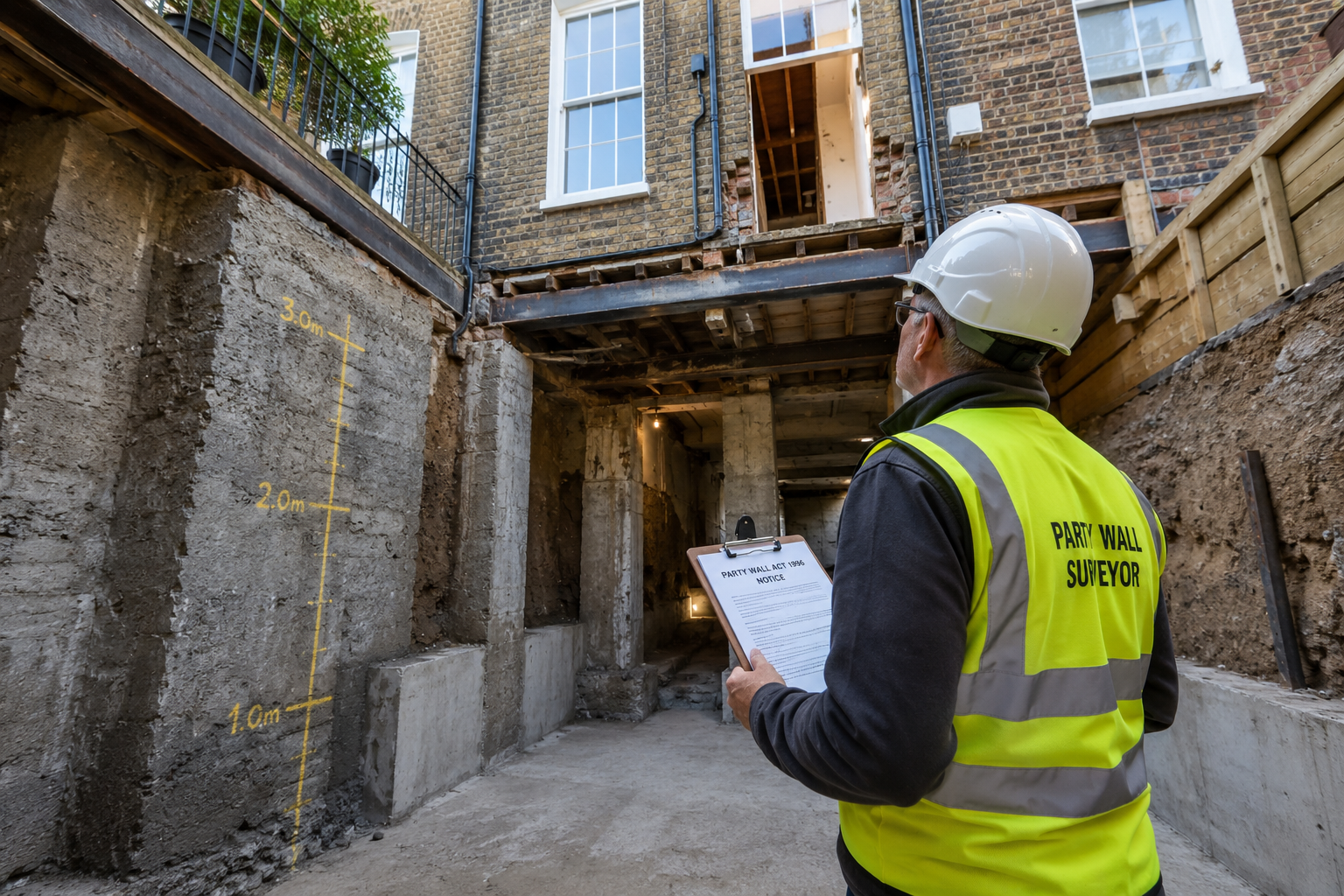
The Party Wall etc. Act 1996 applies across England and Wales and governs three distinct types of work: work on or to a shared party wall or party structure, the construction of a new wall at or astride the boundary line, and excavation within three or six metres of an adjoining building [10]. Basement conversions routinely engage all three provisions.
When a homeowner digs below the existing footprint of a London terrace, the excavation almost certainly comes within three metres of the neighbour's foundations. If the dig goes deeper than the neighbour's foundations, the six-metre rule applies instead [10]. Either way, the building owner is legally required to serve a formal party wall notice before any work begins.
What triggers the Act in a basement project:
- Underpinning shared or adjoining walls
- Excavating within three metres of an adjoining structure at a depth below that structure's foundations
- Cutting into a party wall to insert beams or waterproofing membranes
- Forming new openings or inserting damp-proof courses into a shared structure
Failure to serve notice is not a minor administrative oversight. An adjoining owner who discovers work has started without notice can apply to the courts for an injunction to halt the project immediately [4]. In London, where projects often run to six or seven figures, a court-ordered stop can be financially catastrophic.
For a full breakdown of how the three-metre excavation rule works in practice, see this detailed guide on the 3-metre rule and party wall obligations.
The Notice Process: Timelines and Requirements
The building owner must serve notice at least one month before work begins for party wall and line of junction notices, and at least two months before work begins for excavation notices under Section 6 of the Act. Adjoining owners then have 14 days to respond. If they consent in writing, work may proceed without a formal award. If they dissent, or fail to respond, a dispute is deemed to have arisen and surveyors must be appointed [4].
In practice, most London neighbours will either dissent or fail to respond, particularly where basement works are involved. The scale and duration of basement projects — often running six to twelve months — understandably makes adjoining owners cautious. This means the appointment of surveyors and the preparation of a Party Wall Award is the norm rather than the exception.
2026 London Planning Permissions: What Has Changed
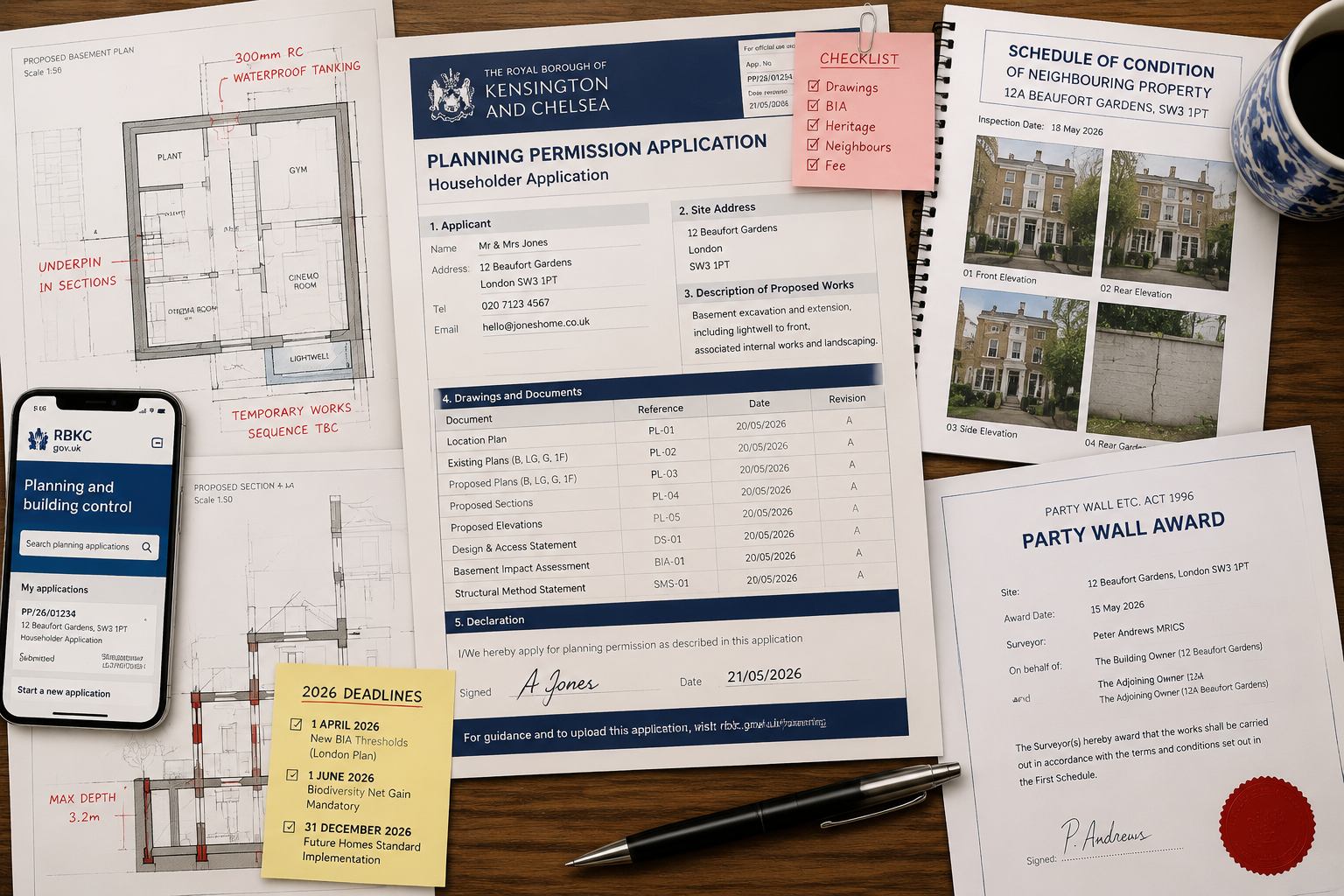
Planning permission for basement conversions in London has become markedly more complex over the past three years. While many basement works still fall within permitted development rights — particularly single-storey excavations beneath an existing footprint — London boroughs have introduced supplementary planning guidance that adds significant conditions [7].
Key 2026 planning considerations for London basement conversions:
| Factor | Requirement |
|---|---|
| Flood risk zones | Sequential test and flood risk assessment required in Zones 2 and 3 |
| Structural method statement | Mandatory for all basement works in most inner London boroughs |
| Neighbour consultation | Required even where permitted development applies in some boroughs |
| Basement impact assessment | Required in boroughs including Westminster, Kensington & Chelsea, and Camden |
| Tree protection | Arboricultural impact assessment needed where roots may be affected |
"The planning landscape for basement conversions in London in 2026 is considerably more demanding than it was five years ago. Structural method statements and basement impact assessments are now near-universal requirements in inner London." [7]
Homeowners and developers should not assume that because a project falls within permitted development rights, planning permission is not needed. Several London boroughs have removed permitted development rights for basement works through Article 4 Directions, meaning a full planning application is required regardless of the project's scale [7].
For those working across London, specialist chartered surveyors in central London can advise on borough-specific requirements before any application is submitted.
Permitted Development vs. Full Planning Permission
The distinction matters enormously for project timelines. A permitted development basement conversion can, in theory, proceed without a planning application, subject to conditions. A full planning application adds eight to thirteen weeks to the programme in most cases, and refusal or conditions can add months more.
The safest approach in 2026 is to obtain a Lawful Development Certificate before starting work. This provides written confirmation from the local planning authority that the proposed works are lawful, giving the building owner and any lender a clear paper trail [7].
Party wall obligations run in parallel to planning. Receiving planning permission does not discharge the duty to serve party wall notices, and vice versa. Both processes must be completed independently.
Neighbour Rights and the Party Wall Award: Protecting All Parties
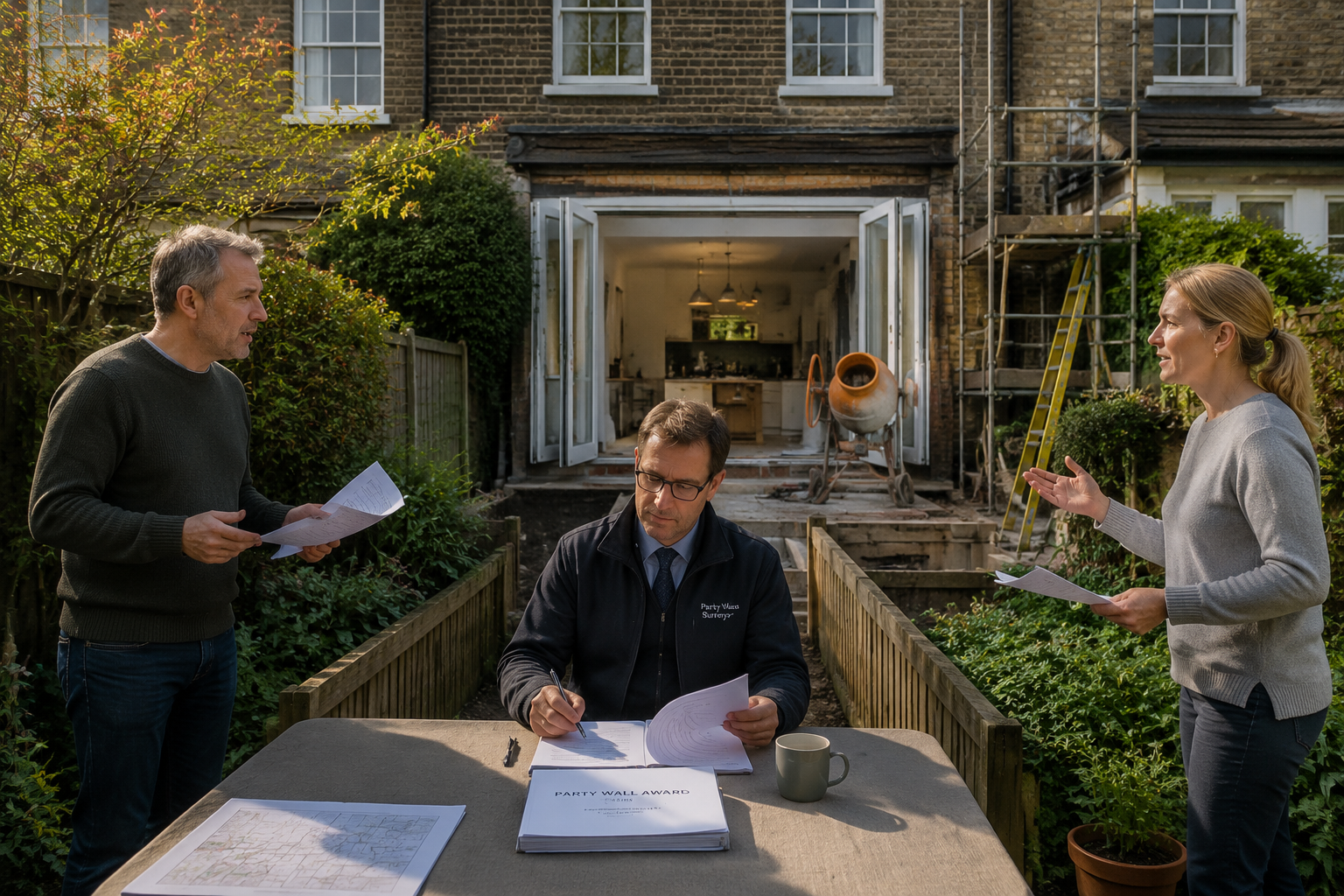
The Party Wall etc. Act exists not to obstruct development but to balance the rights of building owners against those of adjoining owners. Understanding what neighbours are legally entitled to request — and what they are not — is essential for keeping projects moving.
What Adjoining Owners Are Entitled to Demand
Adjoining owners have the right to appoint their own surveyor, at the building owner's expense, once a dispute has been deemed to have arisen [1]. They are entitled to:
- A Schedule of Condition survey of their property before works begin
- Access to inspect the works during the project
- Compensation for any damage caused by the notifiable works
- Reasonable working hours restrictions within the Party Wall Award
A Schedule of Condition survey is arguably the most important document in any basement conversion project. It records the existing state of the adjoining property — cracks, settlement, finishes, and structural elements — before a single spade enters the ground. Without it, any post-construction damage claim becomes a matter of dispute rather than documented fact [2].
What adjoining owners cannot do is simply refuse to allow lawful works to proceed. The Act provides a mechanism — the Party Wall Award — that permits the building owner to carry out the notifiable works even if the neighbour objects, provided the Award is properly made and the conditions within it are followed [4].
Understanding Party Wall Disputes
Disputes most commonly arise in basement projects because of the scale of the works and the proximity to neighbouring foundations. Common flashpoints include:
- Cracking to adjoining walls or ceilings attributed to vibration or ground movement
- Water ingress into neighbouring basements or lower ground floors during excavation
- Noise and working hours extending beyond agreed limits in the Award
- Access disputes where scaffolding or temporary works encroach on neighbouring land
For a clear explanation of how disputes are defined and resolved under the Act, see this guide on what a party wall dispute involves.
If damage does occur, the building owner is liable to make good that damage or pay compensation. The process for handling damage to property in party wall situations is well established, but it is far less costly for all parties to prevent damage through proper engineering and monitoring than to deal with it after the fact.
The Role of Monitoring Surveys During Construction
For basement conversions in particular, structural monitoring during the excavation and underpinning phases is strongly recommended. Monitoring surveys use crack gauges, tiltmeters, and precise levelling to detect movement in the adjoining structure in real time. If movement exceeds agreed trigger levels set out in the Party Wall Award, works can be paused and remedial action taken before damage becomes serious.
This approach has become standard practice among reputable London contractors and is increasingly specified within Party Wall Awards by experienced surveyors [3].
Practical Steps for Building Owners: A Process Checklist
Getting Party Wall Surveys for Basement Conversions right from the outset requires careful sequencing. The following checklist reflects best practice for 2026 London projects.
Before serving notice:
- Appoint a structural engineer to prepare preliminary designs and a method statement
- Identify all adjoining owners, including those above and below if in a block of flats
- Confirm planning requirements with the local authority and obtain a Lawful Development Certificate or planning permission as appropriate
- Instruct a qualified party wall surveyor to advise on the correct notices to serve
Serving notice:
- Serve the correct notice type (Section 3 for party wall works, Section 6 for excavations) in writing
- Allow the statutory notice periods (one month for Section 3, two months for Section 6)
- Keep records of service — recorded delivery or personal service with a signed receipt
After notice is served:
- If consent is given in writing, proceed with caution and document everything
- If dissent or no response, appoint surveyors promptly to avoid further delay
- Commission a Schedule of Condition survey of all adjoining properties before work starts
During construction:
- Ensure contractors comply with all conditions in the Party Wall Award
- Maintain monitoring surveys at agreed intervals
- Report any movement or damage to the party wall surveyor immediately
For homeowners uncertain which type of professional assessment their project requires, this resource on which survey you need provides a useful starting point.
Choosing the Right Party Wall Surveyor for a London Basement Project
Not all party wall surveyors have equal experience with basement conversions. The structural complexity of deep excavations, underpinning, and waterproofing systems demands a surveyor who understands geotechnical risk as well as the legal framework of the Act.
What to look for in a party wall surveyor for basement work:
- RICS accreditation and membership of the Faculty of Party Wall Surveyors or equivalent professional body
- Demonstrable experience with basement and underpinning projects specifically
- Familiarity with the specific London borough's planning and building control requirements
- Ability to coordinate with structural engineers and contractors on technical conditions within the Award
Costs for party wall surveying in London vary considerably. For a basement conversion involving multiple adjoining owners, total surveyor fees — including the adjoining owner's surveyor appointed at the building owner's expense — can range from £2,000 to over £10,000 depending on complexity [2]. Obtaining clear fee estimates at the outset avoids surprises later.
Specialist chartered surveyors in east London and south-east London can provide borough-specific guidance for projects in those areas, where Victorian terrace stock and dense urban development make basement conversions particularly complex.
Conclusion
London's basement conversion revival in 2026 brings real opportunity — and real legal responsibility. Party Wall Surveys for Basement Conversions: Navigating 2026 London Planning Permissions and Neighbour Rights is not an optional extra; it is a statutory obligation that, when handled correctly, protects the building owner, the adjoining owner, and the project itself.
Actionable next steps for anyone planning a London basement conversion:
- Engage a structural engineer and party wall surveyor before finalising designs — not after.
- Check with the local planning authority whether permitted development rights apply or whether an Article 4 Direction removes them.
- Serve the correct party wall notices within the statutory timeframes, keeping clear records of service.
- Commission a Schedule of Condition survey of all adjoining properties before excavation begins.
- Build structural monitoring into the construction programme and specify trigger levels within the Party Wall Award.
- Budget for adjoining owner surveyor fees from the outset — they are the building owner's legal responsibility.
The legal framework exists to make basement conversions work for everyone. Engaging with it early, thoroughly, and with qualified professionals is the most reliable route to a completed project and a satisfied neighbourhood.
References
[1] Party Wall Agreement London 2026 – https://www.mayfairstudio.co.uk/blog/party-wall-agreement-london-2026
[2] Party Wall Cost London Guidelines – https://www.surveyofpartywall.co.uk/party-wall-cost-london-guidelines/
[3] ricspartywallsurveyors.co.uk – https://www.ricspartywallsurveyors.co.uk
[4] Party Wall Agreements For Basement Projects A Homeowners Guide – https://www.simplybasement.co.uk/party-wall-agreements-for-basement-projects-a-homeowners-guide/
[7] Do I Need Planning Permission For A Basement 2026 – https://www.bestbuilders.co.uk/guides/planning/do-i-need-planning-permission-for-a-basement-2026
[10] Basements And The Party Wall Act – https://www.peterbarry.co.uk/blog/basements-and-the-party-wall-act/