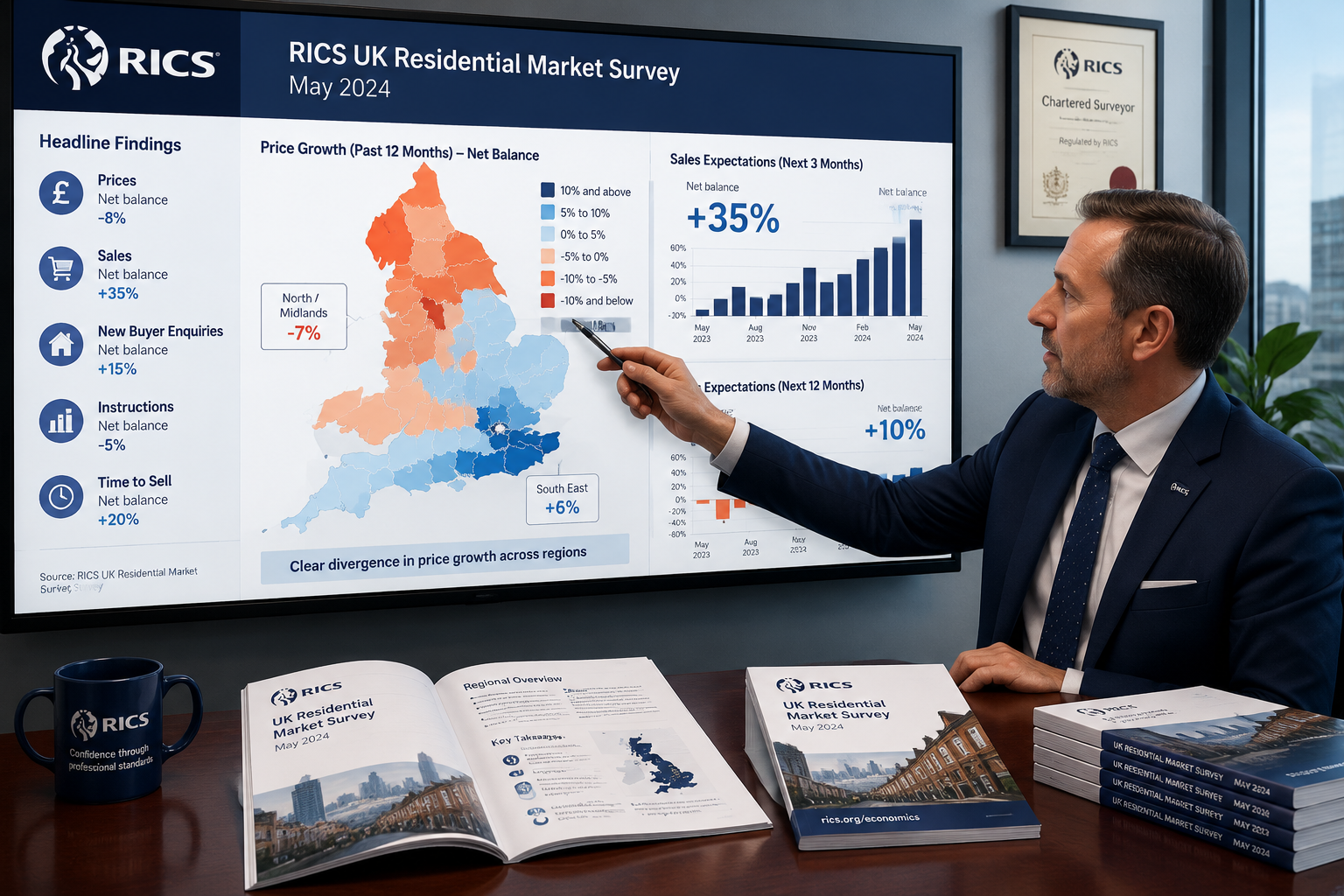
When RICS sales expectations hit a 12-month net balance of +35% in early 2026, property transaction volumes surged — and so did the number of valuation disagreements landing in court. Expert Witness Surveys for Valuation Disputes: Strategies in the 2026 Market Upturn have become a critical discipline for chartered surveyors navigating a property market that is moving faster than many valuations can keep pace with. Rising prices, regional divergence, and heightened lender scrutiny have combined to create conditions where a poorly constructed expert opinion can collapse under cross-examination. This article sets out the core strategies surveyors and legal teams need to produce credible, court-ready valuation evidence in 2026.
Key Takeaways
- The 2026 market upturn has increased both transaction volumes and valuation disputes, raising the bar for expert witness evidence.
- RICS survey data — including specific net balance figures — must be anchored to expert reports to demonstrate market context at the valuation date.
- Region-specific comparables, time adjustments, and transparent methodology are non-negotiable in 2026 court proceedings.
- RICS Expert Witness Accreditation Service (EWAS) accreditation has become an essential credential for surveyors giving evidence.
- Single Joint Expert appointments, rebuttal reports, and cross-examination preparation each require distinct, documented strategies.
Why the 2026 Market Upturn Is Driving More Valuation Disputes
The relationship between rising markets and rising disputes is not coincidental. When prices climb sharply and unevenly across regions, the gap between what one party believes a property is worth and what another party accepts widens significantly. The surge in lending activity throughout 2026 has increased demand for qualified expert witnesses, driven by increased transaction volume, market volatility, regulatory scrutiny, and heightened litigation awareness among borrowers [5].
Several factors are converging to make valuation disputes more common and more complex:
- Regional divergence: Within Greater Manchester alone, city centre luxury apartments recorded 8.2% annual growth driven by professional migration, while suburban stock in the same local authority saw flat or negative movement [6]. A single regional average is therefore misleading.
- Sentiment vs. transactional data gaps: The February 2026 RICS survey recorded an -18% net balance in price expectations nationally, even as certain micro-markets showed strong growth [2]. Experts who conflate sentiment indicators with hard transactional evidence expose their reports to challenge.
- Lender scrutiny: Mortgage lenders are reviewing valuations more carefully, and disputes between borrowers and lenders over assessed values have increased in volume and complexity [5].
Understanding these pressures is the starting point for any surveyor seeking to produce expert witness evidence that will withstand scrutiny. For those considering the broader scope of professional valuation services, reviewing factors of valuation provides useful context on the variables that courts and tribunals expect experts to address.
The Role of RICS Survey Data in Expert Witness Reports
One of the most significant shifts in expert witness practice during 2026 has been the expectation that surveyors anchor their opinions to specific, quantified market data rather than general assertions about market conditions.
Citing Net Balance Figures Correctly
The RICS UK Residential Market Survey publishes net balance figures that represent the difference between the percentage of respondents reporting increases and those reporting decreases. Citing these figures precisely — for example, the -40% net balance for London flats recorded in February 2026 — provides authoritative, verifiable support for a valuation opinion [1]. Courts respond well to specificity. A report that states "the market was soft at the valuation date" is far weaker than one that references a named survey, a specific month, and a precise net balance figure.
Best practice for integrating RICS data:
| Data Point | How to Use It |
|---|---|
| Monthly net balance figures | Anchor market condition narrative at valuation date |
| Regional breakdowns | Demonstrate local conditions distinct from national averages |
| New buyer enquiries data | Support or challenge demand-side assumptions |
| Price expectation indicators | Contextualise forward-looking adjustments |
Experts should also distinguish between sentiment indicators and transactional evidence. The February 2026 survey's -18% net balance in price expectations is a sentiment measure; it should be used to contextualise the market environment, not as a direct substitute for comparable sales data [2].
Matching Data to the Valuation Date
A common weakness in expert reports is the use of survey data that post-dates the valuation date. Courts apply the principle that a valuation must reflect the market as it existed on the specific date in question. Surveyors must identify the RICS survey publication closest to — and ideally bracketing — the valuation date, and explain clearly why that data is the most relevant available.
Building Court-Ready Comparable Evidence

The selection and presentation of comparable sales evidence is where many expert reports succeed or fail. In the current market environment, using generic comparables drawn from a wide geographic area is inadequate [1]. Courts in 2026 are applying greater scrutiny to how comparables are chosen, adjusted, and weighted.
Region-Specific Selection Criteria
Experts are advised to:
- Select comparables within the same local authority wherever possible, and document why any comparable drawn from outside that boundary is nonetheless relevant.
- Apply time adjustments that reflect actual price movements between the date of each comparable transaction and the valuation date, using a documented index or market evidence.
- Explain the rationale for each comparable chosen and each one rejected, particularly where the pool of available comparables is limited.
This level of documentation serves two purposes. It demonstrates rigour to the court, and it prepares the expert for cross-examination on their selection methodology [3].
The Three Core Valuation Methods
Courts expect experts to be familiar with — and to apply where appropriate — the three principal valuation methods:
- Comparable Sales Method: Most commonly used for residential property. Relies on recent arm's-length transactions of similar properties.
- Income Capitalisation Method: Applied to investment and commercial property. Capitalises the net income stream at an appropriate yield.
- Depreciated Replacement Cost (DRC): Used where no active market exists, typically for specialist properties.
The choice of method must be justified in the report. Where more than one method is applied, the expert must explain how the results have been weighted and reconciled [1]. For commercial property disputes, understanding valuation of commercial property is essential context for selecting the right approach.
RICS Red Book Compliance
Expert witness valuations are expected to comply with the RICS Valuation — Global Standards (the Red Book). Compliance is not merely procedural; it signals to the court that the expert has followed a recognised professional framework. Surveyors should be familiar with the RICS Valuation Red Book requirements and reference their compliance explicitly in their reports.
Accreditation, Methodology Transparency, and Cross-Examination
"A valuation opinion is only as strong as the methodology that produced it. In 2026, courts are no longer willing to accept eminence as a substitute for evidence."
RICS Expert Witness Accreditation Service (EWAS)
Obtaining accreditation through the RICS Expert Witness Accreditation Service has become an essential credential for surveyors giving evidence in court [1]. EWAS accreditation demonstrates:
- Training in legal procedures and courtroom protocol
- Familiarity with Civil Procedure Rules (CPR) Part 35
- Understanding of the expert's duty to the court, which overrides any duty to the instructing party
Without this accreditation, opposing counsel may challenge the expert's competence at the outset of proceedings. Surveyors who provide expert witness reports should treat EWAS accreditation as a baseline requirement, not an optional enhancement.
Transparent Methodology: What Courts Now Expect
Courts are scrutinising valuation methodologies more closely than at any point in the past decade [1]. A transparent methodology section in an expert report should include:
- A clear statement of the valuation method(s) applied and why
- All assumptions made, with the evidence base for each assumption
- The weighting applied to different pieces of evidence
- Any departures from standard methodology and the reasons for those departures
Pull quote: Transparency is not a sign of weakness in a valuation report — it is the primary indicator of professional credibility.
Preparing for Cross-Examination
Experts should anticipate specific lines of challenge during cross-examination, including [3]:
- Why particular comparables were selected or excluded
- How time adjustments were calculated and what index was used
- Whether the expert has distinguished between market sentiment data and transactional evidence
- Whether the expert's opinion would change if a different set of comparables were applied
Preparation involves stress-testing the report before it is served. A useful exercise is to draft the cross-examination questions that opposing counsel is most likely to ask, then verify that the report answers each one adequately.
For surveyors who want to understand the full scope of expert witness obligations, the expert witness services page provides a practical overview of what instructing parties should expect from a qualified expert.
Single Joint Experts, Rebuttal Reports, and Dispute Resolution
Single Joint Expert Appointments
In many regional valuation disputes, courts direct the appointment of a Single Joint Expert (SJE) rather than allowing each party to instruct their own expert. The SJE must be [1]:
- Geographically competent: The expert must have demonstrable knowledge of the specific local market, not just the broader region.
- Explicitly acknowledging regional conditions: The SJE report must address local market characteristics, not rely on national or regional averages.
- Accessible to both parties: Under CPR 35.6, both parties retain the right to submit written questions to the SJE, and the expert must answer them within the time directed by the court.
Being appointed as an SJE carries significant responsibility. The expert's primary duty is to the court, and any perception of bias toward the appointing party — even unintentional — can undermine the entire report.
Writing Effective Rebuttal Reports
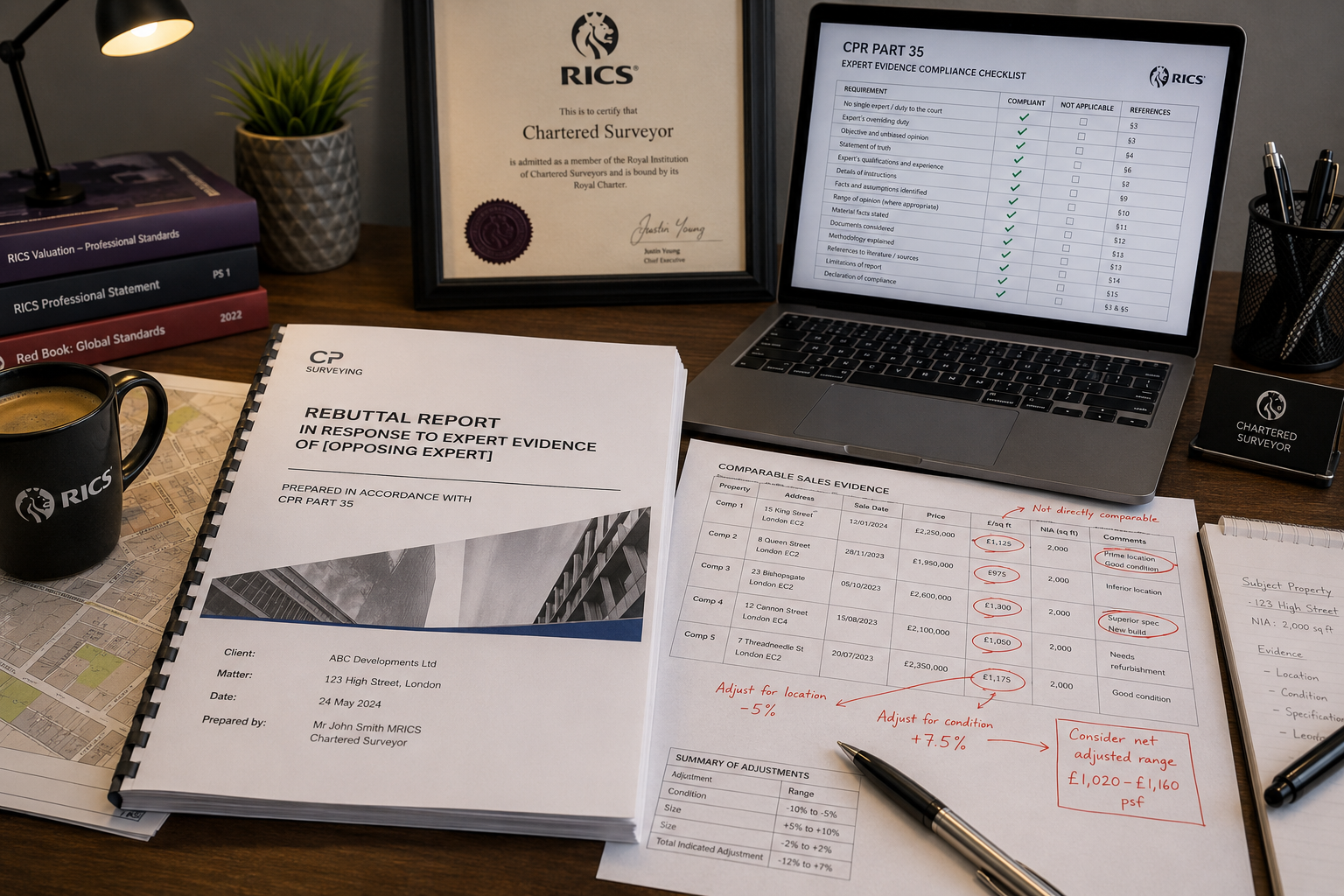
Where each party instructs their own expert, rebuttal reports become a key battleground. A rebuttal report challenges the assumptions, data selections, and conclusions of the opposing expert [4]. Effective rebuttal reports share several characteristics:
- Objectivity: The rebuttal must identify genuine weaknesses in the opposing report, not simply advocate for a different number.
- Specificity: Each point of challenge should reference a specific paragraph or conclusion in the opposing report.
- Evidence-based reasoning: Every challenge must be supported by data, precedent, or professional standards — not opinion alone.
- Clarity: Courts are not valuation experts. The rebuttal must be written so that a non-specialist judge can follow the argument.
A poorly constructed rebuttal — one that reads as advocacy rather than analysis — can damage the credibility of the expert who produced it. The goal is to assist the court, not to win an argument [4].
Without Prejudice Meetings and Joint Statements
CPR Part 35 encourages experts to meet without prejudice before trial to narrow the issues in dispute. These meetings should result in a joint statement that clearly identifies:
- The points on which the experts agree
- The points on which they disagree
- The reasons for any remaining disagreement
A well-managed joint statement can significantly reduce the scope of the trial and, in some cases, facilitate settlement. Surveyors involved in party wall disputes will recognise a similar dynamic, where early expert engagement can prevent costly litigation.
Regional Market Analysis: Going Beyond the Headline Figures
The 2026 market upturn is not uniform. Experts who treat it as such produce reports that are vulnerable to challenge. Developing a systematic approach to regional data analysis is now a core competency for expert witnesses [6].
Identifying Micro-Markets
Within any given local authority, distinct micro-markets may exist with characteristics that diverge significantly from the area average. Relevant micro-market variables include:
- Property type (houses vs. flats, new build vs. period stock)
- Tenure (freehold vs. leasehold)
- Transport connectivity and commuter patterns
- Local employment drivers and professional migration trends
For example, the 8.2% annual growth recorded in Manchester city centre luxury apartments reflects a specific demand driver — professional migration — that does not apply to suburban family housing in the same local authority [6]. An expert who applies the city centre growth rate to a suburban comparable has made a fundamental error that opposing counsel will exploit.
Documenting the Micro-Market Analysis
The micro-market analysis should appear as a distinct section in the expert report, covering:
- The geographic boundaries of the relevant market
- The data sources used to characterise that market
- Any sub-markets identified and how they differ from the broader area
- The implications of those differences for the valuation
Surveyors working on Manchester valuations will be well-positioned to provide this level of granular analysis, given the city's particularly diverse property sub-markets.
Conclusion: Actionable Steps for Surveyors in 2026
Expert Witness Surveys for Valuation Disputes: Strategies in the 2026 Market Upturn demand a level of rigour, transparency, and regional specificity that was not always required in quieter market conditions. The combination of rising transaction volumes, regional price divergence, and closer judicial scrutiny has raised the standard for what constitutes credible expert evidence.
Surveyors and legal teams should take the following steps:
- Obtain RICS EWAS accreditation if not already held. This is now a baseline expectation in contested valuation proceedings.
- Anchor every report to specific RICS survey data at the valuation date, citing net balance figures by region and property type.
- Select and document comparables systematically, applying time adjustments and explaining every inclusion and exclusion decision.
- Conduct a genuine micro-market analysis that identifies the specific sub-market relevant to the subject property, rather than relying on local authority or regional averages.
- Stress-test the report by drafting likely cross-examination questions before serving the report, and verify that the methodology section answers each one.
- Approach rebuttal reports with objectivity, focusing on evidence-based challenges rather than advocacy.
- Engage early in without-prejudice expert meetings to narrow the issues and reduce litigation costs for all parties.
For those seeking qualified expert witness support or a comprehensive property survey in the current market, reviewing the full range of survey types available is a practical first step toward instructing the right expert for the dispute at hand.
References
[1] Valuation Divergence Post Rics February 2026 Expert Witness Strategies For Regional Disputes – https://www.canterburysurveyors.com/blog/valuation-divergence-post-rics-february-2026-expert-witness-strategies-for-regional-disputes/?utm_source=openai
[2] Expert Witness Valuations Amid February 2026 Rics Market Slowdown Adjusting For 18 Price Expectation Shifts – https://wimbledonsurveyors.com/expert-witness-valuations-amid-february-2026-rics-market-slowdown-adjusting-for-18-price-expectation-shifts/?utm_source=openai
[3] Valuation Challenges From Rics February 2026 Survey Expert Witness Strategies For 26 Buyer Enquiry Dip Disputes – https://wimbledonsurveyors.com/valuation-challenges-from-rics-february-2026-survey-expert-witness-strategies-for-26-buyer-enquiry-dip-disputes/?utm_source=openai
[4] Expert Witness Business Valuation Rebuttal Reports Best Practices – https://www.vallitadvisors.com/news/2026/06/expert-witness-business-valuation-rebuttal-reports-best-practices/?utm_source=openai
[5] Expert Witness Roles In 2026 Lender Valuation Disputes Evidence Standards Amid Rising Transactions – https://wimbledonsurveyors.com/expert-witness-roles-in-2026-lender-valuation-disputes-evidence-standards-amid-rising-transactions/?utm_source=openai
[6] Expert Witness Testimonies In 2026 Valuation Disputes Rics Strategies Amid Stabilising House Prices And Regional Divides – https://nottinghillsurveyors.com/blog/expert-witness-testimonies-in-2026-valuation-disputes-rics-strategies-amid-stabilising-house-prices-and-regional-divides?utm_source=openai