Northern England's construction pipeline hit £2.33 billion in Q1 2026 alone, with Manchester anchoring mega-projects such as a £400 million water adventure park and a £286 million student accommodation scheme at Manchester Metropolitan University [2]. Against this backdrop of rapid development, the legal framework governing shared walls and boundaries is under greater pressure than ever. Understanding the Party Wall Act Essentials for Northern Construction Uptick: Minimising Disputes in Scotland and North West Booms is no longer optional for developers, homeowners, and surveyors working in these regions — it is a prerequisite for avoiding costly, time-consuming neighbour disputes.

Key Takeaways
- The Party Wall etc. Act 1996 applies only in England and Wales, meaning Scotland operates under a completely different legal framework for boundary and shared-wall disputes.
- The North West construction sector recorded £493 million in private housing starts in the three months to February 2026, making party wall compliance a high-frequency issue in residential neighbourhoods [4].
- Serving a valid party wall notice at least two months before notifiable works begin is the single most effective way to prevent disputes escalating.
- Scotland's construction boom — driven by a £10.85 billion pipeline including a £1.5 billion offshore wind farm — requires developers to rely on common law remedies and the law of the tenement rather than the Party Wall Act [5].
- Appointing an agreed surveyor early, before disputes arise, can reduce resolution costs by a significant margin compared to contested proceedings.
What the Party Wall etc. Act 1996 Actually Covers
The Party Wall etc. Act 1996 creates a statutory framework for resolving disputes about shared walls, boundary structures, and excavations near neighbouring buildings. It applies only in England and Wales [1]. This is a critical starting point for anyone working across the Scottish border or advising clients who own property in both regions.
The Three Trigger Categories
Works that activate the Act fall into three broad categories:
| Category | Description | Notice Period Required |
|---|---|---|
| Party wall works | Cutting into, demolishing, or underpinning a shared wall | 2 months |
| New walls on the boundary | Building a new wall astride or at the boundary line | 1 month |
| Excavations near foundations | Digging within 3 or 6 metres of a neighbour's structure | 1 month |
The 3-metre rule is particularly relevant in dense urban areas like Greater Manchester and Salford, where Victorian terrace housing means that almost any basement or foundation project will trigger the excavation provisions.
What the Act Does Not Cover
The Act does not resolve planning disputes, deal with trespass, or address noise complaints. It is narrowly focused on structural works affecting shared or adjacent structures. Homeowners sometimes confuse party wall procedures with planning permission — these are separate legal requirements that run in parallel.
For a thorough overview of rights and obligations, the party wall guidance pages provide a practical starting point for both building owners and adjoining owners.
The Scotland Question: A Jurisdiction Gap in the Northern Boom
Scotland's construction sector is experiencing a significant uplift. Between 2018–19 and 2024–25, Scotland delivered 2,522 construction projects, fewer in number than other major UK regions but with notably higher average values [3]. The pipeline has grown by 67.4% year-on-year, reaching £10.85 billion, bolstered by landmark infrastructure such as a £1.5 billion offshore wind farm [5].
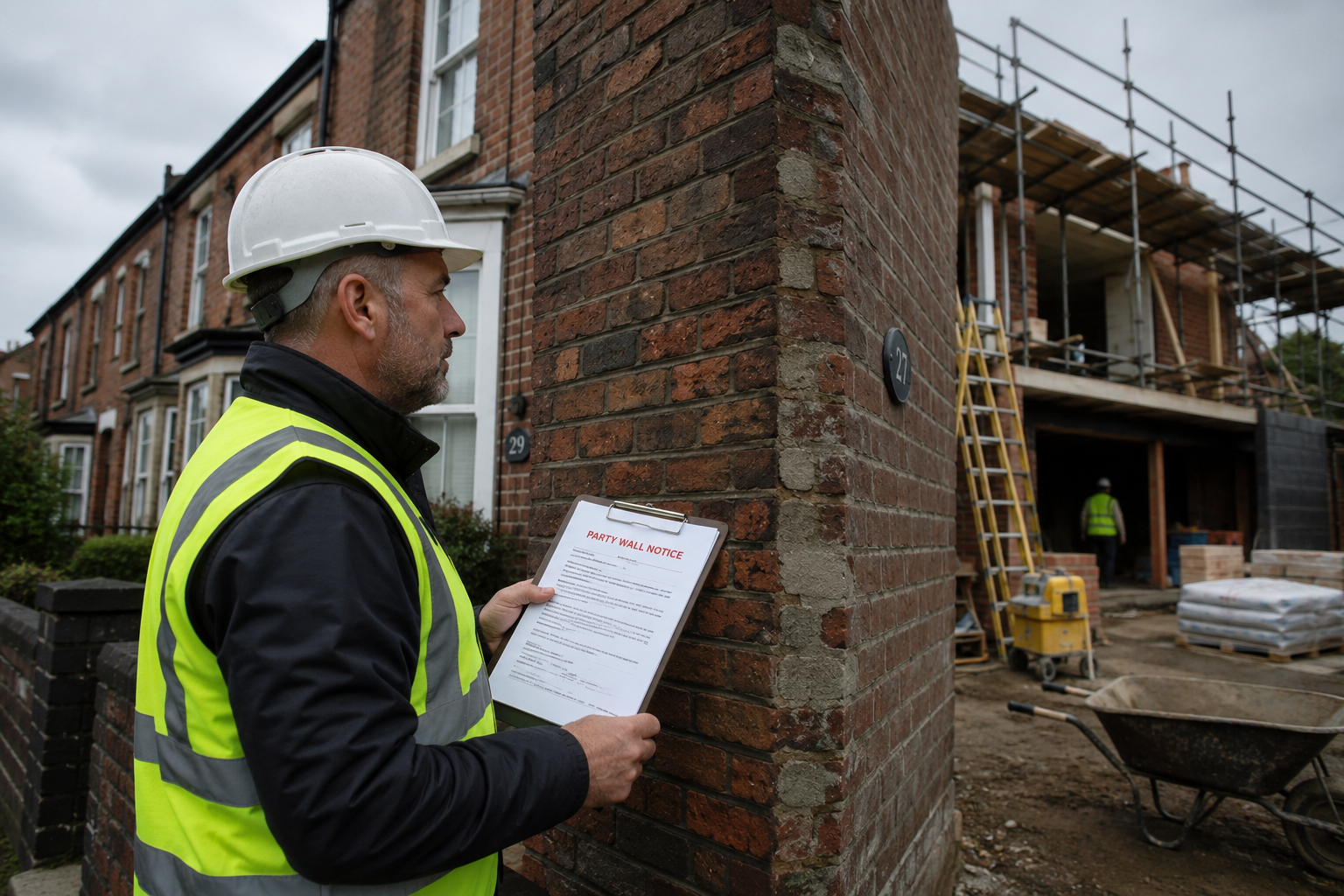
Yet Scotland has no equivalent to the Party Wall etc. Act 1996. Developers and homeowners north of the border cannot serve a party wall notice, appoint a party wall surveyor under the statutory framework, or rely on the Act's dispute resolution mechanism.
What Applies in Scotland Instead
In Scotland, the relevant legal instruments include:
- The Tenements (Scotland) Act 2004 — governs shared ownership and maintenance obligations in tenement buildings, which are common in Edinburgh, Glasgow, and Aberdeen.
- Common law nuisance and negligence — the primary route for resolving damage caused by neighbouring construction works.
- Title deeds and real burdens — specific obligations written into property titles that may restrict or regulate works affecting shared structures.
- The Title Conditions (Scotland) Act 2003 — provides a framework for enforcing real burdens between neighbouring proprietors.
"The absence of a statutory party wall regime in Scotland places a greater burden on solicitors, architects, and structural engineers to identify and manage boundary risks at the project planning stage."
This jurisdictional gap means that Scottish developers undertaking large-scale residential or commercial projects must commission detailed title searches and obtain specialist legal advice before breaking ground. Unlike in England and Wales, there is no default mechanism that compels a neighbour to engage with the process.
Practical Implications for Cross-Border Developers
Developers active in both Scotland and the North West need clear internal protocols that distinguish between jurisdictions. A standard party wall notice template used in Manchester is legally meaningless in Glasgow. Project managers should flag the jurisdiction at the earliest stage of feasibility and instruct the appropriate professional accordingly.
Party Wall Act Essentials for Northern Construction Uptick: Minimising Disputes in Scotland and North West Booms — A Practical Checklist

The North West's construction activity is broad-based. Private housing accounted for 38% of work starting on site in the region during the three months to February 2026, totalling £493 million [4]. Healthcare, logistics, and advanced manufacturing projects add further volume [7]. Each sector brings its own party wall risk profile.
The following checklist is designed for building owners, project managers, and surveyors operating in high-growth northern areas.
Pre-Works Checklist
Six months before works begin:
- Confirm whether the project is in England/Wales or Scotland, and apply the correct legal framework.
- Commission a structural survey to establish the existing condition of shared walls and adjacent structures.
- Identify all adjoining owners and occupiers, including freeholders, leaseholders, and mortgagees.
Two to three months before works begin:
- Serve the correct form of party wall notice — party structure notice, line of junction notice, or three/six-metre notice as appropriate.
- Keep proof of service (recorded delivery, process server, or acknowledgement from the adjoining owner).
- Allow the statutory response period to elapse before assuming consent.
If the neighbour dissents or does not respond:
- A dispute is deemed to have arisen automatically if no response is received within 14 days of serving a party wall notice.
- Appoint a surveyor promptly. An agreed surveyor (one surveyor acting for both parties) is typically the most cost-effective route.
- The surveyors will draw up a Party Wall Award, which sets out the permitted works, working hours, and any protective measures required.
During works:
- Carry out a schedule of condition before works begin, documenting the state of the adjoining property with photographs and written notes.
- Notify the adjoining owner of any unexpected structural findings immediately.
- Ensure contractors are briefed on the terms of the Party Wall Award and comply with them.
After works:
- Conduct a post-works inspection with the adjoining owner.
- Address any damage claims promptly and in good faith.
- Retain all documentation for at least six years.
Loft Conversions: A High-Frequency Trigger in Northern Terraces
Loft conversions are among the most common triggers for party wall notices in the North West, where terraced and semi-detached housing stock is dense. Works that involve cutting into a chimney breast, raising a party wall, or installing a steel beam that bears on a shared wall all require formal notice. The detailed guidance on loft conversions and party wall obligations is essential reading for homeowners and contractors undertaking these projects.
Similarly, works involving shared chimneys — common in Victorian terraces across Manchester, Salford, and Liverpool — carry specific obligations. The party wall shared chimneys guidance explains how the Act applies to chimney stacks that straddle a boundary.
Minimising Disputes: Lessons from the Northern Construction Uptick

Why Disputes Are Rising in High-Growth Areas
Construction booms compress timelines. Developers under pressure to start on site quickly sometimes skip or rush the party wall notice process. In dense urban areas, the margin for error is small — a single terrace can have multiple adjoining owners, each of whom must receive separate notice.
The commercial sector in the North West remains active but cautious, with rising input costs sharpening sensitivity to any delay [7]. A contested party wall dispute can add weeks or months to a programme, with injunctions in extreme cases halting works entirely.
The Cost of Getting It Wrong
When a building owner carries out notifiable works without serving notice, the adjoining owner has several remedies:
- Seeking an injunction to stop the works.
- Claiming damages for any loss or damage caused.
- Retrospectively appointing surveyors to draw up an award — at the building owner's expense.
If a neighbour is carrying out works without a party wall agreement, the guidance on works without agreement sets out the steps an adjoining owner can take to protect their property.
Case Study: Residential Extension in Salford
A homeowner in Salford applied for planning permission to build a two-storey rear extension. The project involved underpinning the shared party wall and excavating within three metres of the neighbour's foundations. No party wall notice was served.
Works began in early spring. Within two weeks, the adjoining owner noticed cracks appearing in their kitchen wall. They instructed a surveyor, who confirmed the damage was consistent with the excavation works. An injunction was sought and granted, halting the project for six weeks while a retrospective award was drawn up.
The building owner incurred:
- Surveyor fees for both parties (payable by the building owner under the Act).
- Contractor standing-time costs during the injunction period.
- Remediation costs for the damage caused.
- A strained relationship with a neighbour who shares a wall they will both live beside for years.
The total additional cost exceeded £18,000 — all of which was avoidable with a properly served notice and a schedule of condition prepared in advance.
Insulation Works and the Party Wall Act
As energy efficiency retrofits accelerate across the North West — driven by both regulatory pressure and rising energy costs — insulation works that affect party walls are an increasingly common trigger. Cavity wall insulation injected through a party wall, for example, may require notice. The party wall insulation guidance explains when insulation works cross the threshold into notifiable territory.
Obstruction and Access Rights
The Act grants building owners a right of access to the adjoining owner's land for the purpose of carrying out notifiable works, but this right must be exercised reasonably and with proper notice. Obstruction of that access can itself become a source of dispute. The guidance on obstruction in party wall matters outlines the legal position and practical remedies available to both parties.
Applying Party Wall Act Essentials for Northern Construction Uptick: Minimising Disputes in Scotland and North West Booms Across Sectors
Private Housing
With private housing representing the largest share of North West construction starts [4], the residential sector generates the highest volume of party wall notices. Developers building new homes on infill sites, homeowners extending, and landlords converting properties all need to navigate the Act. The party wall FAQ addresses the most common questions from residential clients.
Healthcare and Public Sector
NHS construction projects in the North West involve large, complex sites that often adjoin existing buildings [7]. Party wall issues on healthcare projects tend to be more technically demanding, with vibration monitoring, structural engineering input, and detailed schedules of condition required as standard.
Logistics and Manufacturing
Warehouse and manufacturing projects on the urban fringe of Greater Manchester and Merseyside frequently involve large-scale excavations and piled foundations. The six-metre rule — which applies when excavations go deeper than the foundations of an adjoining structure — is a common trigger on these sites. Early engagement with a party wall surveyor at the design stage can allow engineers to adjust pile locations and avoid triggering the Act unnecessarily.
Conclusion
The construction booms unfolding across the North West and Scotland in 2026 create both opportunity and risk. Understanding the Party Wall Act Essentials for Northern Construction Uptick: Minimising Disputes in Scotland and North West Booms is the foundation of responsible project management in England and Wales, while recognising that Scotland operates under an entirely separate legal regime is equally important for cross-border developers.
Actionable next steps for developers, homeowners, and surveyors:
- Confirm jurisdiction before any design work begins — the Party Wall etc. Act 1996 does not apply in Scotland.
- Use the pre-works checklist above to map all notifiable works and identify every adjoining owner at least six months before the planned start date.
- Serve notices in the correct form, with adequate notice periods, and retain proof of service.
- Commission a schedule of condition before works begin — this single step resolves the majority of post-works damage disputes.
- Appoint a qualified party wall surveyor early. An agreed surveyor acting for both parties is typically faster and less expensive than two separately appointed surveyors.
- In Scotland, instruct a solicitor with expertise in property law and real burdens at the earliest feasibility stage to identify title-based constraints on the proposed works.
Proactive compliance with the party wall framework is not a bureaucratic obstacle — it is a risk management tool that protects programme, budget, and neighbourly relations in equal measure. For specialist advice tailored to the North West market, contact a chartered surveyor with party wall experience before works begin.
References
[1] Party Walls – https://www.rics.org/consumer-guides/party-walls?utm_source=openai
[2] Construction Market Reports Q1 2026 – https://www.constructionline.co.uk/insights/market-reports/construction-market-reports-q1-2026/?utm_source=openai
[3] New Report Shows Scotland Seeing Fewer But Higher Value Construction Projects – https://projectscot.com/2026/03/new-report-shows-scotland-seeing-fewer-but-higher-value-construction-projects/?utm_source=openai
[4] UK Construction Activity February 2026 North West 27 03 2026 – https://www.constructionnews.co.uk/cn-intelligence/uk-construction-activity-february-2026-north-west-27-03-2026/?utm_source=openai
[5] The Construction Regions Risk Report – https://www.darttoolgroup.com/en-gb/the-construction-regions-risk-report?utm_source=openai
[6] stormpartywallsurveyors.co.uk – https://www.stormpartywallsurveyors.co.uk/?utm_source=openai
[7] North West – https://www.rlb.com/europe/resources/insights/construction-market-intelligence-cmi-q1-2026/north-west?utm_source=openai