Northern house prices rose by an average of 6.2% in the twelve months to early 2026, pushing homeowners toward extending rather than moving. At the same time, a gradual easing of permitted development (PD) rights has made loft conversions and side return extensions more accessible than at any point in the past decade. For surveyors, buyers, and homeowners navigating this landscape, Building Survey Checklists for 2026 Permitted Development Expansions: Loft and Side Returns in Suburban Recovery have become an essential tool — not just a formality, but a structured defence against costly compliance failures, structural defects, and neighbour disputes.
This article sets out what those checklists must cover, why the suburban recovery context makes thoroughness more urgent than ever, and how to apply PD rules correctly before a single brick is laid or a purchase is completed.
Key Takeaways
- Loft conversions under permitted development are capped at 40 cubic metres for terraced houses and 50 cubic metres for detached and semi-detached properties.
- Side return extensions must not exceed half the original house width and must sit at least 7 metres from the boundary opposite the side — a rule that catches many London terraced houses.
- A Level 3 building survey checklist in 2026 must assess PD compliance, structural integrity, fire safety, party wall obligations, and asbestos risk as distinct, documented stages.
- Designated areas including conservation zones, National Parks, and AONBs face stricter or entirely removed PD rights for side and loft extensions.
- Pre-purchase surveys that incorporate development potential assessments can materially affect valuation and mortgage decisions.
Why Suburban Recovery Is Driving Demand for Expansion Surveys in 2026
The post-pandemic reconfiguration of where people live and work has not faded. Suburban and commuter-belt locations across the North West, Yorkshire, and the South East continue to attract buyers who need more space but cannot afford to upsize. Rather than trading up, many households are trading out — extending upward into the loft or sideways into the narrow gap beside a terraced or semi-detached house.
This trend has created a surge in pre-purchase and pre-build surveys focused specifically on expansion potential. Surveyors assessing development upside now evaluate existing use value, model achievable scenarios such as a rear dormer loft conversion providing an additional bedroom and en-suite, and carry out planning risk assessments that include PD compliance checks and reviews of local precedents [6]. A survey that omits these elements in 2026 is incomplete by current professional standards.
The suburban recovery also brings risk. When demand is high and timelines are compressed, homeowners and builders sometimes proceed with extensions that do not fully comply with PD rules or building regulations. The result is unpermitted work that surfaces at resale, triggers enforcement action, or creates structural liabilities. Comprehensive building survey checklists for 2026 permitted development expansions are the primary safeguard against these outcomes.
For properties in areas such as North London, South East London, and Essex, where terraced housing stock dominates and side returns are narrow, the checklist must be especially granular.
Understanding the 2026 Permitted Development Rules for Loft and Side Returns
Before any checklist can be applied, surveyors and homeowners must understand the current PD thresholds. These rules define the boundary between what can be built without a planning application and what requires full permission.
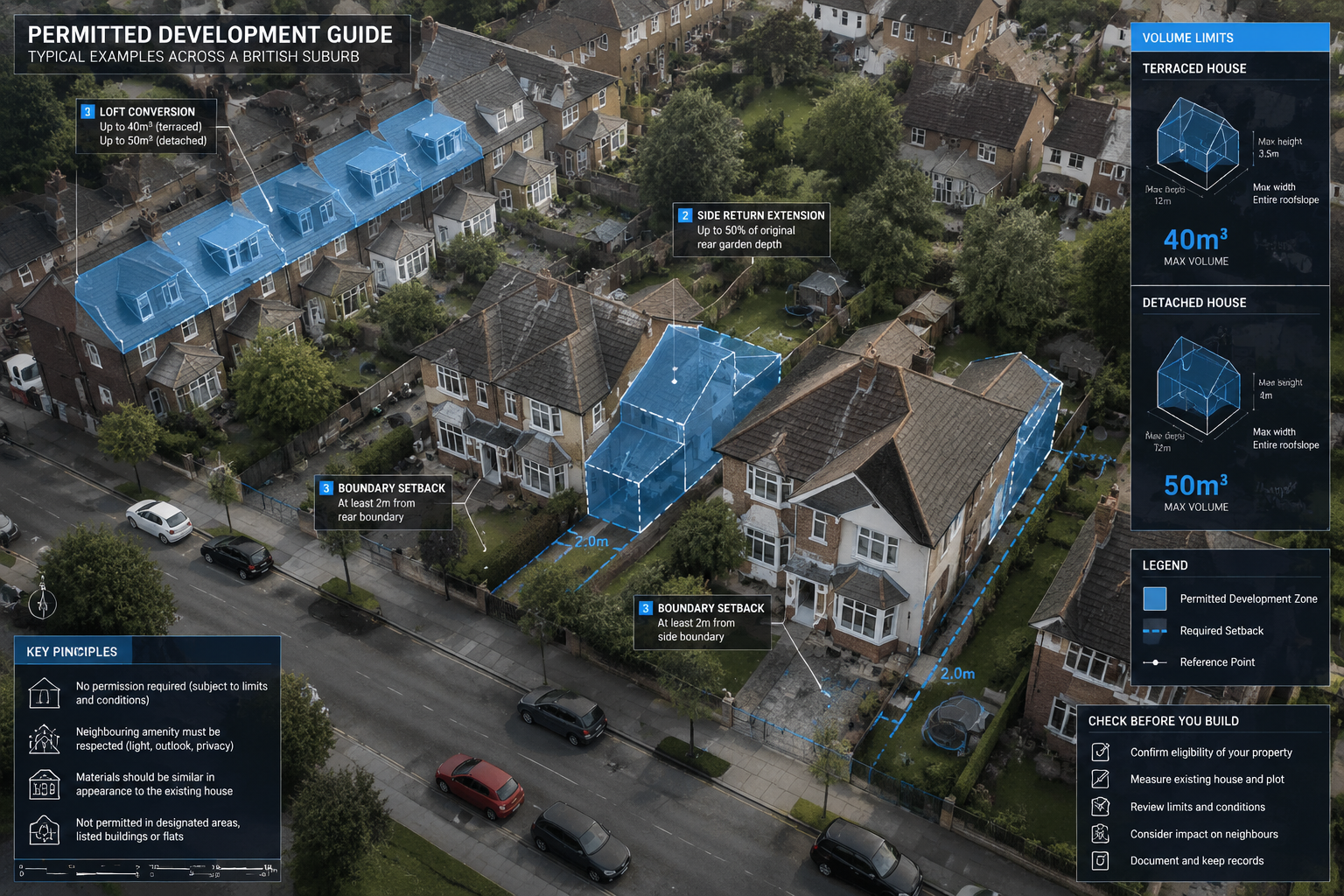
Loft Conversion Volume Limits
Under current PD rights, a loft conversion must not increase the total roof space by more than:
- 40 cubic metres for terraced houses
- 50 cubic metres for detached and semi-detached houses [1]
Additional conditions apply:
| Condition | Requirement |
|---|---|
| Roof plane facing a highway | Extension must not project beyond existing plane |
| Rear dormer setback from eaves | Minimum 20 centimetres |
| Rear dormer setback from party walls | Minimum 20 centimetres |
| Ridge height | Must not exceed existing ridge |
| Materials | Must match existing house in appearance |
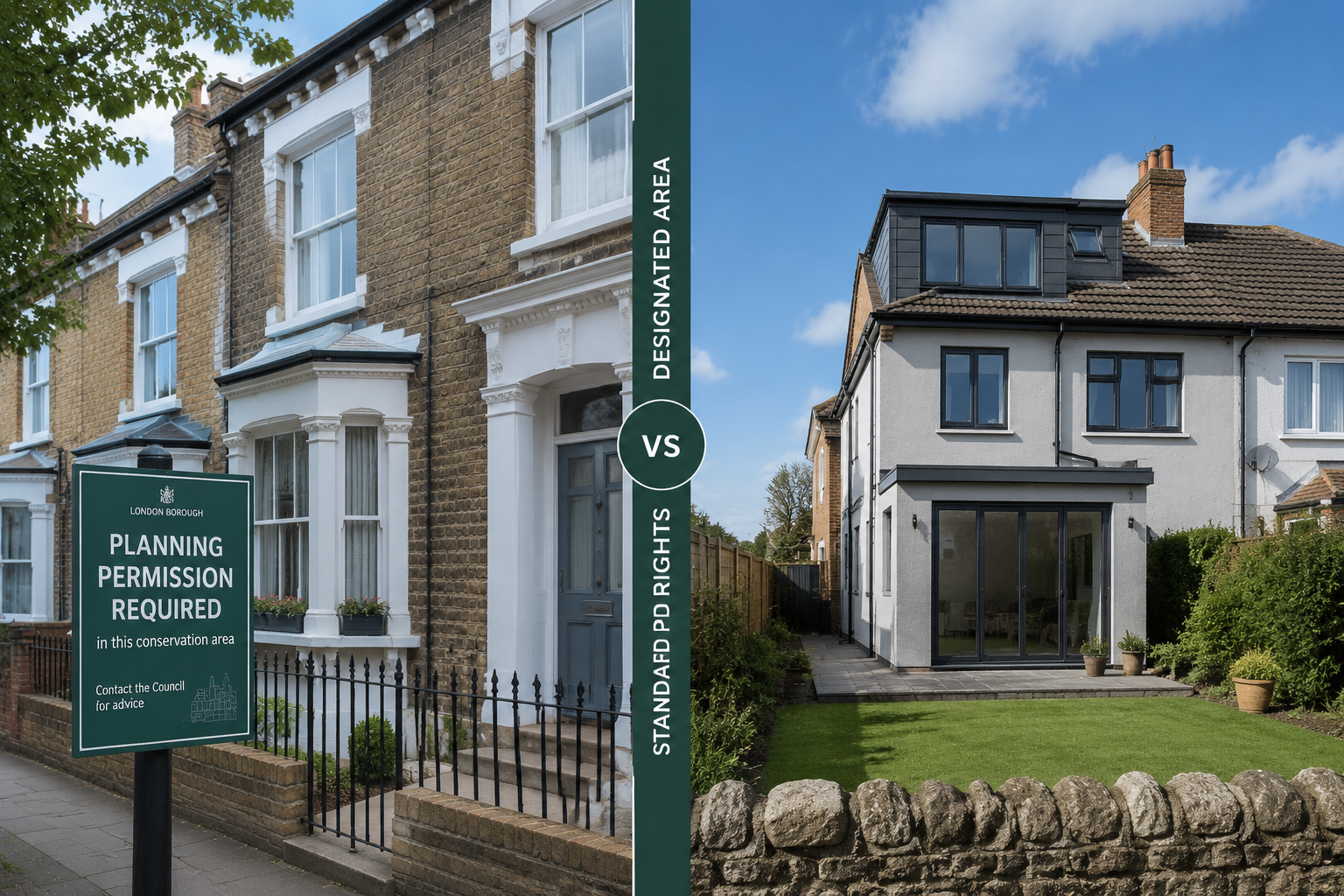
Front-facing dormers, properties in conservation areas, and those subject to an Article 4 Direction all require full planning permission regardless of size [5]. Surveyors must verify designation status as a preliminary step.
For properties where a loft conversion is planned alongside a party wall, the party wall obligations for loft conversions must be addressed separately from PD compliance — they are parallel, not alternative, requirements.
Side Return Extension Rules
Single-storey side extensions are permitted development only when they meet all of the following:
- Height does not exceed 4 metres
- Width does not exceed half the width of the original house
- The extension is at least 7 metres from any boundary opposite the side [1]
"Many London terraced houses have side returns narrower than 7 metres from the boundary, meaning full planning permission is required even for modest side extensions." [1]
This is a critical compliance point that catches a significant number of suburban properties. A surveyor working in West London or Bromley must measure the actual gap between the side wall and the opposing boundary before confirming PD eligibility.
For extensions within 2 metres of a boundary, specific design considerations apply regarding eaves height and materials, adding another layer to the checklist [2].
Building Survey Checklists for 2026 Permitted Development Expansions: Core Sections
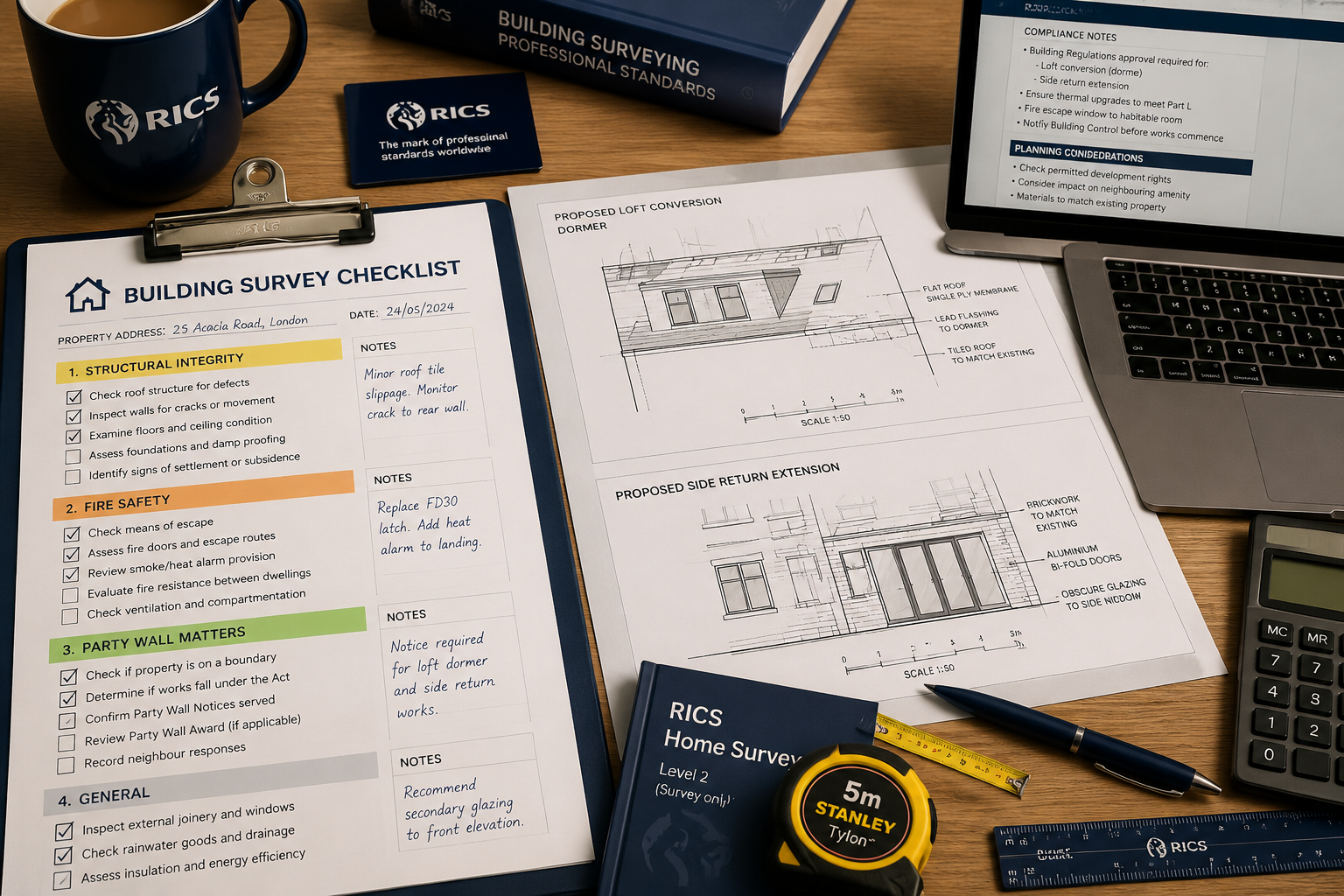
A robust survey checklist for loft and side return expansions in 2026 is not a single document but a structured sequence of assessments. The following sections represent the minimum standard for a Level 3 survey addressing PD expansion work.
Section 1: Pre-Inspection Risk Assessment
The RICS has refined pre-inspection protocols for 2026 to require documented risk assessments before the physical survey begins [7]. For expansion-focused surveys, this means:
- Property location risk: Is the property in a conservation area, AONB, National Park, or subject to Article 4? Designated areas remove or restrict PD rights for side extensions entirely and impose additional controls on loft work [3].
- Structural hazards: Age of construction, known subsidence zones, proximity to trees with high root activity.
- Environmental factors: Presence of asbestos in older roof structures — a particular concern for pre-1985 properties. An asbestos survey should be commissioned where risk is identified.
- Access requirements: Can the surveyor physically inspect the loft void, underfloor areas, and the full extent of any existing side return?
Section 2: PD Compliance Verification
This section translates the rules above into measurable site checks:
For loft conversions:
- Measure existing roof void volume against the applicable cubic metre limit
- Confirm dormer setbacks from eaves and party walls (minimum 20 cm each)
- Verify ridge height does not exceed existing structure
- Check that no roof plane facing a highway is altered
- Confirm materials match existing house appearance
- Establish whether any previous loft works have already consumed part of the permitted volume allowance
For side returns:
- Measure width of proposed extension against half the original house width
- Measure distance from side wall to opposing boundary
- Confirm height does not exceed 4 metres
- Check boundary proximity rules for eaves height if within 2 metres
For rear extensions referenced in the survey context:
- Single-storey: maximum 4 metres beyond original rear wall for detached, 3 metres for terraced or semi-detached [3]
- Two-storey: maximum 3 metres depth, minimum 7 metres from rear boundary [4]
Section 3: Structural Integrity Assessment
Expansion work places new loads on existing structures. The checklist must document:
- Foundation adequacy: Can existing foundations carry additional loads from a side return or dormer? Clay soils common in many suburban areas are particularly susceptible to movement.
- Roof structure condition: Rafters, purlins, ridge boards, and ceiling joists must be assessed for condition and load capacity before any loft conversion proceeds.
- Party wall condition: Cracks, damp penetration, or previous underpinning on shared walls affect both structural safety and the scope of required party wall notices.
- Lintel and beam assessment: Side return extensions require new openings in external walls; existing lintels above windows and doors in the affected wall must be checked.
A structural survey provides the detailed engineering context that a standard Level 2 homebuyer report cannot deliver for expansion projects.
Section 4: Fire Safety and Building Regulations Compliance
PD rights govern planning; building regulations govern construction safety. These are separate systems, and compliance with one does not imply compliance with the other. The fire safety checklist for loft conversions must address:
- Escape route: A loft conversion that creates a habitable room requires a protected escape route to the ground floor. This typically means a 30-minute fire-rated enclosure of the staircase.
- Interlinked smoke alarms: Required on every floor including the new loft level.
- Structural fire protection: Steel beams used in side return openings must be fire-protected to the required standard.
- Glazing: Fire-rated glazing requirements apply to certain internal windows adjacent to the escape route.
Where existing extensions are being assessed in a pre-purchase context, the surveyor must check for building regulations completion certificates. The absence of a certificate for loft or extension work is a significant red flag that should be flagged in the survey report and investigated before exchange of contracts.
Section 5: Party Wall and Neighbour Consultation
Side return extensions and loft conversions frequently trigger obligations under the Party Wall etc. Act 1996. The checklist must confirm:
- Whether the proposed or completed works fall within the Act's scope
- Whether a Party Wall Notice was served and an Award obtained
- The condition of the adjoining owner's property at the time works commenced — documented in a schedule of condition
- Any existing damage claims or disputes relating to previous works
For buyers purchasing a property where extension work has already been completed, verifying that party wall obligations were properly discharged protects against inherited liability for neighbour damage claims.
Section 6: Drainage and Services
Side returns often cover or redirect existing drainage runs. The checklist must include:
- Location of existing drainage relative to the proposed or completed extension footprint
- Evidence of any drainage diversion and whether it was approved
- Condition of existing gutters, downpipes, and soakaways affected by the new roof area
A drainage survey is advisable where a side return covers a significant area of the original side passage.
Designated Areas and Article 4 Directions: The Checklist Additions
Properties in conservation areas, National Parks, AONBs, and the Broads require a separate layer of checklist items [3]. In these locations:
- Side extensions are not permitted development and require full planning permission
- Rear extensions may face additional height and depth restrictions
- Cladding materials, window styles, and roof finishes may be controlled by local design guides
- Loft dormers visible from the street or in sensitive settings may require Conservation Area Consent
Article 4 Directions — used by local authorities to remove PD rights in specific streets or areas — must be checked against the local planning authority's register. This is a desktop check that should precede any site visit.
For properties in Hampshire, Sussex, or Hertfordshire, where AONB boundaries and conservation areas are widespread, this check is not optional.
Valuation Implications of Expansion Potential in 2026 Surveys
A survey that identifies clear, compliant PD expansion potential adds measurable value to the assessment. Surveyors in 2026 are expected to evaluate development upside as part of the overall appraisal, including:
- Existing use value: The baseline value of the property as currently configured
- Achievable development scenarios: For example, a rear dormer providing an additional bedroom and en-suite bathroom
- Residual appraisal: The value added after accounting for build costs
- Planning risk assessment: Probability of PD compliance and local precedent for similar works [6]
Where a property has already been extended, the survey must confirm that the work was completed lawfully. Unlawful extensions — those built without required planning permission or building regulations approval — can affect mortgage eligibility, insurance, and resale value. A specific defect report may be warranted where the compliance status of existing works is unclear.
Applying Building Survey Checklists for 2026 Permitted Development Expansions: Practical Steps
The following sequence reflects best practice for homeowners, buyers, and their surveyors in 2026:
- Commission a desktop PD eligibility check before any design work or offer is made. Confirm designation status, Article 4 coverage, and basic dimensional compliance.
- Instruct a Level 3 building survey that explicitly includes the PD compliance, structural, fire safety, party wall, and drainage sections described above.
- Request building regulations certificates for any existing extension or loft work. If unavailable, consider a regularisation application or indemnity insurance, with legal advice.
- Serve party wall notices at least two months before works begin for loft conversions or side returns that affect a shared wall.
- Commission specialist reports where the Level 3 survey identifies specific risks: structural engineer's report for foundation concerns, asbestos survey for pre-1985 roof structures, drainage CCTV survey where drainage is at risk.
- Document the pre-works condition of neighbouring properties through a formal schedule of condition.
- Obtain a Lawful Development Certificate from the local planning authority after completion to provide permanent proof of PD compliance.
Conclusion
The suburban recovery of 2026 has made loft conversions and side return extensions a mainstream response to rising house prices and changing space needs. Permitted development rights provide a streamlined route to expansion, but they come with precise dimensional, locational, and design conditions that are easy to breach and costly to remedy after the fact.
Building Survey Checklists for 2026 Permitted Development Expansions: Loft and Side Returns in Suburban Recovery provide the structured framework that protects homeowners, buyers, and surveyors from compliance failures, structural defects, fire safety gaps, and neighbour disputes. A checklist that covers PD eligibility verification, structural integrity, fire safety, party wall obligations, drainage, and designated area restrictions is not excessive — it is the minimum standard for responsible practice in the current market.
Actionable next steps:
- If purchasing a property with existing extension work, instruct a Level 3 survey with explicit PD compliance and building regulations verification before exchange.
- If planning a loft conversion or side return, commission a pre-application desktop PD check and party wall assessment before engaging a builder.
- If the property is in or near a designated area, confirm Article 4 and conservation area status with the local planning authority before assuming PD rights apply.
- Obtain a Lawful Development Certificate on completion to protect resale value and mortgage eligibility.
References
[1] Permitted Development Rights London 2026 – https://www.mayfairstudio.co.uk/blog/permitted-development-rights-london-2026?utm_source=openai
[2] Building Survey Protocols For Bungalow Conversions Level 3 Checks For Loft And Side Extensions In 2026 – https://kingstonsurveyors.com/building-survey-protocols-for-bungalow-conversions-level-3-checks-for-loft-and-side-extensions-in-2026/?utm_source=openai
[3] Permitted Development Rear Extensions Guide – https://www.mybuildwise.co.uk/blog/permitted-development-rear-extensions-guide?utm_source=openai
[4] Do I Need Planning Permission For A Two Storey Extension 2026 – https://www.bestbuilders.co.uk/guides/planning/do-i-need-planning-permission-for-a-two-storey-extension-2026?utm_source=openai
[5] Do I Need Planning Permission For A Loft Dormer 2026 – https://www.bestbuilders.co.uk/guides/planning/do-i-need-planning-permission-for-a-loft-dormer-2026?utm_source=openai
[6] Valuing Development Potential How Surveyors Assess Loft Extension And Conversion Upside In 2026 UK Appraisals – https://www.canterburysurveyors.com/blog/valuing-development-potential-how-surveyors-assess-loft-extension-and-conversion-upside-in-2026-uk-appraisals/?utm_source=openai
[7] Building Survey Checklists For Bungalow Purchases 2026 RICS Guidance On Structural Risks And Costs – https://nottinghillsurveyors.com/blog/building-survey-checklists-for-bungalow-purchases-2026-rics-guidance-on-structural-risks-and-costs?utm_source=openai