Rental supply across the UK remains 20% to 30% below pre-pandemic levels even as the average rent for a new tenancy reached £1,321 in June 2026 — and that structural imbalance is driving a sharp rise in formal disputes between landlords, tenants, and tribunals [2]. Against this backdrop, Expert Witness Roles in 2026 UK Rental Valuation Disputes: Navigating Tenant Demand Surges have moved from a niche specialism to a central pillar of property litigation strategy. When a landlord seeks to justify a rent increase on a portfolio property in Manchester or a tenant challenges a market rent assessment before the First-tier Tribunal (Property Chamber), it is the expert witness — typically a RICS-accredited chartered surveyor — who provides the independent, evidence-based testimony that resolves the dispute.
Key Takeaways
- Supply shortages of 20-30% below pre-pandemic levels and a 2.1% annual rent increase are generating more rental valuation disputes across all UK regions in 2026 [2].
- The Renters' Rights Act (effective May 2026) abolished fixed-term tenancies and restricted rent increases, making landlord-tenant valuation disagreements more legally complex.
- Expert witnesses in rental valuation cases must follow RICS Red Book Global Standards and CPR Part 35 duties, placing impartiality above client instructions.
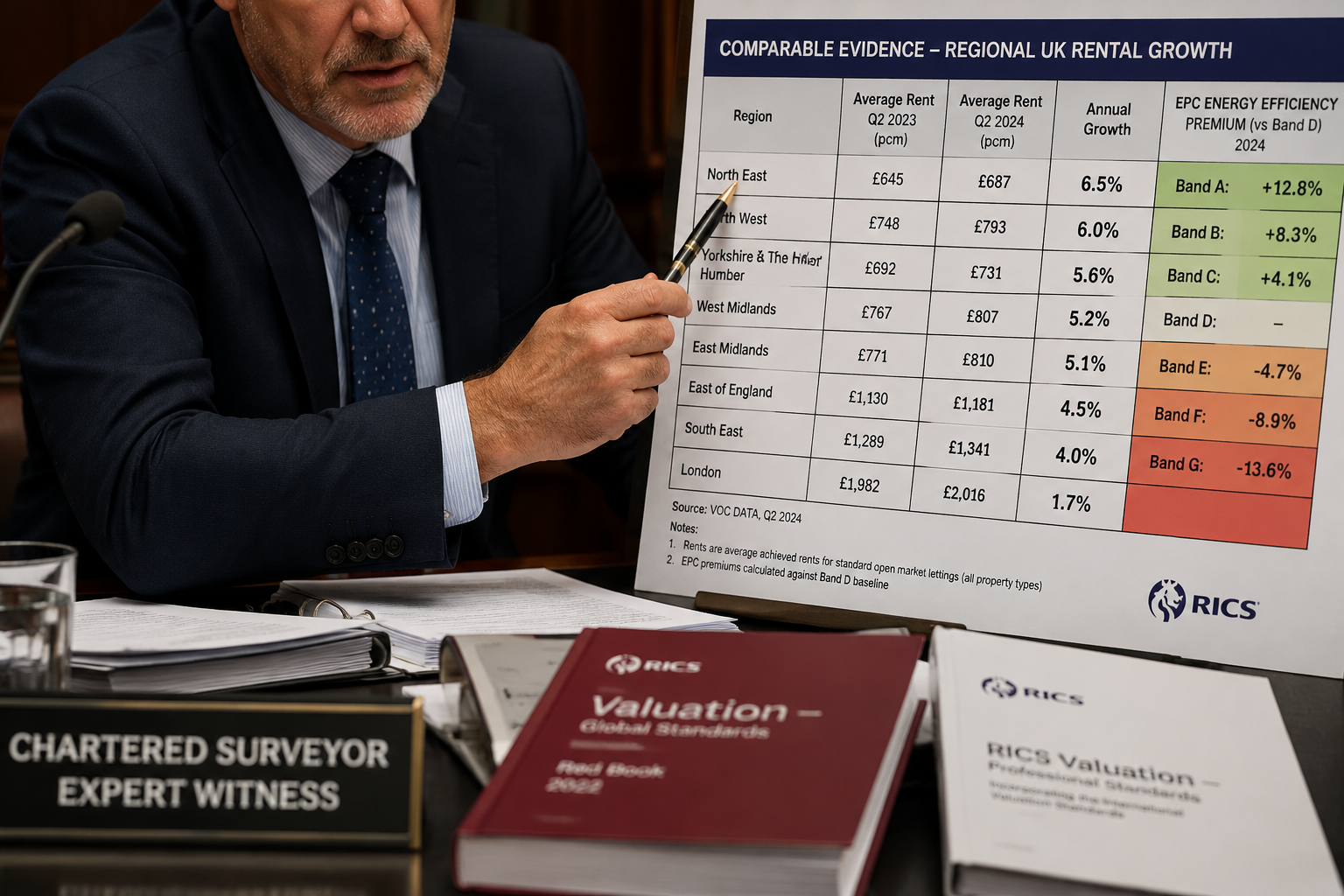
- Regional rental growth disparities — from 6.5% in the North East to 1.7% in London — mean that comparable evidence must be carefully localised [3].
- EPC ratings now materially affect rental value, with A/B-rated properties earning up to 13.3% more in parts of northern England, a factor expert witnesses must account for in their reports [5].
The 2026 UK Rental Market: Why Disputes Are Escalating
Understanding why expert witness instructions have increased requires a clear view of the current market pressures shaping every landlord-tenant relationship.
Supply Constraints and Rising Competition
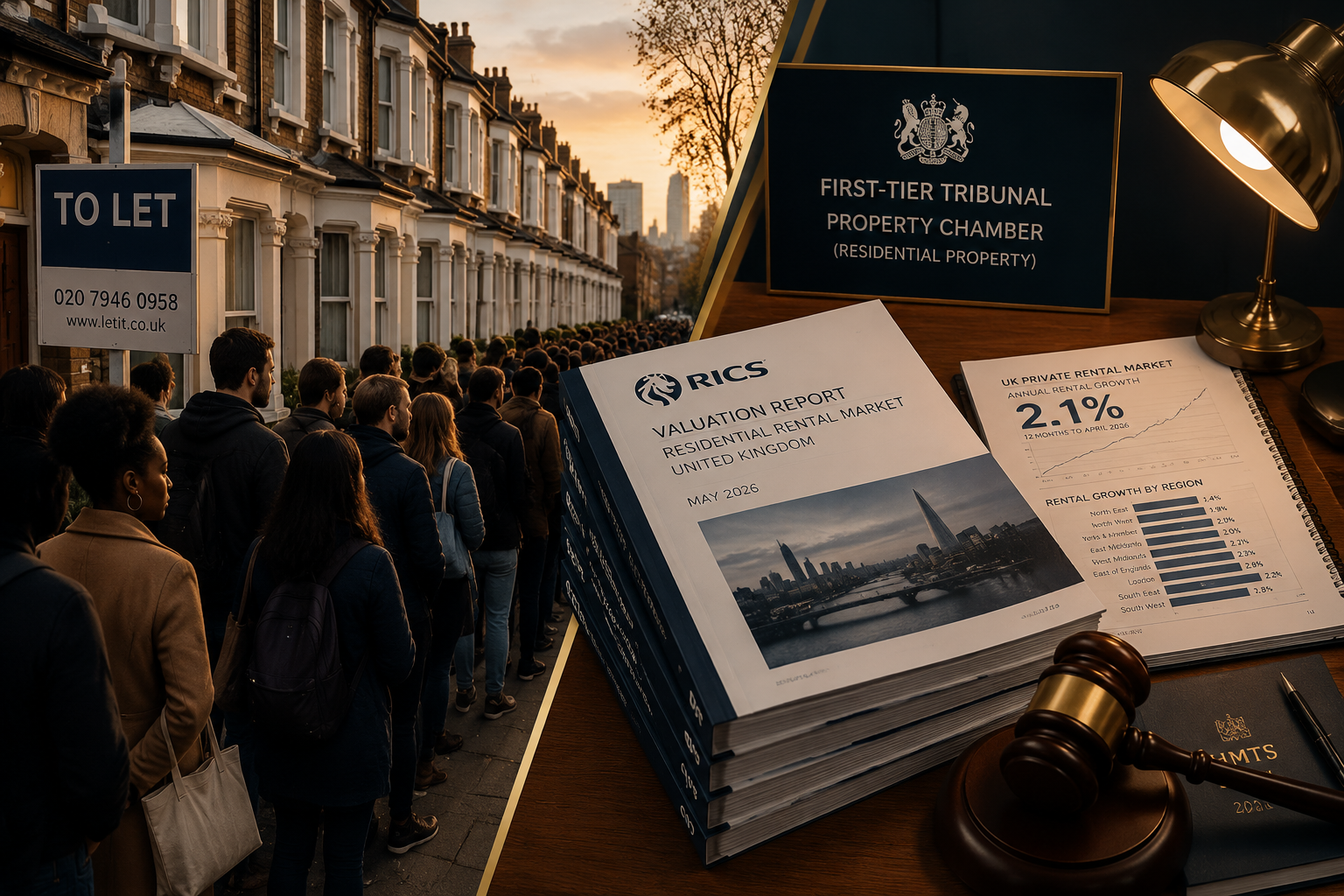
Despite a modest slowdown in rental growth, the fundamental supply problem has not eased. Available rental stock remains 20% to 30% below pre-pandemic norms across every region [2]. Approximately 25% of rental properties are already let before they are formally advertised, with the strongest competition concentrated in two- and three-bedroom homes across the East of England, South East, and South West [4]. This scarcity inflates market rents, and when landlords attempt to capture that inflation through rent review clauses or open-market lettings, tenants increasingly challenge the figures.
The Renters' Rights Act 2026 and Its Dispute Implications
Effective May 2026, the Renters' Rights Act introduced sweeping reforms: the abolition of fixed-term assured shorthold tenancies, the end of Section 21 "no-fault" evictions, and tighter restrictions on the frequency and scale of rent increases. These changes have made landlords more cautious about letting decisions and more likely to seek formal market rent determinations to justify any increase they do pursue. Simultaneously, tenants now have a stronger statutory platform to challenge rents they consider above market level. The result is a measurable increase in First-tier Tribunal referrals — and a corresponding demand for qualified expert witnesses who can provide defensible rental valuation evidence.
Regional Disparities That Complicate Valuation
The national headline figure of 2.1% annual rental growth [2] masks significant regional variation. The North East recorded the highest growth at 6.5%, while London — despite its absolute rent levels — saw the lowest at just 1.7% [3]. For an expert witness, these disparities are not merely academic. A comparable transaction drawn from the wrong submarket can undermine an entire report. Proper localisation of evidence is therefore one of the most critical technical skills an expert witness must demonstrate in 2026.
Expert Witness Roles in 2026 UK Rental Valuation Disputes: Core Duties and Legal Framework
The role of an expert witness in a rental valuation dispute is fundamentally different from that of a party-appointed valuer. Understanding that distinction is essential for both legal practitioners and property owners who are considering instructing one.
The Overriding Duty to the Tribunal
Under Civil Procedure Rules Part 35, an expert witness owes a primary duty to the court or tribunal — not to the instructing party. This means that even when instructed by a landlord seeking to defend a higher rent, the expert must present all material comparable evidence, including transactions that may support the tenant's position. Failure to do so risks the report being disregarded or the expert being criticised in the tribunal's written decision.
For those seeking a deeper understanding of what a formal expert witness instruction involves, the expert witness report service produced by RICS-accredited surveyors sets out the structure and content requirements that tribunals expect.
RICS Red Book Standards and Rental Valuation Methodology
Expert witnesses instructed in rental valuation disputes are required to follow RICS Valuation — Global Standards (the Red Book). The Red Book mandates that market rent be defined as the estimated amount for which an interest in real property should be let on the valuation date between a willing lessor and a willing lessee on appropriate lease terms in an arm's-length transaction, after proper marketing, where the parties have each acted knowledgeably, prudently, and without compulsion.
In practice, this means the expert must:
- Identify genuinely comparable lettings — same property type, similar size, equivalent location, comparable lease terms, and recent transaction dates
- Adjust for material differences — EPC rating, condition, floor level, parking, and amenity provision
- Apply a recognised valuation approach — typically the comparable method, but occasionally the profits or cost approach for specialist properties
- Disclose all assumptions — including any adjustments made to comparables and the reasoning behind them
The factors of valuation that RICS surveyors apply in formal assessments provide a useful framework for understanding how each variable is weighted in a rental context.
When an Expert Witness Is Required
Not every rental dispute requires expert witness testimony. Many straightforward cases are resolved through negotiation or mediation. Expert witnesses become necessary when:
| Scenario | Why Expert Evidence Is Needed |
|---|---|
| First-tier Tribunal rent determination | Tribunal requires independent market rent evidence |
| Commercial lease rent review arbitration | Arbitrator needs comparable evidence from a qualified expert |
| Dilapidations disputes with rent implications | Condition affects achievable market rent |
| Portfolio acquisition disputes | Buyer and seller disagree on passing rent vs. market rent |
| Judicial review of local housing allowance | Market rent benchmark must be independently established |
For landlords and tenants navigating rent reviews, understanding when to escalate to formal expert evidence — rather than relying solely on agent opinion — can be the difference between a successful and an unsuccessful tribunal outcome.
Navigating Tenant Demand Surges: How Expert Witnesses Build Defensible Evidence
The surge in tenant demand that has characterised the 2026 market creates a specific evidentiary challenge: when demand is abnormally high, achieved rents may reflect a temporary spike rather than a sustainable market level. Expert witnesses must distinguish between cyclical demand pressure and structural market rent.
Selecting and Adjusting Comparable Evidence
The cornerstone of any rental valuation expert report is the comparable evidence schedule. In a high-demand environment, the expert must be particularly careful to:
- Use a sufficient sample size — a minimum of three to five comparables is expected; more are preferable in volatile markets
- Date-adjust for market movement — a comparable from twelve months ago may need upward adjustment if the local market has moved, but only where that movement is evidenced by index data, not assumed
- Strip out demand-driven premiums — where a letting was achieved through a bidding war among multiple applicants, the achieved rent may not represent the open-market level under the Red Book definition
The Manchester valuation process illustrates how local market knowledge must be combined with methodological rigour to produce a figure that will withstand tribunal scrutiny.
The EPC Premium: A Material Valuation Factor in 2026
One of the most significant developments in rental valuation methodology in 2026 is the growing evidential weight attached to EPC ratings. Properties rated A or B in England earn on average 8.1% more rent than equivalent D-rated properties, with the premium rising to 13.3% in parts of northern England [5]. Expert witnesses who fail to account for EPC differentials when selecting or adjusting comparables risk producing a report that is successfully challenged on this specific point.
"An expert witness who ignores the EPC premium in a 2026 rental valuation is not just methodologically incomplete — they are presenting a distorted market rent figure that a well-prepared opposing expert will dismantle."
This is particularly relevant in portfolio disputes, where a landlord may have upgraded some properties to meet forthcoming EPC minimum standards while others remain below the threshold. The rent differential between those properties is not cosmetic — it is a material valuation input.
Rent Guarantor Data as a Market Indicator
Following the Renters' Rights Act, companies providing rent guarantor services have seen revenue growth of 115% as landlords seek additional security in a market where eviction has become more complex [1]. While rent guarantor data is not itself a comparable transaction, the volume and terms of guarantor arrangements in a given submarket can serve as a useful indicator of demand intensity and landlord risk perception — context that an expert witness may reference in the narrative section of a report to support their market commentary.
Technology and AI-Assisted Valuation Tools
Emerging AI-powered systems designed to optimise rental placement and valuation — such as the DOMUS framework developed for temporary accommodation — are beginning to influence how comparable data is aggregated and analysed [6]. Expert witnesses are not yet expected to use AI tools in their formal reports, but they should be aware that opposing experts or tribunal members may reference algorithmically-derived rental benchmarks. The expert's role is to assess whether such outputs are consistent with RICS methodology and, where they are not, to explain why the traditional comparable approach produces a more reliable figure.
For a broader understanding of how RICS-certified valuers approach formal assessments, the Red Book valuation methodology page provides a clear explanation of the standards that govern all formal rental valuation work.
Practical Guidance for Instructing an Expert Witness in a Rental Valuation Dispute

Selecting the right expert witness is as important as the quality of the report itself. Tribunals pay close attention to the expert's credentials, experience, and demonstrated independence.
Credentials and Qualifications to Look For
An expert witness instructed in a UK rental valuation dispute should hold:
- RICS membership (MRICS or FRICS) with a current Practising Certificate
- Registered Valuer status with RICS — this is a specific designation that confirms the individual meets the competency standards for formal valuation work
- Demonstrable experience in the specific property type and geographic market relevant to the dispute
- Prior tribunal experience — familiarity with the procedural requirements of the First-tier Tribunal (Property Chamber) or the Upper Tribunal (Lands Chamber)
The chartered surveyors who specialise in expert witness work will typically be able to provide a CV and a list of previous tribunal appointments on request.
Structuring the Letter of Instruction
A well-drafted letter of instruction reduces the risk of the expert's report being challenged on procedural grounds. It should:
- Clearly identify the property and the interest to be valued
- Specify the valuation date
- Set out the legal context — including the relevant lease terms or statutory provision under which the rent is being determined
- Confirm that the expert understands their overriding duty to the tribunal
- Provide all relevant background documents — lease, rent review memoranda, previous valuation reports, and any correspondence between the parties
Timetabling and Costs
Expert witness reports in rental valuation disputes typically take four to eight weeks to prepare, depending on the complexity of the comparable evidence and the need for site inspection. Valuation costs vary by property type and location, but parties should budget for a report fee, any tribunal attendance fee, and the cost of preparation for cross-examination.
Where both parties instruct their own experts, tribunals will often direct a without-prejudice meeting of experts to narrow the issues before the hearing. This "single joint statement" process can significantly reduce the scope of the dispute — and therefore the time and cost of the tribunal hearing itself.
Conclusion
Expert Witness Roles in 2026 UK Rental Valuation Disputes: Navigating Tenant Demand Surges represent one of the most technically demanding areas of property practice in the current market. With supply shortages persisting, the Renters' Rights Act reshaping landlord-tenant relationships, and regional rental growth ranging from 1.7% in London to 6.5% in the North East [3], the need for rigorous, independently-prepared valuation evidence has never been greater.
Actionable next steps for landlords, tenants, and legal practitioners:
- Instruct a RICS Registered Valuer with demonstrable tribunal experience at the earliest stage of a dispute — before positions harden and costs escalate.
- Ensure the letter of instruction clearly specifies the valuation date, the interest to be valued, and the relevant statutory or contractual framework.
- Require the expert to address EPC premiums explicitly in their comparable analysis — this is now a standard point of challenge in 2026 tribunal proceedings.
- Where both parties have instructed experts, engage proactively in the joint statement process to narrow the issues and reduce hearing time.
- For portfolio disputes, consider whether a single expert instruction covering multiple properties is more cost-effective than property-by-property reports.
Those involved in rental valuation disputes — whether as landlords managing expanding portfolios, tenants challenging above-market rents, or solicitors preparing tribunal bundles — should engage a qualified expert witness at the earliest opportunity. The quality of the expert's evidence, and their ability to withstand cross-examination, will in most cases determine the outcome.
References
[1] Rentguarantor Holdings A Small Upstart With Huge Potential – https://moneyweek.com/investments/share-tips/rentguarantor-holdings-a-small-upstart-with-huge-potential?utm_source=openai
[2] Rental Market Report – https://www.zoopla.co.uk/discover/property-news/rental-market-report/?utm_source=openai
[3] Uk Rental Market 2026 – https://propertydispatch.co.uk/market-data/uk-rental-market-2026/?utm_source=openai
[4] Uk Rental Market Demand 2026 Space Affordability – https://www.benhams.com/press-release/london-property-market/uk-rental-market-demand-2026-space-affordability/?utm_source=openai
[5] Top Areas For Buy To Let – https://moneyweek.com/investments/property/top-areas-for-buy-to-let?utm_source=openai
[6] arxiv – https://arxiv.org/abs/2606.16652?utm_source=openai