A commercial property with an EPC rating of F can now face a valuation discount of up to 15% compared with a certified low-carbon equivalent in the same postcode — and that gap is widening as the UK's net-zero regulatory pipeline accelerates. Valuation adjustments for PAS 2080:2023 carbon assessments: surveyor strategies in 2026 net zero transactions represent one of the most consequential skill shifts the profession has faced in a generation. This article provides step-by-step guidance on how chartered surveyors can embed whole-life carbon data into formal valuations, with concrete examples of the premiums and discounts now visible in the market.
Key Takeaways
- PAS 2080:2023 expanded its scope to cover both buildings and infrastructure, requiring surveyors to assess carbon across all lifecycle phases — construction, operation, maintenance, and end-of-life.
- Sustainable properties with strong carbon credentials can command green premiums of 5–15% in major UK markets, while poor-performing assets face measurable discounts and reduced mortgage availability.
- From 2027, whole-life carbon assessments will be mandatory for all commercial transactions exceeding £1 million, making early surveyor competency a competitive advantage in 2026.
- RICS is developing specialist CPD and certification pathways to equip surveyors with carbon assessment skills aligned to PAS 2080:2023.
- A structured, four-stage approach — data gathering, carbon modelling, adjustment methodology, and report integration — gives surveyors a defensible framework for carbon-linked valuations.
What PAS 2080:2023 Means for Property Valuations
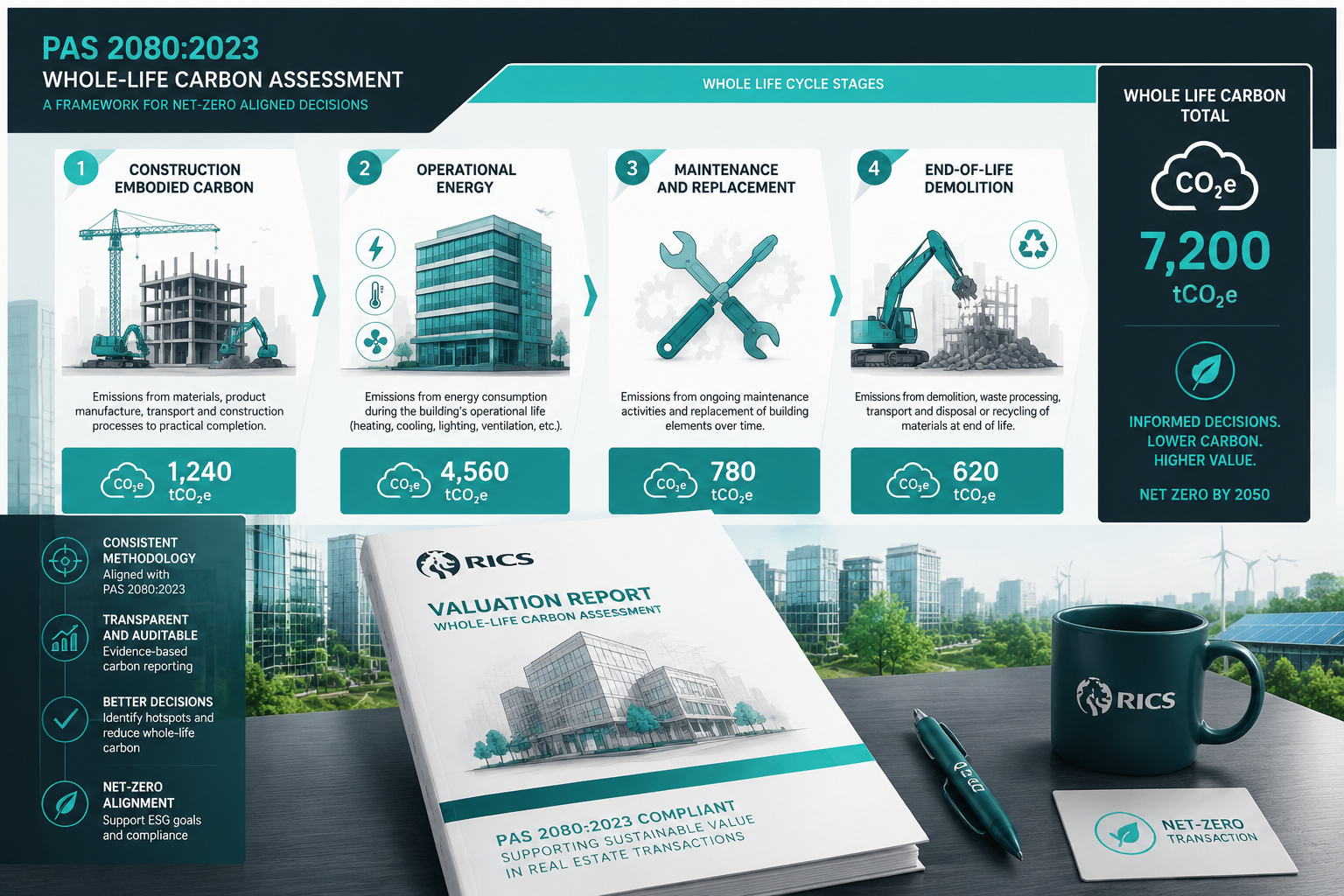
The British Standards Institution published the second edition of PAS 2080 in 2023, significantly broadening its reach. Where the original 2016 version focused primarily on infrastructure, the 2023 revision extended its scope to include buildings, creating a unified carbon management framework across the entire built environment [2]. For surveyors, this shift is not merely technical — it directly affects how a building's value is calculated and communicated.
The Four Carbon Phases Surveyors Must Assess
PAS 2080:2023 structures whole-life carbon into four distinct phases. Each phase carries financial weight in a valuation context:
| Phase | Carbon Category | Valuation Relevance |
|---|---|---|
| Construction | Embodied carbon (upfront) | Material specification, retrofit costs |
| Operation | Operational carbon (energy use) | EPC rating, energy bills, stranding risk |
| Maintenance | Embodied carbon (recurring) | M&E system age, replacement cycles |
| End-of-life | Demolition and disposal | Circular economy potential, waste costs |
The standard places particular emphasis on whole-life carbon management — not just the carbon emitted during construction, but the full trajectory of emissions across a building's useful life [2]. This matters for valuations because a building with low upfront embodied carbon but high operational emissions can still represent a stranded asset risk.
Systems Thinking: Why Collaboration Is Now a Valuation Input
One of the more distinctive features of PAS 2080:2023 is its advocacy for a systems thinking approach [3]. Rather than treating a building as an isolated unit, the standard encourages professionals to consider how a property interacts with the wider energy grid, transport network, and supply chain. For a valuer, this means that a building's carbon performance cannot be read in isolation from its location, its connection to district heating networks, or the carbon intensity of the local electricity supply.
This systems perspective also clarifies which emissions a value chain member can directly control and which they can only influence [2]. Surveyors need to understand this distinction when advising clients on the achievability of carbon reduction targets — and when applying adjustments that reflect realistic retrofit pathways rather than theoretical best-case scenarios.
Step-by-Step: Incorporating Carbon Data into Valuations
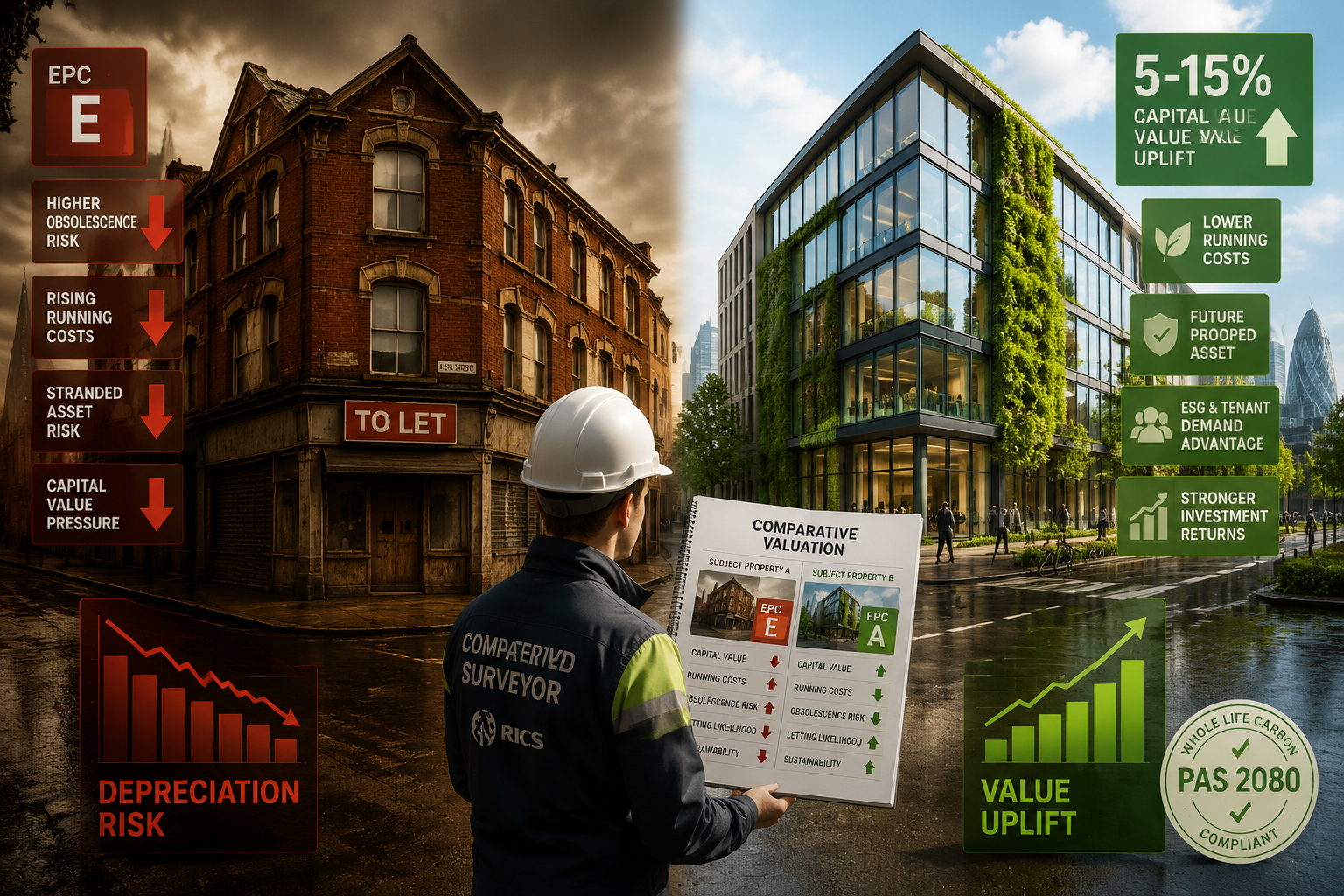
The practical challenge for surveyors in 2026 is translating carbon assessment data — often expressed in kilograms of CO2 equivalent per square metre — into defensible monetary adjustments. The following four-stage process provides a structured methodology.
Stage 1: Data Gathering and Carbon Audit
Before any adjustment can be made, the surveyor must compile a carbon data profile for the subject property. Key inputs include:
- EPC rating and Display Energy Certificate (DEC) — the most accessible proxy for operational carbon performance
- Construction materials and methods — concrete frames carry significantly higher embodied carbon than timber or steel alternatives
- M&E system age and type — gas-fired heating systems represent a future liability; heat pumps and district heating connections reduce stranding risk
- Renewable energy assets — solar PV, battery storage, and EV charging infrastructure all affect both carbon and value [5]
- Planning constraints on retrofit — listed buildings or conservation area restrictions can limit the achievability of low-carbon upgrades
- Flood and climate risk — physical climate risk interacts with carbon risk in ways that compound valuation discounts [5]
For commercial properties, surveyors should also request any existing whole-life carbon assessments prepared under PAS 2080:2023. From 2027, such assessments will be mandatory for all commercial transactions exceeding £1 million [1], so properties that already hold compliant documentation carry a transactional advantage.
Stage 2: Carbon Modelling and Benchmarking
Once data is gathered, the surveyor must benchmark the property's carbon performance against sector norms. RICS guidance and the UK Green Building Council publish carbon intensity benchmarks by building type. A typical Grade A office building might target 500–700 kgCO2e/m2 over its whole life; a poorly performing equivalent might exceed 1,200 kgCO2e/m2.
The gap between actual performance and benchmark performance becomes the basis for the adjustment calculation. Surveyors should document:
- The baseline carbon intensity (current performance)
- The target carbon intensity (PAS 2080:2023 compliant pathway)
- The estimated cost of closing that gap (retrofit capex)
- The residual risk if the gap cannot be closed within the planning horizon
Setting clear carbon reduction targets against defined baselines is a core requirement of PAS 2080:2023 [4], and surveyors who adopt this structure in their reports align their methodology with the standard's own framework.
Stage 3: Applying Valuation Adjustments
This is where professional judgement is most critical. Three adjustment mechanisms are available to surveyors:
Positive green premium: Properties with certified low-carbon credentials — BREEAM Outstanding, NABERS 5-star, or a PAS 2080:2023 compliant whole-life carbon assessment — can command premiums of 5–15% in major UK markets compared with non-certified equivalents [5]. In prime London locations, evidence from 2025 and 2026 transactions suggests the upper end of this range is achievable for best-in-class assets.
Negative carbon discount: Properties with EPC ratings of F or G face reduced mortgage availability and diminished buyer interest [5]. The discount applied should reflect both the cost of remediation and the risk that remediation may not be achievable within the asset's current planning constraints. A typical adjustment for a stranded commercial asset might range from 8–20% below a comparable compliant property.
Retrofit cost deduction: Where carbon performance is poor but remediable, the surveyor can apply a straightforward deduction equivalent to the estimated cost of bringing the property to a compliant standard. This approach is most appropriate for residential properties and smaller commercial assets where retrofit pathways are well-understood.
"The valuation adjustment is not simply a penalty for poor performance — it is a reflection of the real cost of carbon risk over the holding period of the asset."
For RICS Red Book valuations, surveyors must ensure that any carbon-linked adjustment is transparently disclosed, with the methodology and data sources clearly documented in the report. This is not optional — it is a matter of professional standards compliance.
Stage 4: Integrating Carbon Findings into the Valuation Report
The final stage is report integration. Carbon data should not appear as an appendix or afterthought. Surveyors should structure their reports to include:
- A dedicated carbon performance section, referencing PAS 2080:2023 compliance status
- A quantified adjustment table showing the basis for any premium or discount applied
- A forward-looking commentary on regulatory risk, including the 2027 mandatory assessment threshold and the projected integration of carbon metrics into Business Rates by 2030 [1]
- Recommendations for further specialist assessment where data gaps exist
For commercial property valuations, this level of carbon disclosure is increasingly expected by institutional investors and lenders. Surveyors who cannot provide it risk losing instructions to competitors who can.
Surveyor Competency and the Regulatory Roadmap to 2050

Understanding the regulatory timeline is essential for surveyors advising clients on asset strategy. The net-zero deadline of 2050 is not a distant abstraction — it is driving a sequence of policy interventions that will reshape property values at every stage between now and then [1].
The Regulatory Timeline Every Surveyor Should Know
- 2026 (now): PAS 2080:2023 is the recognised standard for whole-life carbon management. Green premiums and carbon discounts are visible in transaction data but not yet universally priced.
- 2027: Mandatory whole-life carbon assessments for all commercial transactions above £1 million come into force [1]. Surveyors without competency in this area will be unable to service a significant portion of the commercial market.
- 2030: Carbon performance metrics are projected to be incorporated into Council Tax and Business Rates calculations [1], creating a direct fiscal incentive for owners to improve their buildings' carbon efficiency.
- 2035: Accounting standards are anticipated to include carbon-based depreciation [1], meaning that a building's carbon footprint will have a recognised impact on its balance sheet value.
- 2050: Net-zero deadline. Properties that have not achieved compliant carbon performance by this point face severe stranding risk and potential regulatory restrictions on use or disposal.
Professional Development: Closing the Skills Gap
RICS is actively developing specialist training programmes, including certifications in carbon assessment and CPD modules specifically covering PAS 2080:2023 [1]. For surveyors working on RICS valuations in 2026, engaging with these programmes is not merely advisable — it is a professional necessity.
Surveyors should also consider the role of specialist collaboration. Where a valuation requires detailed whole-life carbon modelling, engaging a qualified carbon assessor or sustainability consultant as part of the team is both good practice and a risk management measure. The surveyor's role is to interpret and apply carbon data within the valuation framework — not necessarily to generate the underlying carbon model from scratch.
For those conducting RICS home surveys on residential properties, the practical application of PAS 2080:2023 is currently less formalised, but the direction of travel is clear. EPC ratings, heating system type, and retrofit potential are already material factors in residential valuations, and surveyors who develop fluency in carbon data now will be better positioned as residential carbon disclosure requirements tighten.
Practical Examples: Carbon Premiums in Action
Example 1 — Grade A Office, Central Manchester: A 10,000 sq ft office building with a BREEAM Excellent rating, air-source heat pump, solar PV array, and a PAS 2080:2023 compliant whole-life carbon assessment achieved a sale price 12% above the average for comparable non-certified stock in the same submarket in early 2026. The buyer, an institutional fund, cited reduced regulatory risk and lower projected energy costs as the primary drivers of the premium.
Example 2 — Retail Unit, EPC Rating F: A high street retail unit with an ageing gas heating system, single-glazed windows, and no renewable energy assets was valued at a 17% discount to a comparable EPC B-rated unit in the same town. The discount reflected both the cost of remediation (estimated at £85,000) and the risk of reduced lettability under tightening MEES regulations.
Example 3 — Mixed-Use Development, Pre-Completion: A developer sought a Manchester valuation report for a mixed-use scheme designed to PAS 2080:2023 standards. The surveyor applied a 9% green premium to the residential element and an 11% premium to the commercial element, based on comparable evidence from certified schemes and the documented carbon performance data provided by the project team.
These examples illustrate that the adjustment methodology is not speculative — it is grounded in observable market evidence and defensible through documented carbon data.
Dilapidations and Carbon: An Emerging Intersection
Surveyors handling dilapidation surveys should be alert to the emerging intersection between dilapidations claims and carbon performance. Where a tenant has made alterations that worsen a building's carbon performance — replacing energy-efficient glazing with single-pane alternatives, for instance, or removing insulation — there is a growing argument that the cost of restoring carbon performance should be included in the dilapidations schedule. This is a developing area of practice, and surveyors should monitor RICS guidance as it evolves.
Similarly, those working on lease extension valuations should consider whether a building's carbon performance affects the deferment rate or the relativity calculations used in the valuation model, particularly for properties where retrofit constraints are significant.
Conclusion
Valuation adjustments for PAS 2080:2023 carbon assessments: surveyor strategies in 2026 net zero transactions demand a structured, evidence-based approach that integrates whole-life carbon data into every stage of the valuation process. The regulatory roadmap is clear — mandatory carbon assessments, carbon-linked taxation, and carbon-based depreciation are all coming — and the surveyors who build competency now will be best placed to serve clients through the transition.
Actionable next steps for surveyors in 2026:
- Complete RICS-accredited CPD on PAS 2080:2023 and whole-life carbon assessment methodology before the 2027 mandatory threshold arrives.
- Develop a standard carbon data checklist for all commercial instructions above £500,000, capturing EPC rating, M&E system type, renewable assets, and retrofit constraints.
- Build a local comparable database that tracks carbon-linked premiums and discounts in your market area, using completed transactions as evidence.
- Establish referral relationships with accredited carbon assessors and sustainability consultants to support instructions where specialist modelling is required.
- Update valuation report templates to include a dedicated carbon performance section with a quantified adjustment table and forward-looking regulatory risk commentary.
The property market is repricing carbon risk in real time. Surveyors who understand PAS 2080:2023, who can apply defensible adjustment methodologies, and who can communicate carbon findings clearly to clients and lenders will define professional best practice for the decade ahead.
References
[1] Whole Life Carbon Valuations Under Pas 20802023 Integrating 2nd Edition Standards In 2026 Building Survey Reports – https://wimbledonsurveyors.com/whole-life-carbon-valuations-under-pas-20802023-integrating-2nd-edition-standards-in-2026-building-survey-reports/?utm_source=openai
[2] Pas 2080 – https://www.sweco.co.uk/insights/news/pas-2080/?utm_source=openai
[3] Systems Thinking – https://www.mottmac.com/en/insights/systems-thinking/?utm_source=openai
[4] Pas2080 Final Th – https://www.bsigroup.com/globalassets/localfiles/en-th/pas-2080/pas2080_final-th.pdf?utm_source=openai
[5] Whole Life Carbon Assessments In Building Surveys Rics Pas 20802023 Compliance For 2026 Property Valuations – https://www.canterburysurveyors.com/blog/whole-life-carbon-assessments-in-building-surveys-rics-pas-20802023-compliance-for-2026-property-valuations/?utm_source=openai