
Approximately 6.4 million homes in England alone have cavity walls filled with retrofitted insulation, yet a significant proportion of those installed before the year 2000 are now exhibiting moisture-related defects that were never anticipated at the time of installation [1]. For buyers, owners, and surveyors dealing with 1980s and 1990s properties, this is not a peripheral concern — it is one of the most consequential defect categories in the current housing market. Level 3 Building Surveys for Cavity Wall Insulation Failures: Detecting Damp in 1980s-1990s Housing Stock have become an essential tool for uncovering problems that a standard visual inspection will almost always miss.
Key Takeaways
- Cavity wall insulation retrofitted into 1980s and 1990s homes frequently causes penetrating damp when insulation slumps, bridges the cavity, or degrades over time.
- Level 3 Building Surveys (formerly RICS Building Surveys) are the only survey type with sufficient scope to detect and diagnose these defects properly.
- Thermal imaging, borescope inspection, and calibrated moisture metering are the three core diagnostic tools used in combination.
- Confirmed insulation failure can reduce a property's market value and mortgage eligibility, making early detection critical.
- Remediation options range from targeted extraction to full cavity clearance, with costs varying widely depending on the extent of failure.
Why 1980s and 1990s Housing Stock Carries Elevated Risk
The homes constructed between roughly 1980 and 1999 occupy a unique and problematic position in the UK housing stock. They were built during a period when energy efficiency began to be taken seriously at a policy level, yet construction standards, material science, and installation practices had not yet caught up with the ambition. Many cavity walls built before 1990 were left uninsulated at the time of construction, with retrofitting carried out later — often hastily, under government grant schemes, and by contractors whose quality control was inconsistent [1].
The insulation materials most commonly used during this era included:
- Blown mineral wool fibre — prone to slumping and moisture absorption
- Urea formaldehyde foam — now largely banned due to off-gassing and degradation
- Polystyrene bead — susceptible to settling and void formation at the base of the cavity
Beyond insulation, 1980s homes introduced a range of cost-saving construction methods that have not aged well. Oriented strand board (OSB) used in some construction types absorbs moisture readily and loses structural integrity when saturated [7]. Mild steel wall ties, used extensively before the widespread adoption of stainless steel alternatives, are prone to corrosion — leading to horizontal cracking in mortar joints and outward bulging of the outer leaf [3]. These compounding vulnerabilities make the era's housing stock particularly susceptible to moisture-related defects.
Thermal imaging surveys carried out on 1990s properties have confirmed that while such homes perform reasonably for their age, insulation levels are considered inadequate by current standards, and cold bridging is common [4]. When combined with degraded insulation, the result is a wall construction that actively draws moisture inward rather than repelling it.
How Cavity Wall Insulation Fails: The Mechanisms of Damp Transfer
Understanding why insulation fails is essential to understanding what a Level 3 Building Survey must look for. There are four primary failure mechanisms in retrofitted cavity wall insulation:
1. Insulation Slumping and Settlement
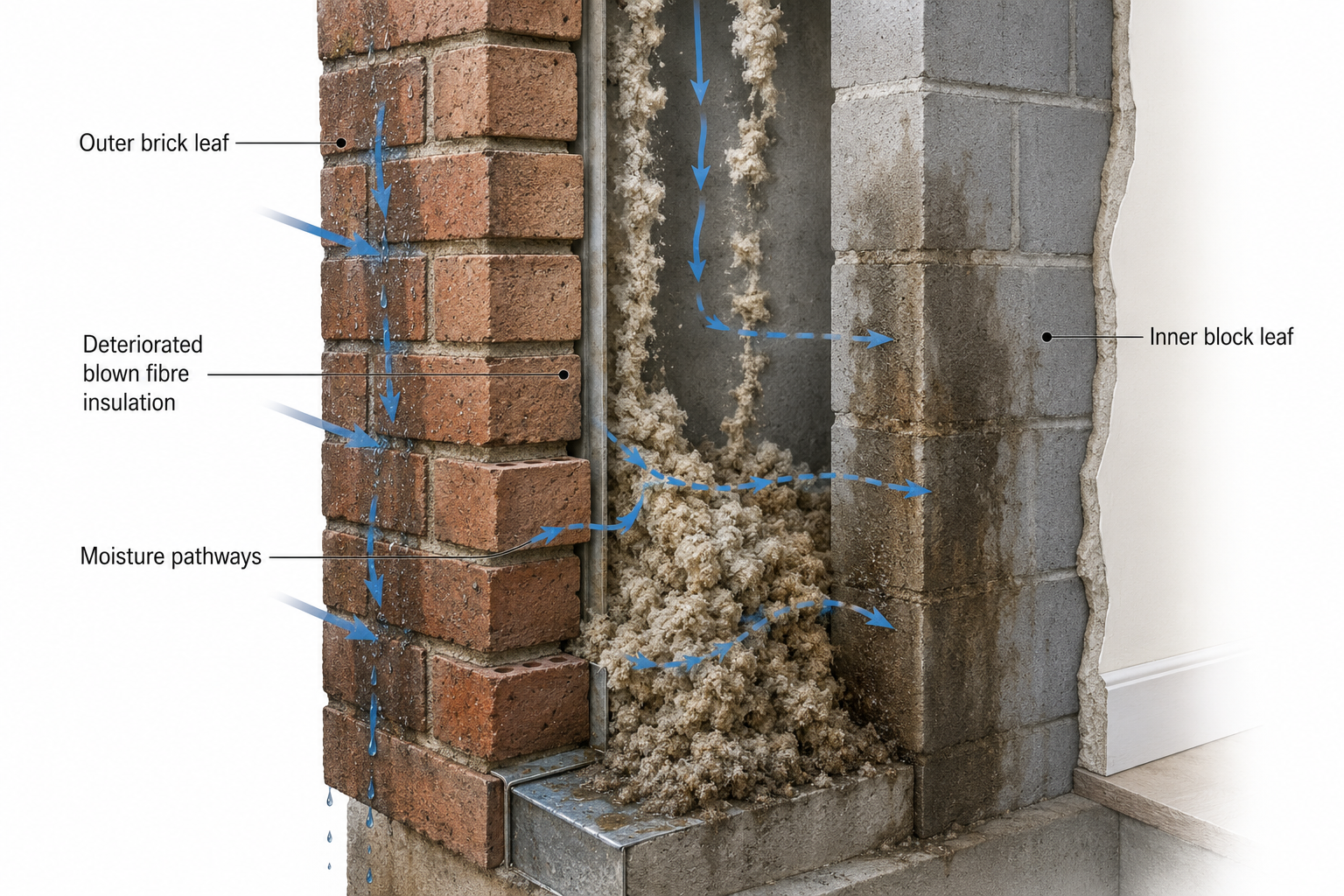
Over time, blown fibre insulation loses its structural integrity and settles toward the base of the cavity. This creates uninsulated voids in the upper sections of the wall while concentrating dense, moisture-laden material at the bottom. The dense lower section then acts as a wick, drawing rainwater from the outer leaf across to the inner leaf.
2. Cavity Bridging
The cavity in a traditional brick wall is designed to function as a drainage and ventilation gap. When insulation is installed improperly — or when it degrades and clumps — it creates a continuous bridge between the outer and inner leaves. Any water penetrating the outer brick now has a direct pathway to the internal structure [3].
3. Inadequate Installation at Critical Junctions
Window reveals, door frames, and roof eaves represent junctions where insulation was often installed poorly or not at all. These gaps create thermal bridges and entry points for moisture. Surveyors frequently find that damp is concentrated around window openings precisely because the insulation was not properly terminated at these junctions.
4. Exposure and Wall Orientation
Properties in exposed locations — particularly those with south-west facing elevations receiving the prevailing wind-driven rain — experience significantly higher rates of insulation failure. The English Housing Survey noted that cavity walls in such positions are subject to sustained moisture loading that many retrofitted insulation products were never designed to handle [1].
| Failure Type | Typical Location | Visual Indicator |
|---|---|---|
| Slumping | Lower wall sections | Damp patches at skirting level |
| Bridging | Mid-wall, around openings | Horizontal damp bands |
| Junction gaps | Window/door reveals | Damp concentrated at frames |
| Exposure-driven saturation | South-west elevations | Widespread internal staining |
The Level 3 Building Survey Protocol for Insulation Defect Detection
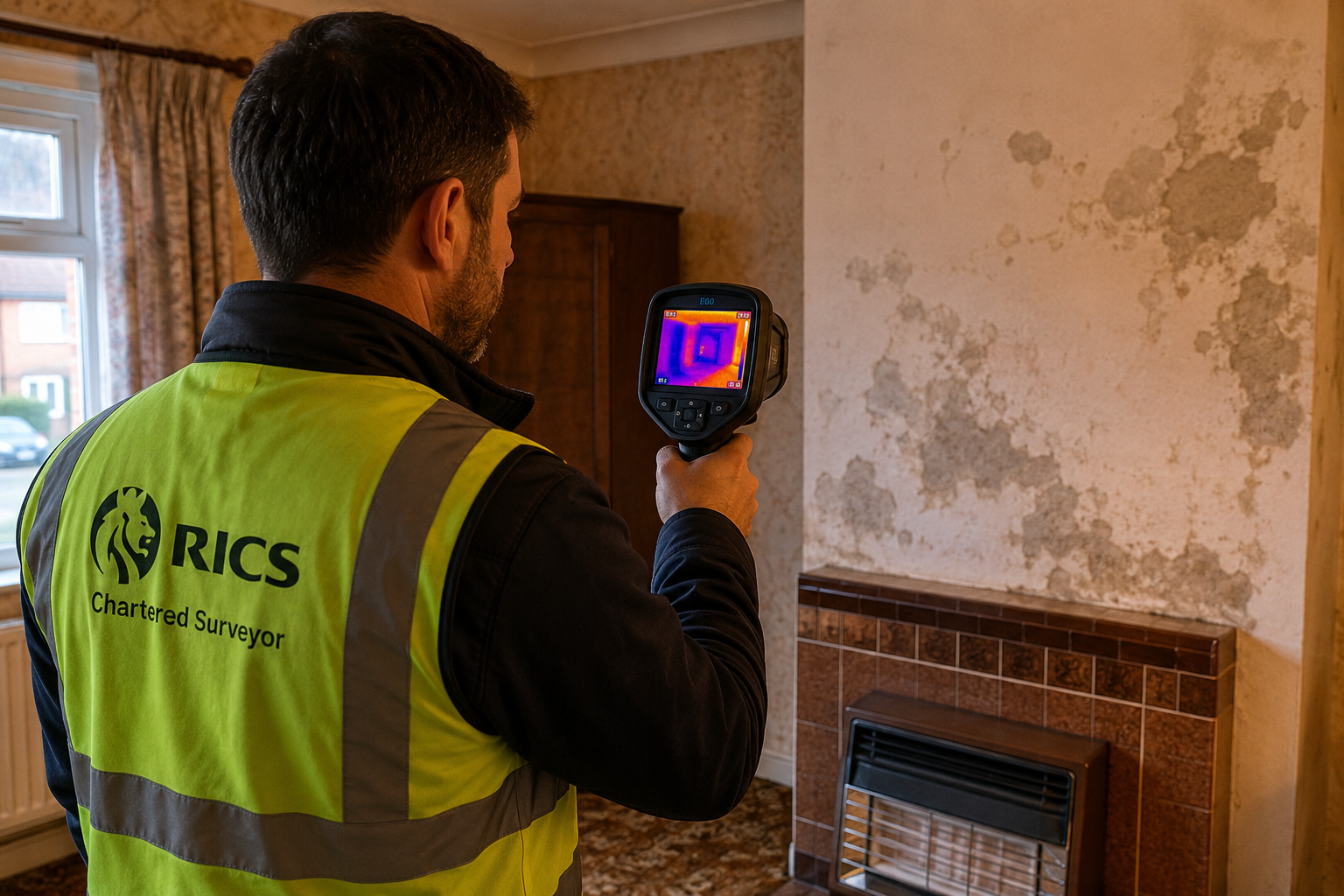
A RICS Level 3 Building Survey is the most thorough residential survey available, and it is the appropriate instruction for any 1980s or 1990s property where cavity wall insulation is present or suspected. Unlike a Level 2 HomeBuyer Report, which relies primarily on visual inspection, a Level 3 survey permits the surveyor to recommend and carry out — or arrange — specialist investigations where defects are suspected [8].
For cavity wall insulation failures specifically, the protocol involves three complementary diagnostic methods used in combination.
Thermal Imaging Surveys
Thermal imaging (infrared thermography) is the most efficient first-pass diagnostic tool for identifying insulation voids, cold bridges, and areas of moisture ingress. The technique works by detecting temperature differentials on internal wall surfaces: areas where insulation is absent or compromised appear as cold spots, while areas of active moisture show characteristic thermal signatures.
For accurate results, thermal imaging must be conducted under appropriate conditions:
- A minimum temperature differential of 10 degrees Celsius between internal and external temperatures
- Surveys conducted at night or in overcast conditions to avoid solar gain distorting readings
- Heating running for at least 24 hours prior to inspection
Thermal imaging surveys of 1990s properties have shown that even where insulation appears intact from the outside, significant cold bridging and insulation voids are common when examined with infrared equipment [4]. The results form a map that directs the surveyor toward specific areas requiring further investigation.
Borescope Inspection
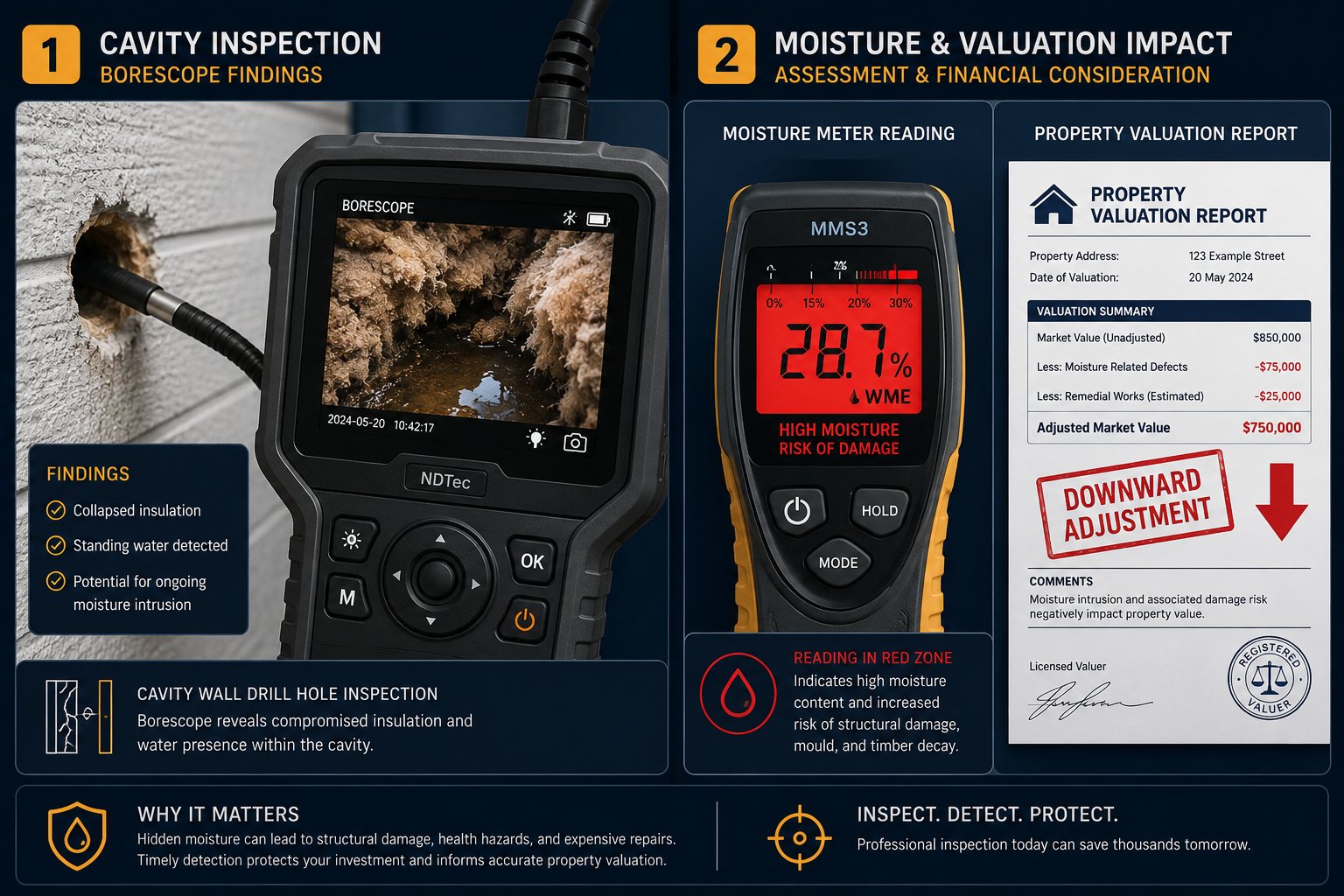
Where thermal imaging identifies suspect areas, a borescope inspection provides direct visual confirmation of conditions within the cavity. A small-diameter drill hole (typically 22mm) is made in the mortar joint of the outer leaf, and a flexible camera probe is inserted to examine the cavity directly.
Borescope inspection can confirm:
- Whether insulation is present and in what condition
- Whether the cavity contains standing water or debris
- Whether the wall ties are corroded or displaced
- Whether the insulation has slumped, leaving voids
This is an invasive technique, but the drill holes are easily repointed after inspection. The value of direct visual evidence in a Level 3 report cannot be overstated — particularly when the findings will influence mortgage decisions or purchase negotiations.
Calibrated Moisture Metering
Moisture meters measure the electrical resistance or capacitance of a material, providing a reading that correlates with moisture content. For cavity wall insulation investigations, readings are taken at multiple points across internal wall surfaces — typically at 300mm intervals — to build a moisture profile of each elevation.
Readings above 20% on a wood-equivalent scale in plaster or masonry indicate active moisture penetration. Surveyors cross-reference these readings with the thermal imaging map to distinguish between:
- Penetrating damp from insulation failure
- Rising damp from a compromised damp-proof course
- Condensation from inadequate ventilation
This distinction is critical. Misdiagnosis is common in 1980s and 1990s properties, and treating the wrong cause of damp is both costly and ineffective. For a broader comparison of how different survey types approach these issues, the guide to comparing different types of survey provides useful context.
Valuation Impacts and Mortgage Implications
Confirmed cavity wall insulation failure has direct and measurable consequences for property value and mortgageability. Lenders have become increasingly alert to the issue, and several major mortgage providers now require specialist reports before lending on properties where insulation failure is identified or suspected.
The valuation impacts typically fall into three categories:
1. Retention or Decline
Where a surveyor flags suspected insulation failure, a mortgage valuer may apply a retention — withholding a portion of the loan until remediation is completed — or decline to lend altogether until a specialist cavity wall investigation report is provided.
2. Negotiated Price Reduction
A RICS Level 3 Building Survey that identifies insulation failure provides the buyer with documented evidence to negotiate a price reduction reflecting the cost of remediation. Depending on the extent of failure, full cavity clearance and re-insulation can cost between £2,000 and £8,000 for a typical semi-detached property.
3. Insurance Reinstatement Considerations
Properties with known insulation failure and associated damp damage may face increased premiums or exclusions. An insurance reinstatement valuation should reflect the full cost of reinstatement including remediation of moisture damage to internal finishes, structural timbers, and any affected floor construction.
"A Level 3 Building Survey that identifies cavity wall insulation failure early in the transaction process gives buyers the information they need to make an informed decision — and the evidence they need to negotiate effectively."
Remediation Options and Retrofit Recommendations
When Level 3 Building Surveys for Cavity Wall Insulation Failures: Detecting Damp in 1980s-1990s Housing Stock confirm that remediation is necessary, the appropriate course of action depends on the type and extent of failure identified.
Targeted Extraction
Where failure is localised — typically around specific junctions or on a single elevation — targeted extraction using a high-powered vacuum system can remove the failed insulation from affected sections. New insulation is then injected into the cleared cavity. This approach is suitable where the majority of the existing insulation remains in good condition.
Full Cavity Clearance
Where failure is widespread, or where the original insulation is urea formaldehyde foam (which degrades into a powder that blocks drainage paths), full cavity clearance is recommended. This involves systematic drilling and vacuuming across all elevations, followed by inspection and re-insulation with a modern, certified product.
Re-insulation Material Selection
Following clearance, the choice of replacement insulation matters. For properties in exposed locations, cavity wall insulation should only be re-installed if the wall construction is suitable — specifically, if the cavity is at least 50mm wide and the outer leaf is in good condition. In some cases, particularly for exposed elevations, external wall insulation (EWI) may be a more appropriate long-term solution.
Surveyors should also consider whether adjacent works are needed. Where wall ties have corroded — a common finding in 1980s properties [3] — tie replacement must be addressed before any re-insulation is carried out. For properties where neighbouring works or shared wall construction is relevant, understanding party wall insulation considerations is an important part of the remediation planning process.
Damp Remediation to Internal Fabric
Remediation of the insulation itself does not automatically resolve the internal damp damage. Affected plasterwork must be hacked off and replaced, typically with a sand and cement render or specialist renovation plaster. Structural timbers — particularly floor joists and wall plates — must be inspected for rot and treated or replaced as necessary. A structural survey may be warranted where timber decay is suspected.
Choosing the Right Survey for a 1980s or 1990s Property
Not every survey type is equipped to identify cavity wall insulation failures. A Level 2 HomeBuyer Survey, for example, is a visual-only inspection that will note visible damp staining but cannot diagnose its cause or assess the condition of the cavity [8]. For any property built between 1980 and 1999 with suspected or confirmed cavity wall insulation, a RICS Level 3 Building Survey is the appropriate instruction.
The RICS HomeBuyer Survey Level 2 remains suitable for newer, conventionally constructed properties in good condition, but it is not designed for the complexity of defects found in this era's housing stock. If there is any uncertainty about which survey level is appropriate, the which survey do you need guide provides a useful framework for making that decision.
For properties where specific defects have already been identified — perhaps through a previous survey or a vendor disclosure — a RICS Specific Defect Survey focused on the cavity wall and damp may be a cost-effective alternative to a full Level 3 instruction.
Conclusion
Level 3 Building Surveys for Cavity Wall Insulation Failures: Detecting Damp in 1980s-1990s Housing Stock represent one of the most technically demanding areas of residential surveying practice in 2026. The combination of ageing insulation materials, corrosion-prone wall ties, and construction methods that were never fully tested for long-term durability has created a cohort of properties that carry significant latent defect risk [5].
Actionable next steps for buyers and owners of 1980s-1990s properties:
- Commission a Level 3 Building Survey from a RICS-qualified surveyor with specific experience in cavity wall defect investigation before exchanging contracts.
- Request thermal imaging as part of the survey scope — confirm with the surveyor that this will be included and that appropriate conditions will be arranged.
- Insist on borescope inspection of any elevation where thermal imaging or moisture readings indicate a problem.
- Obtain specialist remediation quotes before finalising any purchase price, using the survey findings as the basis for negotiation.
- Verify wall tie condition as part of the same investigation — tie failure and insulation failure frequently co-exist in this era's properties.
- Plan for internal reinstatement as a separate cost line — damp remediation to plasterwork and timbers is often as costly as the cavity clearance itself.
Early, thorough investigation is always less expensive than discovering these defects after completion. A comprehensive Level 3 survey, conducted by a qualified professional using the right diagnostic tools, is the most reliable protection available to anyone transacting in this sector of the housing market.
References
[1] Ehs Energy Efficiency Of English Housing 2013 – https://assets.publishing.service.gov.uk/government/uploads/system/uploads/attachment_data/file/445440/EHS_Energy_efficiency_of_English_housing_2013.pdf
[2] Handling Sensitive Legal Or Financial Matters Let Us Help Ease The Pressure 2 – https://www.haussurveyors.co.uk/2025/08/01/handling-sensitive-legal-or-financial-matters-let-us-help-ease-the-pressure-2/
[3] Cavity Wall Construction Common Defects – https://www.bookabuilderuk.com/blog/cavity-wall-construction-common-defects
[4] Thermal Imaging Survey Of 1990s Property – https://www.kelleherthermalimaging.ie/recent-projects/thermal-imaging-survey-of-1990s-property/
[5] What Are The Problems With Houses Built In The 1980s – https://engineerfix.com/what-are-the-problems-with-houses-built-in-the-1980s/
[6] Level 3 Surveys For Bungalows In 2026 Targeting Subsidence And Damp Risks In Single Storey Properties – https://www.canterburysurveyors.com/blog/level-3-surveys-for-bungalows-in-2026-targeting-subsidence-and-damp-risks-in-single-storey-properties/
[7] Dfw Home Humidity Damage By Era – https://truficient.com/blog/dfw-home-humidity-damage-by-era
[8] Level 3 House Survey – https://www.surveymerchant.com/blog/level-3-house-survey