Nearly one in five UK property transactions is renegotiated or abandoned after a survey uncovers defects the buyer never expected — defects that a trained eye, armed with decades of building pathology knowledge, could have spotted within minutes of stepping through the front door. Building Pathology Insights for Homebuyer Surveys: Diagnosing Defects with 30+ Years of RICS-Regulated Expertise is not just a professional credential — it is the systematic science of reading a building's history through its failures, cracks, stains, and structural behaviour. Understanding how experienced, RICS-regulated surveyors diagnose these defects can be the difference between a sound investment and a costly mistake.
Key Takeaways 📋
- Building pathology is a structured discipline — not guesswork — grounded in RICS-defined competency standards and decades of field experience.
- Level 2 and Level 3 surveys serve different diagnostic purposes; choosing the right one protects buyers from hidden costs.
- A three-tier condition rating system (Red/Amber/Green) helps buyers instantly understand the severity of any defect found.
- Common defects — damp, roof failure, subsidence, and timber decay — follow recognisable patterns that experienced surveyors are trained to trace back to root causes.
- RICS standards mandate clear, jargon-free reporting, ensuring buyers receive objective, actionable intelligence rather than vague disclaimers.
What Is Building Pathology and Why Does It Matter for Homebuyers?
Building pathology is the study of how and why buildings deteriorate, fail, or underperform. Much like medical diagnosis, it involves identifying symptoms (a crack, a stain, a sagging floor), tracing them to causes (poor workmanship, material failure, ground movement), and recommending treatment (repair, further investigation, or monitoring).
For homebuyers, this matters enormously. A property that looks well-presented on a viewing can conceal:
- 🔴 Active structural movement
- 🔴 Penetrating or rising damp behind freshly painted walls
- 🔴 Timber decay hidden beneath carpets or floor coverings
- 🔴 Asbestos-containing materials in older construction
- 🔴 Roof defects invisible from ground level
RICS maintains defined competency standards for building pathology assessment as a core element of surveyor qualifications [8]. This means that when a buyer commissions a survey from a RICS-regulated firm, they are accessing a framework built on rigorous, peer-reviewed professional standards — not a simple visual checklist.
💬 "The value of a survey is not in the pages it produces — it is in the decades of pattern recognition the surveyor brings to the front door."
The RICS Survey Landscape: Choosing the Right Level of Diagnosis
Not all surveys are created equal. Understanding the three survey levels is essential before exploring how building pathology insights are applied in practice.
Level 1, Level 2, and Level 3: A Practical Comparison
| Survey Level | Depth of Inspection | Structural Analysis | Best For |
|---|---|---|---|
| Level 1 (Condition Report) | Visual only | None | New builds, modern properties in good condition |
| Level 2 (Homebuyer Survey) | Standard visual + limited testing | Highlights concerns, no confirmation | Conventional properties in reasonable condition |
| Level 3 (Building Survey) | Comprehensive, including concealed areas | Full structural commentary | Older, altered, or complex properties |
Only a Level 3 Building Survey provides meaningful structural analysis — including assessment of movement, stability, and the probable causes of defects [1]. Level 2 surveys flag concerns but do not confirm structural soundness. This distinction is critical for buyers of Victorian terraces, converted properties, or any home showing visible signs of distress.
For buyers uncertain about which report they need, the RICS Homebuyer Survey (Level 2) and the RICS Building Survey (Level 3) each serve distinct diagnostic purposes. A guide to choosing the right survey can help narrow down the best option based on property age, type, and condition.
The Revised RICS Home Survey Standard
In 2026, the RICS Home Survey Standard continues to shape how all residential surveys are conducted across the UK. The standard was designed to increase consistency, transparency, and competency across the profession, replacing previous fragmented practice notes and guidance documents with a single unified framework [4].
A key requirement of the standard is that reports must:
- Use non-technical language accessible to lay readers
- Provide objective assessments that clearly separate facts from surveyor opinion
- Include property-specific analysis rather than generic commentary
- Clearly define the scope and limitations of the inspection [4]
RICS is also progressing a 2nd Edition update in response to member feedback, consumer insights, and technological changes in the industry [7]. This signals a profession that is actively evolving — not resting on legacy practices.
Applying Building Pathology Insights for Homebuyer Surveys: Diagnosing Defects with 30+ Years of RICS-Regulated Expertise
This is where experience becomes irreplaceable. A surveyor with 30+ years of RICS-regulated practice has encountered thousands of defect patterns across hundreds of property types, construction eras, and regional building traditions. That accumulated knowledge transforms a survey from a tick-box exercise into a genuine diagnostic consultation.
The Three-Tier Condition Rating System
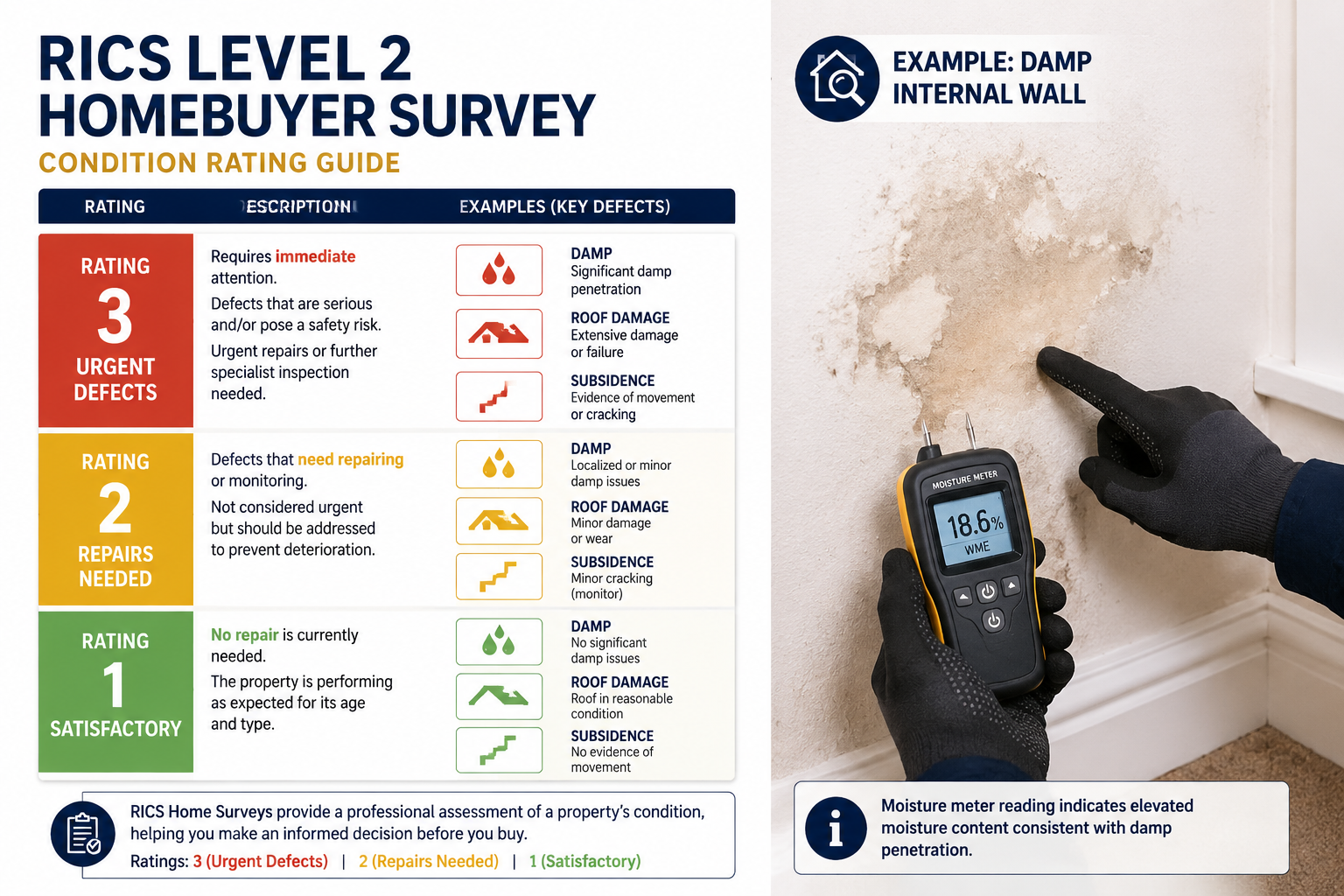
Level 2 surveys use a standardised traffic-light rating system to communicate defect severity clearly [2]:
- 🔴 Rating 3 (Red): Serious defects requiring urgent repair or further investigation. These can affect safety, structural integrity, or property value significantly.
- 🟡 Rating 2 (Amber): Defects that need repair but are not immediately urgent. Buyers should budget and plan for these.
- 🟢 Rating 1 (Green): No repair needed at the time of inspection. Normal maintenance only.
This system ensures that even a buyer with no construction knowledge can immediately understand which findings demand action.
Common Defects Diagnosed Through Building Pathology
Experienced surveyors apply building pathology methodology to a wide range of recurring defect categories. Below are the most frequently encountered:
🏚️ 1. Damp — The Most Misdiagnosed Defect
Damp is perhaps the most common and most misunderstood defect in residential surveys. It presents in three primary forms:
- Rising damp: Moisture travelling upward through masonry from the ground. Often misidentified — true rising damp is less common than frequently claimed.
- Penetrating damp: Water entering through defective roofs, flashings, gutters, or external walls.
- Condensation: Moisture from internal air depositing on cold surfaces. Frequently confused with rising damp by untrained observers.
A building pathologist does not simply note "damp present." They trace the moisture pathway, assess the likely source, and distinguish between causes — because the remediation is entirely different for each type.
🏗️ 2. Structural Movement and Subsidence
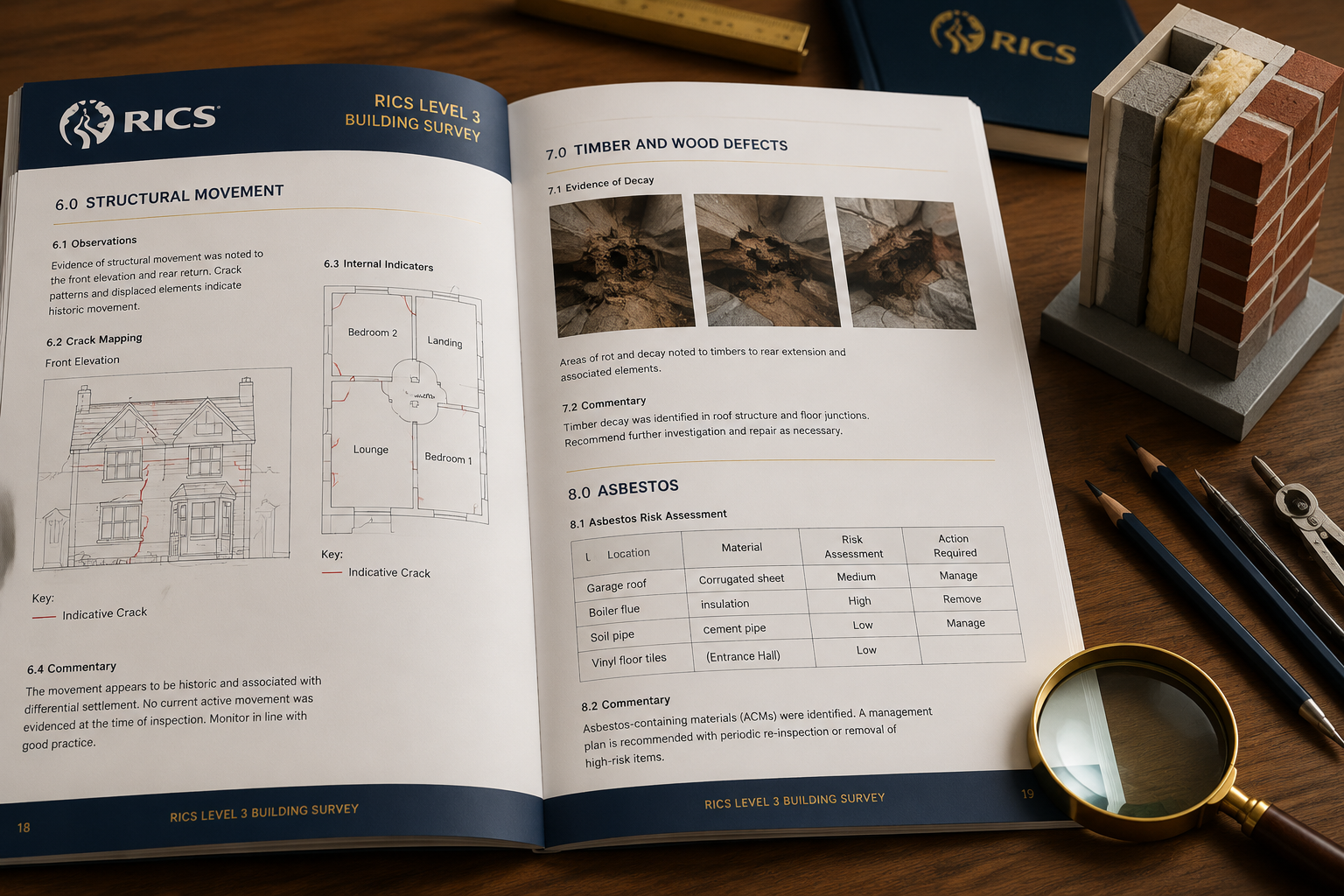
Surveyors identify signs of structural movement including cracks in walls, uneven floors, and sticking doors or windows [2]. The critical diagnostic skill is distinguishing between:
- Thermal/seasonal movement: Normal, cyclical, and generally harmless
- Settlement: Historic movement that has stabilised
- Active subsidence: Ongoing movement requiring urgent investigation
Crack pattern analysis — including crack width, orientation, taper, and whether edges are sharp or rounded — provides vital clues. A diagonal crack running from a window corner tells a very different story from a horizontal crack mid-wall. For properties showing signs of ground movement, a dedicated subsidence survey may be recommended as a follow-up.
🔨 3. Roof and Weathering Defects
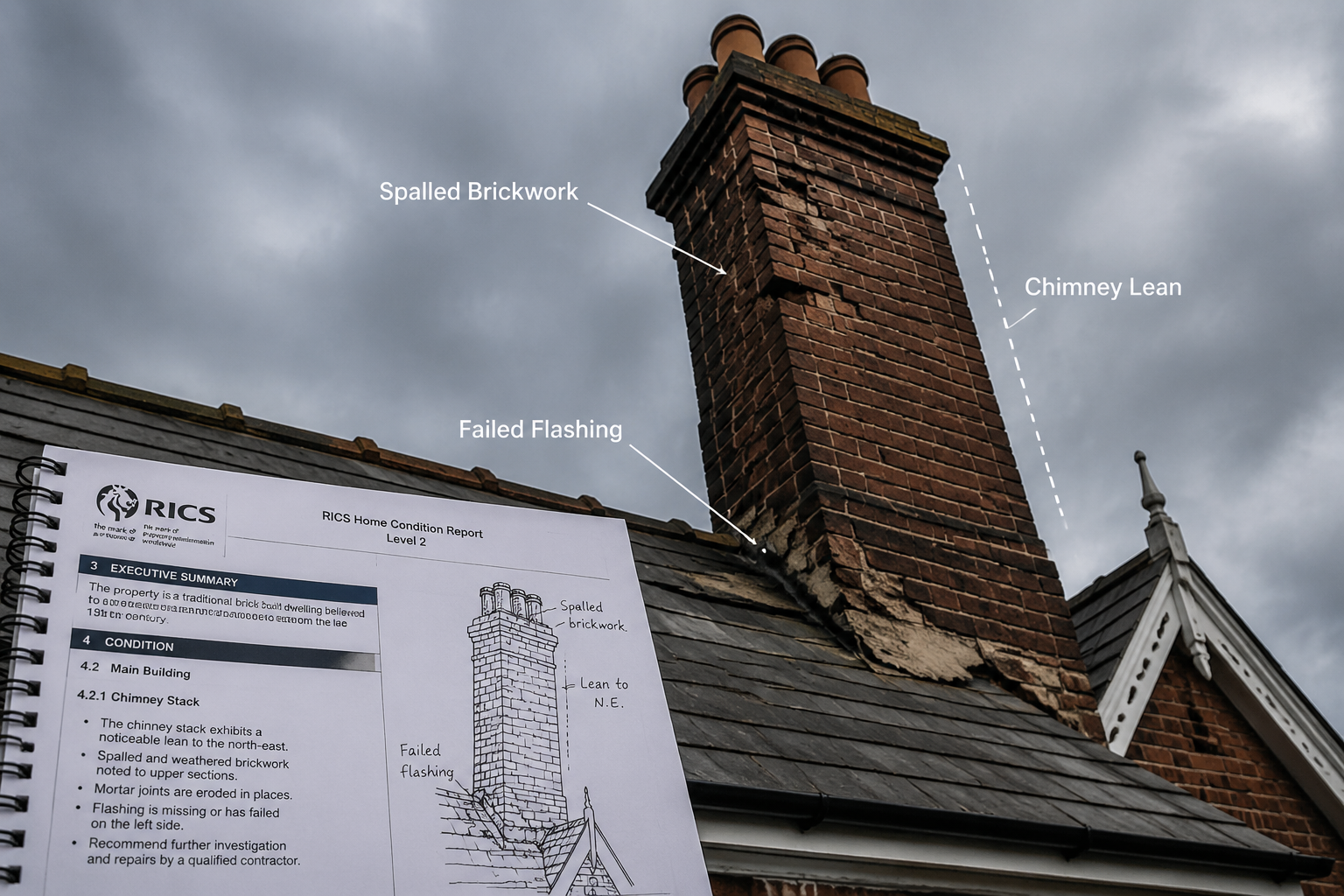
Damaged or missing roof tiles, deteriorating flashings, and leaning or cracked chimneys are among the most frequently identified defects in residential surveys [2]. These defects matter because:
- They allow water ingress that cascades into secondary defects (rot, damp, ceiling damage)
- Chimney instability poses a safety risk
- Flat roof coverings have finite lifespans and are often near end-of-life on older properties
An experienced surveyor will assess roof covering condition, valley and parapet details, chimney pointing, and lead or felt flashing integrity — even where direct access is not possible, using binoculars and drone imagery where appropriate.
🪲 4. Timber Decay, Woodworm, and Dry Rot
Level 3 surveys specifically examine timber decay, woodworm infestation, and dry rot as part of the pathology assessment [1]. These are not cosmetic issues:
- Dry rot (Serpula lacrymans) can spread through masonry and destroy structural timbers rapidly
- Wet rot is more localised but signals persistent moisture
- Woodworm (various beetle species) weakens floor joists, roof timbers, and stud walls over time
Diagnosis requires probing, moisture measurement, and sometimes opening up of floor or ceiling voids — capabilities that only a Level 3 survey provides.
⚠️ 5. Hazardous Materials
Older properties — particularly those built before 1985 — may contain asbestos-containing materials (ACMs) in textured coatings, floor tiles, pipe lagging, and roof sheets. Level 3 surveys include assessment of potential hazardous materials and flag where specialist testing is required [1]. This protects buyers from unknowingly purchasing properties with significant remediation liability.
Workmanship Defects: The Hidden Cost of Poor Construction
Beyond age-related deterioration, a significant proportion of defects in UK residential properties stem from poor workmanship — either in original construction or in subsequent alterations. Common examples include:
| Workmanship Defect | Typical Consequence |
|---|---|
| Incorrectly installed cavity wall insulation | Moisture bridging, penetrating damp |
| Inadequate roof ventilation | Condensation, timber decay |
| Poorly executed extensions | Differential movement, cracking |
| Non-compliant electrical or drainage work | Safety hazard, legal liability |
| Blocked or missing wall ties | Outer leaf instability |
An experienced building pathologist recognises the signature patterns of these failures — the tell-tale crack above a lintel that was never properly bedded, or the damp patch that appears only on one wall of an insulated cavity.
How Building Pathology Insights for Homebuyer Surveys: Diagnosing Defects with 30+ Years of RICS-Regulated Expertise Translates Into Actionable Reports
The diagnostic skill of the surveyor is only valuable if it is communicated effectively. This is where RICS standards play a crucial role. Reports must translate technical findings into clear, jargon-free language that empowers buyers to make informed decisions [4].
From Diagnosis to Decision: The Report Structure
A well-constructed homebuyer or building survey report will typically include:
- Executive summary — headline findings and their urgency
- Section-by-section condition ratings — using the Red/Amber/Green system
- Defect descriptions — what was found, where, and what it means
- Probable causes — the pathological explanation
- Recommended actions — repair, specialist investigation, or monitoring
- Legal and regulatory notes — planning, building regulations, party wall matters
For buyers of properties requiring more detailed structural analysis, a structural survey provides an additional layer of engineering-level assessment beyond the standard homebuyer report.
Specific Defect Surveys: When a Full Survey Isn't Enough
Sometimes a buyer or seller needs a focused investigation of a single issue — a crack, a damp patch, a sagging roof. Specific defect surveys concentrate on individual problems to provide detailed diagnosis and a clear remediation pathway [3]. These are particularly useful:
- After a homebuyer survey flags a Rating 3 issue requiring specialist input
- Before exchange, to quantify the cost of a known defect
- When a vendor disputes a surveyor's finding and independent verification is needed
Understanding what RICS-certified chartered surveyors look for during a property inspection provides buyers with a clearer picture of the inspection process before commissioning any survey type.
Why RICS Regulation Matters
The RICS regulatory framework is not bureaucratic formality — it is the guarantee that the person inspecting a property has demonstrated competency in building pathology, adheres to professional indemnity requirements, and is accountable to an independent standards body [8]. When selecting a surveyor, buyers should always verify:
- ✅ Full RICS membership (MRICS or FRICS)
- ✅ Relevant building surveying specialism
- ✅ Local market knowledge and experience with the property type
- ✅ Clear fee structure with no hidden costs
For Manchester and surrounding areas, understanding why choosing an RICS chartered building surveyor is the right decision provides further context on professional standards and accountability.
Conclusion: Protecting Your Investment Starts with the Right Diagnosis
The science of building pathology transforms a property survey from a formality into a genuine risk-management tool. Whether a buyer is purchasing a modern apartment or a 150-year-old stone terrace, the principles remain the same: identify the symptoms, trace the cause, assess the severity, and communicate clearly.
Building Pathology Insights for Homebuyer Surveys: Diagnosing Defects with 30+ Years of RICS-Regulated Expertise represents the gold standard of residential property assessment — combining rigorous RICS-regulated methodology with the pattern recognition that only decades of field experience can provide.
Actionable Next Steps for Homebuyers in 2026 🏠
- Match the survey level to the property — never commission a Level 2 for a pre-1919 property showing visible defects.
- Read the condition ratings carefully — a single Rating 3 finding can justify renegotiating the purchase price by thousands of pounds.
- Ask your surveyor to explain — RICS standards require clear communication; do not accept vague language.
- Commission specific defect surveys where a homebuyer report flags issues requiring specialist follow-up.
- Verify RICS credentials before appointing any surveyor — check the RICS Find a Surveyor register.
- Use survey findings as a negotiation tool — documented defects provide objective grounds for price adjustment or vendor remediation.
Explore the full range of residential and commercial survey options available from RICS-regulated professionals to find the right level of protection for your next property purchase.
References
[1] Watch – https://www.youtube.com/watch?v=fKTVS0xu9dE
[2] Common Issues Uncovered In Level 2 Homebuyer Surveys – https://www.mvsurveying.co.uk/common-issues-uncovered-in-level-2-homebuyer-surveys
[3] The New Rics Home Survey Standard Explained – https://www.surveymerchant.com/blog/the-new-rics-home-survey-standard-explained
[4] The New Home Survey Standard – https://ww3.rics.org/uk/en/journals/property-journal/the-new-home-survey-standard.html
[7] Home Survey Standard 2nd Edition A Progress Update – https://www.rics.org/news-insights/home-survey-standard-2nd-edition-a-progress-update
[8] Building Pathology Competency – https://ww3.rics.org/uk/en/journals/built-environment-journal/building-pathology-competency.html