A single boundary dispute in Cornwall recently reduced a coastal cottage's market value by 18% — not because of structural failure, but because of a disputed right of way that buyers simply would not accept. That figure came from a chartered surveyor acting as an expert witness, and it changed the outcome of the entire claim.
This is the world of diminution in value assessments by expert witnesses: surveyor strategies for property damage claims in 2026 — a discipline that sits at the crossroads of property law, valuation science, and litigation strategy. Whether a claimant is pursuing an insurer, a neighbour, or a developer, the quality of the expert witness evidence often determines the result. This guide explains how surveyors quantify value loss, what legal standards apply, and how both claimants and defendants can use these assessments effectively in negotiations or court.
Key Takeaways 📋
- Diminution in value (DIV) — also called loss-on-value (LOV) — measures how much a property's market value falls because of damage, defects, or legal encumbrances, even after repairs are completed [4].
- Expert witness testimony on DIV must meet strict reliability standards (including Rule 702 in the US and equivalent RICS/CPR standards in the UK) to be admissible in court [6].
- Surveyors must use market-based evidence — comparable sales, buyer surveys, and hedonic analysis — not just repair cost estimates [1].
- Causes of DIV range from soil subsidence and construction defects to easements, nuisances, and impaired views or access [3].
- Both claimants and defendants benefit from instructing a RICS-registered expert witness early, before positions become entrenched.
What Is Diminution in Value? A Surveyor's Definition
Diminution in value (DIV) represents the difference between what a property would have been worth in an undamaged or unencumbered condition and what it is actually worth given the damage, defect, or legal issue in question [4]. The International Society of Appraisers describes it as "loss-on-value" (LOV) — the residual stigma that remains in the market even after physical repairs have been completed [4].
💬 "Repair costs and diminution of value are not the same thing. A property can be fully repaired and still sell for less — because buyers know its history."
This distinction matters enormously in property damage claims. An insurer may argue that paying for repairs is sufficient. A well-prepared expert witness will demonstrate that the market disagrees.
Common Causes of Diminution in Value
Surveyors encounter DIV across a wide range of scenarios [3]:
| Cause | Example |
|---|---|
| Soil subsidence | Foundation movement leaving residual stigma |
| Construction defects | Defective cladding or roof structures |
| Easements & rights of way | Disputed access routes reducing buyer appetite |
| Defective title | Unresolved covenants or ownership gaps |
| View or access impairment | New development blocking sea views |
| Nearby nuisances | Industrial noise, contaminated land proximity |
| Flood history | Documented flooding reducing mortgage availability |
Each cause requires a different evidential approach, which is why the surveyor's methodology is as important as their conclusion.
Legal Standards Governing Diminution in Value Assessments by Expert Witnesses: Surveyor Strategies for Property Damage Claims in 2026
The Reliability Requirement
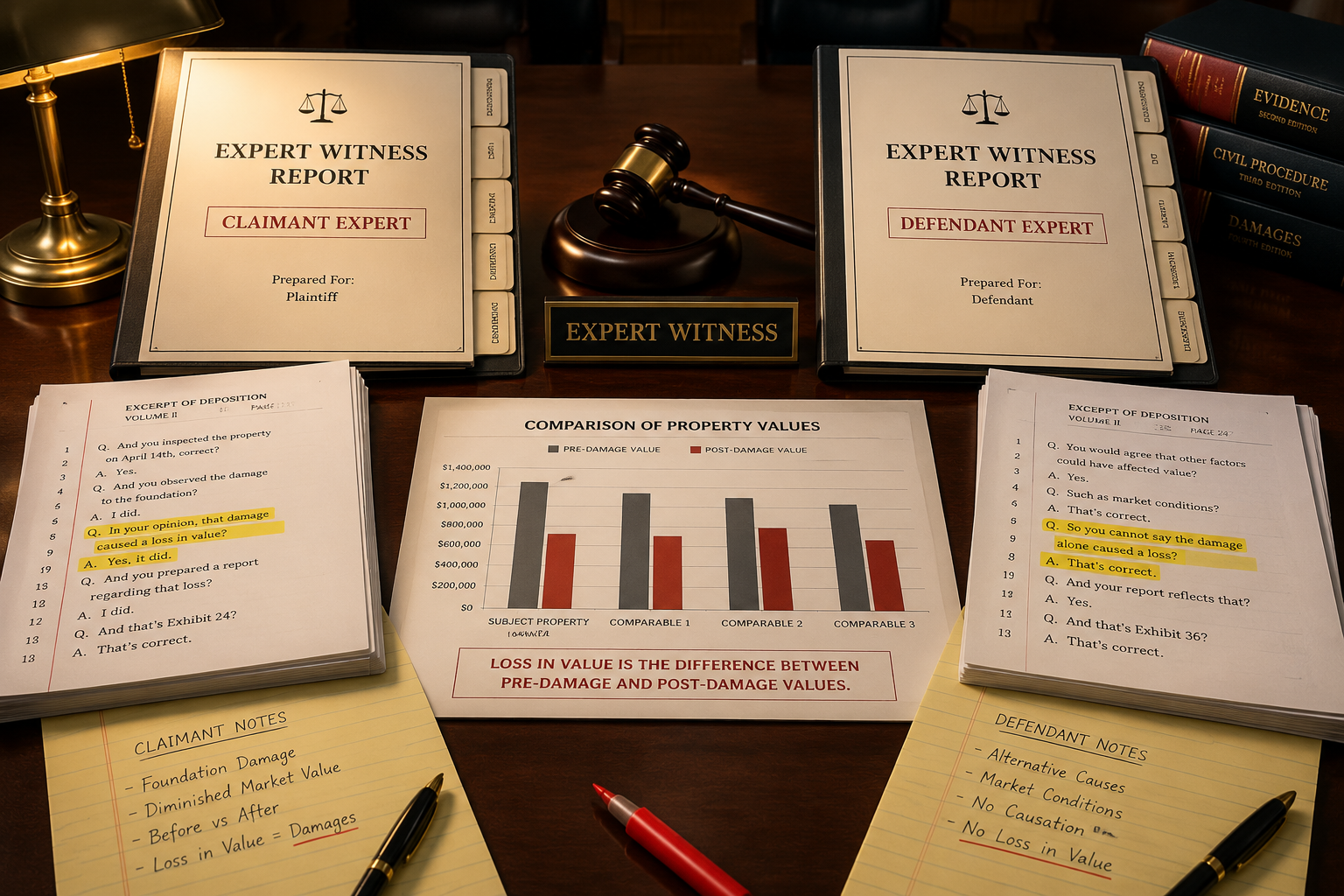
Courts on both sides of the Atlantic demand that expert witness testimony be reliable, not merely credible. In the United States, economic damages assessments — including DIV — are subject to Rule 702 reliability standards, which require that the expert's methodology be grounded in sufficient facts, reliable principles, and proper application [6].
The landmark Georgia case Woodrum v. Georgia Farm Bureau Mutual Insurance Company illustrates this precisely. The court held that testimony on diminution of value must be supported by market comparisons and a sufficiently reliable methodology — estimation based solely on a witness's repair experience does not qualify [1]. This ruling has influenced how expert witnesses across multiple jurisdictions structure their reports.
In the UK, the Civil Procedure Rules (CPR) Part 35 imposes equivalent obligations. An expert witness's overriding duty is to the court, not to the instructing party. RICS members acting as expert witnesses must also comply with the RICS Surveyors Acting as Expert Witnesses guidance note, which aligns closely with CPR Part 35 requirements.
When a Lay Witness Can Testify Instead
Not every DIV claim requires a fully qualified expert. Under Georgia OCGA § 24-7-701(b), "a witness need not be an expert or dealer in an article or property to testify as to its value if he or she has had an opportunity to form a reasoned opinion" [1]. Similar provisions exist in English law for straightforward claims.
However, for contested, high-value, or technically complex property damage claims — the kind that routinely come before the Upper Tribunal or Technology and Construction Court — a qualified expert witness is not optional. It is essential.
RICS Registration and Credibility
Courts and opposing counsel scrutinise the expert's qualifications carefully. Instructing a RICS-registered valuer provides an immediate credibility baseline. RICS registration signals adherence to the Red Book (RICS Valuation — Global Standards), mandatory continuing professional development, and professional indemnity insurance.
Surveyor Strategies: How DIV Is Quantified in Practice
The Three Core Methodologies
Surveyors use three principal approaches when quantifying diminution in value, often in combination:
1. Sales Comparison (Paired Sales Analysis)
The most persuasive method in most courts. The surveyor identifies comparable properties — ideally identical in all respects except the defect in question — and measures the price differential. This is market evidence, and it speaks directly to what buyers actually do, not what they theoretically should do.
2. Income Capitalisation (for Investment Properties)
Where the property generates rental income, the surveyor models the reduction in achievable rent caused by the defect, then capitalises that reduction at an appropriate yield. This approach is common in commercial property surveying disputes involving industrial contamination or access restrictions.
3. Cost-to-Cure vs. Residual Stigma
The surveyor first establishes the cost of full remediation. Where repair costs exceed the diminution in value, the DIV figure caps the claim. Where residual stigma persists after repair — as it frequently does with flood damage or subsidence history — the surveyor must quantify that stigma separately using buyer survey data or hedonic regression analysis.
The Cornwall Case Study: Boundary Dispute and View Loss
A Cornwall-based practice recently handled a claim involving a period farmhouse where a neighbour had erected a 2.4-metre boundary wall, blocking a previously unobstructed sea view. The surveyor's approach:
- Step 1: Identified five comparable sales of similar farmhouses with and without sea views in the same postcode district over 36 months.
- Step 2: Calculated the average view premium at 14.3% of open market value.
- Step 3: Adjusted downward by 20% to account for partial view retention, arriving at a net DIV of 11.4%.
- Step 4: Supported the figure with a structured buyer survey (n=47 respondents) confirming that 79% of prospective buyers would pay less for the property given the obstruction.
The result: a negotiated settlement at 10.8% of the property's pre-obstruction value — achieved without going to trial.
Subsidence and Structural Defect Claims
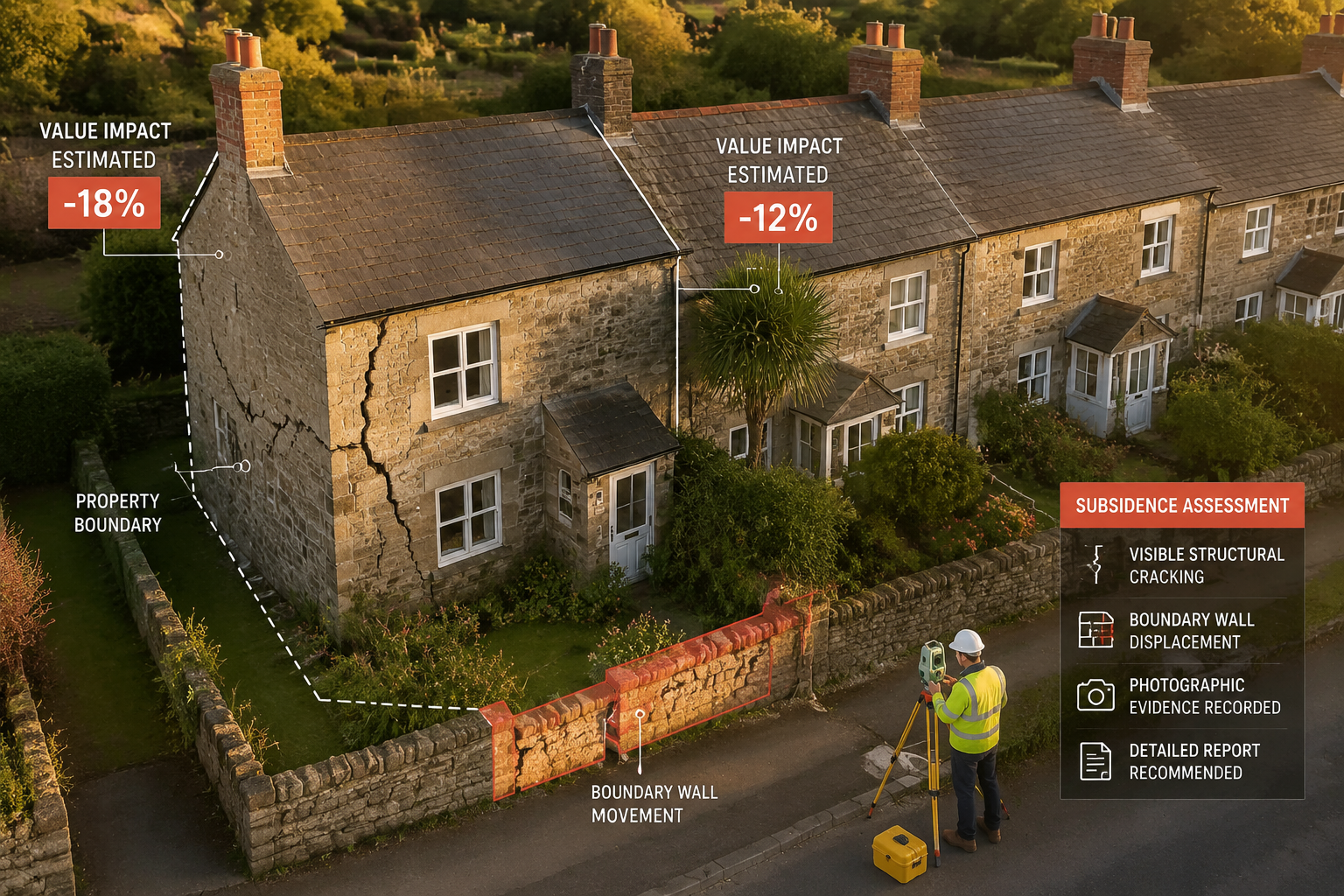
Subsidence claims are among the most technically demanding DIV assessments. Even after full underpinning and structural certification, properties with a documented subsidence history typically sell at a 5–15% discount compared to equivalent unaffected properties, depending on the severity of the original movement, the quality of the repair, and local market sentiment.
A thorough building survey forms the foundation of any subsidence-related DIV claim. The surveyor must document the original defect, the repair methodology, and the residual risk — then translate all three into market impact language that a judge or arbitrator can follow.
For properties where the structural integrity is in dispute, a specific defect report provides the technical underpinning that the DIV assessment requires.
Preparing a Court-Ready Expert Witness Report
Structure of a Compliant Expert Witness Report
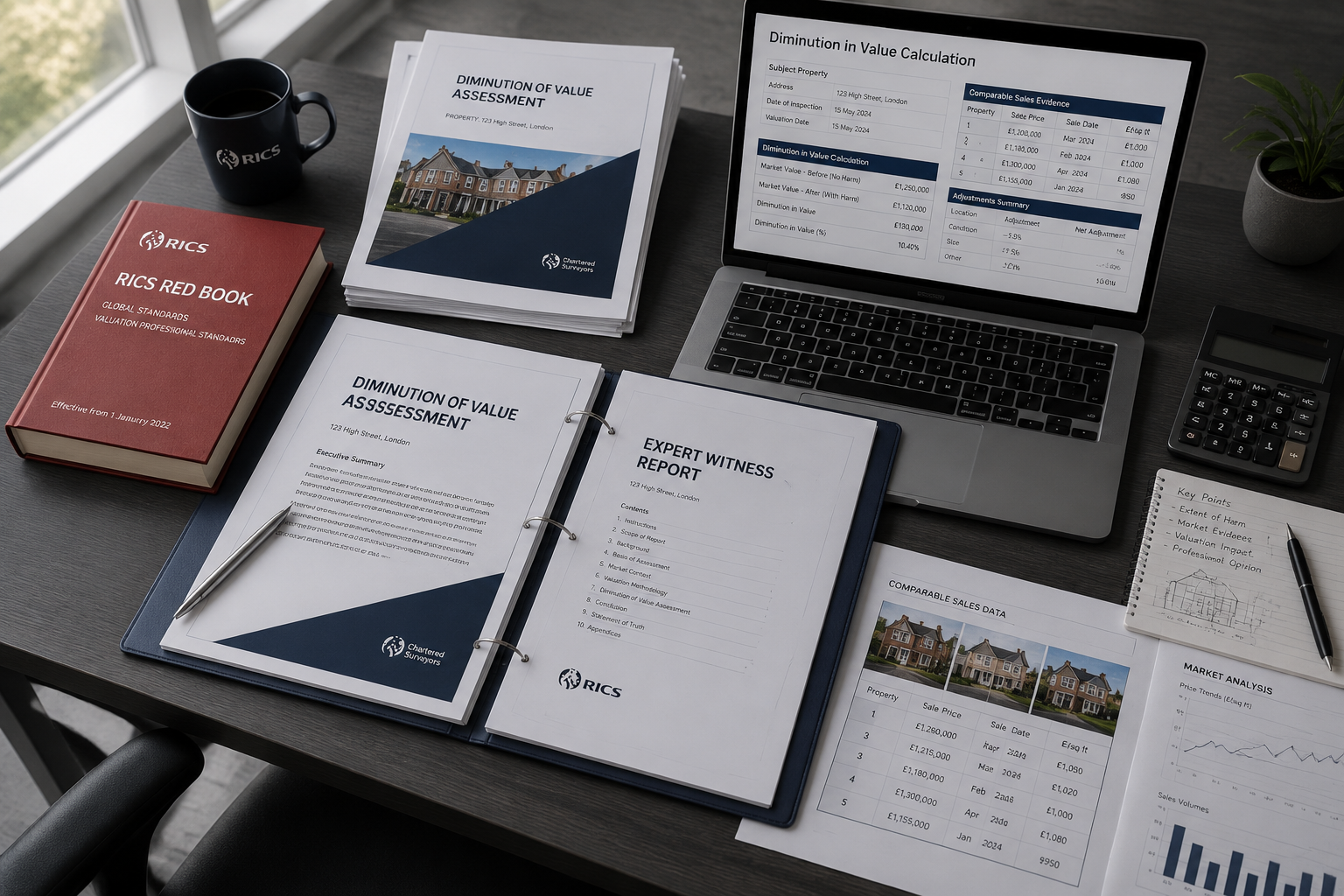
A DIV expert witness report must be structured to satisfy both the court's procedural requirements and the opposing party's scrutiny. The core sections are:
- Instructions and scope — who instructed the expert and on what terms
- Expert's qualifications — RICS membership, relevant experience, prior court appearances
- Facts relied upon — inspection findings, documents reviewed, data sources
- Methodology — which valuation approach was used and why
- Comparable evidence — market transactions, adjusted for differences
- Opinion — the DIV figure, expressed as a range where appropriate
- Statement of truth — confirming the overriding duty to the court
The expert witness report must be written so that a non-specialist reader — a judge, a mediator, or a claims handler — can follow the logic from evidence to conclusion without needing to take anything on faith.
Common Weaknesses That Undermine DIV Evidence
Opposing counsel will probe for these vulnerabilities:
- ❌ Insufficient comparables — fewer than three paired sales weakens the analysis significantly
- ❌ Failure to adjust for differences — comparables must be adjusted for size, condition, location, and date of sale
- ❌ Circular reasoning — using the repair cost as a proxy for DIV without market evidence
- ❌ Lack of inspection — an expert who has not physically inspected the property is vulnerable to challenge
- ❌ Advocacy tone — language that appears to favour the instructing party undermines the expert's credibility with the court
Dilapidations and Lease-End Claims
DIV principles also apply in commercial lease disputes. At lease expiry, a landlord may claim that a tenant's failure to maintain the property has reduced its capital value beyond the cost of repair. A dilapidations surveyor who also holds expert witness experience can quantify both the repair cost and any residual diminution — a dual-track approach that strengthens the landlord's position considerably.
The dilapidation surveys process should begin well before lease expiry to establish a clear baseline condition, making any subsequent DIV argument far easier to substantiate.
Strategies for Claimants and Defendants in 2026
For Claimants: Maximising the DIV Assessment
🎯 Instruct early. The surveyor should inspect before any repairs are carried out where possible, or immediately after if repairs are urgent. Photographic and documentary evidence of the pre-repair condition is critical.
🎯 Commission a reinstatement valuation alongside the DIV assessment. Understanding the reinstatement valuation helps frame the total loss — repair costs plus residual stigma — in a single coherent narrative.
🎯 Use buyer surveys as supplementary evidence. Structured surveys of prospective buyers in the relevant market segment provide direct evidence of market perception, which is harder for defendants to dismiss than theoretical adjustments.
🎯 Consider the tax implications. Where a DIV settlement involves a capital payment, valuation for capital gains tax advice may be needed to ensure the claimant does not face an unexpected tax liability on the compensation received.
For Defendants: Challenging an Overstated DIV Claim
🛡️ Commission an independent expert immediately. Do not rely solely on cross-examining the claimant's expert. An independent DIV assessment — even if it produces a lower figure — demonstrates good faith and provides a credible counter-narrative.
🛡️ Scrutinise the comparables. Are they truly comparable? Location, size, tenure, and condition adjustments must be transparent and defensible. Inadequate adjustment is the most common ground for challenging a DIV figure.
🛡️ Challenge the stigma assumption. Where the defect has been fully repaired and the property has since sold at full market value, the residual stigma argument collapses. Transaction evidence post-repair is powerful defence evidence.
🛡️ Explore mediation. DIV claims are well-suited to mediation because the range of reasonable expert opinion is often narrower than the parties' opening positions suggest. A mediator with property expertise can bridge the gap efficiently.
Selecting the Right Expert Witness in 2026
The expert witness market has matured significantly. Directories such as SEAK maintain specialist listings for both "Real Estate Diminution of Value Damages Expert Witnesses" and "Diminished Value Expert Witnesses" who can provide expert opinions, formal reports, deposition testimony, and trial evidence [2][7].
When selecting an expert, consider:
| Criterion | Why It Matters |
|---|---|
| RICS membership | Regulatory baseline; Red Book compliance |
| Local market knowledge | Comparables must be drawn from the relevant market |
| Court experience | Withstanding cross-examination is a distinct skill |
| Sector specialism | Residential, commercial, and agricultural DIV differ materially |
| Report quality | Request a sample report before instructing |
For claims involving properties across the South East and Home Counties, surveyors with deep local knowledge — such as those covering Guildford, Esher, and surrounding areas — will have access to the most relevant comparable evidence for those markets.
Conclusion: Actionable Next Steps for Property Damage Claims in 2026
Diminution in value assessments by expert witnesses — and the surveyor strategies that underpin property damage claims in 2026 — are no longer a niche corner of property law. As property values remain high and litigation costs continue to rise, the quality of expert evidence has never mattered more.
Here is what to do next:
- ✅ Identify the cause of value loss early — subsidence, defective title, easement, or nuisance — and instruct a surveyor with specific experience in that category.
- ✅ Preserve evidence before repairs — photographs, structural reports, and pre-repair valuations are the foundation of any successful DIV claim.
- ✅ Instruct a RICS-registered expert witness who understands both valuation methodology and the procedural requirements of the court or tribunal where the claim will be heard.
- ✅ Consider the full financial picture — repair costs, residual stigma, tax implications, and legal costs all affect the net outcome.
- ✅ Explore early settlement — a well-evidenced DIV report from a credible expert often resolves claims at mediation, avoiding the cost and uncertainty of trial.
The difference between a claim that settles at fair value and one that collapses under cross-examination often comes down to a single decision: choosing the right surveyor, at the right time, with the right methodology.
References
[1] Lay Witness Or Expert Witness Testimony On Diminished Value – https://www.propertyinsurancecoveragelaw.com/blog/lay-witness-or-expert-witness-testimony-on-diminished-value/
[2] Real Estate Diminution Of Value Damages Expert Witness – https://seakexperts.com/keywords/real-estate-diminution-of-value-damages-expert-witness
[3] Value Diminution – https://www.irr.com/services/litigation-support-and-expert-testimony/value-diminution
[4] Part 1 Understanding Loss On Value In Damage Claims – https://www.isa-appraisers.org/about/blog/details/531/part-1-understanding-loss-on-value-in-damage-claims
[5] Property Damage And Diminution In Value – https://schneidervc.com/areas-of-specialty/property-damage-and-diminution-in-value/
[6] What Are Economic Damages A Detailed Explanation For Legal Cases – https://www.forensisgroup.com/resources/expert-legal-witness-blog/what-are-economic-damages-a-detailed-explanation-for-legal-cases
[7] Diminished Value Expert Witness – https://seakexperts.com/keywords/diminished-value-expert-witness