Fewer than 18 months after Phase 1 of Awaab's Law came into force targeting damp and mould, the legislation is expanding dramatically — and surveyors who are unprepared face serious professional and legal consequences. Building Survey Inspection Checklists for Structural Collapse and Explosion Risks: Awaab's Law 2026 Prescribed Hazards now sit at the centre of compliance obligations for social housing providers across England, requiring structured inspection protocols, strict investigation timelines, and rigorous documentation standards for two of the most dangerous hazard categories in residential property [1][2].
This guide breaks down exactly what surveyors, housing managers, and compliance officers need to know — and do — before these obligations take effect.
Key Takeaways
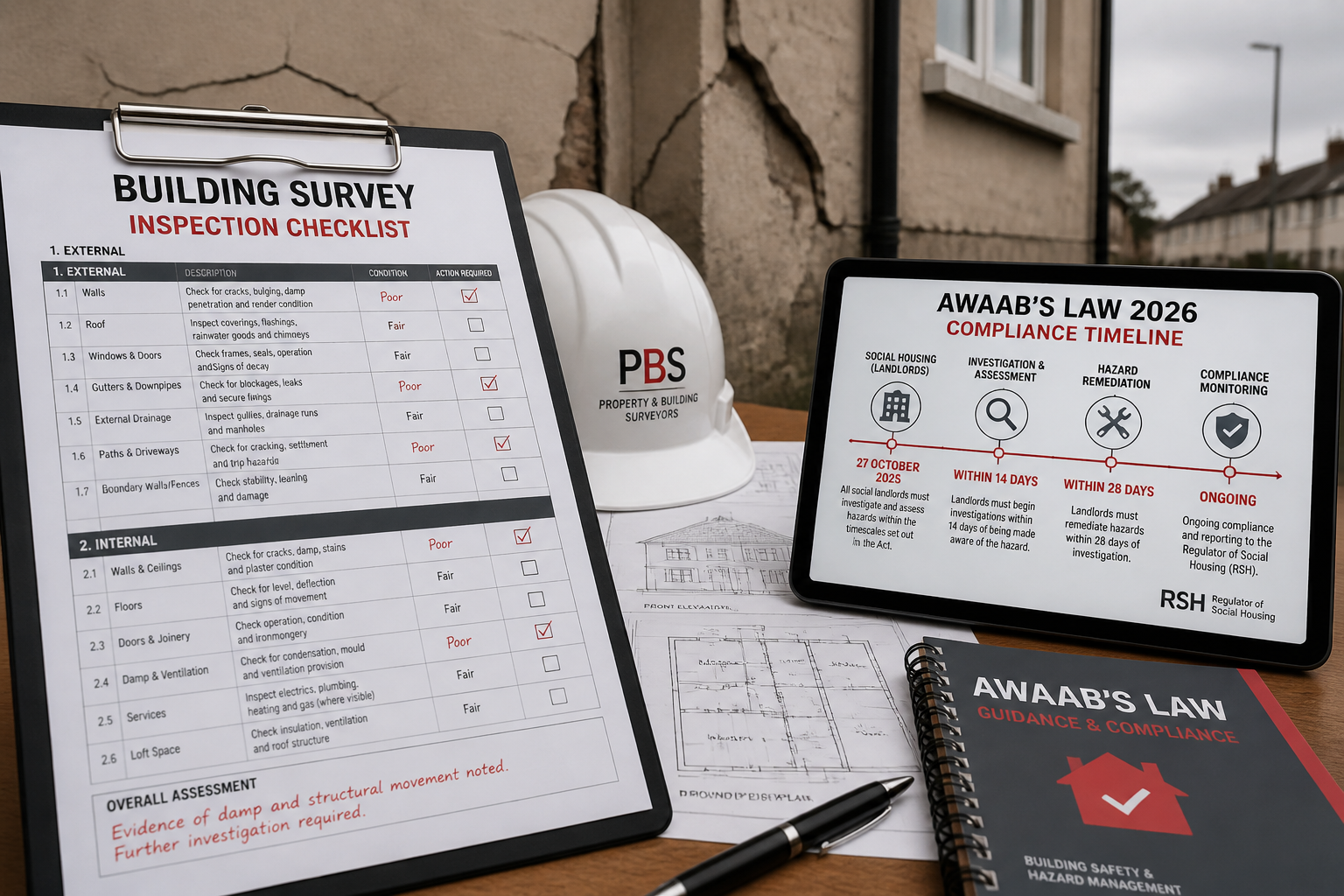
- ⚠️ Phase 2 of Awaab's Law (2026) adds structural collapse and explosion risks to the list of prescribed hazards that social landlords must investigate and remediate within strict legal timeframes [2].
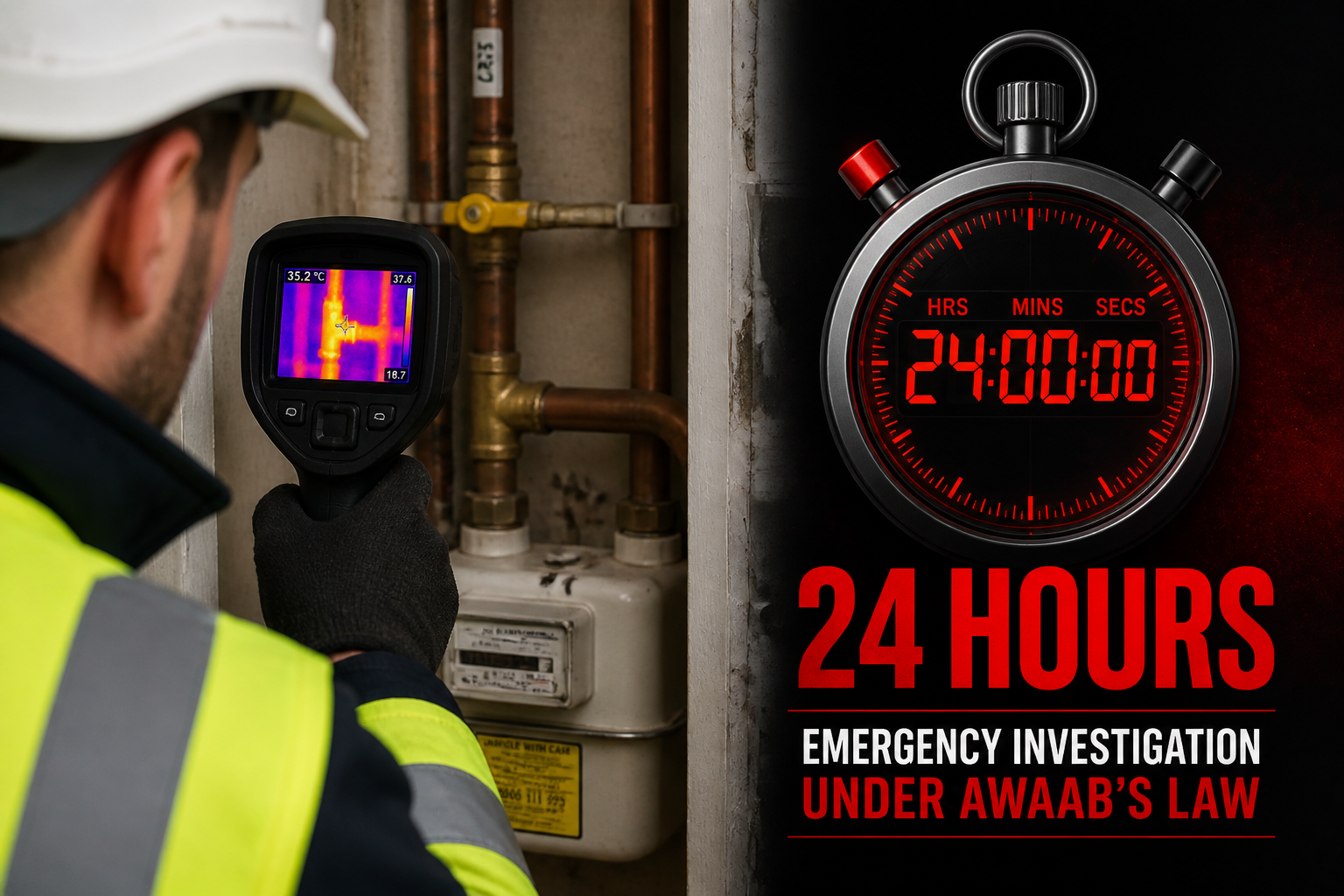
- 🕐 Emergency hazards — including imminent structural collapse or explosion risk — must be investigated and made safe within 24 hours of being reported [2][5].
- 📋 Inspection checklists must cover cracked walls, subsidence, unsafe balconies, gas leaks, and Higher-Risk Building explosion scenarios [2][3].
- 📝 Written summaries of investigation findings must be provided to tenants within 3 working days of the investigation concluding [2][5].
- 🏛️ Non-compliance can result in enforcement orders, tenant compensation, legal cost coverage, and potential loss of rent [1].
What Awaab's Law Phase 2 Actually Means for Surveyors in 2026
Awaab's Law was named after two-year-old Awaab Ishak, who died in 2020 as a direct result of prolonged exposure to mould in a Rochdale social housing property. Phase 1 of the legislation, which came into force in late 2025, focused on damp and mould hazards. Phase 2, taking effect in 2026, dramatically widens the scope [1][2].
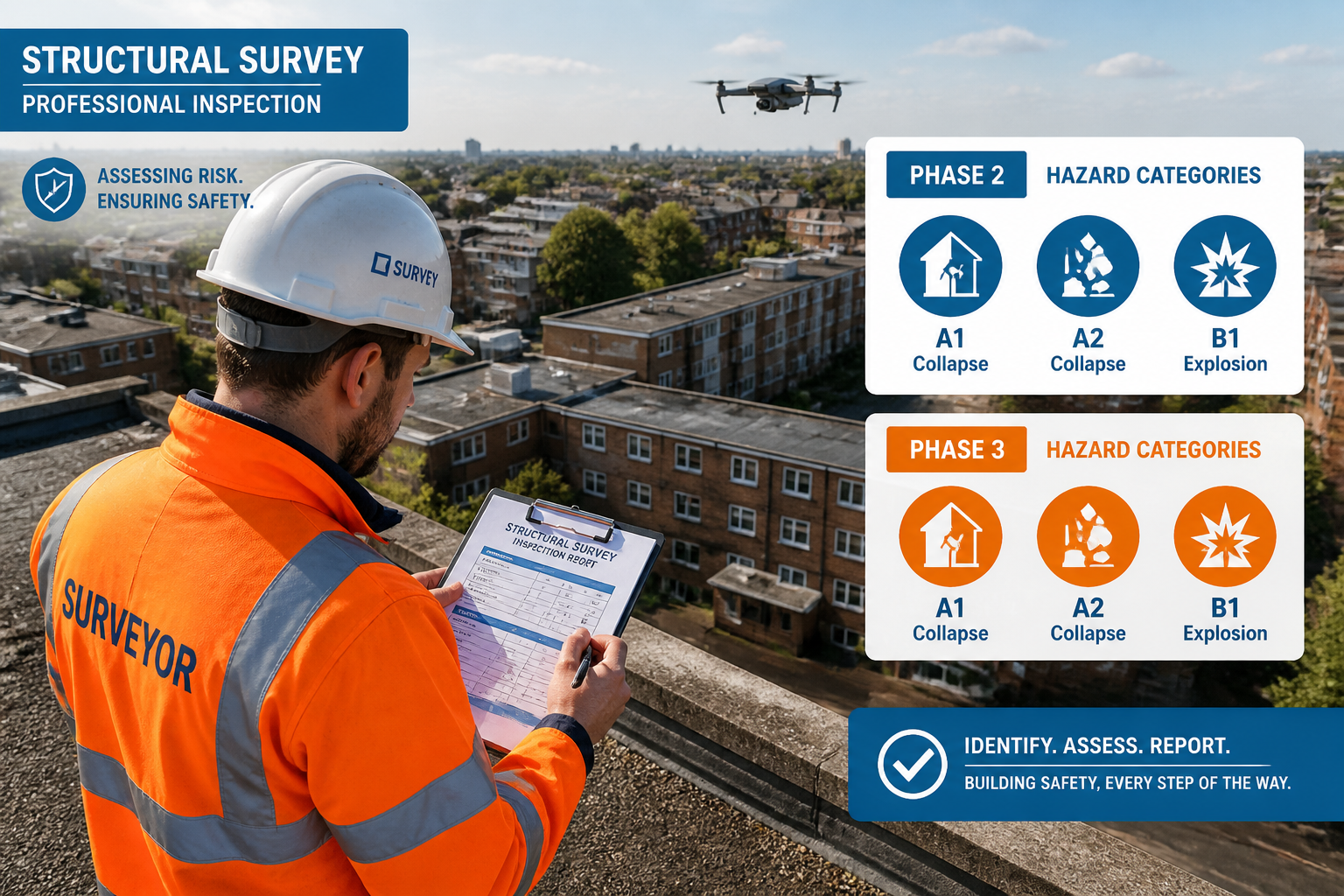
Phase 2 adds 13 additional hazard categories to the prescribed list, two of the most critical being:
- Structural collapse and falling elements
- Explosions
These are not minor additions. Structural collapse and explosion hazards represent some of the highest-consequence risks in residential buildings — scenarios where failure to act swiftly can result in fatalities [2][3].
💬 "Awaab's Law Phase 2 transforms what was once a reactive maintenance culture into a legally enforced, time-bound inspection and remediation regime."
For surveyors, this means that Building Survey Inspection Checklists for Structural Collapse and Explosion Risks: Awaab's Law 2026 Prescribed Hazards are no longer a best-practice recommendation — they are a legal necessity. A full building survey must now incorporate these hazard categories as standard components of the inspection scope.
The Phase 2 and Phase 3 Roadmap
| Phase | Timeline | Hazards Covered |
|---|---|---|
| Phase 1 | Late 2025 | Damp and mould |
| Phase 2 | 2026 | 13 additional hazards including structural collapse and explosions |
| Phase 3 | Expected 2027 | All remaining HHSRS hazards (except overcrowding) |
Source: [2][3]
Understanding the Prescribed Hazards: Structural Collapse and Explosions
Structural Collapse and Falling Elements
This hazard category covers a wide range of physical defects that could cause a building — or parts of it — to fail catastrophically. Under the Housing Health and Safety Rating System (HHSRS), structural integrity is assessed across multiple building components. Surveyors must now inspect and document all of the following as part of their checklist [2]:
🔍 Structural Collapse Inspection Checklist Items:
- Cracked walls — Identify crack type (diagonal, horizontal, vertical), width, location, and pattern to assess whether they indicate active movement or historical settlement
- Subsidence indicators — Uneven floors, sticking doors/windows, and stepped cracking in brickwork
- Unsafe balconies and external features — Corroded fixings, delaminating concrete, inadequate balustrade heights, and spalling
- Roof structure integrity — Sagging ridgelines, rafter spread, and purlin failure
- Lintel and beam conditions — Deflection, corrosion, and inadequate bearing
- Retaining walls — Leaning, cracking, and drainage failure
- Foundation movement — Evidence of differential settlement, particularly in clay soils
A structural survey provides the depth of assessment required to properly document these hazards. Standard homebuyer reports are unlikely to meet the evidentiary standard required under Awaab's Law compliance frameworks.
For properties showing active subsidence indicators, a dedicated subsidence survey should be commissioned as part of the investigation workflow.
Explosion Hazards
Phase 2 explicitly includes explosion risks as a prescribed hazard category. This is particularly relevant for Higher-Risk Buildings as defined under the Building (Higher-Risk Buildings Procedures) (England) Regulations 2023 [3]. However, explosion risk assessment applies across all social housing stock, not just high-rises.
🔍 Explosion Risk Inspection Checklist Items:
- Gas supply infrastructure — Meter condition, pipework integrity, flexible hose age and condition, and emergency control valve accessibility
- Gas appliance condition — Boiler flues, cooker connections, and ventilation adequacy
- Suspected gas leaks — Odour reports, pilot light failures, and unexplained carbon monoxide detector activations
- Electrical fault risks — Overloaded circuits, damaged wiring in proximity to gas supplies
- Structural voids — Basement or subfloor spaces where gas accumulation is possible
- Ventilation adequacy — Blocked air bricks, sealed vents, and inadequate combustion air supply
💬 "An explosion risk is not theoretical — a single missed gas leak in a social housing block can have consequences for dozens of families. The 24-hour emergency response window under Awaab's Law reflects this reality."
Legal Timelines: What Surveyors Must Document and When
The investigation and remediation timelines under Awaab's Law Phase 2 are non-negotiable. Building Survey Inspection Checklists for Structural Collapse and Explosion Risks: Awaab's Law 2026 Prescribed Hazards must be designed to capture information in a format that supports compliance with these specific windows [2][5].
The Four Critical Timelines
| Obligation | Timeframe | Trigger |
|---|---|---|
| Emergency investigation and make-safe | 24 hours | Report of emergency structural collapse or explosion hazard |
| Significant hazard investigation | 10 working days | Report of non-emergency structural or explosion hazard |
| Written summary to tenant | 3 working days | Conclusion of investigation |
| Remedial works commencement | 5 working days | Conclusion of investigation |
Sources: [2][5]
What Counts as an "Emergency"?
An emergency under Awaab's Law is defined by the immediacy of the risk to life. For structural collapse and explosion hazards, the following scenarios would typically trigger the 24-hour emergency response obligation:
- Active gas leak confirmed or strongly suspected
- Visible structural failure (e.g., partial wall collapse, fallen ceiling)
- Cracking that has progressed rapidly and is accompanied by building movement
- Explosion damage to any part of the structure
- Report of structural distress in a Higher-Risk Building
Non-emergency but significant hazards — such as progressive cracking without immediate collapse risk, or a deteriorating gas appliance that is still functional — would fall under the 10 working day investigation window [2][5].
Documentation Standards for Compliance
Every inspection must produce a written record that can withstand regulatory scrutiny. The checklist output should include:
✅ Date and time of initial hazard report
✅ Name and qualification of the surveyor conducting the inspection
✅ Photographs with timestamps and location references
✅ Hazard classification (emergency vs. significant)
✅ Specific defects identified with severity ratings
✅ Recommended remedial actions with priority levels
✅ Timeline for works commencement
✅ Confirmation of written summary provided to tenant (with date)
For properties with complex defect histories, a schedule of condition report provides an auditable baseline that supports ongoing compliance monitoring.
Practical Inspection Protocols for Surveyors
Pre-Inspection Preparation
Before arriving on site, surveyors should:
- Review the property's defect history — Prior reports, tenant complaint logs, and any previous structural investigations
- Check for Higher-Risk Building status — Properties over 18 metres or 7 storeys have additional obligations under the Building Safety Act 2022 [3]
- Confirm gas and electrical safety records — Outstanding Gas Safe certificates or electrical installation condition reports (EICRs) are immediate red flags
- Assess access requirements — Confined spaces, roof access, and basement inspections may require specialist equipment or safety protocols
For large-scale social housing stock assessments, a stock condition survey provides the systematic framework needed to identify and prioritise structural and explosion hazards across an entire portfolio.
On-Site Inspection Methodology
Structural Assessment Sequence:
- External perimeter walk — document all visible cracking, movement, and falling element risks
- Roof inspection — use drone surveys where direct access is unsafe or impractical
- Internal structural elements — walls, floors, ceilings, and staircases
- Basement and subfloor spaces — foundation condition and gas accumulation risk
- Balconies and external attachments — fixings, drainage, and load-bearing capacity
Explosion Risk Assessment Sequence:
- Gas meter and supply pipework — visual inspection and pressure test where appropriate
- All gas appliances — flue integrity, ventilation, and appliance age
- Electrical distribution board — condition, age, and any evidence of overloading
- Ventilation survey — all combustion air vents and extract systems
- Structural voids — any spaces where gas could accumulate undetected
Specialist Referrals
Not every hazard can be fully assessed by a building surveyor alone. The checklist should include referral triggers for:
- Gas Safe registered engineers — Any suspected gas leak or appliance defect
- Structural engineers — Active movement, foundation failure, or post-explosion structural assessment
- Fire engineers — Higher-Risk Buildings with explosion risk scenarios
- Geotechnical specialists — Subsidence or ground movement investigations
For properties with non-standard construction — including large-panel system (LPS) buildings common in 1960s and 1970s social housing stock — specialist assessment of non-standard construction is essential, as these buildings carry elevated structural collapse risk profiles.
Liability Management and Professional Standards
The Consequences of Non-Compliance
Social housing providers that fail to meet Awaab's Law Phase 2 obligations face a range of serious consequences [1]:
- 🚫 Enforcement orders from the Regulator of Social Housing
- 💷 Tenant compensation payments for harm caused by delayed action
- ⚖️ Coverage of tenant legal costs in successful claims
- 🏠 Loss of rent if properties are deemed uninhabitable as a result of unaddressed hazards
For surveyors, professional liability exposure increases significantly if inspection reports fail to identify hazards that subsequently cause harm. Thorough, well-documented Building Survey Inspection Checklists for Structural Collapse and Explosion Risks: Awaab's Law 2026 Prescribed Hazards are therefore both a legal compliance tool and a professional indemnity safeguard.
RICS Standards and Competency Requirements
Surveyors conducting inspections under Awaab's Law Phase 2 obligations should hold appropriate RICS qualifications and maintain competency in structural defect assessment. Engaging a RICS-certified chartered building surveyor provides housing providers with the professional assurance that inspections meet the evidential standard required for regulatory compliance.
Where disputes arise — for example, regarding the severity classification of a structural defect or the adequacy of remedial works — an expert witness report from a qualified surveyor can provide the independent technical evidence needed to resolve the matter.
Record Retention and Audit Trails
All inspection records, checklist outputs, photographs, and tenant communications must be retained for a minimum period consistent with limitation periods for property-related claims. Best practice recommends:
- Digital storage with version control and access logging
- Tenant communication records — Written summaries must be provided within 3 working days and copies retained [2][5]
- Remediation evidence — Contractor invoices, completion certificates, and post-works inspection records
- Escalation logs — Any cases referred to structural engineers, Gas Safe engineers, or other specialists
Conclusion: Actionable Next Steps for 2026 Compliance
Awaab's Law Phase 2 represents a fundamental shift in the legal obligations of social housing providers — and by extension, the surveyors they rely on. The inclusion of structural collapse and explosion risks as prescribed hazards means that inspection checklists, investigation timelines, and documentation standards must all be upgraded before these provisions take effect in 2026 [1][2].
Here are the immediate actions to take:
- Audit your current inspection templates — Ensure structural collapse and explosion risk categories are explicitly included with specific checklist items for each
- Train your teams on the four key timelines — 24 hours, 10 working days, 3 working days, and 5 working days must be embedded in operational procedures [2][5]
- Commission baseline stock condition surveys — Identify properties with existing structural or explosion risk indicators before the legal obligations activate
- Establish specialist referral pathways — Gas Safe engineers, structural engineers, and geotechnical specialists should be pre-contracted for rapid deployment
- Engage RICS-qualified surveyors — Ensure all inspections are conducted by professionals with the competency and indemnity coverage appropriate for high-consequence hazard assessment
- Review your documentation systems — Written tenant summaries, investigation records, and remediation evidence must be producible on demand
The 24-hour emergency response window for structural collapse and explosion hazards leaves no room for procedural gaps. Preparation now — with robust checklists, trained teams, and qualified surveyors — is the only reliable path to compliance.
References
[1] Awaabs Law Comes Into Force What Does It Mean For Construction – https://www.trowers.com/insights/2025/november/awaabs-law-comes-into-force-what-does-it-mean-for-construction
[2] Awaabs Law Phase 2 Changes 2026 – https://hazardclock.co.uk/blog/awaabs-law-phase-2-changes-2026/
[3] Awaabs Law Policy Web Version 10 – https://www.southernhousing.org.uk/media/cxvlllnp/awaabs-law-policy-web-version-10.pdf
[4] Awaabs Law An Overview – https://www.fourmillionhomes.org/wp-content/uploads/2025/08/Awaabs-Law-an-overview.pdf
[5] Awaabs Law Legislation Requires Extra Clarity Capacity And Capability – https://www.ube.ac.uk/whats-happening/articles/awaabs-law-legislation-requires-extra-clarity-capacity-and-capability/
[6] Awaabs Law 2026 Social Landlords Housing Associations – https://www.villageheating.co.uk/awaabs-law-2026-social-landlords-housing-associations/