Over 60% of construction defect disputes that reach litigation in England and Wales are resolved faster when a compliant, court-ready expert witness report is filed at the outset — yet a significant number of reports are still rejected or heavily criticised by judges for failing basic CPR Part 35 requirements. That gap between a technically sound surveyor's opinion and a legally admissible expert report is where cases are won or lost.
Expert Witness Reports for Defective Construction Claims: Surveyor Protocols and CPR Part 35 Compliance in 2026 Disputes sits at the intersection of technical surveying expertise and procedural legal compliance. Whether the dispute involves failed guttering, water ingress through defective masonry, or structural movement caused by poor workmanship, the quality of the expert witness report determines whether the court can act on the evidence presented.
This article explains what chartered surveyors must do — from the first site visit to the final signed declaration — to produce reports that satisfy both technical standards and the strict requirements of CPR Part 35.
Key Takeaways 📋
- CPR Part 35 compliance is non-negotiable: expert witness reports must contain a signed Statement of Truth and demonstrate overriding duty to the court, not the instructing party.
- Forensic site investigation is the foundation: thorough onsite inspection, photographic evidence, and material testing underpin defensible conclusions.
- Multi-disciplinary expertise matters: complex defect claims often require input from structural engineers, architects, and geotechnical specialists alongside the lead surveyor.
- Impartiality is legally enforceable: surveyors must refuse instructions where independence could be compromised.
- Early expert involvement reduces costs: courts increasingly expect expert evidence to narrow issues before trial, not simply support one side's case.
What CPR Part 35 Actually Requires from Surveyors in 2026
Civil Procedure Rules Part 35 governs expert evidence in English and Welsh courts. For surveyors preparing reports in defective construction claims, the rules impose specific, non-negotiable obligations that go well beyond writing a technically accurate assessment.
The Overriding Duty to the Court
The single most important principle in CPR Part 35 is that an expert's primary duty is to the court, not to the party who instructed and is paying them. This is not merely a formality. Judges scrutinise reports for signs of advocacy — language that consistently favours the instructing party, selective presentation of evidence, or conclusions that overreach the surveyor's actual findings.
"The expert witness who acts as a hired gun rather than an impartial adviser does their client a disservice — courts give such reports little weight and may award adverse costs."
In practice, this means the report must:
- Acknowledge facts and evidence that do not support the instructing party's case
- Clearly distinguish between fact, inference, and opinion
- Identify the limits of the expert's knowledge and expertise
- State where there is genuine uncertainty in the conclusions
Mandatory Report Contents Under CPR Part 35.10
Every compliant expert witness report must include:
| Required Element | Purpose |
|---|---|
| Expert's qualifications and experience | Establishes credibility and competence |
| Statement of the instructions received | Defines the scope of the opinion |
| Statement of facts relied upon | Separates evidence from opinion |
| The expert's opinion with reasoning | Core technical analysis |
| Summary of conclusions | Court-accessible digest |
| Statement of Truth | Confirms honesty and CPR compliance |
| Declaration of understanding of duties | Confirms overriding duty to court |
The Statement of Truth is mandatory. A report without it is not admissible as expert evidence. The declaration must confirm that the expert understands their duty to the court and has complied with it throughout.
Practice Direction 35 and the Expert's Declaration
Practice Direction 35 supplements the rules by requiring that the report include a specific declaration. Surveyors must state that the report contains their true and complete professional opinion, that they have not included anything that falls outside their expertise, and that they will inform the court if their opinion changes.
Surveyor Protocols for Investigating Defective Construction Claims
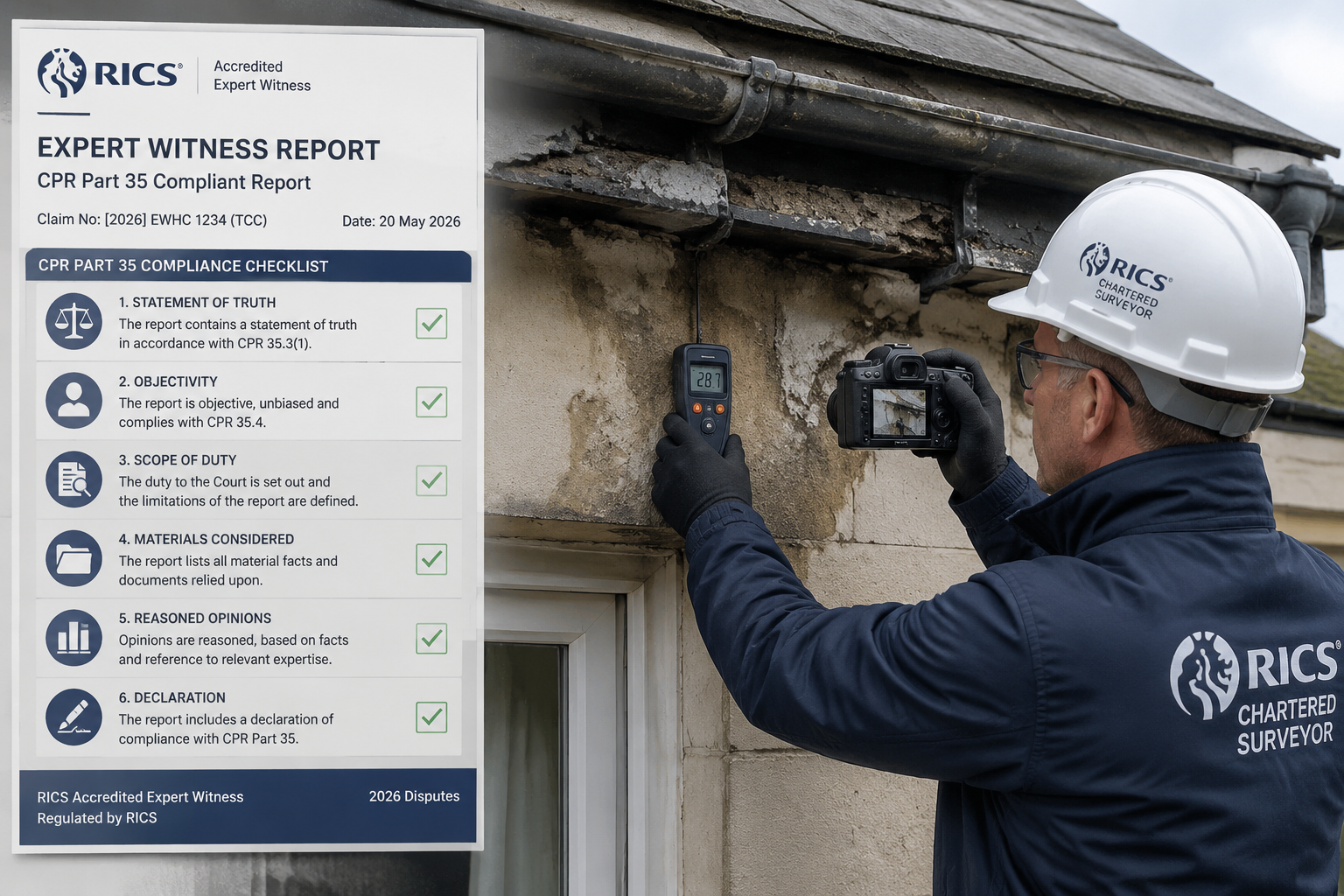
The credibility of any expert witness report rests on the quality of the underlying investigation. Courts are increasingly sophisticated in their reading of expert evidence, and a report built on a cursory site visit will not withstand cross-examination. [1]
Stage 1: Pre-Investigation Review
Before setting foot on site, a competent surveyor will:
- Review all available construction drawings, specifications, and contracts
- Examine any existing survey reports, snagging lists, or previous correspondence about defects
- Identify the relevant building regulations and British Standards applicable at the time of construction
- Clarify the precise issues in dispute with the instructing solicitor
For claims involving guttering failures, pre-investigation review might include examining the original specification for the drainage system, manufacturer installation guidance, and any maintenance records. For structural movement claims, it would extend to ground investigation reports and structural calculations.
Surveyors undertaking RICS specific defect surveys will already be familiar with the structured approach to isolating and analysing individual building failures — the same discipline applies in the expert witness context.
Stage 2: Forensic Onsite Investigation
The site investigation is where the technical case is built. Professional training delivered in early 2026 has emphasised the importance of systematic, documented investigation methodology for construction defect claims. [8]
Key investigation activities include:
- 📸 Photographic evidence: timestamped, geotagged, and cross-referenced to a site plan
- 🔬 Material sampling and testing: where appropriate, samples may be sent for laboratory analysis
- 📏 Dimensional surveys: measuring deviations from specification or building regulations
- 💧 Moisture and thermal imaging: critical for water ingress and condensation claims
- 🏗️ Opening up works: where agreed by parties, limited destructive investigation to expose hidden defects
For guttering defect claims specifically, the surveyor will assess fall gradients, joint integrity, fixing spacing, material condition, and whether the installation complied with BS EN 607 or BS EN 1462 standards. Evidence of blockage history, overflow staining, and consequential damp penetration must all be documented.
The schedule of condition reporting methodology — used extensively in dilapidations and party wall work — provides a useful framework for systematic defect documentation that translates well into expert witness reports.
Stage 3: Causation Analysis
Identifying a defect is only half the task. The expert witness must establish causation — the direct link between the defect and the loss or damage claimed. This is where forensic engineering methodology becomes critical. [5]
Determining responsibility requires evaluation of:
- Construction plans and whether they were followed
- Site conditions at the time of construction
- Applicable building codes and whether they were met
- The sequence of events leading to failure
Construction defect expert witnesses strengthen causation arguments by linking technical evidence to specific defects and demonstrating how those defects directly caused the damage or failure. [3] This causal chain must be explicit in the report — courts cannot be expected to draw inferences that the expert has not drawn themselves.
Stage 4: Report Drafting
The report structure should follow a logical progression from instructions through to conclusions. A well-structured expert witness report for a defective construction claim will typically contain:
- Introduction and qualifications — establishing the expert's credentials
- Instructions and scope — what the expert was asked to do
- Documents reviewed — full list of materials considered
- Site investigation methodology — how the inspection was conducted
- Findings — factual description of what was observed
- Analysis — technical interpretation of the findings
- Causation — linking defects to damage
- Conclusions and opinions — clear, reasoned, proportionate
- Statement of Truth and CPR Part 35 declaration
Multi-Disciplinary Expertise and the Role of Different Experts in 2026 Disputes
Construction defect claims in 2026 rarely involve a single type of expert. The complexity of modern construction means that different specialists contribute distinct perspectives, and the lead surveyor must understand how their report fits within this broader expert evidence framework. [2]
Types of Expert Commonly Instructed
| Expert Type | Typical Contribution |
|---|---|
| Chartered Building Surveyor | Overall defect identification, specification compliance, workmanship assessment |
| Structural Engineer | Framework compliance, load-bearing capacity, structural movement |
| Architect | Design intent, workmanship deviations from drawings |
| Geotechnical Engineer | Foundation failures, soil conditions, subsidence |
| Property Valuer | Diminution in value, cost of remediation |
| General Contractor | Construction methodology, programme, industry practice |
For claims involving structural defects, the structural engineering input will address whether the building's frame meets design requirements. For foundation-related claims, geotechnical evidence is essential. The chartered surveyor often acts as the coordinating expert, providing the overarching defect assessment within which specialist opinions sit.
Where disputes involve party wall damage — for example, where construction works have caused cracking to an adjoining property — the surveyor's expert report may need to address issues covered by the Party Wall etc. Act 1996, including whether a proper schedule of condition was prepared before works commenced.
Qualifications and Selection Criteria
When selecting or evaluating an expert witness for a construction defect claim, the following criteria apply: [3]
- ✅ RICS membership (for surveying experts) or equivalent professional accreditation
- ✅ Demonstrable experience in construction defect litigation
- ✅ Prior expert witness testimony track record
- ✅ Familiarity with CPR Part 35 requirements
- ✅ Hands-on construction or surveying experience — not purely academic credentials
- ✅ Ability to communicate technical findings clearly to a non-technical audience
The most persuasive expert witnesses combine forensic investigation skills with the ability to give clear, credible testimony under cross-examination. [3] An expert who cannot explain their methodology in plain language will struggle in the witness box, regardless of how technically sound their report may be.
Independence and Conflicts of Interest
Professional standards require experts to maintain strict objectivity and to refuse instructions where their independence could be compromised. [5] This means:
- Disclosing any prior relationship with either party
- Refusing instructions where the expert has a financial or personal interest in the outcome
- Protecting confidentiality of all parties' information appropriately
Surveyors who regularly act for one side — always for claimants or always for defendants — may face challenge on grounds of apparent bias, even if their individual reports are technically sound. Courts value experts who can demonstrate a balanced instruction history.
Practical Compliance: Making Expert Witness Reports Court-Ready in 2026
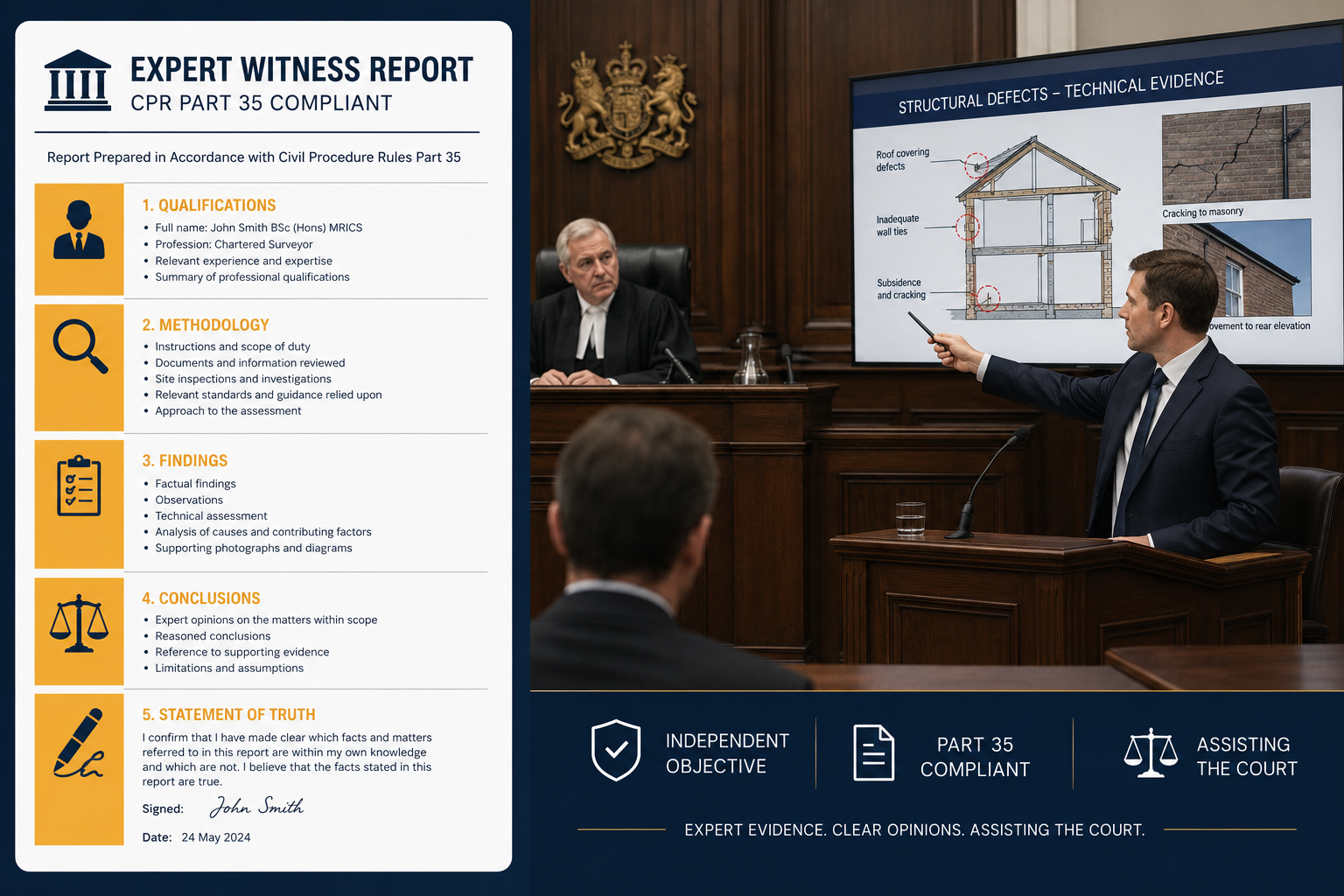
Producing a technically excellent report that fails on procedural grounds is a frustrating and costly outcome. The following practical steps ensure compliance with both CPR Part 35 and the expectations of courts handling defective construction claims in 2026.
Common Reasons Expert Reports Are Criticised or Rejected
- ❌ Missing or incorrectly worded Statement of Truth
- ❌ Failure to acknowledge contrary evidence
- ❌ Conclusions that exceed the expert's stated expertise
- ❌ Advocacy language — appearing to argue the client's case
- ❌ Inadequate methodology description — courts cannot assess reliability
- ❌ Failure to comply with any pre-action protocol requirements for expert evidence
- ❌ Not addressing the specific issues identified by the court or parties
Joint Expert Meetings and Statements of Agreed Issues
Courts frequently direct that experts from each side meet without their clients or lawyers present. The purpose is to narrow the issues genuinely in dispute and produce a Joint Statement identifying points of agreement and disagreement.
Surveyors must approach these meetings with genuine openness. Refusing to concede obvious points, or retreating from well-founded positions under pressure, both damage credibility. The Joint Statement is a court document — it carries significant weight in proceedings.
Dilapidations and Defect Claims: Overlapping Expertise
Many defective construction claims overlap with dilapidations disputes, particularly in commercial property contexts where tenants or landlords argue about the cause of deterioration. Understanding the dilapidations surveyor role helps clarify where defect liability ends and maintenance obligations begin — a distinction that expert witnesses are frequently asked to address.
Similarly, dilapidation surveys provide a structured methodology for assessing property condition that informs both the factual findings and the remediation cost estimates in expert witness reports.
The Expert's Continuing Duty
CPR Part 35 imposes a continuing duty on experts. If new evidence emerges, or if the expert's opinion changes for any reason, they must notify the instructing solicitor promptly. Failing to update an opinion when material new information comes to light is a serious professional failure that can result in adverse costs orders and reputational damage.
Conclusion: Actionable Steps for Surveyors and Legal Teams in 2026
Expert Witness Reports for Defective Construction Claims: Surveyor Protocols and CPR Part 35 Compliance in 2026 Disputes demand a disciplined, structured approach from the first instruction through to the final declaration. The cases that succeed are built on thorough forensic investigation, impartial analysis, and procedurally compliant reporting.
Actionable Next Steps ✅
- Instruct early: involve an expert witness at the pre-action stage to assess the merits of the claim and comply with pre-action protocols.
- Check qualifications rigorously: RICS membership, relevant defect experience, and a track record of court-compliant reporting are minimum requirements.
- Invest in the site investigation: a thorough, well-documented forensic inspection is the foundation of every credible report.
- Review the report against CPR Part 35 before filing: use the mandatory elements checklist and ensure the Statement of Truth is correctly worded.
- Prepare for joint expert meetings: approach them as an opportunity to narrow genuine issues, not as a negotiation.
- Maintain independence throughout: any instruction that compromises objectivity should be declined.
For property owners, contractors, or legal teams seeking expert surveying support for a defective construction claim, engaging a qualified expert witness surveyor with demonstrable CPR Part 35 compliance experience is the most important single step toward a successful resolution.
References
[1] Construction Defects Expert Witness – https://www.seakexperts.com/specialties/construction-defects-expert-witness
[2] Expert Witness Construction Disputes – https://furukawacastles.com/blog/2026/04/expert-witness-construction-disputes/
[3] Construction Defect – https://www.expertinstitute.com/expert-witness/construction-defect/
[4] Construction Damages S 88 – https://www.jurispro.com/category/construction-damages-s-88
[5] Construction Claims And Disputes – https://rimkus.com/article/construction-claims-and-disputes/
[6] Construction Defects – https://www.experts.com/expert-witnesses/categories/construction-defects
[7] Construction Defect Expert – https://www.constructionwitness.com/expert-services-trades/construction-defect-expert/
[8] Onsite Investigation Of Construction Defect Claims – https://www.petefowler.com/2026-webinar-calendar/2026/02/26/onsite-investigation-of-construction-defect-claims