Over 4.6 million households in England rent privately — and from 1 May 2026, the rules governing every single one of those tenancies changed fundamentally. The Renters Rights Act 2026 landlords Section 13 framework is not a minor tweak; it is the most significant overhaul of the private rented sector (PRS) in a generation. If you own buy-to-let (BTL) property in Manchester and you have not yet audited your portfolio for compliance, the clock is already ticking. ⏰
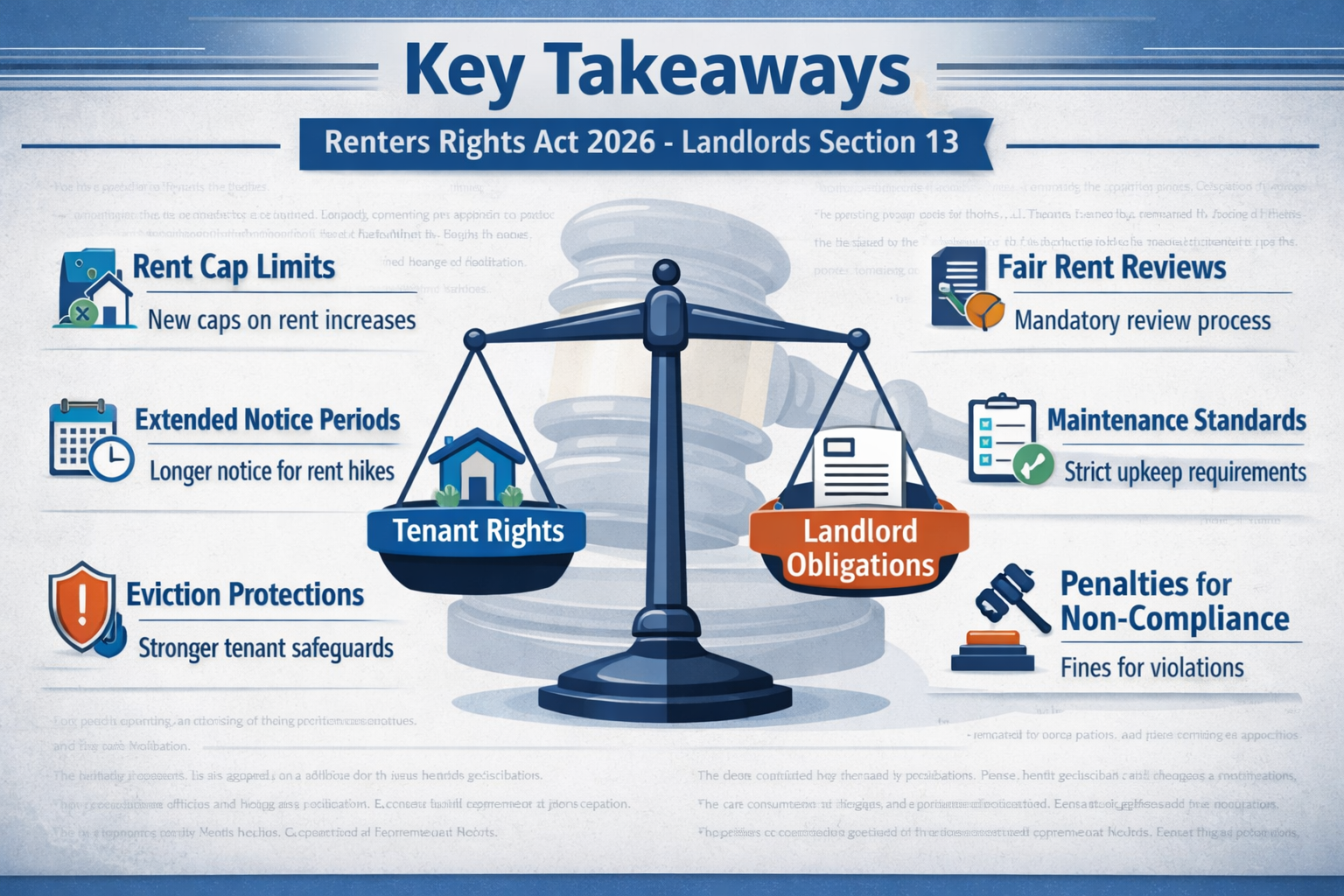
Key Takeaways
- Section 21 'no-fault' evictions are abolished from 1 May 2026; all existing Assured Shorthold Tenancies (ASTs) automatically convert to Assured Periodic Tenancies.
- Rent increases can only be made via Section 13 notice (Form 4A), with a mandatory minimum two months' notice and a maximum of one increase per 12-month period.
- Contractual rent review clauses are no longer enforceable — the statutory Section 13 procedure is the only lawful route.
- Tenants can challenge increases at the First-tier Tribunal without fear of retaliatory eviction.
- Property condition standards — including the Decent Homes Standard — now apply to the PRS, making professional HHSRS assessments and compliance audits essential for landlords.
What Has Actually Changed From 1 May 2026?
The Renters' Rights Act 2025 (UKPGA 2025/26) commenced in stages, with the principal provisions taking effect from 1 May 2026. Here is what that means in practice:
The End of ASTs and Section 21
Every existing Assured Shorthold Tenancy automatically converted to an Assured Periodic Tenancy on commencement. There are no more fixed-term ASTs for new lettings. Crucially, Section 21 'no-fault' eviction notices can no longer be served. Landlords who wish to recover possession must now rely on specified statutory grounds — for example, wishing to sell the property or move in a family member — and must follow a court-based process.
The financial stakes are real: illegal eviction attempts can attract fines of up to £7,000, with criminal prosecution and unlimited fines possible in the most serious cases.
New Landlord Database and Ombudsman
All private landlords in England must register on a new Private Rented Sector Landlord Database. Alongside this, a mandatory New Homes Ombudsman (extended to the PRS) provides tenants with an accessible, low-cost route to resolve disputes without going to court. Failure to register carries its own financial penalties.
Decent Homes Standard Extended to the PRS
Previously applying only to social housing, the Decent Homes Standard now covers private rented properties. This means your property must be free from serious hazards, in a reasonable state of repair, and have reasonably modern facilities. Local councils have strengthened enforcement powers to investigate non-compliant landlords.
Understanding the Renters Rights Act 2026 Landlords Section 13 Process
This is the section that will affect your day-to-day management most immediately. Under the Renters Rights Act 2026 landlords Section 13 provisions, the statutory rent increase process has been tightened considerably.
The Four Core Rules for Section 13 Rent Increases
| Rule | Detail |
|---|---|
| Prescribed Form | Landlords must use Form 4A — no other format is valid |
| Notice Period | Minimum 2 months written notice before the increase takes effect |
| Frequency Cap | Maximum one increase per 12-month period |
| First-Year Protection | No Section 13 notice can be served in the first 12 months of a tenancy |
💡 Pull Quote: "From 1 May 2026, contractual rent review clauses are unenforceable. The Section 13 statutory procedure is the only lawful route to increase rent — full stop."
Market Rent Is the Benchmark
Every increase proposed under Section 13 must reflect the open market rent for comparable properties in the local area. Landlords cannot simply apply an arbitrary percentage uplift. If a tenant believes the proposed increase exceeds market value, they have the right to refer the matter to the First-tier Tribunal (Property Chamber), which will scrutinise local comparable evidence before approving or adjusting the figure.
Critically, tenants cannot be evicted for challenging a Section 13 notice. The law explicitly protects them from retaliatory action.
Why Documentation Errors Are Costly
Any error in the Form 4A — incorrect notice period, wrong rent figure, inaccurate tenancy start date — invalidates the entire notice. The landlord must then restart the process from scratch, potentially losing months of rental income at the revised rate. Getting it right first time is not optional; it is financially essential.
For landlords managing multiple Manchester properties, we recommend keeping a structured rent review calendar. Our rent review guidance explains how professional advice can help you stay compliant and maximise lawful income.
How the Renters Rights Act 2026 Landlords Section 13 Affects Your Compliance Obligations
The rent increase rules do not sit in isolation. They are part of a broader compliance picture that now demands far greater attention to property condition.
HHSRS Assessments and Decent Homes Compliance
The Housing Health and Safety Rating System (HHSRS) has always been the mechanism for assessing hazards in rented homes. Now, with the Decent Homes Standard extended to the PRS, a formal HHSRS assessment is no longer just good practice — it is a prerequisite for demonstrating compliance. Category 1 hazards (the most serious) can trigger council enforcement action, civil penalties, and rent repayment orders.
A chartered building surveyor in Manchester can carry out a thorough HHSRS assessment, identify hazards before a council inspector does, and produce a remediation plan that protects both your tenants and your investment.
Mid-Tenancy Condition Reports and Schedules of Dilapidations
With Section 21 gone, disputes about property condition at the end of a tenancy are likely to become more frequent and more contentious. A robust mid-tenancy condition report creates a dated, independent record of the property's state — invaluable if a deposit dispute or tribunal claim arises later.
Similarly, a professionally prepared schedule of dilapidations documents tenant-caused deterioration beyond fair wear and tear, giving you a defensible basis for any deductions. Understanding what a dilapidations surveyor does is a good starting point for landlords new to this process.
Mandatory Certification: EICR, Gas Safety, and EPC
The Act reinforces existing obligations around:
- ✅ Electrical Installation Condition Reports (EICR) — required every five years
- ✅ Annual Gas Safety Certificates — no change to frequency, but non-compliance penalties are now higher
- ✅ Energy Performance Certificates (EPC) — minimum Band E currently; proposed Band C requirements are progressing through policy
Our property certification services cover all mandatory checks, giving Manchester landlords a single point of contact for compliance.
Practical Steps for Manchester BTL Investors Right Now
Here is a straightforward action checklist:
- Audit all tenancies — confirm conversion to Assured Periodic Tenancy status and remove any contractual rent review clauses from future agreements.
- Diarise Section 13 deadlines — calculate the earliest lawful date for your next rent review on each property.
- Commission an HHSRS/Decent Homes audit — identify and remediate any Category 1 or Category 2 hazards before a council inspection.
- Register on the Landlord Database — penalties for non-registration are enforceable from commencement.
- Update all certification — EICR, gas safety, and EPC must all be current.
- Instruct a surveyor for condition reports — protect your deposit position and tribunal readiness.
For a detailed property inspection tailored to Manchester's housing stock, see what Manchester Surveyors look for in a property inspection.
Conclusion: Compliance Is Now a Competitive Advantage
The Renters Rights Act 2026 landlords Section 13 changes are not going away, and enforcement is only going to intensify as local councils exercise their new powers. For Manchester landlords and BTL investors, the choice is straightforward: get ahead of compliance now, or face fines, tribunal challenges, and reputational damage later.
The landlords who will thrive in this new environment are those who treat professional property assessments — HHSRS audits, condition reports, dilapidations surveys, and certification checks — as standard operating procedure rather than an afterthought.
📞 Ready to protect your portfolio? Contact Manchester Surveyors today for a Decent Homes compliance audit, HHSRS assessment, or mid-tenancy condition report. Our RICS-qualified surveyors understand Manchester's rental market and the full scope of the new legislation — so you don't have to navigate it alone.