Over 85% of the buildings standing in England today will still be in use in 2050 — meaning the retrofit of existing stock, not new construction, is the single most critical lever for decarbonising the built environment. Yet when that retrofit involves a shared wall between neighbours, a layer of legal and technical complexity enters the picture that many project teams underestimate. Party Wall Surveys for Whole Life Carbon Retrofits: RICS Protocols Under 2026 Sustainability Reporting sits at the precise intersection of property law, sustainability science, and professional practice — and getting it right matters more than ever in 2026.
This article unpacks exactly what surveyors, homeowners, and developers need to know when low-carbon retrofit works — from external wall insulation to loft upgrades — trigger the Party Wall etc. Act 1996, and how RICS's evolving sustainability protocols shape every stage of the process.
Key Takeaways 📋
- Party wall legislation applies to many common retrofit measures, including insulation upgrades that affect shared walls, loft conversions, and foundation works.
- RICS launched the CLEAR initiative in April 2026 to harmonise whole-life carbon measurement and reporting globally, directly influencing how surveyors document retrofit impacts. [1]
- The draft 8th edition of RICS Party Wall Legislation and Procedure is under active consultation in 2026, with sustainability considerations increasingly embedded in practice guidance. [4]
- Schedule of Condition reports are now expected to capture pre-retrofit baseline data that feeds into whole-life carbon assessments (WLCA).
- Non-compliance with party wall notice requirements during retrofit projects can expose building owners to legal disputes, project delays, and invalidated sustainability claims.
Why Whole Life Carbon Retrofits Trigger Party Wall Obligations

The phrase "whole life carbon retrofit" covers a broad spectrum of interventions: external wall insulation (EWI), internal wall insulation (IWI), loft conversions with structural alterations, basement excavations, and the installation of heat pump infrastructure requiring wall penetrations. What these measures share — beyond their carbon-reduction goals — is the potential to physically affect a party wall, party fence wall, or party structure as defined under the Party Wall etc. Act 1996.
Which Retrofit Works Require a Party Wall Notice?
Under the Act, a building owner must serve formal notice before undertaking certain categories of work. In the context of low-carbon retrofits, the most commonly triggered provisions include:
| Retrofit Measure | Relevant Section of the Act | Notice Required |
|---|---|---|
| External wall insulation attached to party wall | Section 2 | Party Structure Notice |
| Loft conversion with new beams into party wall | Section 2 | Party Structure Notice |
| Basement excavation within 3–6 metres of neighbour's foundations | Section 6 | Notice of Adjacent Excavation |
| Heat pump installation with wall penetrations | Section 2 (if structural) | Party Structure Notice |
| Internal wall insulation cutting into party wall | Section 2 | Party Structure Notice |
For homeowners planning a loft conversion with party wall implications, understanding these triggers early prevents costly delays once contractors are on site.
💡 Pull Quote: "Serving the wrong notice — or no notice at all — can invalidate a party wall award and expose a building owner to injunctions even after retrofit works are complete."
Critically, the embodied carbon locked into retrofit materials — insulation boards, fixings, membranes — is now subject to scrutiny under whole-life carbon assessment frameworks. If works are later disputed or must be reversed due to party wall non-compliance, the environmental cost of those materials is wasted. Legal compliance and carbon efficiency are therefore directly linked.
For anyone unsure whether their project triggers notice requirements, reviewing comprehensive party wall guidance is an essential first step.
RICS Protocols Under 2026 Sustainability Reporting: The CLEAR Framework and Party Wall Practice
The CLEAR Initiative: A Game-Changer for Retrofit Assessments
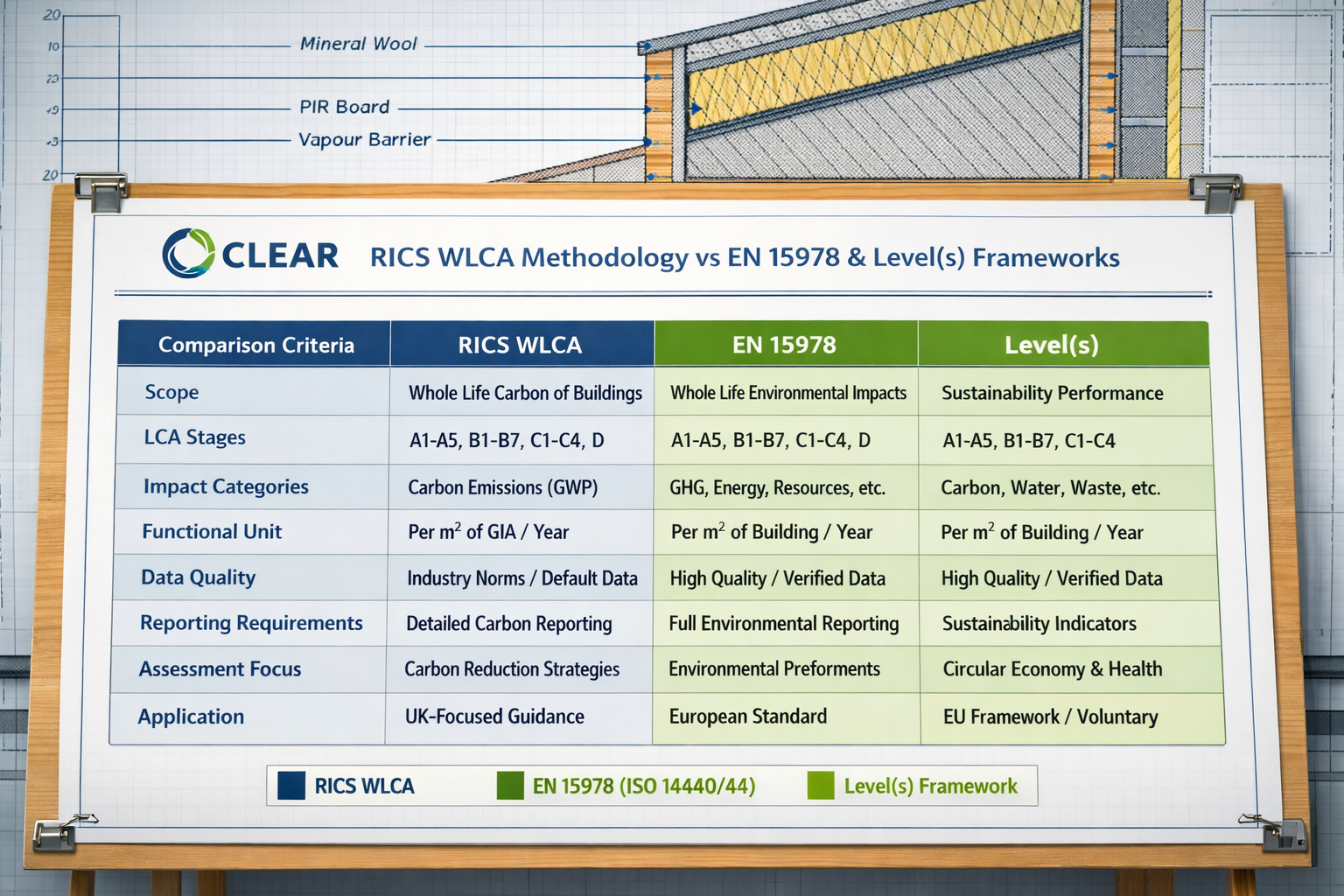
In April 2026, RICS launched the Coalition for Life Cycle Emissions Alignment and Reporting (CLEAR) at the Sustainable Buildings and Construction Summit in Lausanne. The initiative brings together global partners to harmonise whole-life carbon measurement across the built environment. [1]
CLEAR is structured as a three-year programme with three core deliverables:
- 🌍 A globally aligned framework for whole-life carbon measurement
- 🔧 Tools for comparing methodologies — including EN 15978, Level(s), and RICS WLCA
- 💻 A digital platform to support practical implementation [2]
In its first year, CLEAR focuses on coalition building, analysing existing whole-life carbon assessment methodologies, and developing resources for industry and policy stakeholders. [1] For party wall surveyors, this matters because the methodology used to calculate embodied carbon in retrofit materials — and the operational carbon savings projected over the building's lifespan — now needs to be consistent and auditable.
How RICS Party Wall Guidance Is Evolving in 2026
Separately, RICS launched a consultation on the draft 8th edition of Party Wall Legislation and Procedure in 2026, inviting feedback from surveyors, legal professionals, and dispute resolution practitioners across England and Wales. [4] The consultation signals a profession actively updating its frameworks to reflect contemporary construction realities — including the surge in retrofit activity driven by net-zero targets.
The 8th edition is expected to address:
- Sustainability clauses within party wall awards
- Material specification requirements that consider embodied carbon
- Digital documentation standards for condition schedules
- Dispute resolution pathways specific to retrofit-related damage claims
This evolution aligns with RICS's broader Global Certificate in Whole Life Carbon Assessment, the 2026 version of which equips surveyors to integrate WLCA principles into everyday practice — including party wall surveying. [6]
Party Wall Surveys for Whole Life Carbon Retrofits: RICS Protocols Under 2026 Sustainability Reporting in Practice
When a party wall surveyor is appointed in the context of a whole-life carbon retrofit, their role extends beyond the traditional scope of checking structural integrity and serving notices. Under 2026 sustainability reporting expectations, the surveyor must now consider:
- Embodied carbon of proposed materials — does the insulation specified in the party wall award reflect low-carbon alternatives?
- Thermal bridging at wall junctions — poor detailing at party wall interfaces can undermine the operational carbon savings of the entire retrofit
- Whole-life durability — materials with shorter service lives may have lower upfront embodied carbon but higher whole-life carbon when replacement cycles are factored in
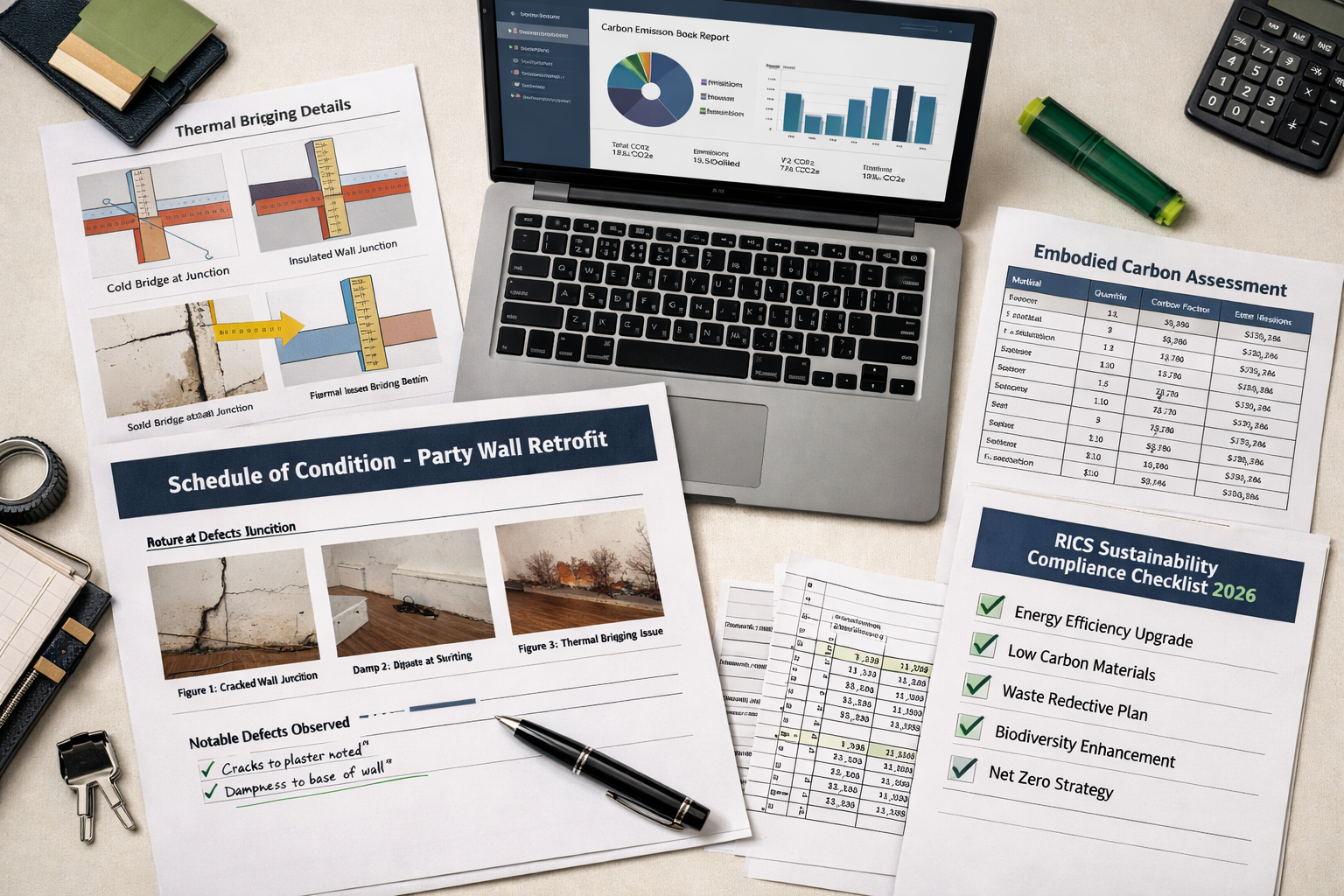
- Pre-works baseline documentation — the Schedule of Condition must capture sufficient detail to support future carbon performance comparisons
For surveyors seeking to understand the full scope of condition documentation required, the Schedule of Condition guidance provides a strong foundation.
Schedule of Condition Reports: The Carbon Baseline Document
Why the Schedule of Condition Is Now a Sustainability Document
Traditionally, a Schedule of Condition served one purpose: to record the pre-works state of an adjoining owner's property so that any damage caused by the building owner's works could be identified and remedied. In 2026, this document carries additional weight.
Under emerging sustainability reporting requirements, the Schedule of Condition now functions as a pre-retrofit baseline record that can:
- Establish the thermal performance status of the party wall before intervention
- Document existing defects that might compromise insulation continuity
- Record material compositions (where visible) to support whole-life carbon calculations
- Provide photographic evidence of wall construction that informs embodied carbon modelling
📌 Key Point: A well-prepared Schedule of Condition is no longer just legal protection — it is the first chapter of a whole-life carbon story for the building.
What a Carbon-Aware Schedule of Condition Should Include
A Schedule of Condition prepared for a whole-life carbon retrofit project should go beyond standard photographic records. Best practice in 2026 includes:
Structural and Material Documentation:
- Wall construction type (solid brick, cavity, timber frame)
- Visible insulation already present and estimated thickness
- Evidence of damp, condensation, or mould that could affect insulation performance
- Condition of existing pointing, render, or cladding
Thermal Performance Indicators:
- Thermal imaging results (where commissioned) showing heat loss patterns
- Location of cold bridges at wall junctions, window reveals, and floor/ceiling interfaces
- Any existing party wall penetrations that could compromise airtightness
Carbon-Relevant Observations:
- Age and likely specification of existing materials
- Evidence of previous retrofit interventions
- Notes on material condition relevant to whole-life durability assessments
For projects where pre-existing damage to the party wall is identified, understanding how damage to property in party wall scenarios is handled is essential before retrofit works commence.
Common Pitfalls in Party Wall Surveys for Whole Life Carbon Retrofits
⚠️ Pitfall 1: Failing to Serve Notice Before Retrofit Works Begin
External wall insulation is one of the most common retrofit measures applied to terraced and semi-detached properties. When the insulation system is fixed to, or abuts, a party wall, a Party Structure Notice is required. Many homeowners — and even some contractors — assume that because the work is on "their side" of the wall, no notice is needed. This is incorrect.
The consequences of failing to serve a party wall notice include injunctions to stop works, mandatory removal of completed work, and personal liability for the building owner.
⚠️ Pitfall 2: Selecting Materials Without Embodied Carbon Consideration
Party wall awards specify the nature of works permitted. In 2026, surveyors acting for adjoining owners are increasingly scrutinising material specifications within proposed awards. An award that permits the use of high-embodied-carbon insulation materials — when lower-carbon alternatives exist — may face challenge under sustainability reporting obligations, particularly on publicly funded or ESG-governed projects.
⚠️ Pitfall 3: Inadequate Documentation for Carbon Reporting
If the Schedule of Condition does not capture sufficient pre-works data, the building owner cannot demonstrate the carbon performance improvement achieved by the retrofit. This matters for:
- Green mortgage products that require evidenced energy performance improvements
- ESG reporting for landlords and property investors
- Future sale of the property, where retrofit documentation supports EPC ratings and carbon credentials
⚠️ Pitfall 4: Ignoring Thermal Bridging at Party Wall Interfaces
Even a perfectly executed insulation retrofit can be undermined by thermal bridging where the insulation layer meets the party wall. This is a technical detail that sits at the boundary between party wall surveying and building physics — and it is one that a chartered building surveyor with retrofit experience is best placed to address.
Integrating Party Wall Surveys for Whole Life Carbon Retrofits: RICS Protocols Under 2026 Sustainability Reporting Into Project Workflows
A Step-by-Step Compliance Pathway 🗺️
Integrating party wall compliance with whole-life carbon retrofit objectives requires a structured approach from the earliest stages of project planning:
Stage 1 — Pre-Design (Months 1–2)
- Identify all party walls, party fence walls, and party structures affected by the proposed retrofit
- Commission a structural survey to establish baseline condition and identify any pre-existing issues
- Engage a party wall surveyor to advise on notice requirements and likely award conditions
Stage 2 — Design Development (Months 2–4)
- Select retrofit materials with reference to RICS WLCA methodology and CLEAR framework tools [2]
- Detail insulation continuity at party wall junctions to minimise thermal bridging
- Prepare draft party wall notices incorporating material specifications
Stage 3 — Notice Service and Award (Months 3–5)
- Serve Party Structure Notices (minimum 2 months before works) or Adjacent Excavation Notices (minimum 1 month)
- Commission Schedule of Condition — ensuring carbon-aware documentation standards are met
- Negotiate and agree party wall award, with sustainability clauses where applicable
Stage 4 — Construction
- Implement works strictly in accordance with the party wall award
- Maintain photographic records of insulation installation at party wall interfaces
- Monitor for any signs of damage to adjoining property
Stage 5 — Post-Works Documentation
- Prepare post-works condition record
- Compile whole-life carbon assessment documentation referencing pre-works baseline
- Retain all party wall documentation for future ESG and EPC reporting
The Role of RICS Certification in Whole Life Carbon Party Wall Practice
RICS's Global Certificate in Whole Life Carbon Assessment (2026 edition) provides surveyors with the competency framework to integrate carbon assessment into their professional practice. [6] For party wall surveyors, this certification signals to clients that the professional advising them understands not just the legal framework of the Party Wall Act, but also the carbon implications of the works being authorised.
The certificate covers:
- Whole-life carbon assessment methodologies (EN 15978, Level(s), RICS WLCA)
- Embodied carbon calculation for construction materials
- Operational carbon modelling
- Reporting standards aligned with CLEAR framework outputs [1][2]
As the RICS 8th edition Party Wall guidance moves toward finalisation following its 2026 consultation [4], surveyors holding this certification will be best positioned to advise on the intersection of party wall awards and sustainability reporting obligations.
For those exploring the full range of survey types available for retrofit projects, comparing different types of survey helps clients understand which professional services they need at each stage.
Conclusion: Actionable Next Steps for 2026 and Beyond
The convergence of party wall legislation and whole-life carbon reporting is not a future trend — it is the operational reality of retrofit practice in 2026. The RICS CLEAR initiative [1][2], the draft 8th edition Party Wall guidance [4], and the expanded WLCA certification programme [6] collectively signal a profession that is embedding sustainability into every layer of professional practice.
For homeowners and developers planning a low-carbon retrofit:
✅ Identify party wall triggers before appointing a contractor — not after
✅ Commission a carbon-aware Schedule of Condition that captures thermal performance baseline data
✅ Specify retrofit materials with reference to whole-life carbon methodology, not just upfront cost
✅ Retain all party wall documentation for future ESG, EPC, and green finance reporting
✅ Work with a surveyor holding RICS WLCA certification for integrated compliance
For surveyors:
✅ Familiarise with CLEAR framework tools for methodology comparison [2]
✅ Update Schedule of Condition templates to capture carbon-relevant baseline data
✅ Monitor the RICS 8th edition Party Wall guidance consultation for sustainability clauses [4]
✅ Consider RICS Global Certificate in Whole Life Carbon Assessment to expand retrofit advisory capability [6]
The buildings being retrofitted today will define the carbon performance of the UK's housing stock for decades. Party wall surveyors who understand the sustainability dimension of their work are not just protecting neighbours' properties — they are protecting the integrity of the nation's net-zero commitments.
References
[1] RICS and Global Partners Launch CLEAR – https://www.rics.org/news-insights/rics-and-global-partners-launch-clear
[2] RICS Launches CLEAR to Align Whole Life Carbon Reporting Across Construction – https://oneclicklca.com/en/resources/articles/rics-launches-clear-to-align-whole-life-carbon-reporting-across-construction
[3] Integrating PAS 2080:2023 Whole Life Carbon Into Party Wall Awards 2nd Edition Standards For Sustainable Boundary Works – https://nottinghillsurveyors.com/blog/integrating-pas-20802023-whole-life-carbon-into-party-wall-awards-2nd-edition-standards-for-sustainable-boundary-works
[4] RICS Launches Consultation on Updated Party Wall Practice Guidance – https://www.rics.org/news-insights/rics-launches-consultation-on-updated-party-wall-practice-guidance
[5] RICS Launches Consultation on Updated Party Wall Practice Guidance – https://wholelifecarbon.com/article/rics-launches-consultation-on-updated-party-wall-practice-guidance
[6] WLCA v2.0 Course Guide 2026 v1 – https://www.rics.org/content/dam/ricsglobal/documents/event-programmes/wlcav20Courseguide2026v1.pdf