Over 40% of global carbon emissions originate from the built environment — and as net-zero legislation tightens across the UK, disputes over whole life carbon assessments are landing in courts and tribunals with increasing regularity. For surveyors, engineers, and construction professionals stepping into the expert witness role, the stakes have never been higher. Understanding Expert Witness Roles in Whole Life Carbon Disputes: CPR Part 35 Evidence from RICS Assessments is no longer a niche specialism — it is a core professional competency for 2026 and beyond.
This guide walks through how RICS-accredited professionals can prepare, structure, and deliver carbon assessment evidence that satisfies court impartiality requirements under CPR Part 35, while leveraging the RICS Whole Life Carbon Assessment (WLCA) 2nd Edition standard.
Key Takeaways 📋
- An expert witness's primary duty is to the court, not the instructing party — independence is non-negotiable under CPR Part 35.
- RICS WLCA 2nd Edition provides the methodological backbone for credible, court-ready carbon assessment evidence.
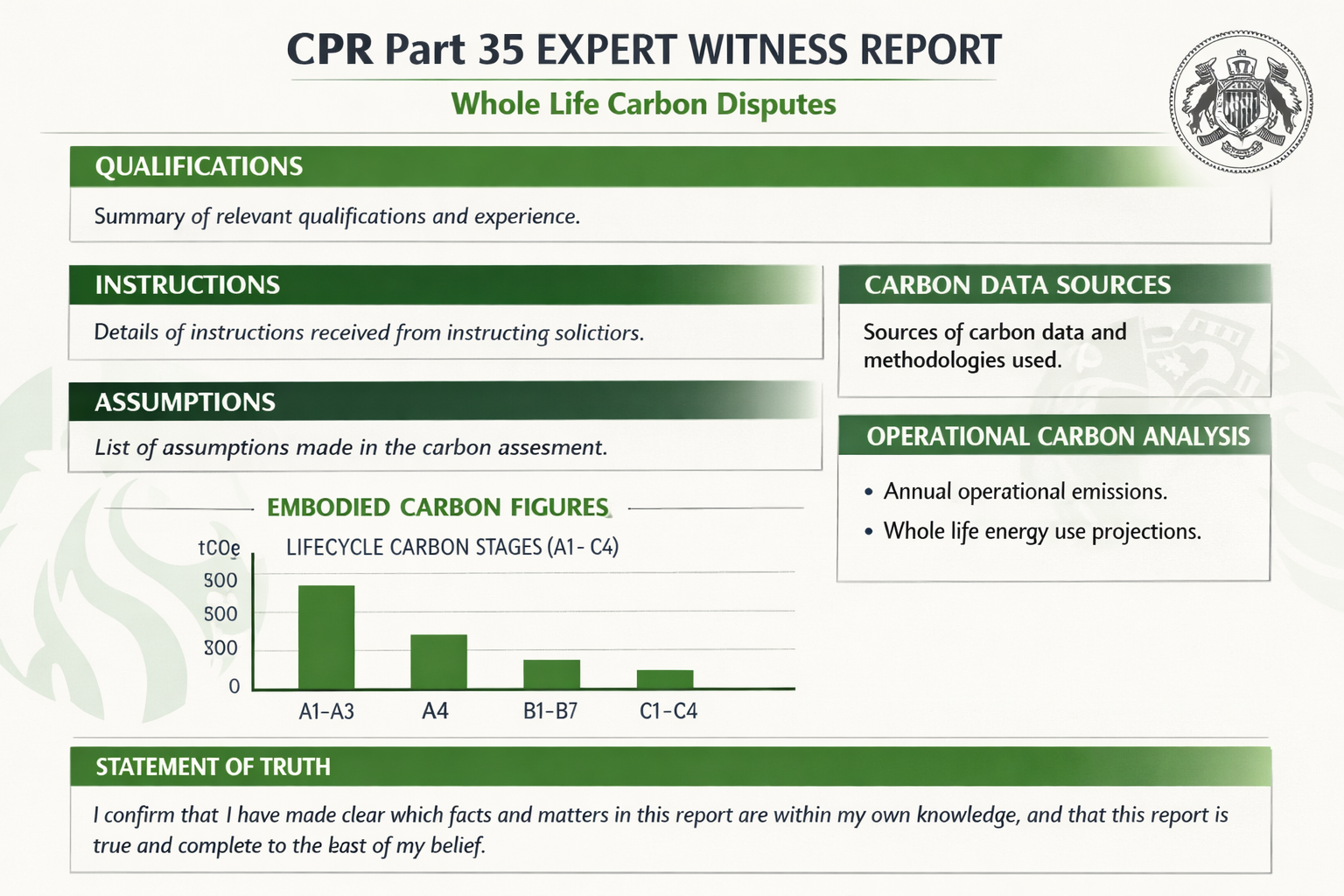
- CPR Part 35-compliant reports must include qualifications, instructions, assumptions, reasoning, a statement of truth, and a declaration of compliance.
- Multiple expert roles exist — Party Expert, Single Joint Expert (SJE), Shadow Expert — each with distinct obligations and limitations.
- RICS issued a formal practice alert in February 2024 following tribunal concerns about expert conduct, signalling heightened scrutiny across the profession.
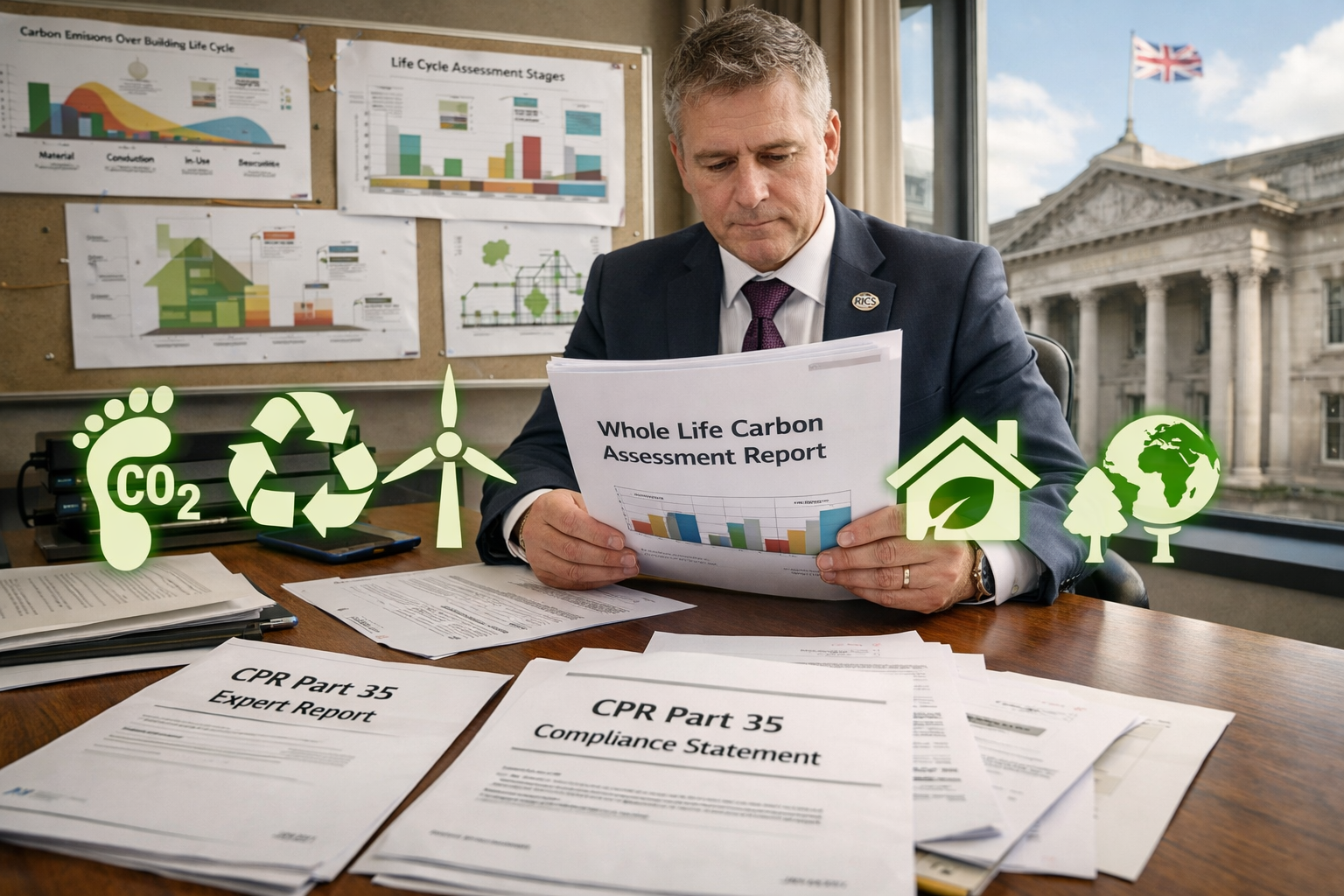
Understanding the Legal Framework: CPR Part 35 and Expert Duties
Before preparing a single page of carbon assessment evidence, any expert witness must fully grasp the legal architecture governing their role.
What CPR Part 35 Requires
Civil Procedure Rules Part 35 governs expert evidence in English and Welsh courts. Its central principle is unambiguous: an expert's overriding duty is to the court, not to the party who instructs or pays them [2]. This duty supersedes any contractual obligation to a client.
Under CPR Part 35 and its accompanying Practice Direction, a compliant expert witness report must contain [4]:
| Report Component | What It Must Include |
|---|---|
| Qualifications & Experience | Relevant credentials, years of practice, specialist knowledge |
| Instructions Received | A summary of the questions the expert was asked to address |
| Documents Relied Upon | Full list of materials reviewed and considered |
| Assumptions Made | Any factual assumptions underpinning the analysis |
| Reasoning & Conclusions | Clear logic trail from evidence to opinion |
| Statement of Truth | Confirmation the evidence is true and complete |
| Declaration of Compliance | Acknowledgment of CPR Part 35 duties |
Failure to include any of these elements can result in the report being rejected, the evidence being given reduced weight, or — in serious cases — the expert being criticised by the judge in a published judgment.
💬 "An expert who abandons objectivity in favour of advocacy does not assist the court — they undermine it." — A principle consistently reinforced in UK case law.
RICS's Role in Shaping Expert Standards
RICS does not simply credential surveyors; it actively shapes how they perform in legal settings. The RICS guidance document "Surveyors acting as expert witnesses" sets out competence and training requirements that members must satisfy before undertaking expert witness work [1]. This includes understanding legal process, applicable procedural rules, and the expectations of tribunals and courts.
Critically, in February 2024, RICS issued a formal expert witness practice alert to members following concerns raised by multiple tribunals about expert conduct [1]. This alert underscored that impartiality is not optional — it is a professional obligation with regulatory consequences.
RICS has also launched a global consultation on an updated expert witness standard [6], signalling that the profession is actively tightening its framework. Professionals working in this space should monitor developments closely.
For those seeking to formalise their credentials, RICS maintains an Accredited Expert Witness Panel, with specific qualification requirements including LETAPAEWE accreditation [7]. Membership of this panel signals to courts and instructing solicitors that the expert meets a verified standard of competence.
Professionals considering this path can explore the expert witness services available through experienced RICS-accredited firms to understand what instructing parties typically require.

Expert Witness Roles in Whole Life Carbon Disputes: CPR Part 35 Evidence from RICS Assessments — Role Types Explained
Not all expert witnesses perform the same function. In whole life carbon disputes, professionals may be called upon in several distinct capacities — each carrying different obligations and strategic implications.
The Four Key Expert Roles
1. Party Expert
Appointed by one side in the dispute. While the expert's duty remains to the court, they are instructed by a single party and their report is typically disclosed to the opposing side. In carbon disputes, a party expert might be asked to assess whether a building's embodied carbon calculations were correctly performed or whether the RICS WLCA methodology was properly applied.
2. Single Joint Expert (SJE)
Jointly instructed by both parties, the SJE provides a single, independent opinion that both sides must work with. Courts increasingly favour SJEs in technical disputes where the subject matter — such as whole life carbon accounting — is highly specialised. The SJE's report carries significant weight precisely because neither party controls the instruction [3].
3. Shadow Expert
A shadow expert is not disclosed to the court. They work confidentially behind the scenes, advising legal teams on the technical merits of the opposing expert's evidence. In carbon disputes, a shadow expert might identify methodological weaknesses in a rival WLCA report without ever appearing in court.
4. Advisory Expert
Operating in a purely consultative capacity, the advisory expert helps legal teams understand complex technical issues before proceedings begin. They may assist in drafting technical questions for interrogatories or reviewing documents during disclosure [3].
Choosing the Right Role
| Role | Disclosed to Court? | Instructed By | Primary Function |
|---|---|---|---|
| Party Expert | ✅ Yes | One party | Independent opinion, disclosed |
| Single Joint Expert | ✅ Yes | Both parties | Neutral technical resolution |
| Shadow Expert | ❌ No | One party | Confidential strategic advice |
| Advisory Expert | ❌ No | One party | Pre-litigation technical support |
Understanding which role is appropriate requires careful discussion with instructing solicitors at the outset. Mixing roles — for example, acting as an advisory expert and then transitioning to a party expert — can compromise perceived independence and invite challenge.
Applying RICS WLCA Standards to Court-Ready Carbon Evidence
This is where technical expertise and legal compliance converge. Expert Witness Roles in Whole Life Carbon Disputes: CPR Part 35 Evidence from RICS Assessments demand that the expert not only understands carbon science but can translate it into evidence that a judge — who may have no technical background — can follow and rely upon.
The RICS WLCA 2nd Edition Standard
RICS has published a dedicated standard for Whole Life Carbon Assessment for the built environment [5]. This standard provides a structured methodology for quantifying carbon across a building's entire lifecycle, from raw material extraction through to demolition and disposal.
The lifecycle stages covered typically include:
- A1–A5: Product manufacturing and construction processes (embodied carbon)
- B1–B7: In-use operational carbon and maintenance
- C1–C4: End-of-life demolition and waste processing
- D: Beyond boundary benefits (e.g., material reuse, energy export)
When preparing expert evidence, grounding the analysis in RICS WLCA methodology provides a recognised, peer-validated framework that courts can assess against an objective standard. Departures from the standard must be explicitly justified.
Common Dispute Scenarios in 2026
Whole life carbon disputes are arising in several contexts:
🏗️ Construction contracts — where specifications required a maximum embodied carbon threshold and the contractor claims compliance but the client disputes the assessment methodology.
🏢 Commercial leases — where green lease clauses impose carbon performance obligations and disagreements arise over measurement approaches.
⚖️ Planning appeals — where carbon impact assessments are challenged as part of development consent disputes.
🔧 Dilapidations — where the carbon cost of remediation works is disputed between landlord and tenant. Those involved in dilapidations matters can find relevant context in dilapidation survey guidance and the role of a dilapidations surveyor.
💡 Insurance claims — where the carbon-related cost of reinstatement following damage is contested.
Structuring a CPR Part 35-Compliant WLCA Expert Report
A well-structured report follows a logical architecture that mirrors both CPR Part 35 requirements and RICS WLCA methodology:
Section 1: Executive Summary
Brief, jargon-free summary of the expert's conclusions. Written for a non-technical reader.
Section 2: Expert's Qualifications
RICS membership status, relevant accreditations (including any LETAPAEWE or RICS Accredited Expert Witness Panel membership), and experience in whole life carbon assessments.
Section 3: Instructions and Scope
Verbatim or summarised instructions from the instructing solicitor, with the specific questions the expert has been asked to address.
Section 4: Methodology
Explanation of the RICS WLCA 2nd Edition standard applied, data sources used (e.g., EPDs, CIBSE guides, ICE database), and any departures from standard methodology with justification.
Section 5: Findings and Analysis
Stage-by-stage carbon accounting, clearly showing inputs, calculations, and outputs. Tables and charts are strongly recommended for clarity.
Section 6: Opinion
The expert's considered professional opinion on the disputed issues, expressed with appropriate confidence levels and acknowledgment of uncertainty.
Section 7: Statement of Truth and CPR Declaration
Mandatory under CPR Part 35 [4].
🔑 Key principle: Every assumption must be stated. Every data source must be cited. Every departure from RICS WLCA methodology must be explained. Courts do not tolerate unexplained gaps.
The Importance of RICS Credentials in Carbon Disputes
Courts and tribunals place significant weight on the credibility of the expert's professional standing. RICS-registered valuers and surveyors carry institutional credibility that reinforces the reliability of their evidence. An expert who is a chartered building surveyor with demonstrable experience in sustainability assessments will carry greater evidential weight than an unaccredited consultant.
For complex technical matters, courts may also draw on the expertise of professionals who conduct RICS building surveys as part of their standard practice, since familiarity with construction materials and methods is directly relevant to embodied carbon calculations.
Practical Guidance: Maintaining Impartiality Under Cross-Examination
Preparing a technically sound report is only half the challenge. Expert witnesses in whole life carbon disputes must also withstand cross-examination by opposing counsel — often a rigorous process designed to expose bias, methodological weakness, or overreach.
Staying Within the Expert's Lane
One of the most common criticisms levelled at expert witnesses is exceeding the scope of their expertise. A surveyor qualified in whole life carbon assessment should not offer opinions on legal interpretation or financial loss quantification unless they hold separate qualifications in those areas.
Equally, experts must resist the temptation to advocate. The moment an expert appears to be arguing for the instructing party's position rather than assisting the court, their credibility — and the weight of their evidence — diminishes sharply.
Handling Uncertainty Honestly
Carbon assessment involves inherent uncertainty. Embodied carbon figures vary depending on the data source, geographic origin of materials, and transport assumptions. A credible expert acknowledges this uncertainty explicitly, quantifies it where possible, and explains how it affects their conclusions.
Attempting to present carbon figures with false precision will be exposed under cross-examination and can fatally undermine the report's credibility.
Joint Statements and Without Prejudice Meetings
Under CPR Part 35, the court may direct opposing experts to meet and produce a joint statement identifying areas of agreement and disagreement. In whole life carbon disputes, this process is particularly valuable — experts often agree on methodology but disagree on specific data inputs or assumptions.
Preparing thoroughly for these meetings, with a clear understanding of the RICS WLCA standard and the specific disputed issues, is essential. The joint statement becomes a key document in the proceedings.
Conclusion: Actionable Steps for Expert Witnesses in Carbon Disputes ✅
Expert Witness Roles in Whole Life Carbon Disputes: CPR Part 35 Evidence from RICS Assessments sit at the intersection of environmental science, professional standards, and legal procedure. Getting this right requires deliberate preparation.
Here are the actionable steps every expert should take in 2026:
-
Verify your credentials — Ensure RICS membership is current and consider pursuing LETAPAEWE accreditation or RICS Accredited Expert Witness Panel membership [7].
-
Complete CPR Part 35 training — RICS guidance requires demonstrable competence in legal process and court expectations [1]. Formal training is not optional.
-
Ground every assessment in RICS WLCA 2nd Edition — Use the published standard as your methodological anchor and document any departures carefully [5].
-
Structure reports to CPR requirements — Include all mandatory components: qualifications, instructions, documents relied upon, assumptions, reasoning, statement of truth, and CPR declaration [4].
-
Declare conflicts of interest immediately — Any prior relationship with the instructing party or opposing party must be disclosed upfront.
-
Prepare for joint expert meetings — Know the RICS WLCA standard inside out and be ready to identify areas of genuine agreement with opposing experts.
-
Stay current — Monitor RICS's ongoing global consultation on the updated expert witness standard [6] and incorporate any new guidance as it is published.
For those working across construction, dilapidations, commercial property, or sustainability disputes, connecting with RICS-accredited expert witness professionals is a strong first step toward building the credibility and competence that courts demand.
References
[1] Expert Witness Duties Responsibilities – https://ww3.rics.org/uk/en/journals/built-environment-journal/expert-witness-duties-responsibilities.html
[2] Watch – https://www.youtube.com/watch?v=q-VnCRyMi90
[3] Construction Expert Witness – https://arbicon.co.uk/services/construction-expert-witness
[4] Pd Part35 – https://www.justice.gov.uk/courts/procedure-rules/civil/rules/part35/pd_part35
[5] Whole Life Carbon Assessment – https://www.rics.org/profession-standards/rics-standards-and-guidance/sector-standards/construction-standards/whole-life-carbon-assessment
[6] Rics Launches Global Consultation On Updated Expert Witness Standard – https://wholelifecarbon.com/article/rics-launches-global-consultation-on-updated-expert-witness-standard
[7] Expert Witness Accreditation Service – https://www.rics.org/dispute-resolution-service/panel-of-experts/expert-witness-accreditation-service